Every morning begins with habits so ordinary that they rarely feel historical. We wake according to a schedule shaped by a calendar. We check messages written in symbols created thousands of years ago. We turn on water that travels through engineered channels. We walk on floors strengthened by materials first perfected in antiquity. We navigate using maps whose logic was developed long before satellites existed.
Modern life feels new, but much of it rests on ancient foundations.
Human civilization did not emerge fully formed. It accumulated solutions—practical, ingenious responses to everyday problems. How do we move heavy objects? How do we record information? How do we build structures that last? How do we organize time, space, and exchange?
Some inventions solved such fundamental challenges that humanity never abandoned them. Instead, we refined them, scaled them, digitized them—but their core principles remain unchanged.
These inventions are not museum relics. They are living technologies. They operate quietly beneath the routines of modern life, shaping how we build, communicate, measure, travel, and think.
The following ten inventions are among the most enduring creations of early human ingenuity. Each emerged in a specific historical context. Each solved a real problem. Each transformed civilization. And each remains embedded in daily life today.
1. The Wheel
Long before engines, roads, or vehicles, human beings faced a simple mechanical challenge: how to move heavy loads efficiently across land. Dragging objects required enormous energy and caused friction that slowed progress. The solution—elegant in its simplicity—was rotational motion.
Archaeological evidence suggests that the earliest wheels appeared in the region of Mesopotamia during the fourth millennium BCE. One of the earliest known depictions of wheeled transport comes from the ancient city of Uruk, a major urban center where technological innovation flourished alongside the growth of organized society.
The scientific principle behind the wheel is the reduction of friction. Sliding friction, which occurs when one surface moves across another, is far greater than rolling friction. A circular object distributes contact continuously, allowing motion with far less resistance. When combined with an axle, rotational force can carry heavy loads efficiently across distances.
This concept revolutionized transportation. It also transformed mechanical engineering. The wheel became the foundation of gears, pulleys, turbines, clocks, and countless machines. Modern vehicles—from bicycles to aircraft landing systems—still rely on rotational motion derived from this ancient insight.
Every time something rolls rather than slides, the wheel lives on.
2. Writing Systems
Human memory is powerful, but it is limited. As societies grew larger and more complex, they required permanent records—for trade, law, governance, and culture. Spoken language could not preserve detailed information across generations without distortion.
Writing solved that problem.
The earliest known writing systems developed in ancient urban societies, particularly in the Sumerian world. Clay tablets discovered in Nippur preserve administrative records, economic transactions, and linguistic experimentation dating back more than five thousand years.
Writing transformed thought itself. It allowed knowledge to accumulate. It enabled mathematics, literature, science, and legal systems to persist beyond individual lifetimes. Written language created shared memory across centuries.
From a cognitive perspective, writing externalizes information storage. It reduces the burden on biological memory by creating symbolic systems that can be physically preserved and transmitted.
Modern digital communication—text messages, books, emails, databases—remains an extension of the same principle: encoding meaning into visible symbols that can be stored and retrieved.
Every written word is part of an unbroken tradition that began when humans first inscribed marks into clay.
3. Paper
Recording information requires not only symbols but also a surface. Early writing materials included stone, bone, metal, and clay—durable but often heavy or impractical. A lightweight, flexible medium would transform communication.
Paper emerged as that solution.
The invention of true paper is traditionally attributed to Cai Lun in ancient China during the early second century CE. By processing plant fibers into thin, compressed sheets, paper provided an inexpensive and versatile writing surface.
The science of papermaking involves fiber suspension in water, followed by filtration and compression. As water drains, interlocking cellulose fibers form a cohesive sheet. This process creates a surface both durable and lightweight.
Paper enabled widespread literacy, administrative expansion, and cultural transmission. Books could be produced more efficiently. Knowledge could circulate widely. Education became scalable.
Even in a digital age, paper remains central—to notebooks, packaging, hygiene products, and countless everyday uses. The physical sheet is still one of humanity’s most adaptable technological forms.
4. Concrete
Building permanent structures requires materials capable of withstanding compression, weathering, and time. Stone is strong but difficult to shape. Early civilizations sought materials that could be molded and hardened into durable forms.
Ancient engineers achieved this through concrete.
The material reached extraordinary refinement within the Roman Empire, where builders developed mixtures combining lime, volcanic ash, and aggregate. When combined with water, these components undergo chemical reactions that produce a hardened, stone-like mass.
Concrete is strong in compression and can be poured into molds, allowing complex architectural shapes. Roman engineers used it to construct domes, aqueducts, harbors, and massive public buildings—many of which still stand today.
Modern concrete is chemically different in composition but identical in principle: a mixture that hardens through hydration reactions to form a structural material.
From sidewalks to skyscrapers, modern infrastructure depends on a concept perfected thousands of years ago.
5. Urban Plumbing Systems
Reliable water supply and sanitation are essential for public health. Dense populations cannot survive without systems that transport clean water and remove waste.
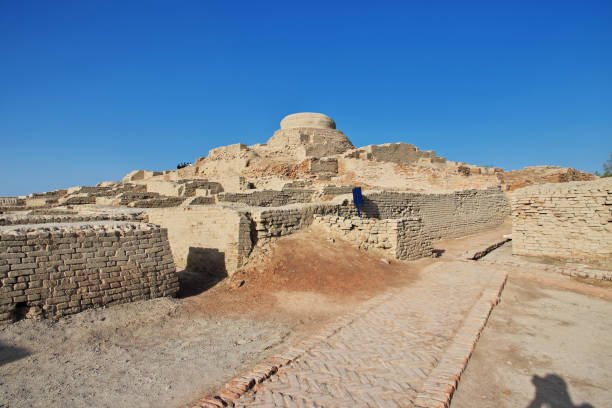
Some of the earliest sophisticated plumbing systems developed in the urban settlements of the Indus Valley. The city of Mohenjo-daro contained covered drains, water channels, and standardized brick pipelines designed to manage flow and maintain hygiene.
Hydraulically, these systems depended on gravity-driven movement, channel gradients, and controlled drainage. Water distribution required careful planning of elevation and flow resistance.
Modern plumbing systems still rely on the same principles: pressure differentials, flow control, and waste removal through enclosed channels.
Every faucet, sink, and sewer reflects a technological tradition rooted in early urban engineering.
6. The Compass
Navigation across land and sea depends on orientation. Before magnetic navigation, travelers relied on stars, landmarks, and environmental cues—methods limited by weather and visibility.
The discovery that certain minerals align with Earth’s magnetic field transformed navigation. Early magnetic compasses developed in ancient China during the era of the Han dynasty.
The scientific principle behind the compass is geomagnetism. Earth behaves like a giant magnet, generating a magnetic field that extends through space. A magnetized needle aligns with this field, indicating directional orientation.
This simple device enabled reliable navigation across oceans, contributing to exploration, trade expansion, and global cultural exchange.
Modern navigation technologies incorporate satellites and digital mapping, yet magnetic compasses remain essential tools—especially where electronic systems fail.
7. Calendars
Human life unfolds in cycles—day and night, seasons, lunar phases. Predicting these cycles is essential for agriculture, ritual, and social organization.
Ancient societies developed calendar systems by observing celestial motion. Among the most influential early systems emerged in Egypt, where solar observation allowed prediction of the Nile’s seasonal flooding.
Calendars represent the mathematical modeling of astronomical periodicity. By tracking repeating celestial patterns, early scientists created structured systems for measuring time across years.
Modern calendars—though refined with greater astronomical precision—still follow the same fundamental logic: dividing time according to predictable celestial cycles.
Every appointment, deadline, and celebration depends on ancient timekeeping systems.
8. Glass
Transparent materials are rare in nature. The ability to produce clear, durable glass opened entirely new possibilities in storage, optics, and architecture.
Glassmaking emerged in ancient workshops, including those in Alexandria, where artisans mastered high-temperature furnaces capable of melting silica-based materials.
Glass forms when molten material cools without crystallizing, creating an amorphous solid. This structure allows transparency and smooth surfaces.
From windows to laboratory equipment to optical lenses, glass remains indispensable. Scientific instruments, eyeglasses, and electronic screens all rely on glass technology rooted in ancient experimentation with heat and minerals.
9. Maps and Systematic Cartography
Understanding space requires representation. Maps transform landscapes into visual information, allowing planning, navigation, and analysis.
The foundations of scientific cartography were advanced by Claudius Ptolemy, whose geographic works described coordinate systems for representing Earth’s surface mathematically.
Mapping involves projection—translating a curved surface onto a flat plane. This requires geometric modeling and spatial measurement.
Modern digital mapping systems still rely on coordinate geometry and projection principles first formalized in antiquity.
Every navigation app follows a conceptual framework developed long before satellites existed.
10. Coined Money
Trade requires a standardized medium of exchange. Barter systems are inefficient because they depend on direct matching of needs.
Coined money provided a portable, measurable store of value. One of the earliest known systems of standardized coinage developed in Sardis, where metal coins of consistent weight and composition facilitated commerce.
Coins function because they represent socially recognized value encoded into physical form. Their reliability depends on standardization and trust.
Modern currency—whether physical or digital—remains conceptually identical: a symbolic medium that enables economic exchange.
The Continuity of Human Ingenuity
These inventions share a common feature. They solved fundamental problems—movement, communication, construction, sanitation, navigation, timekeeping, vision, spatial understanding, and exchange.
Because these problems remain essential to human life, the solutions remain indispensable.
Modern technology often appears revolutionary, yet it frequently refines ancient ideas rather than replacing them. Computers still encode writing. Smartphones still use maps. Infrastructure still depends on concrete and plumbing. Transportation still relies on wheels.
Human progress is cumulative. Each generation inherits tools shaped by countless predecessors.
The Living Presence of the Ancient World
Ancient inventions are not relics buried in archaeological sites. They are active participants in daily life. They structure routines, shape cities, enable knowledge, and support survival.
They remind us that the past is not separate from the present. It is embedded within it.
Every written note, every paved road, every flowing pipe, every measured day carries forward the intellectual labor of people who lived thousands of years ago.
The modern world is not built upon ancient ruins. It is built upon ancient ideas—ideas so powerful that humanity never stopped using them.
And perhaps the most remarkable truth is this: the tools we depend on today may endure for thousands of years more, quietly guiding lives yet to be imagined, just as ancient inventions continue to guide ours.