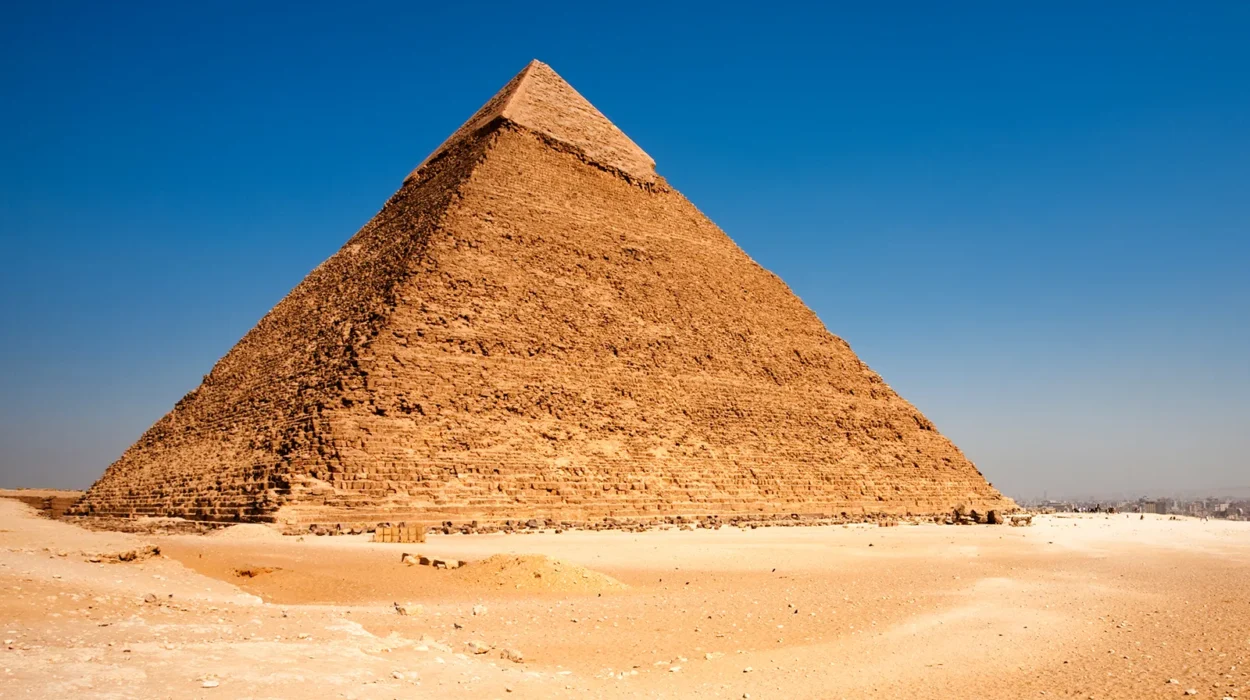
Rising from the Giza Plateau on the edge of the Nile Valley, the Great Pyramid stands like a silent equation carved in stone. Built during the reign of Pharaoh Khufu in the Fourth Dynasty of ancient Egypt, around 2600 BCE, it remains the largest of the pyramids at Giza and one of the most studied structures in human history. Known today as the Great Pyramid of Giza, it originally soared to about 146.6 meters and for nearly 3,800 years it was the tallest human-made structure on Earth.
To modern engineers, it is not merely impressive. It is unsettling. The more carefully its dimensions are measured, the more precisely its stones are examined, the more deeply its internal passages are scanned, the more it seems to challenge assumptions about what ancient builders could achieve without steel, advanced machinery, or digital tools.
This article explores ten engineering feats of the Great Pyramid that continue to astonish researchers. Each is grounded in archaeological evidence and scientific analysis. None require mystery to be extraordinary. The wonder lies in what humans accomplished with stone, copper, wood, rope, water, mathematics, and disciplined organization.
1. Monumental Scale Built With Astonishing Precision
The Great Pyramid contains an estimated 2.3 million stone blocks, with total mass exceeding six million tons. The average block weighs around 2.5 tons, while some interior stones, especially granite beams in the upper chambers, weigh between 25 and 80 tons.
To move and place such immense quantities of stone required extraordinary logistical coordination. Quarrying, shaping, transporting, and positioning each block had to follow a precise plan. Archaeological evidence indicates that limestone was quarried locally at Giza, while granite came from Aswan, nearly 800 kilometers to the south, transported via the Nile.
What defies modern expectations is not just the size, but the uniformity. Many blocks are fitted so tightly that a thin blade cannot slide between them. The casing stones that once covered the pyramid were polished limestone, set with such accuracy that the outer surface formed a smooth, continuous plane.
Modern construction equipment would make such a task manageable. But the ancient Egyptians relied on copper tools, stone pounders, wooden sledges, and human coordination. Experimental archaeology has shown that large stones can indeed be moved using sledges over wet sand, reducing friction significantly. Relief carvings from ancient tombs depict precisely this method.
The feat here is not supernatural. It is the disciplined scaling of simple tools across massive manpower. Tens of thousands of workers, organized into rotating labor crews, likely operated under centralized management. The pyramid is evidence not only of engineering knowledge, but of social engineering on a grand scale.
2. Near-Perfect Cardinal Alignment
One of the most astonishing aspects of the Great Pyramid is its orientation. Its sides are aligned to the cardinal directions—north, south, east, and west—with an error of only a tiny fraction of a degree. The deviation from true north is so small that even modern buildings sometimes fail to match its precision.
This alignment was achieved long before the invention of magnetic compasses. Instead, researchers believe the Egyptians used astronomical observations. By tracking circumpolar stars—stars that circle the north celestial pole without setting—they could determine true north with remarkable accuracy. One proposed method involves observing two stars as they crossed the meridian and marking their alignment vertically.
The consistency across multiple pyramids suggests that this was not a lucky accident. It was a repeatable, carefully practiced surveying method. The builders were not just stacking stones; they were anchoring the structure to the geometry of the Earth and the sky.
The emotional impact of this precision is profound. Imagine standing in the desert over 4,500 years ago, watching stars wheel overhead, using them to define the orientation of a monument that would outlast empires. The pyramid is not only aligned to Earth’s compass points. It is aligned to cosmic cycles.
3. A Base That Is Almost Perfectly Level
The base of the Great Pyramid covers about 13 acres. Despite this vast area, the variation in level across the foundation is only a few centimeters. Achieving such flatness across such a wide span is challenging even with modern laser-guided equipment.
Archaeological studies suggest that the builders may have used water-filled trenches to establish a level reference. Water naturally seeks a horizontal plane. By marking consistent water levels along the perimeter, they could define a flat baseline before laying the first stones.
Once the foundation was prepared, it had to support millions of tons of weight. The underlying bedrock was cut and shaped to create a stable platform. This required careful understanding of geology and load distribution, even if not expressed in modern scientific language.
The emotional power of this feat lies in its quiet invisibility. Visitors see towering stone, but beneath it lies an invisible plane of astonishing flatness. The stability of the monument across millennia begins with this almost perfectly level foundation.
4. The Internal Chamber System and Weight-Relief Design
Inside the Great Pyramid lies a complex system of passages and chambers. Among them is the King’s Chamber, constructed from massive granite blocks. Above this chamber are five so-called relieving chambers, capped by enormous granite beams and a final gabled roof.
These relieving chambers were not decorative. They were structural solutions. The immense weight of stone above the King’s Chamber could have crushed its flat ceiling. Instead, the builders distributed that load upward and outward through stacked granite beams and angled blocks.
This is engineering logic in pure form. The ancient designers understood, through experience and experimentation, how weight travels through stone. They anticipated stress points and created a system to redirect pressure away from vulnerable spaces.
When cracks were discovered in some beams, they were consistent with expected stress patterns over thousands of years. The relieving chambers have done their job. The King’s Chamber remains intact.
To design and execute such a system without formalized structural equations demonstrates empirical mastery. It shows a deep familiarity with material behavior and load dynamics, learned through generations of stone construction.
5. Massive Granite Transport Over Vast Distances
Granite used in the King’s Chamber and other internal structures was quarried at Aswan. Each block had to be extracted, shaped, transported to the Nile, loaded onto barges, floated north, unloaded near Giza, and hauled uphill to the pyramid site.
The logistical challenge is staggering. Some granite beams weigh as much as 70 tons. Moving such weight required coordinated labor, engineered sledges, and possibly temporary canals or ramps connecting the Nile to the plateau.
Recent archaeological discoveries of worker settlements near Giza suggest a highly organized labor force. These were not enslaved masses in chains, as once imagined, but skilled workers provided with food, housing, and medical care.
The transport of granite demonstrates not only engineering ingenuity but supply chain mastery. The Great Pyramid was a national project requiring coordination across hundreds of kilometers.
6. The Precision of the Casing Stones
Originally, the Great Pyramid was covered with fine white Tura limestone casing stones, polished to a high sheen. These stones were cut with astonishing precision, meeting at tight joints that created a smooth outer surface.
The pyramid would have gleamed in the sun, reflecting light brilliantly across the desert. The angles of its faces were uniform, converging at a sharp apex.
The casing stones reveal advanced stone-cutting skills. Copper tools alone would struggle against hard limestone. Archaeologists believe that sand, used as an abrasive with copper saws and drills, allowed for more effective cutting. Stone pounders made from harder materials like dolerite were also used.
The precision of the casing stones shows aesthetic and geometric intent. The pyramid was not merely a pile of blocks; it was a geometrically refined solid.
7. The Grand Gallery’s Corbelled Construction
The Grand Gallery is one of the most striking interior features. Rising about 8.6 meters high, it employs corbelled walls that step inward as they ascend. This technique distributes weight away from the central passage.
Corbelling was not unique to Egypt, but its scale here is extraordinary. The gallery’s walls rise in seven successive layers, each projecting slightly inward. This reduces the span at the top and increases stability.
The engineering insight is clear. Instead of spanning a wide ceiling with a single massive stone, the builders reduced the effective width through incremental inward shifts.
Walking through the Grand Gallery today, one senses both height and compression. It is a corridor shaped by structural logic and monumental ambition.
8. The Subterranean Chamber and Bedrock Integration
Beneath the pyramid lies an unfinished subterranean chamber carved directly into bedrock. Its presence suggests changes in design during construction or symbolic significance.
Carving into bedrock required planning around natural geological features. Integrating natural rock with constructed stone demanded adaptability.
This blending of natural and artificial foundation speaks to a nuanced approach to site engineering. The builders did not simply build on the land; they sculpted the land into the structure.
9. The Air Shafts and Astronomical Possibilities
From the King’s and Queen’s Chambers extend narrow shafts, sometimes referred to as air shafts. While they may have had ventilation functions during construction, their alignment toward specific regions of the sky has attracted attention.
Some shafts align approximately with regions where certain stars would have appeared around the time of construction. While interpretations vary, the precision of these shafts indicates careful angular planning within the pyramid’s interior.
Drilling long, straight shafts through stone at specific angles requires consistent measurement and control. The shafts are engineering channels carved with intent.
10. Longevity Across Millennia
Perhaps the greatest engineering feat is endurance. The Great Pyramid has stood for over 4,500 years. It has survived earthquakes, erosion, human interference, and environmental change.
Its core structure remains largely intact. This longevity is not accidental. It is the result of stable foundation, massive weight, interlocking blocks, and geometric simplicity.
Modern skyscrapers require constant maintenance. The Great Pyramid requires almost none to maintain structural form. Its design is inherently stable.
Standing before it today, one feels the compression of time. Empires have risen and fallen. Languages have evolved. Technologies have transformed the world. Yet the pyramid remains, stone resting on stone in quiet defiance of centuries.
Conclusion: Logic Beyond Assumption
The Great Pyramid does not defy physics. It obeys physics with disciplined mastery. What it defies are assumptions about ancient capability.
Its builders did not possess steel cranes or computer simulations. They possessed knowledge accumulated across generations, precise observation of nature, and extraordinary organizational skill.
The monument is not a mystery of impossible technology. It is a testament to human ingenuity operating within natural laws. It challenges modern logic not because it is illogical, but because it reveals how much can be achieved through careful planning, patient labor, and deep understanding of materials.
In the end, the Great Pyramid is a reminder that engineering is not defined by electronics or machines. It is defined by imagination disciplined by mathematics and reality. And more than four millennia later, its silent geometry continues to speak.