Across human history, people have raised enormous statues not merely as decoration, but as declarations of belief, power, devotion, and identity. These towering forms embodied gods, rulers, ideals, and entire civilizations. They were engineered to endure storms, centuries, and the erosion of time itself. Built of bronze, marble, gold, stone, or clay, they dominated skylines and sacred landscapes alike. They were meant to outlast their creators.
And yet, many did not.
Earthquakes shattered them. Fires melted them. Invaders dismantled them. Religious transformation condemned them. Political change erased them. Sometimes nature reclaimed them quietly; sometimes destruction was deliberate and violent. What remains today are fragments, descriptions, archaeological traces, and the scientific work of reconstruction.
When a massive statue disappears, something more than material is lost. Its destruction alters historical understanding. It interrupts cultural continuity. It transforms landscape and memory alike. Yet paradoxically, disappearance also intensifies fascination. Scholars analyze foundations, metal residues, ancient texts, and artistic copies to reconstruct what once stood. Engineers model structural stresses. Historians trace cultural meaning. Through science, imagination, and evidence, the vanished becomes partially visible again.
The following ten statues were once among the most imposing human creations ever built. Today, none survive in their original monumental form. Their absence tells stories not only of destruction, but of changing civilizations, shifting belief systems, and the fragile permanence of even the greatest human achievements.
1. Colossus of Rhodes
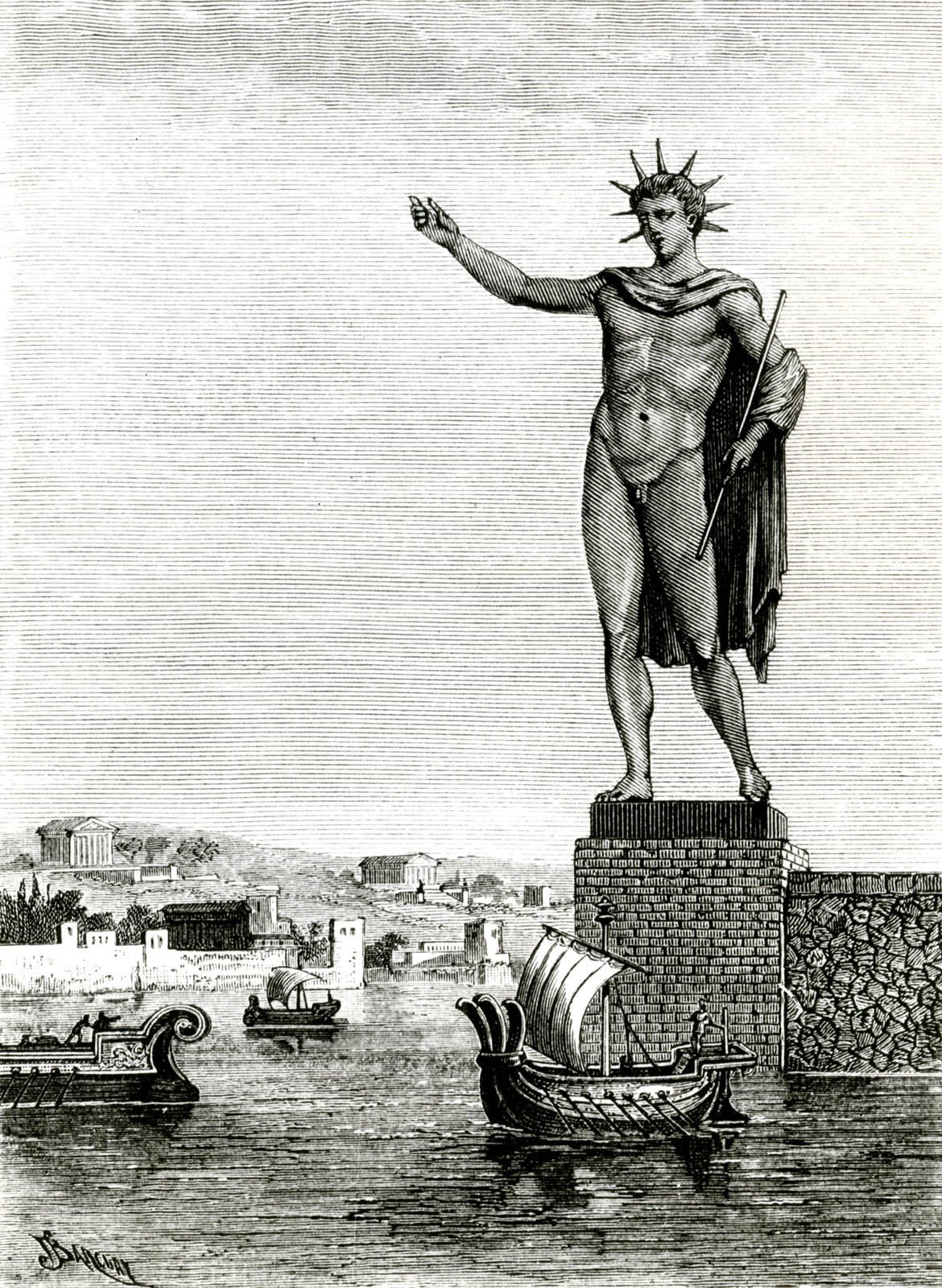
Few lost monuments symbolize vanished grandeur as powerfully as the Colossus of Rhodes. Constructed in the third century BCE, this immense bronze statue represented the sun god Helios and commemorated the successful defense of the island city against invasion.
Ancient descriptions suggest a height of roughly 33 meters—comparable to a modern multi-story building. Engineers of the Hellenistic world achieved this scale through a sophisticated internal framework of iron supports combined with carefully cast bronze plates. The structure stood upon a marble pedestal and dominated the harbor skyline.
For only a few decades, it fulfilled its purpose as both religious symbol and political statement. Then nature intervened.
In 226 BCE, a powerful earthquake fractured the structure at the knees. The immense weight of the upper sections caused the statue to collapse, scattering massive bronze fragments across the ground. Ancient sources describe the fallen remains as so enormous that even lying prone, they inspired awe for centuries.
Unlike many monuments that were rebuilt after disaster, this one was never restored. Economic limitations and religious interpretations of the earthquake discouraged reconstruction. Eventually, centuries later, remaining metal fragments were removed and repurposed.
Today, the statue survives only in textual descriptions and archaeological inference. Yet its engineering achievements continue to be studied as an early example of large-scale bronze structural design.
2. Statue of Zeus at Olympia
Within a great temple sanctuary stood one of the most revered religious images of the ancient world: the Statue of Zeus at Olympia. Created in the fifth century BCE by the sculptor Phidias, it represented the king of the Greek gods seated on an elaborate throne.
This monumental figure stood approximately 12 meters tall. Its construction combined materials in a technique known as chryselephantine sculpture—gold plates formed the garments, while carved ivory shaped the exposed skin. A wooden internal framework supported the structure, requiring controlled environmental conditions to preserve the organic components.
Ancient accounts emphasize not only size but visual impact. The statue filled the interior of the temple so completely that observers felt the deity would rise through the roof if he stood.
The monument survived for centuries before disappearing during late antiquity. Historical evidence suggests it may have been damaged by fire, transported to another city, or destroyed amid religious transformations as classical pagan worship declined.
Archaeological excavations have uncovered the workshop where Phidias created the statue, including tools and materials consistent with large-scale chryselephantine production. Through these findings, scholars reconstruct its design despite the total loss of the original figure.
3. Athena Parthenos
Another monumental creation of Phidias once stood inside the great temple of the Parthenon. The Athena Parthenos depicted the goddess Athena standing in armor, holding a smaller figure of victory and carrying a shield decorated with mythological battle scenes.
This statue was even taller than the seated Zeus of Olympia, rising to approximately 12 meters. Like its counterpart, it used gold and ivory mounted on a wooden framework. The gold elements were designed to be removable, allowing the temple treasury to use them if necessary.
The statue represented not merely religious devotion but civic identity. It embodied the power, wealth, and artistic mastery of Athens during its cultural peak.
Its disappearance occurred gradually through centuries of conflict, fire, and material reuse. Precious metals were stripped away, structural components deteriorated, and the original form vanished entirely. Knowledge of its appearance survives through smaller Roman copies, literary descriptions, and surviving fragments of decorative elements.
The study of these reproductions allows art historians to reconstruct scale, posture, and symbolism with remarkable detail.
4. Athena Promachos
Towering above the Acropolis once stood another monumental representation of Athena—the Athena Promachos, meaning “Athena who fights in the front line.” This enormous bronze statue stood outdoors, visible from great distances, serving as both protective symbol and civic declaration.
Ancient descriptions suggest that sunlight reflecting from the bronze spear and helmet could be seen by sailors approaching the coast. The statue’s strategic placement reinforced its symbolic function as guardian of the city.
Bronze statues of such scale required advanced casting techniques, likely involving sectional casting and internal support structures. Environmental exposure, however, made them vulnerable to corrosion, damage, and eventual removal.
Historical records indicate the statue was later transported during imperial relocation of artworks or destroyed amid warfare. Its metal was likely melted and reused, a common fate for large bronze monuments across antiquity.
Today, its existence is confirmed through literary references and archaeological base remains, allowing approximate reconstruction of its scale and position.
5. Colossus of Nero
In imperial Rome, monumental sculpture became a powerful political instrument. One of the most extravagant examples was the Colossus of Nero, a gigantic bronze statue depicting Emperor Nero himself.
Standing roughly 30 meters tall, the statue represented imperial authority on an unprecedented scale. After Nero’s death, the figure was modified to resemble the sun god, reflecting shifting political messaging.
The statue stood near the future site of the Colosseum, giving the surrounding district its name. Its immense size required complex engineering, including internal structural support and extensive bronze plating.
Over time, the statue disappeared—likely dismantled, toppled by natural forces, or melted down for material reuse. No complete physical remains survive.
Its existence is known through written descriptions, coins depicting its form, and archaeological traces of its base.
6. Bamiyan Buddhas
For more than a millennium, two colossal standing Buddha figures were carved directly into sandstone cliffs in the Bamiyan Valley of Afghanistan. Completed between the sixth and seventh centuries CE, they reached heights of approximately 38 and 55 meters.
These statues were not freestanding structures but monumental rock reliefs integrated into cliff faces. Sculptors carved large forms from stone and added surface details using clay and pigments. The surrounding cave network formed a monastic complex, indicating religious and cultural centrality.
In 2001, the statues were deliberately destroyed using explosives. The event shocked the global community and highlighted the vulnerability of cultural heritage to ideological conflict.
Scientific teams have since used digital modeling, laser scanning, and fragment analysis to document surviving remains. Conservation research continues to explore possibilities for stabilization and partial reconstruction.
Their loss represents both cultural devastation and an urgent case study in heritage preservation under geopolitical instability.
7. Statue of Serapis
In the great city of Alexandria once stood a massive cult statue of the syncretic deity Serapis within the Serapeum temple complex. This figure embodied a fusion of Greek and Egyptian religious traditions, reflecting cultural integration during the Hellenistic period.
The statue was monumental in scale and deeply symbolic of political and religious unity. Its destruction occurred during periods of religious conflict in late antiquity, when temples associated with traditional pagan worship were dismantled.
Archaeological evidence indicates deliberate demolition rather than natural collapse. Surviving fragments and historical accounts confirm both scale and ceremonial importance.
The disappearance of this statue illustrates how ideological transformation can reshape entire urban landscapes.
8. Statue of Bel
The ancient desert city of Palmyra once housed a monumental cult statue within the Temple of Bel, one of the most significant religious centers of the region.
This figure represented divine authority tied to regional identity and long-distance trade networks. Sculptural analysis suggests a combination of Near Eastern and Greco-Roman artistic influence.
In 2015, the temple and its contents were deliberately destroyed during armed conflict. The loss eliminated one of the most important religious sculptures of the ancient Near East.
Digital archaeology now preserves detailed 3D models created from photographs and prior surveys, allowing researchers to study form and structure despite physical destruction.
9. Statue of Marduk
In ancient Mesopotamia, the city of Babylon centered religious life around a grand cult statue of the god Marduk. This figure symbolized divine kingship and cosmic order.
The statue played a central role in ceremonial festivals, including ritual processions reaffirming royal legitimacy. Its materials likely included precious metals and decorated wood, making it both sacred object and political emblem.
Throughout Babylon’s turbulent history, the statue was repeatedly seized, relocated, or destroyed by conquering powers. Its ultimate disappearance reflects cycles of imperial conflict in the ancient Near East.
Archaeological absence is supplemented by extensive textual documentation describing ritual function and symbolic meaning.
10. Jupiter Capitolinus Cult Statue
At the summit of Rome’s Capitoline Hill once stood a monumental cult statue of Jupiter Optimus Maximus, the supreme deity of Roman state religion. Housed within a grand temple, the figure represented divine protection of the republic and later empire.
Constructed from terracotta and later materials, the statue underwent multiple reconstructions after fires damaged the temple. Eventually, successive destruction and rebuilding cycles erased the original monumental form entirely.
Archaeological foundations, temple remains, and literary sources allow historians to reconstruct its ceremonial importance and approximate appearance.
Its disappearance marks the transition from classical polytheistic state worship to new religious systems that reshaped Roman society.
The Science of Reconstructing What Is Gone
Although these statues no longer exist, scientific investigation continues to recover knowledge about them. Archaeologists analyze structural bases, fragment composition, and environmental damage patterns. Art historians compare surviving copies and artistic depictions. Engineers model weight distribution and material stress.
Digital technologies now allow virtual reconstruction using laser scans, photogrammetry, and historical data integration. Through interdisciplinary study, vanished monuments regain form—if not substance.
The Cultural Meaning of Monumental Loss
The destruction of colossal statues reflects more than physical vulnerability. It reveals how societies redefine identity. Monuments embody values; when values change, monuments may fall.
Earthquakes demonstrate nature’s indifference to human achievement. Warfare reveals political fragility. Religious transformation shows cultural evolution. Material reuse reflects economic necessity.
Each loss tells a story about shifting human priorities.
Memory Taller Than Stone
Massive statues once dominated skylines, but their absence can feel equally monumental. Their shadows remain in art, literature, archaeology, and scientific reconstruction. They remind us that scale does not guarantee permanence, and that human creation—no matter how grand—exists within the larger forces of nature and history.
Yet they also demonstrate something enduring: humanity’s impulse to build meaning into matter. Even when stone collapses and bronze melts, the desire to create symbols of identity and belief persists.
The statues are gone. The memory of building them is not.