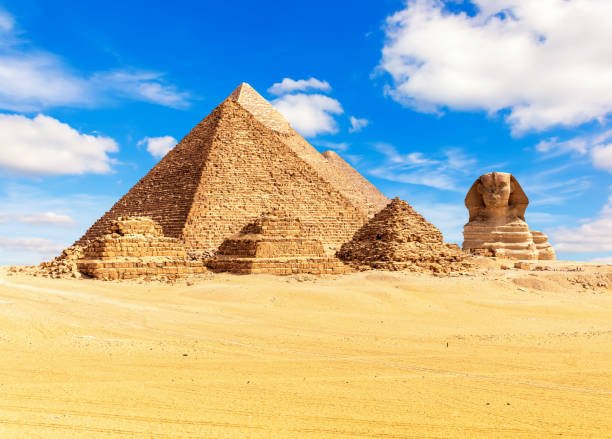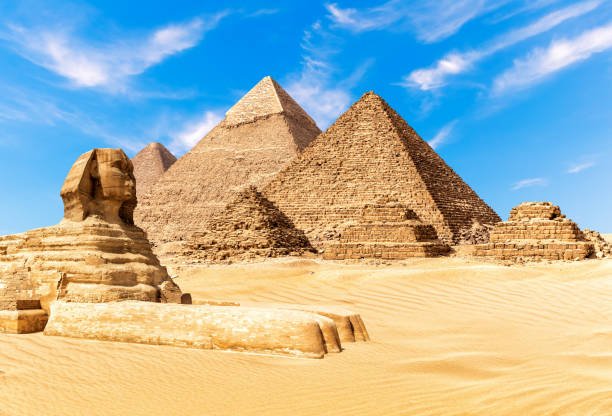
Rising from the desert plateau with geometric perfection and silent authority, the Great Pyramid has commanded human attention for more than four and a half millennia. It is not merely a monument. It is an idea carved into stone—a structure so immense, precise, and enduring that it has continuously challenged human understanding since the moment it was built.
Constructed during the Fourth Dynasty of ancient Egypt, this colossal pyramid has outlived empires, religions, languages, and scientific revolutions. Wind has scoured its limestone surface. Earthquakes have shaken its foundations. Civilizations have risen and fallen around it. Yet the structure remains—still mathematically precise, still structurally stable, still mysterious.
What makes it so fascinating is not just its size or age, but its astonishing complexity. Nearly every measurement, orientation, and internal feature reveals something unexpected. Engineers, astronomers, mathematicians, archaeologists, and historians have all studied it intensely—and still debate many of its secrets.
Some facts about the monument are so strange, so counterintuitive, and so technically impressive that they feel almost unreal. Yet each is supported by measurement, scientific analysis, and historical research.
The following twelve realities reveal just how extraordinary this structure truly is.
1. It Was the Tallest Structure on Earth for Nearly Four Thousand Years
For an astonishing stretch of human history, nothing built by human hands rose higher into the sky.
When completed around 2560 BCE during the reign of Khufu, the pyramid stood approximately 146.6 meters tall. That height made it the tallest artificial structure ever constructed—and it held that record for nearly 3,800 years.
No cathedral, palace, fortress, or tower surpassed it until the completion of the medieval Lincoln Cathedral in the fourteenth century.
To grasp the magnitude of this achievement, consider the technological context. The builders possessed no iron tools, no cranes, no pulleys in the modern mechanical sense, and no wheeled transport for heavy loads across desert terrain. Yet they created a structure taller than many modern skyscrapers built thousands of years later.
Its height was not merely symbolic. It required precise geometric planning, structural stability across immense mass, and logistical coordination on a scale that still challenges modern imagination.
That a single ancient structure dominated the human skyline for nearly four millennia is not just impressive—it is historically unparalleled.
2. Its Orientation to the Cardinal Directions Is Almost Perfect
One of the most astonishing measurable features is its alignment.
Each side of the pyramid is oriented with remarkable precision toward true north, south, east, and west. Modern surveys show that the deviation from true cardinal directions is only a tiny fraction of a degree.
This level of accuracy rivals what can be achieved using advanced modern surveying equipment.
How was this possible without compasses or satellite positioning?
Researchers believe the builders used astronomical observation. By tracking circumpolar stars—stars that never set below the horizon—they could determine true north with extraordinary precision. Observing stellar positions over repeated nights would allow them to establish reference lines for construction.
The fact that this alignment was achieved across a base spanning more than 230 meters per side demonstrates an extraordinary integration of astronomy, geometry, and engineering.
The pyramid is not simply a massive structure—it is astronomically grounded architecture.
3. The Structure Contains About 2.3 Million Stone Blocks
The sheer scale of construction is almost unimaginable.
The pyramid consists of roughly 2.3 million individual stone blocks, each weighing between 2.5 and 15 tons on average. Some internal granite blocks weigh more than 50 tons.
Quarrying, transporting, shaping, and placing this quantity of stone required massive logistical organization. Each block had to be positioned with precision so that weight would distribute evenly through the structure.
Even more astonishing is the rate of construction implied by this number. If completed in about 20 years—a commonly accepted estimate—workers would have needed to place roughly 300 blocks per day, every day, without interruption.
This implies not chaotic labor but a highly organized workforce, advanced planning, and systematic construction methods.
Archaeological discoveries of worker settlements near the Giza Plateau confirm that large teams of skilled laborers, not enslaved masses, built the monument under structured conditions.
The pyramid is not merely large—it is logistically monumental.
4. Its Base Is Nearly Perfectly Level
The foundation demonstrates engineering precision that still astonishes surveyors.
Across its enormous footprint, the base deviates from true level by only a few centimeters. Achieving this required removing large volumes of bedrock and ensuring an even surface across hundreds of meters.
How did ancient builders accomplish such leveling?
Evidence suggests they may have used water-filled trenches to establish horizontal reference lines. Because water naturally seeks a uniform level, it provides a reliable baseline even without modern instruments.
By comparing stone placement against this reference, builders could ensure consistent elevation across the entire foundation.
The result is not simply impressive for its time—it remains impressive by modern construction standards.
5. The Outer Casing Once Made It Shine Like a Mirror
Today the pyramid appears rough and stepped, its internal stone layers exposed. But originally, its surface looked entirely different.
It was covered with highly polished white limestone casing stones fitted so tightly that gaps between them were barely visible. These stones reflected sunlight intensely, making the structure gleam brilliantly across the desert.
Ancient observers described it as shining like a luminous geometric mountain.
Most casing stones were later removed for construction projects in nearby Cairo, particularly after earthquakes loosened them.
What remains today is essentially the internal core of the original design. The smooth exterior—once one of the most visually striking architectural surfaces ever created—is largely gone.
The monument we see is only a fraction of its original visual brilliance.
6. The Internal Temperature Remains Remarkably Constant
Regardless of desert heat or nighttime cold, the internal temperature remains close to about 20°C.
This thermal stability results from massive stone insulation. Thick limestone walls absorb heat slowly and release it gradually, preventing rapid temperature fluctuations.
Such thermal buffering demonstrates that the structure behaves as a giant passive climate system.
This property has fascinated physicists studying heat transfer in large stone masses. It also contributed to long-term preservation of interior spaces and artifacts.
The pyramid does not merely stand in the desert climate—it regulates its own internal environment.
7. Its Geometry Encodes Mathematical Relationships
Researchers have long observed intriguing mathematical properties in the structure’s proportions.
The ratio of its perimeter to its height closely approximates 2π, a relationship associated with circles. The slope angle produces geometric relationships that connect linear and curved measurements.
Whether these ratios were intentionally designed or emerged from construction methods remains debated. However, the mathematical consistency is undeniable.
The structure embodies geometry not only structurally but proportionally.
Its design suggests that ancient Egyptian architects possessed a highly developed understanding of measurement, proportion, and spatial relationships.
8. The Interior Passages Were Precisely Engineered
Inside the pyramid lies a network of chambers and corridors aligned with extraordinary accuracy.
The Grand Gallery rises at a steep angle with carefully corbelled walls. Passageways maintain consistent gradients. Stone joints are precisely fitted.
The so-called King’s Chamber contains massive granite beams forming stress-relief structures above the ceiling—an early example of load distribution engineering.
These features demonstrate that internal architecture was not secondary to external form. The entire structure functioned as an integrated system of weight management and spatial planning.
The interior is not hollowed randomly—it is engineered with structural foresight.
9. It Was Built Near One of the World’s Most Important Rivers
The pyramid’s location was not arbitrary. It stands near the ancient course of the Nile River.
Geological studies indicate that waterways once extended closer to the construction site than they do today. Seasonal flooding would have enabled transport of heavy stone blocks by boat from distant quarries.
Sediment analysis supports the existence of ancient channels linking quarry regions to the building site.
Without river transport, moving millions of tons of stone across desert terrain would have been vastly more difficult.
Hydrology was as essential to construction as engineering.
10. Ancient Historians Were Already Mystified by It
Even in antiquity, people regarded the pyramid as astonishing.
The Greek historian Herodotus described its construction centuries after it was built, recording traditions and speculations about labor, materials, and methods.
Although some of his accounts were inaccurate, his writings demonstrate that the structure had already become an object of historical fascination long before modern archaeology existed.
It was ancient even to the ancient world.
11. Early Explorers Entered It Through Forced Excavation
The original entrance was hidden high on the northern face.
In the ninth century, the Abbasid caliph Al-Ma’mun ordered workers to tunnel into the structure, seeking treasure.
They excavated a passage through the limestone core, creating the entry used by most visitors today.
Their effort revealed internal chambers but found little treasure—suggesting that burial contents had been removed long before.
The first recorded large-scale penetration of the interior was not archaeological but exploratory and destructive.
12. It Continues to Challenge Scientific Understanding
Despite centuries of study, major questions remain unresolved.
Researchers still debate construction methods, workforce organization, symbolic meaning, and certain internal structural features.
Modern techniques—cosmic-ray muon imaging, 3D scanning, and high-resolution structural analysis—continue to reveal new voids and anomalies.
The monument is not fully understood even today.
It remains an active field of scientific investigation.
The Monument That Refuses to Be Finished
Stone endures. Questions endure longer.
This ancient structure is not merely an archaeological site. It is an ongoing scientific puzzle, a historical document, an engineering achievement, and a cultural symbol all at once.
Wind shapes its edges. Sunlight moves across its surfaces. Researchers continue measuring, scanning, modeling, and debating.
It stands in the shadow of the Sahara Desert, yet it casts a far larger shadow across human imagination.
It reminds us that technological sophistication is not confined to modern civilization. It reminds us that knowledge can be embedded in architecture. It reminds us that permanence is possible—but understanding is always incomplete.
And so the monument remains what it has always been: a silent geometric presence, rising from stone, holding secrets, inviting questions, and standing—still—against time itself.