History is often told through the rise and fall of empires, the brilliance of philosophy, the clash of armies, and the slow shaping of civilization. Yet beneath the marble statues and crumbling temples, beneath the epic poetry and imperial decrees, there are darker shadows. The ancient world, like our own, was marked by violence, betrayal, ambition, fear, and mystery. Some deaths changed the course of history. Some were whispered about in marketplaces and courts. Some were buried under centuries of speculation.
In a time before forensic laboratories, DNA analysis, or digital surveillance, truth was fragile. Evidence could be burned, distorted, exaggerated, or lost entirely. Political propaganda often shaped narratives more than eyewitness accounts. And so, across the ancient Mediterranean, the Near East, and beyond, there remain deaths that continue to haunt historians.
Here are seven unsolved murders from the ancient world—cases where the victim is known, the impact is undeniable, but the full truth remains elusive.
1. The Murder of King Tutankhamun
The golden mask of Tutankhamun gazes serenely from museum displays, a symbol of ancient Egypt’s grandeur. But behind the beauty of gold and lapis lazuli lies a far more unsettling question: how did this young pharaoh really die?
Tutankhamun ruled during the 18th Dynasty of Egypt in the 14th century BCE. He ascended the throne as a child and died around the age of nineteen. For centuries, his death was assumed to be natural, perhaps from illness. But when his tomb was discovered in 1922 by Howard Carter in the Valley of the Kings, the preservation of his mummy opened the door to modern scientific investigation.
Early X-ray studies in the 1960s appeared to show a fragment of bone inside his skull, leading to speculation that he had been murdered by a blow to the head. The theory gained popular attention: perhaps a political rival, possibly his advisor Ay or another court figure, had struck him down to seize power.
Later CT scans conducted in the early 21st century challenged this idea. Researchers found no clear evidence of lethal cranial trauma. The bone fragment may have been the result of the mummification process. Further genetic testing revealed that Tutankhamun suffered from several health problems, including a bone disorder affecting his foot. There is also evidence that he had malaria.
Another injury complicates the picture. CT imaging revealed a severe fracture in his left leg, which may have occurred shortly before death. Some researchers propose that a chariot accident caused this injury, leading to infection and fatal complications. Others argue that the fracture might have occurred during mummification.
Was he murdered? Or was he a fragile young ruler whose body simply failed him? The political climate of the time was tense. Egypt was recovering from the religious upheaval initiated by his predecessor Akhenaten. After Tutankhamun’s death, power shifted rapidly.
There is no definitive proof of assassination. No weapon. No confession. Only fragments of bone and fragments of history. The golden mask hides more than it reveals.
2. The Assassination of Philip II of Macedon
In 336 BCE, during a grand wedding celebration in the ancient city of Aegae, King Philip II of Macedon was struck down by one of his own bodyguards, Pausanias. Philip was the father of Alexander the Great and had transformed Macedon into a dominant military power poised to invade Persia.
The assassin was immediately killed, preventing any interrogation. Official accounts suggest that Pausanias acted out of personal grievance, allegedly seeking revenge for a prior humiliation. But the political stakes were enormous.
Philip had recently married a new wife, Cleopatra Eurydice, raising questions about succession. Alexander’s position as heir may have been threatened. Some ancient sources, including later historians, hint at a possible conspiracy involving Alexander’s mother, Olympias. Others speculate that Persian agents may have been involved, seeking to destabilize Macedon before Philip could launch his invasion.
The problem is that much of what we know comes from sources written decades or even centuries later, often colored by political bias. Ancient historians such as Diodorus and Justin offer accounts, but their reliability is debated.
Philip’s death changed history. Within two years, Alexander would begin his campaign against Persia, reshaping the ancient world. But was Alexander an innocent successor, a silent conspirator, or merely the beneficiary of another man’s anger?
The theater where Philip fell still stands in ruins. The questions linger among its stones.
3. The Death of Alexander the Great
Few figures loom as large in ancient history as Alexander the Great. By the age of thirty-two, he had built one of the largest empires in history, stretching from Greece to India. Then, in 323 BCE, in the city of Babylon, he died.
His death was sudden and shocking. According to ancient accounts, he fell ill after a banquet and endured days of fever and weakness before succumbing. But what caused it?
Poison was suspected almost immediately. Rumors circulated that he had been assassinated by political rivals who feared his growing ambition. Some ancient writers mention the possibility of a slow-acting toxin.
Modern historians and medical experts have proposed a range of explanations. Malaria, typhoid fever, West Nile virus, and autoimmune disorders have all been suggested. Some scholars point to descriptions of his symptoms—fever, abdominal pain, progressive paralysis—as clues. Yet ancient sources are inconsistent, and no remains have been conclusively identified for forensic testing.
One intriguing detail is that Alexander’s body reportedly did not show signs of decomposition for several days after death, leading some ancient observers to believe he was divine. Today, some researchers speculate that he may have suffered from Guillain-Barré syndrome, a rare autoimmune condition that can cause paralysis while leaving the patient conscious, possibly leading to a mistaken declaration of death. However, this remains speculative.
Without physical evidence, the cause of death remains uncertain. Poison or disease? Conspiracy or natural illness? The empire he built fragmented almost immediately after his passing, plunging into decades of conflict.
The conqueror who seemed unstoppable was ultimately vulnerable to something invisible—whether microbe or murderer.
4. The Mysterious Death of Cleopatra
The final ruler of Ptolemaic Egypt, Cleopatra, has long been wrapped in legend. In 30 BCE, after the defeat of her forces and those of Mark Antony by Octavian (the future Augustus), Cleopatra was captured. Shortly thereafter, she was found dead.
The traditional story holds that she committed suicide by allowing an asp, a venomous snake, to bite her. Ancient sources, including Plutarch, describe this dramatic end. The image of Cleopatra, dignified and defiant, choosing death over humiliation in a Roman triumph, has endured for centuries.
But historians question the details. The logistics of smuggling a venomous snake into captivity are uncertain. Snake venom can cause a painful and unpredictable death, not necessarily the serene passing depicted in art.
Some scholars propose that she may have used a fast-acting poison mixture rather than a snake. Others raise the possibility that Octavian ordered her execution but allowed the suicide narrative to preserve political dignity.
The problem lies in the sources. Most surviving accounts were written by Roman authors, often sympathetic to Octavian’s regime. Cleopatra’s own perspective is largely absent.
Archaeology has yet to provide definitive answers. Her tomb has not been conclusively identified. Without physical evidence, the exact cause and circumstances of her death remain debated.
Did Cleopatra choose her end, or was the final chapter of her life shaped by imperial propaganda?
5. The Murder of Tiberius Gracchus
In 133 BCE, Rome was simmering with social tension. Wealth inequality was rising, small farmers were losing land, and political reform seemed urgent. Into this storm stepped Tiberius Gracchus, a tribune of the plebs who proposed land reforms aimed at redistributing public land to the poor.
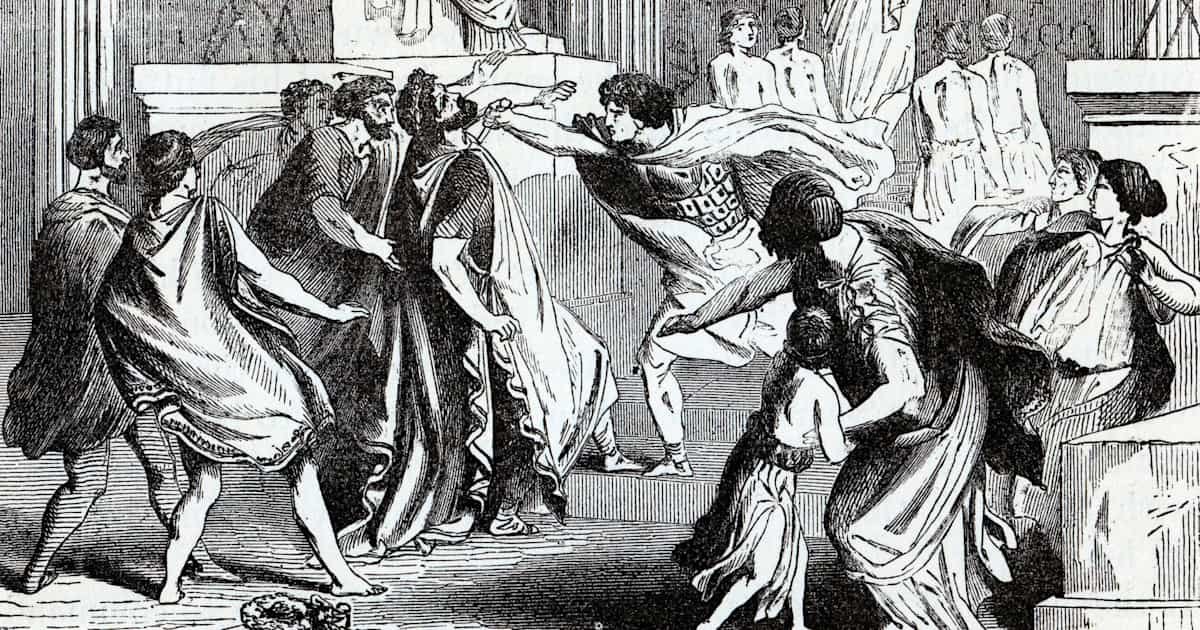
His reforms angered powerful senators. Political conflict escalated. Eventually, during a chaotic assembly, a group of senators and their supporters attacked Tiberius and his followers. He was beaten to death, reportedly with wooden clubs and fragments of furniture.
This was not a secret assassination but a violent political killing in broad daylight. Yet the deeper question remains unresolved: was his death spontaneous mob violence, or was it an organized conspiracy orchestrated by Rome’s elite?
Ancient sources describe senators acting in defense of the Republic, accusing Tiberius of seeking kingship. But other interpretations suggest that entrenched elites feared losing economic power.
His murder marked a turning point in Roman politics. It shattered norms against political violence and set a precedent for future bloodshed, eventually contributing to the fall of the Roman Republic.
The precise motivations and planning behind his death remain debated. What is clear is that Rome crossed a line that day—a line from political rivalry into lethal violence.
6. The Assassination of Hypatia of Alexandria
In 415 CE, the philosopher and mathematician Hypatia was brutally murdered in Alexandria. A renowned scholar, she taught mathematics and Neoplatonic philosophy. She was respected by many, including the Roman prefect Orestes.
Alexandria at the time was a city of religious and political tension. Conflicts between Christian factions, pagans, and Jews were common. Hypatia, though not overtly political, was associated with Orestes, who was in conflict with the powerful bishop Cyril.
According to ancient accounts, a mob of Christian extremists seized Hypatia, dragged her into a church, and killed her in a gruesome manner. The precise chain of events leading to her murder is unclear. Was it a spontaneous act of religious fanaticism? Or was it politically motivated, aimed at weakening Orestes?
Cyril’s direct involvement is debated. Some later traditions portray him as complicit; others argue there is no solid evidence tying him directly to the act.
What is certain is that Hypatia’s death symbolized the violent intersection of politics, religion, and knowledge in late antiquity. It has often been interpreted as a marker of the decline of classical scholarship, though that narrative is likely oversimplified.
Her murder remains unsolved in the sense that the full network of responsibility and motive is still obscured by limited and biased sources.
7. The Death of Seneca
The Roman philosopher Seneca the Younger was ordered to commit suicide in 65 CE after being accused of involvement in the Pisonian conspiracy against Emperor Nero. Officially, he was implicated in a plot to assassinate Nero.
But was he truly guilty?
Seneca had once been Nero’s tutor and advisor. Over time, their relationship deteriorated. By the mid-60s CE, Nero had grown increasingly paranoid and autocratic.
Ancient historian Tacitus describes Seneca’s forced suicide in dramatic detail. He reportedly opened his veins, drank poison, and finally suffocated in a steam bath when the earlier methods failed.
The question is not how he died but why. Was he genuinely part of a conspiracy? Or was he eliminated as a potential rival or moral critic? The evidence is fragmentary and filtered through Roman political narratives.
If Seneca was innocent, his death represents not justice but the silencing of a philosopher by a tyrant. If he was guilty, then the conspiracy against Nero was broader and more complex than surviving records reveal.
The truth may never be fully known.
The Silence of the Past
The ancient world does not speak in clear, courtroom testimony. It whispers through damaged manuscripts, fragmented inscriptions, and archaeological remains. Scientific tools such as CT scanning, radiocarbon dating, and genetic analysis have illuminated some mysteries, but many questions remain beyond reach.
These unsolved murders remind us that history is not only about triumph and progress. It is also about uncertainty. Motives blur. Evidence decays. Power shapes narrative.
And yet, in seeking answers, we do something profoundly human. We listen to the silence of the past and try to piece together the truth. We examine bones, read ancient texts, and weigh competing interpretations. We acknowledge what we know and what we do not.
The ancient world is not entirely lost. It lives in ruins and relics, in stories passed down across centuries. And in its unresolved deaths, we find not only mystery, but a reminder that even in civilizations long gone, justice and truth were as fragile—and as vital—as they are today.