Across deserts, jungles, mountains, and forgotten cities, humanity has left behind messages. Some were carved into stone. Some were pressed into clay. Some were inked onto fragile parchment or etched into bone. These markings are not random scratches; they are deliberate signs, carefully arranged by minds that once thought, loved, feared, traded, ruled, and dreamed. They are scripts—systems of writing created to preserve memory beyond a single lifetime.
Yet not all of these scripts have yielded their secrets.
For many ancient civilizations, writing was the bridge between generations. Through writing, laws were declared, gods were praised, goods were counted, and stories were told. When a script is deciphered, it is as if a sealed chamber opens and voices from thousands of years ago begin to speak again. The decipherment of Egyptian hieroglyphs through the Rosetta Stone allowed the temples of the Nile to whisper their history. The cracking of cuneiform revealed the epics of Mesopotamia. Linear B gave voice to Mycenaean Greece.
But there are still scripts that remain silent. Scholars have studied them for decades, even centuries. They have catalogued every sign, compared patterns, searched for bilingual inscriptions, analyzed statistical frequencies, and applied advanced computational methods. And still, the messages remain locked.
What follows are eight ancient scripts that we have not yet fully deciphered. Each one is a doorway to a lost world. Each one holds the possibility of transforming our understanding of history. And each one reminds us how fragile knowledge can be.
1. The Indus Script
Among the earliest urban civilizations in the world was the Indus Valley Civilization, flourishing between roughly 2600 and 1900 BCE in what is now Pakistan and northwest India. Cities such as Harappa and Mohenjo-daro were marvels of urban planning, with grid-like streets, drainage systems, and standardized brick construction. Trade connected them with Mesopotamia and beyond.
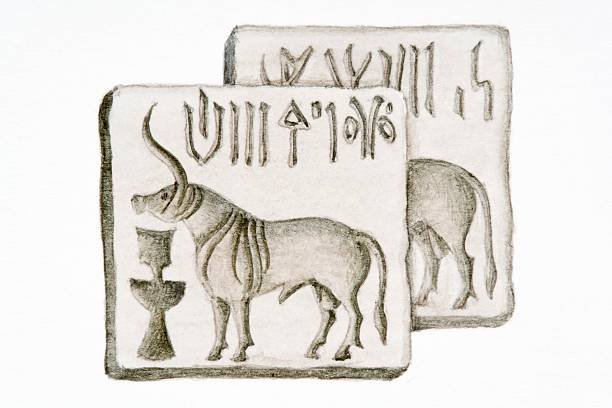
Scattered across thousands of small seals, tablets, pottery fragments, and other artifacts is a script known as the Indus script. It consists of several hundred distinct signs—some resembling animals, others abstract shapes—usually arranged in short sequences. Most inscriptions are extremely brief, often containing fewer than ten symbols.
This brevity is one of the central challenges. Without long texts, it is difficult to identify patterns such as grammar or repeated phrases. There is no known bilingual inscription that pairs Indus signs with a deciphered language, as the Rosetta Stone did for Egyptian hieroglyphs. Moreover, the underlying language of the Indus people remains uncertain. Some scholars have proposed that it may represent an early Dravidian language; others suggest Indo-Aryan or even a language isolate. No consensus has emerged.
There is also debate over whether the Indus symbols represent a fully developed writing system or a proto-writing system used primarily for administrative or ritual purposes. Statistical analyses suggest structured patterns consistent with writing, but definitive proof remains elusive.
If deciphered, the Indus script could illuminate the political organization, religious beliefs, and daily lives of one of the great civilizations of the ancient world. For now, the seals remain small, silent ambassadors from a culture that left impressive cities—but no readable texts.
2. Linear A
Before the rise of classical Greece, the island of Crete was home to the Minoan civilization. Between approximately 1800 and 1450 BCE, the Minoans built palaces such as Knossos and Phaistos, adorned with vibrant frescoes and complex architectural designs. Their society was sophisticated, maritime, and culturally influential.
The Minoans used a script known as Linear A, written primarily on clay tablets and used for administrative purposes. Linear A shares visual similarities with Linear B, a script later used by the Mycenaeans on mainland Greece. In the mid-20th century, Linear B was deciphered by Michael Ventris and shown to represent an early form of Greek.
This breakthrough, however, did not unlock Linear A. Although many Linear A signs resemble those of Linear B, the underlying language appears different. Attempts to read Linear A using Greek phonetic values have not produced coherent results. The language encoded by Linear A, often called Minoan, remains unknown.
The surviving texts are mostly economic records—lists of goods, offerings, and transactions. They provide limited context for linguistic analysis. Without a bilingual inscription or longer narrative texts, decipherment is extremely difficult.
Linear A stands as a reminder that scripts can resemble one another visually while encoding entirely different languages. It also symbolizes the lost voice of the Minoans, a civilization whose art and architecture captivate us, even as their words remain beyond reach.
3. The Rongorongo Script of Easter Island
Far out in the Pacific Ocean lies Rapa Nui, also known as Easter Island. Famous for its monumental stone statues called moai, the island also possesses one of the most mysterious writing systems ever discovered: Rongorongo.
Carved onto wooden tablets and other objects, Rongorongo consists of intricate glyphs depicting human figures, animals, plants, and geometric shapes. The inscriptions appear to follow a unique pattern known as reverse boustrophedon, in which alternate lines are flipped upside down.
The script was first recorded by Europeans in the 19th century. Tragically, much of the island’s cultural knowledge had already been disrupted by disease, slavery, and colonization. By the time scholars began serious study, there were no living individuals who could read the script.
A central debate surrounds whether Rongorongo represents a true writing system capable of encoding language, or a mnemonic device used for reciting oral traditions. The corpus of surviving inscriptions is small, and many tablets have been damaged or lost.
Some researchers have identified recurring sequences that might correspond to genealogies or calendars. However, without a bilingual text or a large body of consistent material, definitive decipherment remains out of reach.
Rongorongo is haunting. It represents a writing tradition that may have developed independently in one of the most isolated places on Earth. If it is indeed a full writing system, it would be one of the few known cases of independent invention of writing in human history.
4. The Voynich Manuscript
Unlike most ancient scripts carved in stone or pressed into clay, the Voynich Manuscript is a medieval codex written on parchment. Radiocarbon dating places it in the early 15th century. The manuscript is filled with strange illustrations—plants that do not clearly correspond to known species, astronomical diagrams, and enigmatic scenes of bathing figures—accompanied by text in an unknown script.
The script of the Voynich Manuscript consists of flowing characters arranged in words and paragraphs. Statistical analysis suggests that the text has structure consistent with natural language. Word frequencies and patterns resemble those found in known languages. Yet every attempt to match the script to a known language has failed.
Some theories propose that it encodes a real language using a cipher. Others suggest it may represent an artificial language or an elaborate hoax. The manuscript has been studied by linguists, cryptographers, historians, and computer scientists for over a century.
Despite numerous claims of decipherment, none have gained broad scholarly acceptance. The meaning of the text remains unknown.
The Voynich Manuscript occupies a unique position. It is not from deep antiquity, yet it is as unreadable as the oldest inscriptions. Its pages are a labyrinth of symbols, inviting and defying interpretation in equal measure.
5. The Phaistos Disc
Discovered in 1908 on the island of Crete, the Phaistos Disc is a small, circular clay object dating to around the second millennium BCE. It is stamped with a spiral of symbols impressed into the clay using carved stamps. This method of production is unusual in the ancient world and suggests a deliberate, standardized process.
The disc contains 45 distinct signs, arranged in a spiral on both sides. The symbols depict human figures, animals, tools, and abstract shapes. Because the disc is unique—no other confirmed examples of the same script have been found—it poses extraordinary challenges.
Without additional texts for comparison, it is nearly impossible to determine whether the disc represents a true writing system, a ritual object, a game board, or something else entirely. Scholars have proposed connections to Linear A, Anatolian languages, and other systems, but none are conclusive.
The Phaistos Disc stands alone, enigmatic and self-contained. Its spiral of symbols feels almost hypnotic, as if inviting the viewer to follow its path inward toward meaning that refuses to reveal itself.
6. The Olmec Cascajal Block
In 2006, archaeologists announced the discovery of the Cascajal Block in Mexico, a stone slab bearing incised symbols believed to date to around 900 BCE. The block is associated with the Olmec civilization, one of the earliest complex societies in Mesoamerica.
The slab contains 62 symbols arranged in horizontal rows. Some symbols resemble maize plants, fish, insects, and geometric forms. If authentic as a writing system, it would represent the earliest known writing in the Americas.
However, the Cascajal Block is controversial. It was not discovered in a controlled excavation, raising questions about its context. Furthermore, like the Phaistos Disc, it is a singular artifact. Without additional inscriptions, establishing patterns and phonetic values is exceedingly difficult.
If the symbols indeed constitute a script, they could provide unprecedented insight into Olmec society, religion, and administration. For now, they remain tantalizing marks on stone, hinting at literacy in a civilization known primarily through colossal heads and archaeological remains.
7. Proto-Elamite Script
In the late fourth millennium BCE, in what is now southwestern Iran, scribes used a script known as Proto-Elamite. This writing system appears on clay tablets and is roughly contemporary with early Mesopotamian cuneiform.
Proto-Elamite texts are primarily administrative, recording goods, labor, and transactions. The script includes numerical signs and other symbols. Although scholars can often identify numerical patterns and some accounting structures, the phonetic values of most signs remain unknown.
Unlike cuneiform, which evolved and was used for thousands of years, Proto-Elamite seems to have disappeared after a few centuries. Its brevity of use limits the available corpus. There is no bilingual inscription linking it to a known language.
Efforts to decipher Proto-Elamite involve detailed sign analysis, digital imaging, and comparison with later Elamite scripts. Yet the underlying language and phonetic system remain uncertain.
Proto-Elamite sits at the dawn of writing in the ancient Near East. It is a sibling to one of humanity’s earliest literate traditions, yet it remains unreadable—a reminder that writing systems can emerge and vanish, leaving only fragments behind.
8. The Harappan-Related Script of the Gulf and Oman
In regions around the Arabian Gulf and Oman, archaeologists have discovered inscriptions and symbols that appear connected to trade networks linking Mesopotamia and the Indus Valley. Some artifacts bear signs that resemble those of the Indus script but are found outside the core Indus region.
These inscriptions are few and often fragmentary. They may represent adaptations of the Indus script for use in distant trading communities. Alternatively, they may constitute distinct local systems influenced by Indus writing.
Because the Indus script itself remains undeciphered, understanding these related inscriptions becomes doubly challenging. Without clarity on the base system, interpreting its possible derivatives is speculative.
These inscriptions testify to the interconnectedness of ancient civilizations. Trade carried goods, ideas, and perhaps writing systems across seas and deserts. Yet even as objects moved, their meanings sometimes did not survive.
Why Decipherment Is So Difficult
The decipherment of an ancient script typically requires several key ingredients: a substantial corpus of texts, knowledge of the underlying language family, and ideally a bilingual inscription. When these elements align, progress becomes possible. When they do not, scholars must rely on indirect methods such as statistical analysis, contextual archaeology, and comparisons with known scripts.
Short inscriptions provide little context. Unique artifacts offer no parallels. Lost languages remove the anchor of linguistic familiarity. In some cases, the script may encode information in a non-phonetic way, complicating efforts to apply standard decipherment techniques.
Modern technology has introduced new tools. Digital imaging enhances faint inscriptions. Machine learning algorithms analyze sign frequencies and patterns. Collaborative databases allow scholars worldwide to share data. Yet technology cannot replace missing evidence.
Decipherment is both a scientific and creative endeavor. It requires rigorous analysis, but also imaginative leaps—hypotheses tested and often discarded.
The Emotional Weight of Silence
Undeciphered scripts carry an emotional resonance. They are reminders of lost voices. Entire belief systems, stories, and personal experiences may lie encoded in signs that we cannot yet read. A seal from the Indus Valley might contain the name of a person who lived four thousand years ago. A tablet in Linear A might record an offering to a forgotten deity. A line of Rongorongo might preserve a genealogy stretching back generations.
To stand before such inscriptions is to feel the closeness of the past—and its distance. The marks are visible. The intention is evident. But meaning slips away.
Yet silence is not emptiness. It is an invitation.
Each undeciphered script challenges scholars to look deeper, to question assumptions, to refine methods. Each one holds the potential for a breakthrough that could reshape our understanding of ancient civilizations.
Perhaps one day a new discovery—a bilingual inscription, a hidden archive, a technological innovation—will unlock one of these scripts. And when that happens, the effect will be profound. A civilization long considered mute will speak again.
Until then, these scripts remain among humanity’s most compelling mysteries. They are testaments to our species’ drive to record, to communicate, to transcend time. Even unread, they tell us something powerful: that long ago, someone wanted to be understood.