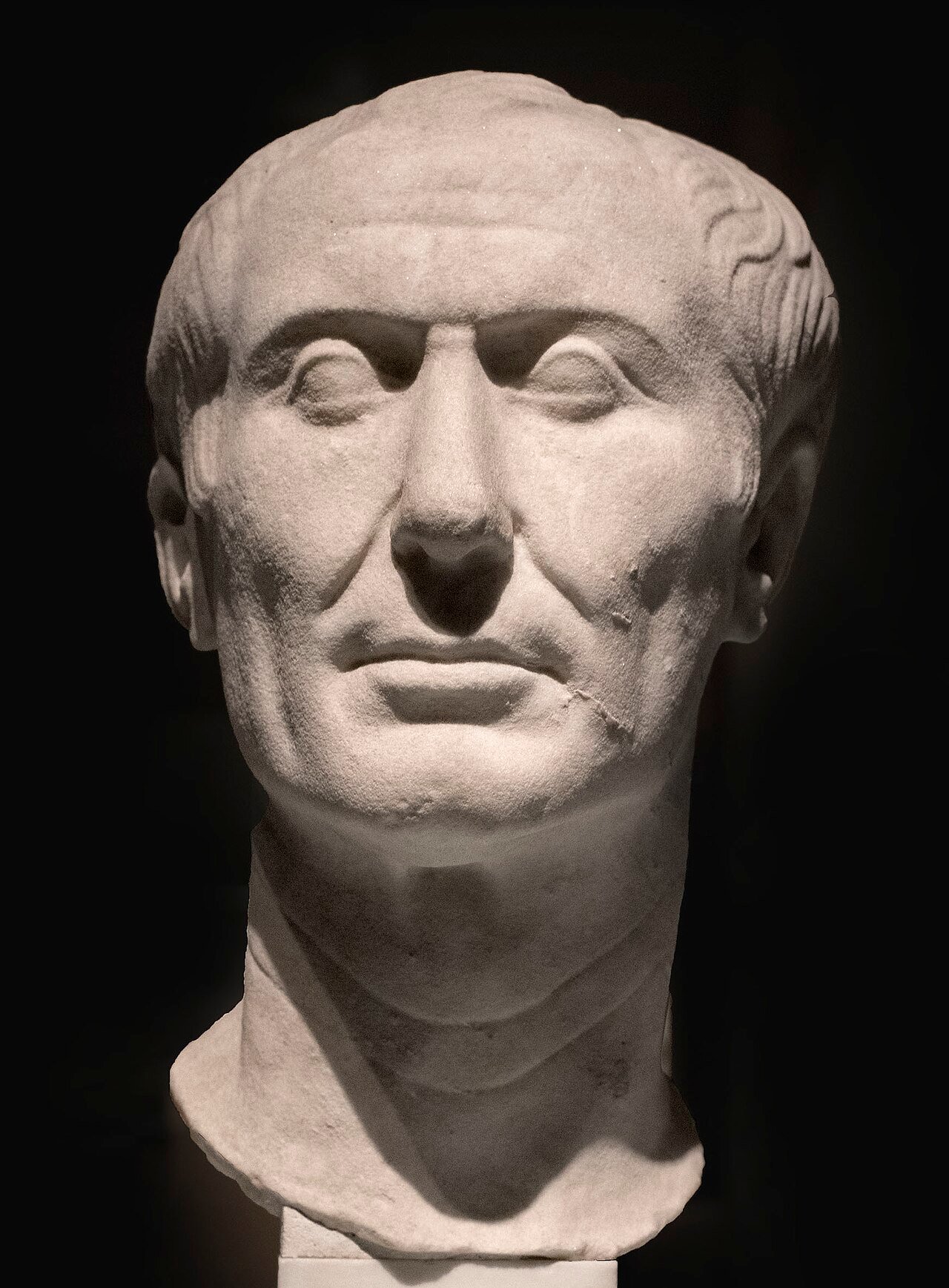
Gaius Julius Caesar (born July 12 or 13, 100 BCE, Rome, Roman Republic—died March 15, 44 BCE, Rome) was a Roman general, statesman, and writer who played a central role in the transformation of the Roman Republic into the Roman Empire. He became famous for his military victories, especially his conquest of Gaul, and his role in a civil war that made him the most powerful political figure in Rome. Appointed dictator for life in 44 BCE, Caesar was assassinated by a group of Roman senators who feared that he intended to make himself king.
Early Life and Family Background
Julius Caesar was born into the Julian family, an old Roman patrician family that claimed descent from Iulus, the son of the Trojan hero Aeneas. According to Roman tradition, Aeneas was the son of the goddess Venus. Although the family had an impressive history, it was not among the wealthiest or most politically powerful families in Rome during Caesar’s childhood.
His father, also named Gaius Julius Caesar, held government positions and served as governor of the Roman province of Asia. His mother, Aurelia Cotta, came from a respected Roman family. She was known for her intelligence and strong character and played an important role in her son’s early upbringing.
Caesar grew up during a period of political tension and violence in the Roman Republic. Rome was governed through a system that included elected officials, a Senate, and popular assemblies. However, wealthy families and powerful generals often competed for control, creating deep divisions within Roman society.
When Caesar was still young, Rome experienced a violent struggle between two major political leaders, Gaius Marius and Lucius Cornelius Sulla. Marius was associated with the popular political movement, while Sulla represented the interests of the traditional aristocracy.
Caesar’s family connections placed him close to Marius. His aunt Julia was married to Marius, and Caesar himself married Cornelia, the daughter of Lucius Cornelius Cinna, one of Marius’s political allies.
These relationships became dangerous when Sulla defeated his opponents and took control of Rome in 82 BCE. Sulla ordered Caesar to divorce Cornelia, but Caesar refused. As a result, he lost much of his property and faced the threat of death.
He eventually obtained a pardon through the influence of relatives and supporters. Recognizing that Rome was no longer safe for him, Caesar left the city and joined the Roman army.
Military Service and Early Career
Caesar began his military career in Asia Minor, where he served under Roman commanders. He gained experience in military operations and demonstrated courage during campaigns.
While serving in the eastern Mediterranean, he participated in the siege of Mytilene, a city on the island of Lesbos. According to ancient accounts, he distinguished himself by saving the life of a fellow soldier and received the civic crown, a military honor awarded for saving a Roman citizen in battle.
After Sulla’s death in 78 BCE, Caesar returned to Rome. He began developing a career as a lawyer and public speaker, skills that helped him build a reputation among Roman citizens.
His public speaking abilities became especially important in political and legal disputes. He understood how to appeal to ordinary people and how to use public attention to strengthen his position.
Around 75 BCE, Caesar traveled to Rhodes to study rhetoric, the art of persuasive speaking. During the journey, pirates captured his ship and demanded a ransom.
Ancient accounts describe Caesar as remaining confident during his captivity. He reportedly joked with his captors that he would return and punish them. After his release, he organized a naval force, captured the pirates, and had them executed.
This episode added to his growing reputation for determination and confidence.
Caesar later returned to Rome and continued his political career. He held several public offices, gradually gaining influence through his speeches, public appearances, and relationships with important political figures.
Marriage and Political Advancement
Caesar’s personal relationships played an important role in his political development. After Cornelia’s death, he married Pompeia, a member of a prominent Roman family.
The marriage ended in 62 BCE after a scandal involving a religious ceremony held at Caesar’s home. A man named Publius Clodius Pulcher reportedly entered the gathering disguised as a woman. Although Caesar’s wife was not accused of involvement, Caesar divorced her, explaining that his wife needed to be beyond suspicion.
In 60 BCE, Caesar married Calpurnia, the daughter of the Roman politician Lucius Calpurnius Piso. She remained his wife until his death.
During these years, Caesar advanced through the Roman political system. He served as quaestor, an official responsible for financial and administrative duties, and later became aedile, a position that involved organizing public games, maintaining public buildings, and overseeing parts of city life.
As aedile, Caesar spent large amounts of money organizing public entertainment and supporting public improvements. These activities helped him become popular with Roman citizens, although they also left him heavily in debt.
In 63 BCE, he was elected pontifex maximus, the chief priest of Roman state religion. The position gave him considerable public standing and political influence.
He later served as praetor, another important elected office, and governed the Roman province of Hispania Ulterior, located in parts of modern-day Spain and Portugal.
During his time in Hispania, Caesar gained military and administrative experience. His success helped strengthen his political reputation and prepared him for a larger role in Roman government.
The First Triumvirate
By 60 BCE, Caesar had become an ambitious political figure, but he still faced opposition from powerful senators.
He formed an informal political alliance with two of Rome’s most influential men: Pompey the Great, a successful general, and Marcus Licinius Crassus, one of the wealthiest men in Rome.
This arrangement became known as the First Triumvirate. The term refers to a group of three men who worked together to advance their political interests. It was not an official government position or a formal constitutional institution.
The alliance allowed each man to benefit from the others’ influence. Pompey wanted land for his veteran soldiers and official approval for arrangements made during his eastern campaigns. Crassus wanted political support for financial interests connected to Roman tax collectors. Caesar wanted a major political position and opportunities for military command.
Their combined influence helped Caesar secure election as consul for 59 BCE, the highest regular elected office in the Roman Republic.
As consul, Caesar supported laws that benefited Pompey and Crassus and helped advance their shared political goals. He also introduced measures involving land distribution and public administration.
His actions created strong opposition among conservative senators, who believed he was using his office to weaken the Senate’s authority.
After his consulship, Caesar received command of several Roman provinces, including Cisalpine Gaul and Transalpine Gaul. These territories provided him with an opportunity to lead military campaigns and build a powerful army.
His command was initially granted for five years and later extended.
The Conquest of Gaul
From 58 to 50 BCE, Caesar led a series of military campaigns that brought much of Gaul under Roman control. Gaul covered a large area of western Europe, including modern France, Belgium, Luxembourg, parts of Switzerland, and nearby regions.
Before Caesar’s campaigns, much of Gaul was occupied by independent Celtic peoples organized into different tribes and political communities. Some groups cooperated with Rome, while others resisted Roman influence.
Caesar began his campaigns in 58 BCE after the Helvetii, a Gallic people, attempted to migrate through Roman territory. He intervened, defeated them, and forced them to return to their homeland.
He then fought against other Gallic groups, including Germanic forces led by Ariovistus. These victories strengthened Roman control and expanded Caesar’s military reputation.
Over the following years, Caesar conducted campaigns against numerous tribes. He used a combination of military force, political alliances, negotiations, and divisions among his opponents.
His campaigns also included two expeditions across the English Channel into Britain in 55 and 54 BCE. These expeditions demonstrated Roman military reach, but they did not establish lasting Roman control over the island.
Caesar’s army faced difficult conditions, including unfamiliar terrain, harsh weather, supply problems, and determined resistance. He built roads, bridges, and fortified camps to support his operations.
One of his most important engineering achievements was the construction of a bridge across the Rhine River in 55 BCE. The bridge allowed his forces to enter Germanic territory and demonstrated Rome’s ability to carry out large military operations.
Despite his victories, resistance in Gaul continued.
The Gallic Rebellion and the Siege of Alesia
In 52 BCE, a major rebellion against Roman rule developed under the leadership of Vercingetorix, a leader of the Arverni tribe.
Vercingetorix united several Gallic groups and organized a coordinated resistance against Caesar. His forces used a strategy that included destroying supplies and settlements to make it harder for Roman troops to obtain food.
Caesar faced serious difficulties as the rebellion spread. However, he managed to maintain control of his army and continued pursuing the Gallic forces.
The most important confrontation took place at Alesia, where Vercingetorix and his army took refuge in a fortified settlement.
Caesar surrounded the town with an extensive system of fortifications. He built defensive walls, trenches, towers, and other obstacles to prevent the defenders from escaping.
When a large Gallic relief army arrived, Caesar ordered the construction of another defensive line facing outward. This allowed his soldiers to defend themselves against both the people inside Alesia and the approaching forces outside.
After several difficult battles, the Roman army defeated the relief forces. Vercingetorix eventually surrendered.
His defeat marked a major turning point in the conquest of Gaul. Although resistance continued in some areas, organized opposition to Roman rule was largely broken.
The conquest brought enormous wealth and political influence to Caesar. He gained access to new territories, valuable resources, and a large number of military recruits. His soldiers also became strongly loyal to him.
Caesar later described these campaigns in his written work Commentaries on the Gallic War, providing a detailed account of the military operations and political events.
The Breakdown of the Political Alliance
While Caesar was campaigning in Gaul, political relationships in Rome began to change.
The First Triumvirate weakened after the deaths of two important family connections. Caesar’s daughter Julia, who had married Pompey, died in childbirth in 54 BCE. Her death removed an important personal connection between the two leaders.
Crassus was killed in 53 BCE during a disastrous military campaign against the Parthian Empire at Carrhae.
With Crassus gone and Julia dead, Pompey and Caesar became increasingly separated by political disagreements.
Pompey moved closer to the conservative senators who opposed Caesar’s growing power. Many of these senators feared that Caesar would use his military success to dominate the Roman government.
They wanted Caesar to give up his command and return to Rome as a private citizen. Caesar, however, feared that surrendering his military protection would leave him vulnerable to prosecution by political enemies.
The disagreement became increasingly serious during 50 and 49 BCE.
The Senate eventually ordered Caesar to dismiss his army and return to Rome without his military command. Caesar resisted, arguing that Pompey should also give up his military authority.
The dispute created a political crisis that threatened to divide the Roman Republic.
Crossing the Rubicon and the Civil War
In January 49 BCE, Caesar made a decision that changed Roman history.
He led one of his legions across the Rubicon River, a boundary separating his province from Italy proper. Roman law prohibited a general from entering Italy with an army under his command without authorization.
By crossing the river, Caesar openly challenged the Senate’s authority and began a civil war.
The phrase “crossing the Rubicon” later became a common expression for making a decision that cannot easily be reversed.
Pompey and many senators left Rome and moved toward Greece, where they hoped to organize their forces.
Caesar advanced rapidly through Italy, gaining control of Rome and much of the Italian peninsula. He then traveled to Spain to confront forces loyal to Pompey.
After securing victories in Spain, Caesar moved east to continue the war.
In 48 BCE, the two sides met at the Battle of Pharsalus in Greece. Despite being outnumbered, Caesar defeated Pompey’s army.
Pompey escaped to Egypt, hoping to find protection from the Egyptian royal court. However, Egyptian officials arranged his murder shortly after his arrival.
When Caesar reached Egypt, he was presented with Pompey’s severed head. Ancient accounts describe Caesar as being displeased by the killing.
Caesar and Cleopatra
While in Egypt, Caesar became involved in a political struggle over the Egyptian throne.
The country was ruled by the Ptolemaic dynasty, whose members included Cleopatra VII and her younger brother Ptolemy XIII. The two had been named joint rulers, but political conflict had pushed Cleopatra from power.
Caesar supported Cleopatra in the dispute. He became closely involved in the conflict between her supporters and those of Ptolemy XIII.
The situation developed into a military confrontation known as the Alexandrian War. Caesar and his forces faced serious resistance in Alexandria before receiving reinforcements and defeating their opponents.
Ptolemy XIII died during the conflict, and Cleopatra regained her position as ruler. She subsequently ruled alongside another younger brother, Ptolemy XIV, according to Egyptian royal tradition.
Caesar and Cleopatra became lovers and had a son, Ptolemy XV Philopator Philometor Caesar, commonly known as Caesarion.
Caesarion was recognized as Cleopatra’s son, although Caesar’s paternity has been a subject of historical discussion.
Caesar remained in Egypt for several months before continuing his military campaigns.
Cleopatra later visited Rome and stayed in Caesar’s residence. Their relationship attracted attention, although Caesar did not marry her.
The Final Military Campaigns
After defeating Pompey’s main forces, Caesar still had to deal with remaining opposition.
In 47 BCE, he defeated Pharnaces II of Pontus at the Battle of Zela in Asia Minor. He later summarized the speed of his victory with the famous Latin phrase “Veni, vidi, vici,” meaning “I came, I saw, I conquered.”
Caesar then returned to Rome and continued working to restore political stability.
However, supporters of Pompey remained active. In 46 BCE, Caesar defeated major opposition forces at the Battle of Thapsus in North Africa.
The remaining Pompeian leaders and their supporters continued resisting in Spain. Caesar eventually defeated them at the Battle of Munda in 45 BCE.
These victories ended the major military resistance to his control.
By this time, Caesar had become the dominant political and military figure in the Roman world. His enemies had been defeated, and the Senate had little power to challenge his decisions.
Caesar as Dictator and Ruler of Rome
After the civil war, Caesar returned to Rome and began reorganizing the government.
He had previously been appointed dictator during periods of political emergency, but his authority increased as his victories continued. In 46 BCE, he received an extended dictatorship, and in 44 BCE he was appointed dictator for life.
Although the title of dictator had existed in the Roman Republic for centuries, it was traditionally a temporary position used during emergencies. Caesar’s permanent appointment was therefore a major departure from Roman political tradition.
He introduced several reforms intended to improve the administration of Rome and its territories.
One of his most important reforms was the reorganization of the Roman calendar. The old Roman calendar had become inaccurate because of irregular adjustments made by religious officials and political leaders.
Caesar introduced a new calendar based on the solar year, with assistance from astronomers, including the Alexandrian scholar Sosigenes. The Julian calendar took effect in 45 BCE and established a year of 365 days, with an additional day every four years.
The calendar was later modified, but its basic structure influenced the calendar used in much of the world today.
Caesar also expanded the Senate, increasing its membership to include more individuals from Italy and the provinces. He reorganized local government, changed aspects of taxation, and established new colonies for Roman citizens and military veterans.
He supported public construction projects and introduced measures intended to address debt and economic difficulties.
Caesar also granted Roman citizenship to some residents of provincial communities and encouraged the settlement of former soldiers in new colonies.
These reforms helped strengthen central government control, but they also increased his personal authority.
He received numerous honors, including the right to wear special clothing and symbols associated with Roman triumphs. His image appeared on Roman coins, and a month of the Roman calendar was eventually renamed July in his honor.
His growing power made many senators uncomfortable. Some feared that he intended to establish a monarchy and permanently destroy the Republic.
Although Caesar did not formally declare himself king, rumors about his ambitions became widespread.
The Assassination of Julius Caesar
By early 44 BCE, opposition to Caesar had become increasingly organized.
A group of senators believed that his permanent dictatorship threatened Roman political traditions. They feared that he would eventually take the title of king and make the Senate powerless.
Among the leading conspirators were Marcus Junius Brutus and Gaius Cassius Longinus. Other senators also joined the plot.
Brutus came from a respected Roman family and was connected to the political tradition that celebrated the overthrow of Rome’s ancient kings. Caesar had previously shown him favor and had allowed him to hold important positions.
The conspirators believed that killing Caesar would restore the Republic and protect their political independence.
On March 15, 44 BCE, a date known in the Roman calendar as the Ides of March, Caesar attended a meeting of the Senate at the Theatre of Pompey.
The conspirators surrounded him and attacked him with daggers. According to ancient accounts, Caesar received 23 stab wounds.
The famous statement “Et tu, Brute?” meaning “And you, Brutus?” is strongly associated with his death, but there is no reliable evidence that he actually spoke those words. The line became especially famous through William Shakespeare’s play Julius Caesar.
Caesar died at the age of 55.
His assassination shocked Rome, but it did not produce the political outcome the conspirators had expected. Instead of restoring stable republican government, it created another period of conflict and civil war.
The Events Following Caesar’s Death
Caesar’s death left Rome without a clear political leader capable of controlling the competing factions.
His supporters, particularly Mark Antony, challenged the conspirators and sought to maintain his political influence.
In Caesar’s will, he had adopted his great-nephew Gaius Octavius as his son and heir. Octavius was only 18 years old when Caesar died and later became known as Octavian.
Octavian joined forces with Mark Antony and Marcus Aemilius Lepidus. Together, they formed the Second Triumvirate in 43 BCE, an official political alliance that received legal authority from the Roman state.
The three men moved against Caesar’s assassins. In 42 BCE, their forces defeated Brutus and Cassius at the Battle of Philippi in Macedonia. Both conspirators died by suicide after their defeat.
The alliance between Octavian, Antony, and Lepidus eventually broke down. Octavian and Antony became rivals, leading to another civil war.
In 31 BCE, Octavian defeated the combined forces of Antony and Cleopatra at the Battle of Actium. The following year, Antony and Cleopatra died in Egypt.
Octavian later became Rome’s first emperor under the name Augustus in 27 BCE.
Caesar himself never became emperor. However, his rise to power, his dictatorship, and the civil wars that followed his assassination helped bring the Roman Republic to an end and established the political conditions for the Roman Empire.