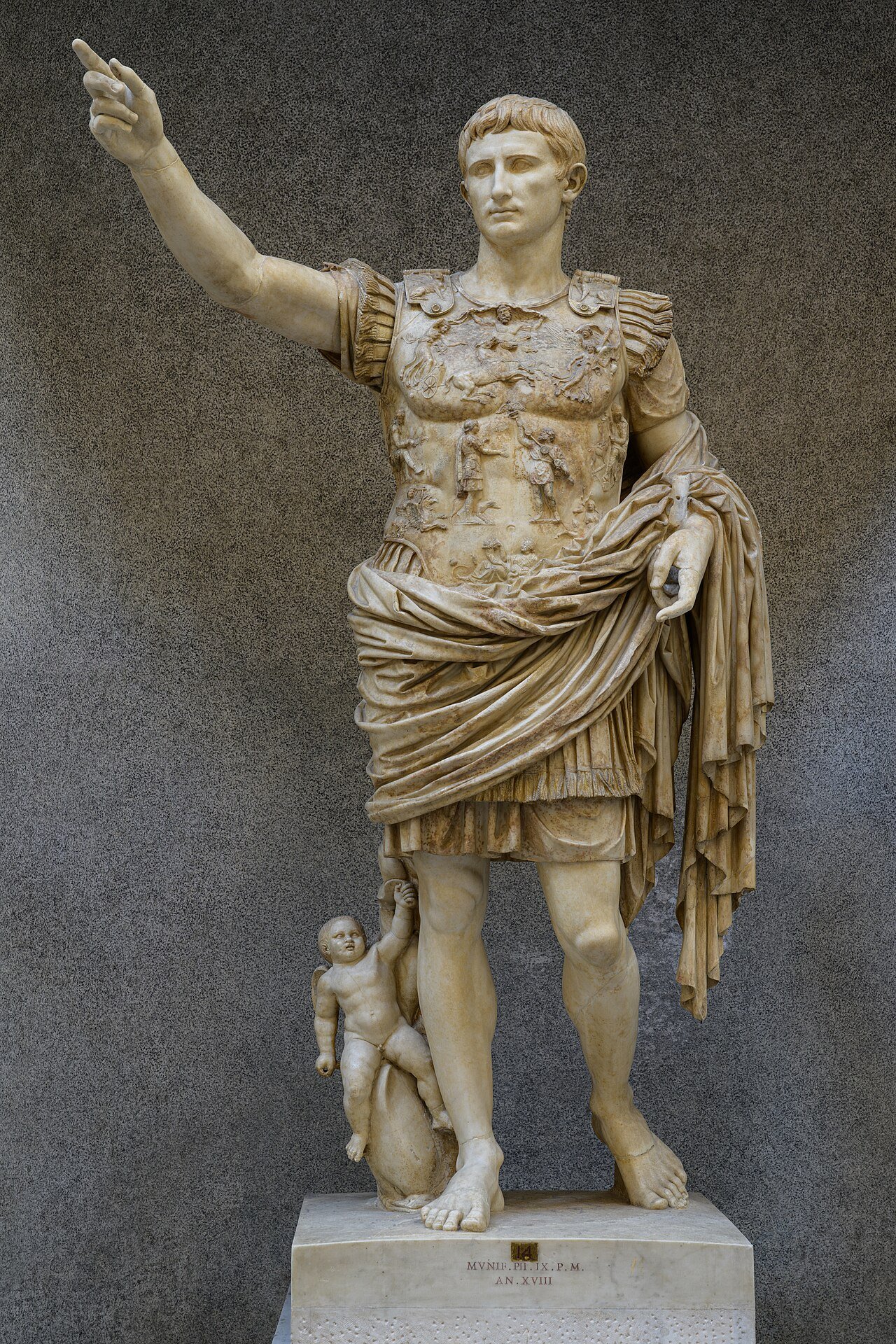
Augustus Caesar (born Gaius Octavius on September 23, 63 BCE, in Rome, Roman Republic—died August 19, 14 CE, at Nola, Italy) was the first Roman emperor and the founder of the Roman Empire. Originally known as Octavian, he was the adopted son and political heir of Julius Caesar. After defeating his rivals in a series of civil wars, he became Rome’s leading ruler in 27 BCE and received the title Augustus from the Roman Senate. He ruled until his death, bringing a long period of political stability to Rome while establishing a system of government that shaped Roman history for centuries.
Birth and Family Background
Augustus was born into a respected but not especially powerful Roman family. His father, Gaius Octavius, was a senator who had served as a governor and held important public offices. His mother, Atia, was the daughter of Julia, a sister of Julius Caesar. This family connection gave the young Octavius a distant but meaningful link to one of Rome’s most influential political figures.
His father died when Octavius was still a child. His mother later married Lucius Marcius Philippus, a Roman politician who helped raise him. Octavius spent much of his early life in Rome and received an education suitable for a young man from an upper-class family. He studied literature, public speaking, and politics, subjects that prepared him for a future in Roman public life.
As a boy, Octavius showed an interest in public affairs. Julius Caesar, who had no legitimate children of his own, became increasingly interested in his young relative. Caesar recognized his abilities and helped open opportunities for him within Roman political society.
Early Life and Connection to Julius Caesar
Octavius grew up during a period of serious political conflict in the Roman Republic. Powerful generals competed for influence, political groups struggled for control, and violence increasingly affected public life.
Julius Caesar became the most powerful figure in Rome after defeating his rivals in a series of military conflicts. He eventually took control of the government and was appointed dictator for life in 44 BCE.
Although Octavius was still young, Caesar included him in important family and political plans. In 45 BCE, Octavius traveled to Spain to join Caesar’s military campaign. He faced the challenges of traveling through an unsettled region and demonstrated a willingness to take part in public affairs despite his limited experience.
Caesar’s plans for Octavius became clear after his assassination. In his will, Caesar adopted Octavius as his son and named him his principal heir. This decision transformed the young man’s future and gave him a powerful political connection.
The Assassination of Julius Caesar
On March 15, 44 BCE, Julius Caesar was assassinated by a group of Roman senators who feared that his growing power threatened the Republic. The killing took place during a Senate meeting in Rome and created a major political crisis.
Octavius was in Apollonia, in present-day Albania, when he learned of Caesar’s death. He was about 18 years old. After discovering that Caesar had adopted him and left him much of his inheritance, he decided to return to Rome and claim his position as Caesar’s heir.
He also adopted Caesar’s name, becoming Gaius Julius Caesar Octavianus, commonly known as Octavian. In Roman society, adoption into a family meant taking its name and becoming part of its legal and social identity.
Octavian faced considerable opposition. Many of Caesar’s former supporters were older and more experienced, while some Roman leaders questioned whether such a young man could hold political influence. Nevertheless, he used his connection to Caesar to attract soldiers, supporters, and political allies.
He also worked to secure Caesar’s promised payments to Roman citizens and veterans. These actions helped him build public support and establish himself as a serious political figure.
The Second Triumvirate and Civil War
After Caesar’s assassination, Rome entered another period of civil conflict. Two important figures, Mark Antony and Marcus Aemilius Lepidus, competed with Octavian for control of Caesar’s political and military legacy.
Octavian initially worked with Antony, despite their rivalry. In 43 BCE, the three men formed the Second Triumvirate, a legally recognized political alliance that gave them extraordinary powers to govern Roman territory and defeat their enemies.
The triumvirs used their authority to eliminate political opponents through a series of official executions known as proscriptions. Thousands of people were affected, including wealthy citizens and prominent politicians. One of the most famous victims was the statesman and writer Cicero, who had criticized Antony.
The alliance then turned against the men responsible for Caesar’s assassination. In 42 BCE, Octavian and Antony defeated the forces of Brutus and Cassius at the Battle of Philippi in Macedonia. Both leading conspirators died following the defeat.
After their victory, the triumvirs divided control of the Roman world. Octavian took responsibility for the western provinces, Antony controlled the eastern territories, and Lepidus received authority over parts of North Africa.
However, their agreement did not last. Octavian and Antony increasingly competed for power, while Lepidus gradually lost political influence.
Conflict With Mark Antony and Cleopatra
Mark Antony became closely involved with Cleopatra VII, the queen of Egypt. Their relationship developed into both a personal partnership and a political alliance. Antony spent considerable time in the eastern Mediterranean, where Cleopatra provided him with resources and political support.
Octavian used Antony’s relationship with Cleopatra to weaken his position in Rome. He presented Antony as a Roman leader who had become too closely tied to an eastern queen and whose actions threatened Roman interests.
The conflict between the two leaders grew more serious. In 32 BCE, the political alliance between them effectively collapsed, and Rome moved toward another civil war.
Octavian’s forces, commanded in part by his close associate Marcus Vipsanius Agrippa, confronted Antony and Cleopatra’s fleet at the Battle of Actium on September 2, 31 BCE. The battle took place off the western coast of Greece.
Octavian’s forces won a decisive victory. Antony and Cleopatra escaped to Egypt, but their military position became increasingly hopeless.
In 30 BCE, Octavian invaded Egypt. Antony and Cleopatra both died by suicide as his forces approached Alexandria. Egypt then came under Roman control and became an important Roman territory.
With their deaths, Octavian’s main political and military rivals were gone. He had become the undisputed leader of the Roman world.
Rise to Power and the Title Augustus
Although Octavian had achieved military victory, he understood that Romans remained suspicious of individuals who appeared to seek absolute power. The memory of Julius Caesar’s assassination made it dangerous to openly establish another dictatorship.
In 27 BCE, Octavian arranged a political settlement with the Roman Senate. He formally returned certain powers to the Senate and the Roman people, while retaining control over important provinces and military forces.
The Senate rewarded him by granting him the title Augustus, meaning something like revered or distinguished. From this point, he became known as Augustus Caesar.
He also received the title Princeps, meaning first citizen. This title reflected his position as Rome’s leading political figure while allowing the traditional institutions of the Republic to continue operating.
Augustus did not officially call himself a king or declare that Rome had become an empire. Instead, he created a system in which he held the most important political and military powers while maintaining the appearance of traditional republican government.
His rise marked the beginning of the Roman Empire, although many Roman institutions continued to use the names and practices established during the Republic.
Marriage and Family Life
Augustus had a complicated personal and family life. His first marriage was to Clodia Pulchra, a stepdaughter of Mark Antony. The marriage was arranged for political reasons and ended in divorce.
He later married Scribonia, a woman from an influential Roman family. Their daughter, Julia, was born in 39 BCE. Augustus divorced Scribonia shortly after Julia’s birth.
In 38 BCE, Augustus married Livia Drusilla, who became his most important wife and remained with him throughout the rest of his life. Livia had two sons from an earlier marriage, Tiberius and Drusus. Augustus treated them as members of his extended family and eventually incorporated them into his political plans.
Augustus had no biological sons of his own. His daughter Julia became an important part of his efforts to arrange a suitable family succession. He married her to several prominent Roman men, including Marcus Vipsanius Agrippa and later Tiberius.
Family relationships were closely connected to political responsibilities during Augustus’s rule. He arranged marriages among members of the ruling family to strengthen alliances and prepare possible successors.
However, his family life was not without difficulties. Julia became involved in a scandal involving alleged adultery and other improper conduct. In 2 BCE, Augustus sent her into exile. He later restricted her contact with others, and she remained away from Rome for the rest of her life.
Augustus also faced repeated disappointments when potential heirs died before they could succeed him. These losses made the question of who would rule after him increasingly important.
Government and Political Reforms
After becoming Rome’s leading ruler, Augustus reorganized the government to make it more stable and effective. He maintained the Senate, elected officials, and many traditional Roman institutions, but he ensured that his own authority remained stronger than that of any individual rival.
He controlled important military provinces and maintained influence over the Senate. The Senate continued to meet and carry out official duties, but Augustus held the authority needed to guide major political decisions.
He also reorganized provincial administration. Some provinces were placed under his direct control, while others remained under senatorial administration. This arrangement helped him maintain authority over territories containing large military forces.
Augustus strengthened the Roman system of taxation and improved the collection of government revenue. He also worked to reduce corruption among provincial officials and establish clearer rules for administration.
Another important change involved the Roman military. Before Augustus, Roman generals often controlled armies that were personally loyal to them. This had contributed to repeated civil wars. Augustus established a more permanent professional army under the authority of the emperor.
He also created the Praetorian Guard, a special military force responsible for protecting the emperor and his household. Over time, this unit became an important political institution in Rome.
These reforms helped create a more organized government and reduced the likelihood of military commanders openly competing for control of the state.
Military Organization and Expansion
Augustus understood that a stable government depended on a reliable military. He reorganized the Roman army into a more permanent force and established clearer arrangements for soldiers’ service and retirement.
Legionaries generally served for a fixed period and received payment for their work. At the end of their service, eligible veterans received retirement benefits, which could include money or land.
Augustus also established a military treasury to help pay soldiers and veterans. This reduced the dependence of military forces on individual commanders and strengthened the connection between the army and the imperial government.
During his reign, Roman territory expanded in several directions. Roman forces strengthened control over parts of Spain, the Balkans, and the eastern Mediterranean. Egypt became an important Roman province after the defeat of Antony and Cleopatra.
However, expansion was not always successful. Roman armies suffered a major defeat in the Teutoburg Forest in 9 CE, when Germanic forces led by Arminius destroyed three Roman legions.
The defeat shocked Rome and forced Augustus to reconsider the empire’s military position in the region. Roman forces maintained control west of the Rhine, but the empire did not permanently conquer the territory between the Rhine and Elbe rivers.
Augustus eventually favored securing existing borders rather than pursuing unlimited expansion.
Changes to Roman Society
Augustus introduced several laws intended to strengthen Roman family life and encourage traditional social behavior. He believed that marriage, children, and family responsibilities were important to the stability of Roman society.
His government passed laws encouraging marriage and childbirth among certain groups of Roman citizens. Other laws attempted to restrict adultery and strengthen traditional expectations surrounding family relationships.
These measures were not always popular. Some Romans viewed them as unnecessary interference in private life, while others resisted the restrictions placed on personal relationships.
Augustus also supported public building projects and improvements to Rome’s infrastructure. During his reign, temples, public spaces, roads, and other structures were built or restored.
He paid particular attention to Rome’s water supply, public order, and fire protection. The city was divided into administrative districts to improve local management, and officials were given responsibilities for maintaining public services.
He also reorganized Rome’s fire brigade and established a permanent force responsible for responding to fires and maintaining security.
These improvements helped manage a growing city that had become the center of a vast empire.
Religion and Public Life
Religion played an important role in Roman political and social life. Augustus understood that restoring religious traditions could help strengthen public confidence in his government.
He restored temples, revived certain religious ceremonies, and encouraged respect for traditional Roman gods and rituals. He also became a leading figure in the Roman state religion.
In 12 BCE, after the death of Lepidus, Augustus became Pontifex Maximus, the highest religious office in Rome. This position gave him authority over important religious matters.
He also promoted the worship of traditional Roman gods and supported religious practices connected with the Roman state. In the provinces, some communities honored him through public ceremonies and temples, although the forms of imperial worship varied across the empire.
Augustus was careful about how he presented his own position. He accepted public honors but generally avoided openly presenting himself as a god during his lifetime in Rome.
Art, Literature, and Public Building Projects
Augustus supported writers, poets, and artists whose work reflected Roman culture and the values promoted by his government.
Several important Roman writers produced major works during his reign. The poet Virgil wrote the Aeneid, an epic poem about the legendary origins of Rome and the journey of Aeneas. The poet Horace produced poems and other works, while the historian Livy wrote an extensive history of Rome.
Augustus did not personally write all these works, but his government and supporters provided an environment in which literature and public culture could flourish.
The emperor also supported major building projects throughout Rome. Temples, theaters, public buildings, and monuments were constructed or restored. These projects helped improve the appearance and function of the capital.
One of the best-known monuments associated with his reign is the Ara Pacis, or Altar of Augustan Peace. Dedicated in 9 BCE, it celebrated the peace and stability associated with his rule.
Augustus also developed the Mausoleum of Augustus, a large tomb in Rome intended for members of the imperial family. He and several relatives were eventually buried there.
The Pax Romana
During Augustus’s reign, Rome entered a long period of relative peace and stability known as the Pax Romana, or Roman Peace. This period is generally dated from the beginning of his rule in 27 BCE to the death of Emperor Marcus Aurelius in 180 CE, although it included wars, revolts, and periods of political difficulty.
Augustus helped establish the political and administrative arrangements that made this period possible. His government reduced large-scale civil conflict within the Roman world and created more dependable systems for managing the empire.
Trade expanded across Roman territories, roads connected distant provinces, and cities developed under Roman administration. The Mediterranean became an important center of commerce, linking Europe, North Africa, and the eastern Mediterranean.
Although peace was not universal, the empire experienced greater internal stability than it had during the final decades of the Roman Republic.
Later Years and the Question of Succession
As Augustus grew older, choosing a successor became one of his greatest political concerns. Because he had no biological sons, he relied on adoption, marriage arrangements, and family connections to prepare possible heirs.
His nephew Marcellus was initially considered a promising successor, but he died in 23 BCE. Augustus later relied more heavily on Marcus Vipsanius Agrippa, his trusted military commander and son-in-law.
Agrippa became an important member of the ruling family and was expected to play a major role in the future government. However, he died in 12 BCE.
Augustus then turned increasingly to the sons of Agrippa and Julia, particularly Gaius and Lucius Caesar. He adopted both boys and prepared them for important public responsibilities. Their early deaths, in 4 CE and 2 CE respectively, created further difficulties.
Tiberius, Livia’s son from her earlier marriage, eventually became the leading candidate. Augustus adopted him in 4 CE and gave him important military and political responsibilities.
Tiberius had already served as a successful general and administrator. His experience made him a practical choice, although Augustus’s relationship with him was not always easy.
In his later years, Augustus continued to take part in government affairs but increasingly relied on trusted officials and family members. He remained concerned with the administration of the empire and the stability of the succession.
Death of Augustus Caesar
Augustus died on August 19, 14 CE, at Nola in southern Italy. He was 75 years old. His wife, Livia, and other members of his household were with him during his final days.
According to ancient accounts, his last words included a remark asking whether he had played his part well in the drama of life. However, the precise wording and historical reliability of the reported statement cannot be established with certainty.
After his death, the Senate formally recognized his divine status, and he became known as Divus Augustus. His successor, Tiberius, took control of the empire and continued the political system Augustus had established.
Augustus was buried in the Mausoleum of Augustus in Rome, where members of his family were also laid to rest.