Across the ancient world, temples were not merely places of worship. They were statements of power, expressions of cosmology, and demonstrations of human ingenuity pushed to extraordinary limits. Many were built long before modern engineering theory existed, yet they display structural stability, acoustic precision, astronomical alignment, and material mastery that can feel almost impossible even today.
When people say these temples “defy the laws of physics,” they do not mean that natural laws are actually broken. Physics is universal and inescapable. Rather, these monuments appear so improbable—so precise, so massive, or so cleverly designed—that they seem to operate beyond ordinary understanding. Their builders exploited natural principles with such sophistication that the results can feel supernatural.
These temples reveal deep empirical knowledge of geometry, material strength, resonance, solar motion, and load distribution. They demonstrate that ancient builders were not merely artisans—they were careful observers of nature, intuitive engineers, and master experimenters working without formal scientific language but guided by practical understanding.
Each of the following temples represents a remarkable convergence of architecture and physical law. Their construction demanded precise control over forces, motion, light, sound, and space. Their survival across centuries demonstrates that the builders not only understood these principles—they mastered them.
1. Kailasa Temple
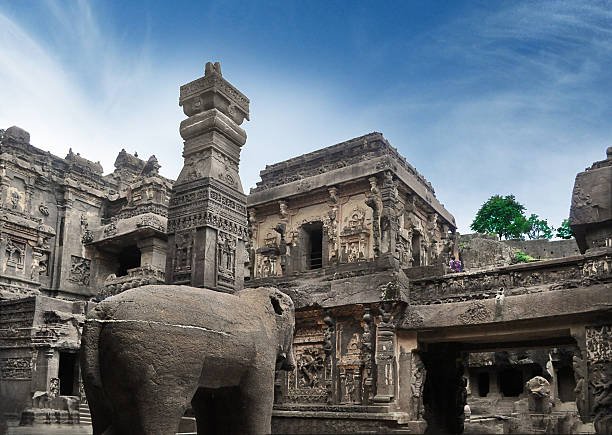
Few structures in human history appear as improbable as the Kailasa Temple. It was not assembled from quarried blocks. It was carved downward from a single massive rock formation. Builders removed hundreds of thousands of tons of stone to reveal a complete architectural complex—pillars, corridors, shrines, stairways, sculptures, and towering walls—all sculpted from one continuous mass.
From a physics perspective, the engineering challenge is astonishing. Most large structures rely on modular construction. Separate blocks allow flexibility in load distribution and structural adjustment. Here, however, everything had to be planned in reverse. Workers began at the top and carved downward, meaning that any mistake would have been irreversible.
Structural stability depended on preserving load-bearing sections precisely where needed. Remove too much stone in the wrong place, and gravitational stress would fracture the entire formation. The temple’s builders had to predict how forces would propagate through the remaining rock before carving began.
Modern analysis shows that the remaining stone mass distributes compressive forces efficiently, channeling weight downward through thick vertical supports. The structure behaves like a natural mountain core, resisting collapse through integrated continuity.
What makes the temple feel physically impossible is not merely its scale but its precision. Pillars stand aligned. Symmetry is maintained. Hollowed chambers do not weaken the outer structure. The builders effectively sculpted a negative space architecture that maintains mechanical equilibrium.
The temple appears to have been “released” from stone rather than constructed—an illusion that makes gravity itself seem momentarily suspended.
2. Brihadeeswarar Temple
Rising dramatically above the surrounding landscape, the central tower of this temple reaches extraordinary height while supporting an immense granite capstone weighing many tons. The question that has fascinated engineers for centuries is simple: how was such a massive stone lifted and placed at such elevation without modern machinery?
Granite is dense and extremely heavy. Transporting it alone would have required large-scale coordination. Elevating it to the top of the towering structure demanded precise control over mechanical advantage and load distribution.
Evidence suggests that builders used an inclined ramp system extending kilometers outward, allowing gradual upward movement of the stone. This approach converts vertical lifting into horizontal pulling, reducing required force. The longer the ramp, the smaller the slope, and the more manageable the load.
What makes the structure remarkable is its stability. The towering mass remains balanced through carefully calculated geometry. The pyramid-like taper distributes weight downward and inward, reducing lateral stress. The foundation absorbs compressive forces across a broad base.
Thermal expansion of stone, seismic vibrations, and long-term material fatigue all influence large structures. Yet this temple’s tower has endured for centuries with minimal structural deformation.
The placement of massive weight at great height appears to challenge gravity—but in truth it demonstrates profound understanding of it.
3. Konark Sun Temple
This temple is designed as a colossal stone chariot, complete with intricately carved wheels aligned with the Sun’s movement. Beyond artistic brilliance, the structure reveals sophisticated astronomical and geometric planning.
Each wheel functions as a type of sundial. The angle of spokes, orientation of surfaces, and placement relative to solar motion allow time to be measured through shadow position. This requires precise understanding of Earth’s rotation, solar trajectory, and seasonal variation.
What gives the temple an almost physics-defying aura is its massive suspended stone components, some of which appear to balance with improbable delicacy. Historical accounts describe strong magnetic elements in the structure, though the exact extent of magnetic use remains debated among researchers.
From a structural perspective, the temple’s platform distributes enormous stone weight through layered interlocking joints. Load transfer occurs through compression rather than tension—an approach common in ancient masonry but executed here with extreme refinement.
The structure also demonstrates knowledge of solar illumination geometry. At specific times of day, sunlight penetrates interior spaces along carefully planned pathways, creating dramatic visual alignment with sacred symbolism.
The temple transforms astronomical motion into architecture—stone behaving as a cosmic instrument.
4. Borobudur
Viewed from above, this temple forms a vast three-dimensional mandala—an architectural diagram of cosmological structure expressed through geometry. Its construction required precise control over symmetry across multiple ascending terraces.
The most remarkable physical challenge lies in its location. The structure stands on a volcanic hill in a region of intense rainfall and seismic activity. Maintaining stability under such conditions demands sophisticated drainage and load management.
Hidden within the structure is an intricate water management system. Channels guide rainwater away from terraces, preventing hydrostatic pressure buildup that could destabilize the foundation. Without such drainage, accumulated water would gradually erode support layers.
The temple’s weight distribution is also carefully engineered. Each level decreases in mass as height increases, lowering the center of gravity and enhancing resistance to earthquake motion. The interlocking stone blocks allow limited movement, absorbing seismic energy rather than fracturing rigidly.
From a distance, the structure appears immovable and eternal. Yet it survives precisely because it was designed to move—subtly, flexibly, in response to natural forces.
Its endurance in a geologically active environment gives the impression of physical impossibility, when in fact it reflects mastery of environmental physics.
5. Angkor Wat
This temple complex represents one of the largest religious structures ever built. Its scale alone challenges comprehension, but its true physical brilliance lies in hydrology and astronomical alignment.
The temple is surrounded by vast moats and reservoirs forming part of an extensive water management network. These systems regulate groundwater levels, stabilize soil, and protect foundations from seasonal flooding.
Hydrological engineering on this scale requires understanding fluid flow, sediment transport, and pressure equilibrium. Improper water balance could cause subsidence or structural collapse.
Astronomical alignment adds another layer of precision. The central towers are positioned so that during equinoxes and solstices, solar movement produces specific visual effects along the temple’s axis. Achieving this requires accurate long-term observation of solar motion relative to Earth’s orbit.
The temple’s sandstone blocks were transported over long distances and assembled with extraordinary precision. Their arrangement distributes compressive forces evenly, allowing the structure to withstand centuries of environmental stress.
The site appears to float between earth and water, between geometry and astronomy—an environment where physics becomes ritualized in stone.
6. Temple of Kukulkan
This pyramid-temple is famous for a phenomenon that occurs during equinox sunsets. As sunlight strikes the stepped terraces, triangular shadows form along the staircase, creating the illusion of a serpent descending toward the ground.
This visual effect depends on extremely precise angular relationships between solar position, architectural geometry, and seasonal variation in sunlight direction. Even slight deviations in orientation would disrupt the illusion.
The structure also demonstrates remarkable acoustic behavior. A sharp clap at the base produces an echo resembling the call of a bird sacred in local tradition. Acoustic analysis suggests that stepped surfaces reflect sound waves in a manner that compresses and reshapes the returning waveform.
Both visual and acoustic effects depend on predictable physical laws: reflection, diffraction, and wave interference. The builders transformed these phenomena into symbolic experiences.
To observers unaware of the underlying geometry, the temple appears to animate light and sound—turning nature itself into a performer.
7. Abu Simbel Temples
Twice each year, sunlight penetrates deep into the interior of these rock-cut temples and illuminates specific statues at the rear chamber. The alignment occurs on particular dates associated with significant events in ancient royal symbolism.
Achieving this effect required precise knowledge of solar azimuth and seasonal variation. The temple’s orientation had to be calculated relative to horizon elevation and Earth’s axial tilt.
The phenomenon is especially remarkable because the temple is carved into solid rock. Adjusting orientation after excavation would have been impossible. Alignment had to be correct from the beginning.
Modern relocation of the temples to avoid flooding required engineers to preserve this solar alignment—a task demonstrating how delicate the geometry truly is.
Light travels in straight lines, but its interaction with architecture here produces the appearance of cosmic intention carved into stone.
8. Parthenon
At first glance, this temple appears perfectly symmetrical and geometrically regular. Careful measurement, however, reveals subtle curvature and intentional deviations from straight lines.
Columns lean slightly inward. Horizontal surfaces curve gently upward. Corner columns are thicker than others. These refinements correct visual distortions caused by perspective and human perception.
From a physics standpoint, this represents mastery of optical geometry. Builders anticipated how light, distance, and human vision interact to create illusion. They modified structure to compensate.
The result is architecture that appears perfectly straight, though it is not. The temple does not defy physical law—it manipulates perception shaped by physical optics.
The structure demonstrates that understanding human sensory response can be as important as understanding material forces.
9. Temple of Jupiter Baalbek
This temple complex contains some of the largest stone blocks ever used in construction. Individual stones weigh hundreds of tons, transported and positioned with remarkable precision.
Moving such masses requires overcoming friction, managing momentum, and distributing force evenly to prevent fracture. Even modern machinery struggles with loads of comparable magnitude.
The stones are fitted so tightly that gaps between them are nearly invisible. This precision reduces stress concentration and increases structural stability.
The scale of these blocks creates the impression that normal physical limits were ignored. In reality, their placement required extraordinary coordination of mechanical advantage, leverage systems, and workforce organization.
The temple embodies the upper threshold of what is mechanically possible using preindustrial methods.
The Physics Behind the Wonder
None of these temples violate natural law. Instead, they demonstrate exceptional application of it. Ancient builders mastered compression, resonance, solar geometry, hydrodynamics, acoustics, and visual perception through observation and experimentation.
Their knowledge was empirical rather than theoretical. They learned by building, measuring, and refining. Their monuments encode centuries of accumulated understanding.
Why These Temples Continue to Astonish
Modern observers are often surprised because technological sophistication is usually associated with advanced science. Yet these temples show that deep physical understanding can emerge through practical engagement with nature.
They remind us that science is not only equations and laboratories. It is also craftsmanship, measurement, and long-term observation of the world.
The Enduring Dialogue Between Stone and Law
These ancient temples do not defy physics. They reveal it—dramatically, beautifully, and with breathtaking ambition. They transform gravity into stability, sunlight into symbolism, sound into ritual, and geometry into sacred space.
They stand not as violations of nature, but as celebrations of humanity’s ability to understand and harness its laws.
And in their silent endurance, they continue to whisper the same message across centuries: the universe is governed by rules—but those who understand them can build wonders that feel almost beyond belief.