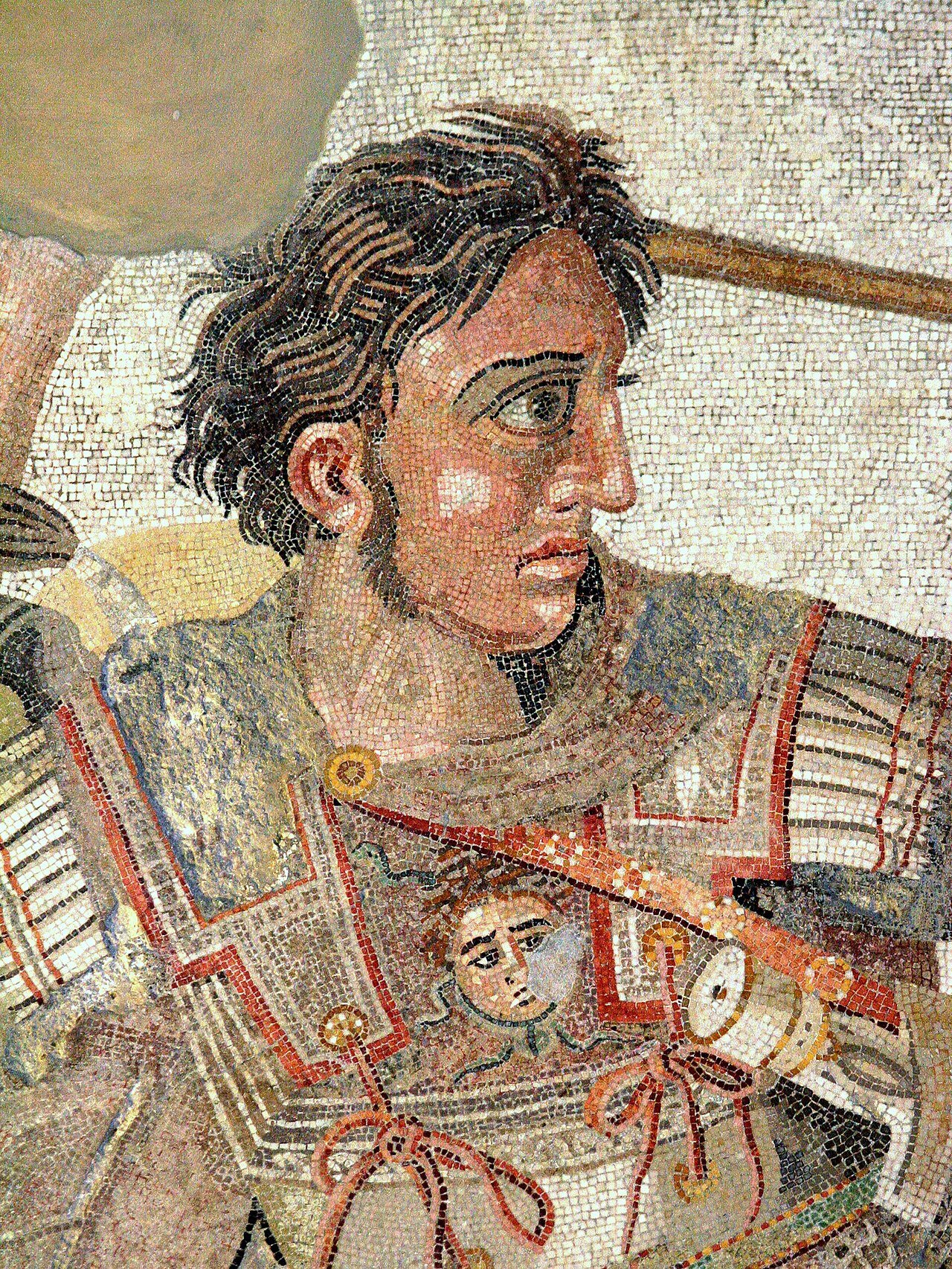
Alexander III of Macedon (born July 20, 356 BCE, in Pella, the ancient capital of Macedonia in northern Greece—died June 10 or 11, 323 BCE, in Babylon, in present-day Iraq), better known as Alexander the Great, was a Macedonian king and military commander who conquered the Persian Empire and established one of the largest empires of the ancient world. The son of King Philip II of Macedon and Queen Olympias, he became king in 336 BCE at the age of 20. During his 13-year reign, he led military campaigns across Asia Minor, Egypt, Persia, and parts of Central Asia and northwestern India. He also founded several cities, many of which were named Alexandria, and helped spread Greek language and culture across the regions he conquered.
Early Life and Family Background
Alexander was born into the royal family of Macedon, a powerful kingdom north of the traditional Greek city-states. His father, Philip II, was an ambitious ruler who strengthened Macedonia’s army, expanded its territory, and brought much of Greece under his influence. His mother, Olympias, was a princess from Epirus, a kingdom west of Macedonia.
Alexander grew up in the Macedonian royal court, where military training, physical fitness, and political education were important parts of a young prince’s upbringing. From an early age, he was expected to prepare for leadership. His father wanted him to become a capable ruler and commander who could continue Macedonia’s expansion.
Ancient accounts describe Alexander as an energetic and determined child who showed an early interest in horses, military matters, and heroic stories. One famous story concerns his encounter with a powerful horse named Bucephalus. According to the account, others had failed to control the animal, but Alexander noticed that the horse was frightened by its own shadow. He turned the horse toward the sun, mounted it, and successfully rode it. Philip was reportedly impressed by his son’s ability and determination.
Bucephalus later became Alexander’s trusted warhorse and accompanied him during much of his military career.
Alexander also developed a strong interest in the legendary Greek hero Achilles, whose adventures were described in Homer’s Iliad. He admired Achilles’ courage and reputation as a warrior. This interest in Greek heroic traditions remained an important part of his identity throughout his life.
Education Under Aristotle
When Alexander was about 13 years old, Philip II arranged for him to receive an advanced education from the Greek philosopher Aristotle. Aristotle was already known for his work in philosophy, science, politics, and literature.
Alexander studied with Aristotle at a place traditionally identified as Mieza, in Macedonia. His education included subjects such as philosophy, poetry, medicine, biology, and politics. He also studied Greek literature, particularly Homer’s Iliad, which shaped his understanding of leadership, courage, and military honor.
Aristotle encouraged Alexander to develop his reasoning skills and understand the natural world. Their relationship introduced the young prince to Greek intellectual traditions and helped prepare him for the responsibilities of kingship.
The exact nature of their personal relationship is not fully known, but Aristotle’s influence on Alexander’s education is well established.
Alexander’s education also strengthened his connection to Greek culture. Although Macedonians had their own political traditions and were sometimes viewed differently by southern Greek city-states, the Macedonian royal family identified strongly with Greek language, religion, and cultural traditions.
First Experience of Leadership
Alexander began gaining practical experience in government and warfare while still a teenager. In 340 BCE, when he was about 16, Philip left Macedonia to campaign elsewhere and entrusted Alexander with responsibility for governing the kingdom during his absence.
During this period, Alexander dealt with a revolt by the Maedi, a people living in the region of Thrace. He led a military response, defeated the rebels, and established a settlement that he named Alexandropolis.
This experience gave him an early opportunity to exercise authority and command soldiers.
In 338 BCE, Alexander took part in the Battle of Chaeronea, where Philip’s army defeated an alliance of Greek city-states led by Athens and Thebes. Alexander commanded cavalry forces and played an important role in the Macedonian victory.
The battle confirmed Macedonia’s military dominance over much of Greece. It also gave Alexander valuable experience in a major military engagement alongside his father.
Becoming King of Macedonia
Philip II was assassinated in 336 BCE during a royal ceremony at Aegae, the ancient Macedonian capital. The circumstances surrounding the assassination remain a subject of historical debate. The assassin, Pausanias of Orestis, was a member of Philip’s bodyguard, but the extent of any wider conspiracy has never been established with certainty.
Following Philip’s death, Alexander became king at the age of 20.
His position was not immediately secure. Rival claimants, political opponents, and neighboring peoples could challenge the authority of the young king. Alexander moved quickly to establish control over the kingdom and eliminate potential threats to his rule.
He secured the support of the Macedonian army and dealt with individuals who opposed his succession. He also took steps to prevent other members of the royal family from becoming political rivals.
Several Greek states attempted to resist Macedonian control after Philip’s death. Alexander responded by moving south with his army and restoring Macedonia’s authority. The city of Thebes rebelled in 335 BCE, believing that the new king might be unable to respond effectively.
Alexander marched rapidly into Greece and attacked Thebes. The city was captured and destroyed, except for certain religious buildings and the house associated with the poet Pindar. Much of its population was killed or enslaved, although the destruction of Thebes was not carried out without exceptions.
The severe punishment discouraged further rebellion among the Greek states. Alexander then secured their renewed cooperation and continued preparations for his father’s planned invasion of the Persian Empire.
Beginning the Campaign Against Persia
Philip II had been preparing to invade the Persian Empire before his assassination. Alexander continued this plan, presenting the campaign partly as an effort to punish Persia for its earlier invasions of Greece.
In 334 BCE, Alexander crossed the Hellespont, the narrow waterway now known as the Dardanelles, with his army and entered Asia Minor, in present-day Turkey.
His forces included Macedonian infantry, cavalry, archers, and soldiers from allied Greek states. The army was highly organized and built around the Macedonian phalanx, a formation of infantry soldiers armed with long spears called sarissas. The long reach of these weapons helped Macedonian soldiers maintain a strong defensive line while cavalry attacked the enemy’s flanks.
Alexander also made effective use of different military units working together. His infantry held the center of the battlefield while cavalry forces delivered attacks at important points.
Before beginning his campaign, Alexander visited the traditional site of Troy. According to ancient accounts, he paid tribute to the heroes of the Trojan War, particularly Achilles, whom he greatly admired.
His first major battle against the Persian forces took place at the Granicus River in 334 BCE. The Persian army attempted to stop his advance, but Alexander led a successful cavalry attack across the river. The Macedonian forces defeated the Persian defenders and gained control of much of western Asia Minor.
The victory opened the way for Alexander to move farther into Persian territory.
The Battle of Issus and the Capture of Egypt
In 333 BCE, Alexander faced the Persian king Darius III at the Battle of Issus in southeastern Asia Minor. Darius had assembled a large army to stop the Macedonian invasion.
The two forces met in a narrow coastal area where the Persian army could not fully use its numerical advantage. Alexander led a direct cavalry attack toward the Persian position, creating pressure on Darius and causing the Persian army to retreat.
Darius escaped, leaving behind his camp, possessions, and members of his family. Alexander captured Darius’s mother, wife, and children but treated them with respect and allowed them to remain under royal protection.
The victory greatly weakened Persian resistance in the western territories. Alexander continued south along the Mediterranean coast, capturing important cities and securing access to Persian naval bases.
One major obstacle was Tyre, a wealthy Phoenician city located on an island off the coast of present-day Lebanon. Its defenders resisted Alexander for several months in 332 BCE. The city was protected by strong walls and surrounded by water, making a direct attack difficult.
Alexander ordered the construction of a causeway connecting the island to the mainland. His engineers and soldiers gradually extended it into the sea, allowing the Macedonian army to bring siege equipment close to the city walls.
After a prolonged siege, Tyre fell. The capture gave Alexander control over an important coastal center and strengthened his position in the eastern Mediterranean.
He then advanced into Egypt, where Persian rule had become unpopular. The Egyptians welcomed him as a liberator, and Alexander was accepted as their ruler.
During his time in Egypt, he visited the religious center at Siwa Oasis, where the oracle of the god Amun was located. Ancient accounts report that he received a favorable response from the oracle, although the exact details of the meeting remain uncertain.
Alexander also founded the city of Alexandria near the Mediterranean coast in 331 BCE. Its location offered access to important trade routes and provided a strategic base for administration and commerce. The city later became one of the most important centers of learning and culture in the ancient world.
The Battle of Gaugamela and the Fall of the Persian Empire
After securing Egypt, Alexander turned northeast toward the heart of the Persian Empire. Darius III had assembled another large army and prepared to confront the Macedonians near Gaugamela, close to modern-day Mosul in Iraq.
The Battle of Gaugamela took place in 331 BCE. Darius selected relatively open ground to give his cavalry and war chariots more room to operate.
Alexander’s army faced a larger Persian force, but its organization and coordination proved decisive. Alexander arranged his troops to respond to attacks from different directions while maintaining the strength of his main formation.
During the battle, he led a cavalry attack toward a gap in the Persian lines. The attack created a serious threat to Darius’s position, and the Persian king again fled the battlefield.
The Persian army collapsed, allowing Alexander to claim victory.
Following the battle, Alexander entered Babylon, one of the empire’s most important cities. He was welcomed by its inhabitants and took control of its treasury and administrative resources.
He later occupied Susa and Persepolis, major centers of Persian government and wealth. Persepolis contained an enormous royal palace complex that symbolized the power of the Persian kings.
In 330 BCE, the palace complex at Persepolis was burned. Ancient accounts differ over the circumstances and reasons for the fire. Some describe it as an act of revenge for the destruction of Greek religious sites during the Persian invasion of Greece, while others connect it to a celebration that became destructive. The full explanation remains uncertain.
Darius III fled eastward as Alexander continued his advance. He was eventually captured and killed by his own subordinates, led by Bessus, a Persian nobleman and regional commander, in 330 BCE.
Alexander later pursued Bessus, who had declared himself king of Persia. Bessus was captured and executed, removing a potential rival and allowing Alexander to present himself as the legitimate successor to the Persian throne.
Campaigns in Central Asia
After the defeat of Darius, Alexander continued his military campaigns into the eastern parts of the former Persian Empire. He entered regions that included present-day Afghanistan, Uzbekistan, and Tajikistan.
These territories presented different challenges from the wealthy cities and established armies he had previously encountered. Local communities resisted Macedonian control, and the difficult geography made military operations more complicated.
Alexander founded military settlements and established garrisons to maintain control over conquered territories. He also used political agreements and local leaders to strengthen his authority.
One of the most difficult periods of his career came during the campaigns in Bactria and Sogdiana, regions located in parts of modern Central Asia. Local resistance continued for several years, forcing Alexander to conduct repeated military operations.
During this period, he married Roxana, the daughter of a local nobleman named Oxyartes. Their marriage took place around 327 BCE and helped establish political connections with influential families in the region.
Alexander also adopted certain Persian court customs and incorporated Persian officials and soldiers into his administration. These policies were intended to make his rule more acceptable to the populations of the conquered territories.
However, some Macedonian officers and soldiers opposed these changes. They believed that Alexander was moving too far away from Macedonian traditions and treating conquered Persians as equals.
The growing tension between Alexander and parts of his army created serious difficulties within his leadership.
Personal Conflicts and Tensions With His Officers
Alexander’s later campaigns were marked by several serious disagreements with members of his inner circle.
In 330 BCE, during the campaign in Persia, he became involved in a conflict with his experienced general Parmenion. Parmenion’s son, Philotas, was accused of knowing about a conspiracy against Alexander and failing to report it. Philotas was executed after being found guilty by a military assembly.
Parmenion, who remained in a position of influence, was later killed on Alexander’s orders. The decision removed a powerful military figure but increased concerns among some Macedonian officers about the king’s treatment of potential opponents.
Another major incident involved Cleitus the Black, one of Alexander’s senior commanders and a man who had saved his life during the Battle of the Granicus.
During a drinking gathering in 328 BCE, Cleitus criticized Alexander’s growing adoption of Persian customs and questioned his treatment of Macedonian veterans. The argument became increasingly heated, and Alexander killed Cleitus during the confrontation.
Ancient historians describe Alexander as deeply distressed afterward. The incident revealed how personal anger, political disagreements, and the pressures of command had begun to affect his relationships with those closest to him.
He also introduced a Persian-style court ceremony called proskynesis, which involved a formal gesture of respect toward the ruler. Some Persians practiced it as a normal expression of respect, but many Greeks and Macedonians considered the gesture inappropriate for a human ruler.
The proposal created further resentment among his followers, and Alexander eventually abandoned attempts to make the practice compulsory for Macedonians.
The Invasion of India
In 327 BCE, Alexander began preparing for an invasion of the Indian subcontinent. His objective was to extend his control farther east and explore territories beyond the former Persian Empire.
He crossed the Hindu Kush mountains and entered the region of present-day Pakistan and northwestern India.
In 326 BCE, Alexander fought King Porus at the Battle of the Hydaspes River, near the modern Jhelum River in Pakistan. Porus commanded a large army that included war elephants, which were unfamiliar and intimidating to many Macedonian soldiers.
Alexander used a carefully planned crossing of the river to surprise Porus’s forces. His cavalry and infantry attacked in coordination, eventually defeating the Indian army.
Porus was captured, but Alexander was impressed by his courage and leadership. According to ancient accounts, Alexander asked him how he wished to be treated. Porus reportedly replied that he should be treated like a king.
Alexander restored Porus to power and allowed him to govern his territory under Macedonian authority. He also granted him additional lands.
After the victory, Alexander founded two cities in the region. One was named Nicaea, meaning victory, and the other was named Bucephala in honor of his horse Bucephalus, who died during the Indian campaign according to traditional accounts.
Alexander continued eastward, but his soldiers had become exhausted after years of fighting. They had traveled far from home, faced difficult weather, and endured repeated battles.
When Alexander reached the Hyphasis River, now known as the Beas River in India, his troops refused to continue advancing. They wanted to return home.
Alexander initially attempted to persuade them to move farther east, but the soldiers remained unwilling. Recognizing that he could not continue the campaign without their cooperation, he agreed to turn back.
The decision ended his plans for further expansion into India.
The Return From India
Alexander began his return journey in 325 BCE. Rather than taking the same route he had used to enter India, he divided his forces.
Part of his army traveled by sea along the coast of the Indian Ocean and the Persian Gulf under the command of Nearchus, an experienced naval officer.
Alexander led another part of the army through the difficult region of Gedrosia, which included areas of present-day southern Pakistan and southeastern Iran.
The journey across the Gedrosian Desert was especially dangerous. Extreme heat, limited water supplies, and shortages of food caused severe suffering among the soldiers and animals. Many members of the expedition died.
The exact number of casualties is unknown, but ancient accounts describe the march as one of the most difficult experiences of Alexander’s military career.
After crossing the region, Alexander reunited with other parts of his army in the Persian territories. He then began reorganizing the administration of his empire and addressing problems that had developed during his long absence.
Governing His Expanding Empire
Alexander’s conquests created an enormous territory that required a stable system of government. Rather than replacing every existing administrative structure, he retained many Persian officials and local systems where they were useful.
He appointed Macedonian and Greek commanders to important military and political positions while allowing some local leaders to continue managing regional affairs.
Alexander also encouraged cooperation between Macedonians, Greeks, Persians, and other peoples. He recruited Persian soldiers into his army and trained some of them in Macedonian military methods.
In 324 BCE, at Susa, he organized a series of marriages between Macedonian officers and Persian noblewomen. Alexander himself married Stateira, a daughter of Darius III, and Parysatis, a daughter of the Persian king Artaxerxes III. His marriage to Roxana had taken place earlier.
These marriages were part of his effort to connect the Macedonian ruling class with the Persian aristocracy. However, many of his soldiers did not welcome the changes, particularly those who believed that Persian influence was weakening traditional Macedonian privileges.
Alexander also faced problems involving corrupt or ineffective officials who had been left in charge of conquered territories. He investigated complaints, punished some administrators, and attempted to strengthen the central government.
His plans for the empire remained incomplete because he died before he could establish a lasting political system across all its regions.
Final Years and Death
In 324 BCE, Alexander returned to Babylon, which he intended to develop as a major center of government and administration.
He continued planning new military and naval expeditions. These included preparations for campaigns in Arabia and further exploration of the regions surrounding the Persian Gulf.
However, his plans were interrupted by the death of Hephaestion, his close companion and one of his most trusted commanders. Hephaestion became seriously ill and died in Ecbatana in 324 BCE.
Alexander was deeply affected by the loss. He arranged an elaborate funeral and ordered honors in Hephaestion’s memory.
In 323 BCE, Alexander became ill while staying in Babylon. Ancient accounts describe a fever that developed after a period of drinking and social gatherings. His condition gradually worsened over several days.
He died in June 323 BCE, at the age of 32. The exact cause of his death remains uncertain. Various explanations have been proposed, including infectious diseases and other medical conditions, but no definitive diagnosis can be established from the surviving accounts.
Alexander had one son, Alexander IV, who was born after his father’s death to Roxana. At the time of Alexander’s death, the child had not yet been born.
When Alexander was asked who should inherit his empire, ancient accounts report that he indicated the strongest, although the precise wording and circumstances of this statement are uncertain. He did not leave a clear and accepted arrangement for succession.
His death created an immediate struggle among his generals, known as the Diadochi, a Greek term meaning successors. They fought over control of the vast territories Alexander had conquered.
The empire eventually broke into several major kingdoms, including those ruled by the Ptolemaic dynasty in Egypt and the Seleucid dynasty across large parts of western Asia. Roxana and Alexander IV were eventually killed during the struggles that followed his death.