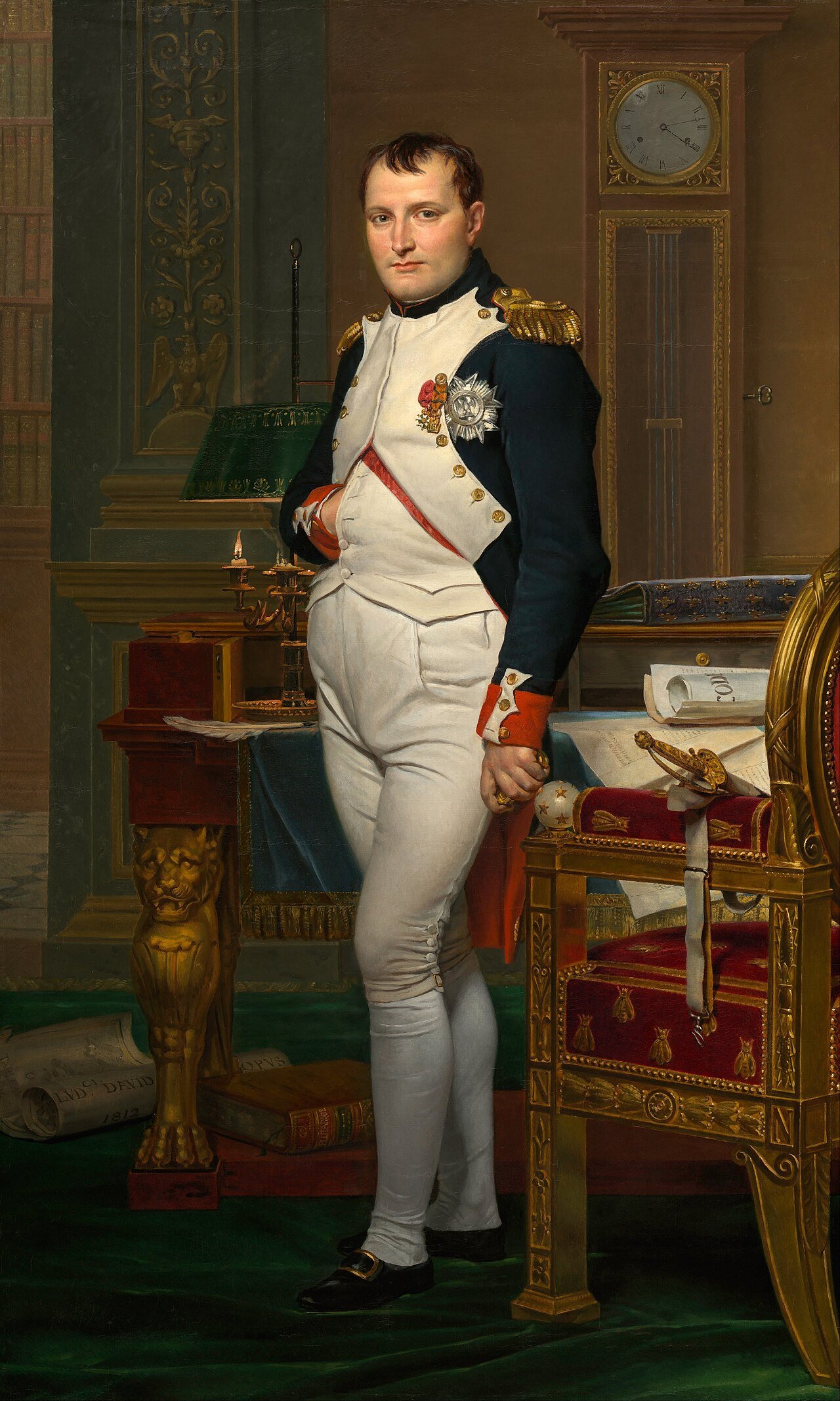
Napoleon Bonaparte (born August 15, 1769, in Ajaccio, Corsica—died May 5, 1821, on the island of Saint Helena in the South Atlantic Ocean) was a French military commander and political leader who became emperor of the French from 1804 to 1814 and again briefly in 1815. He rose to power during the French Revolution, led military campaigns across Europe, and established a powerful empire that changed the political map of the continent. He also introduced major legal and administrative reforms, including the Napoleonic Code, which influenced legal systems in many countries.
Early Life and Family Background
Napoleon was born into a family of minor Italian nobility in Ajaccio, the capital of Corsica. The island had been under the control of the Republic of Genoa before France acquired it in 1768, shortly before his birth. His family had lived in Corsica for generations and maintained connections with local political and social life.
His father, Carlo Buonaparte, was a lawyer who became involved in Corsican political affairs. His mother, Letizia Ramolino, managed the household and raised Napoleon and his siblings. Napoleon was one of eight surviving children, and several of his brothers and sisters later received important positions during his rule.
As a child, Napoleon experienced the political tensions surrounding French control of Corsica. His family had initially supported the Corsican independence movement led by Pasquale Paoli, but Carlo eventually accepted French authority and developed relationships with French officials.
This change helped Napoleon gain access to educational opportunities in France. He left Corsica as a young boy to attend school on the mainland, where he began preparing for a military career.
Education and Military Training
In 1779, Napoleon entered a military school at Brienne-le-Château in northeastern France. He studied mathematics, history, geography, and military subjects. Although he was capable academically, he sometimes struggled to fit in with classmates because of his Corsican background, accent, and limited family wealth.
Napoleon developed a strong interest in military history and the lives of famous commanders. He read extensively about ancient military leaders and studied the campaigns of earlier European generals. Mathematics became one of his strongest subjects, making him particularly well suited for artillery training.
In 1784, he moved to the École Militaire in Paris, one of France’s leading military academies. He completed the program in a relatively short period and received a commission as a second lieutenant in the French artillery in 1785.
His first assignment was with an artillery regiment. During the following years, he served in different locations and spent time in Corsica, where he remained interested in the island’s political affairs.
The French Revolution, which began in 1789, soon created opportunities for ambitious military officers. The collapse of the old political order allowed talented commanders to advance more quickly than they might have under the traditional system.
The French Revolution and Rise Through the Military
When the French Revolution began, Napoleon was a young artillery officer. He supported some revolutionary changes and became increasingly involved in military and political events.
Corsica’s political situation became complicated during this period. Napoleon initially supported Pasquale Paoli, who had returned to the island, but disagreements developed between them. Their relationship eventually collapsed, forcing Napoleon and his family to leave Corsica in 1793 and settle in mainland France.
Napoleon’s military career advanced rapidly during the revolutionary conflicts. His major breakthrough came in 1793, during the siege of Toulon, a French port that had fallen under the control of royalist forces supported by British troops.
Napoleon played an important role in planning the artillery operations against the city. His recommendations helped French forces capture key positions and force the British fleet to withdraw. His performance attracted the attention of senior military officials, and he was promoted to brigadier general at the age of 24.
However, Napoleon’s progress was temporarily interrupted by political difficulties. After the fall of Maximilien Robespierre in July 1794, he was briefly arrested because of his associations with certain revolutionary leaders. He was later released without facing lasting punishment.
In October 1795, royalist opponents attempted to overthrow the revolutionary government in Paris. Napoleon was given responsibility for defending the government and used artillery to defeat the uprising. His actions helped establish his reputation as a reliable military commander.
Soon afterward, he received command of the French Army of Italy, marking the beginning of his rise to national prominence.
Marriage to Joséphine and the Italian Campaign
In March 1796, Napoleon married Joséphine de Beauharnais, a wealthy widow with influential connections in Parisian society. She had two children from her first marriage, Eugène and Hortense, whom Napoleon later treated as members of his extended family.
Shortly after their wedding, Napoleon departed to lead the French Army of Italy. The campaign became one of the most important periods of his early military career.
The French army was poorly supplied and faced powerful Austrian and allied forces in northern Italy. Napoleon used speed, careful planning, and concentrated attacks to defeat opposing armies one after another.
His victories at Montenotte, Lodi, Castiglione, Arcole, and Rivoli forced Austria to withdraw from much of northern Italy. French forces also occupied important Italian cities and territories, creating new political arrangements under French influence.
Napoleon’s victories brought him considerable fame in France. He sent reports to the government describing his achievements and presented himself as a commander capable of delivering victories and wealth to the republic.
The campaign also brought large amounts of money, artwork, and other valuable property into French hands. Some of these resources were transferred to France, while others supported the military occupation.
In 1797, Austria signed the Treaty of Campo Formio, ending the main phase of the fighting in northern Italy. Napoleon returned to France as one of the country’s most celebrated military leaders.
The Egyptian Campaign
After his success in Italy, Napoleon became interested in weakening British influence by attacking Egypt, which occupied an important position along trade routes connecting Europe and Asia.
In May 1798, he sailed from France with a large military expedition that included soldiers, naval forces, scientists, engineers, and scholars. The expedition captured Malta before reaching Egypt.
Napoleon’s forces defeated the Mamluk army at the Battle of the Pyramids in July 1798 and occupied Cairo. The victory gave France control over much of Egypt, although resistance continued.
The expedition also had an important scientific purpose. Napoleon brought scholars and specialists who studied Egypt’s geography, history, architecture, and ancient monuments. Their work contributed to the growth of European interest in ancient Egyptian civilization.
However, the military situation soon became difficult. In August 1798, the British fleet under Admiral Horatio Nelson destroyed much of the French fleet at the Battle of the Nile. This left Napoleon’s army isolated from France and made it difficult to receive supplies or reinforcements.
Napoleon continued military operations in Egypt and invaded Ottoman-controlled Syria in 1799. French forces captured Jaffa and advanced toward Acre but failed to take the city after a prolonged siege.
Disease, supply problems, and growing resistance weakened the expedition. Napoleon eventually abandoned his army and returned to France in August 1799, leaving his forces under the command of General Jean-Baptiste Kléber.
Although the Egyptian campaign did not achieve its main strategic goals, it strengthened Napoleon’s public reputation as a military leader. News of political instability in France also made his return especially important.
The Coup of 18 Brumaire and Rise to Political Power
When Napoleon returned to France in October 1799, the country was experiencing serious political and economic problems. The Directory, the government established after the fall of the radical revolutionary government, faced corruption, public dissatisfaction, and military pressure from foreign enemies.
Several politicians believed that Napoleon could help replace the Directory with a stronger government. Among them was Emmanuel-Joseph Sieyès, a leading political figure who wanted a new constitution.
On November 9 and 10, 1799, corresponding to 18 and 19 Brumaire in the French revolutionary calendar, Napoleon and his political allies carried out a coup that overthrew the Directory.
The coup established a new government known as the Consulate. Napoleon became First Consul, giving him control over the executive branch and making him the most powerful political figure in France.
Although the new government maintained some republican institutions, Napoleon increasingly concentrated authority in his own hands. He reorganized the administration, strengthened central government, and worked to restore financial stability.
In 1802, he became First Consul for life following a national vote. This appointment effectively ended the possibility of a regular change in national leadership through elections.
Domestic Reforms and the Napoleonic Code
While expanding French power abroad, Napoleon introduced major changes to France’s legal, educational, financial, and administrative systems.
One of his most important achievements was the Civil Code of 1804, commonly known as the Napoleonic Code. It brought together many existing laws and established a more uniform legal system across France.
The code protected private property, recognized equality of male citizens before the law, and ended many privileges based solely on birth. It also confirmed the abolition of feudal privileges and strengthened the authority of the state.
However, the code did not establish equal rights for everyone. Women were placed under significant legal restrictions, especially within marriage and family relationships. Husbands held authority over their wives, and married women had limited control over property and legal decisions.
Napoleon also reorganized education. He established state-supported secondary schools called lycées to prepare students for government and military service. These schools emphasized subjects such as mathematics, science, history, and classical studies.
His government improved financial administration and helped establish the Bank of France in 1800. It also introduced measures to stabilize taxation and strengthen public finances.
In 1801, Napoleon reached an agreement with Pope Pius VII known as the Concordat. It restored formal relations between France and the Catholic Church after years of conflict during the Revolution. Catholicism was recognized as the religion of the great majority of French citizens, but the agreement did not restore the church’s former political power.
These reforms strengthened the central government and helped establish a more organized system of administration throughout France.
Becoming Emperor of the French
Napoleon’s growing political authority eventually led him to establish a hereditary monarchy. In May 1804, the French Senate declared him Emperor of the French.
On December 2, 1804, he held a coronation ceremony at Notre-Dame Cathedral in Paris. Pope Pius VII attended the event, but Napoleon personally placed the imperial crown on his own head before crowning Joséphine as empress.
The ceremony demonstrated that Napoleon intended to establish his authority independently of the church and traditional European royal families.
As emperor, he created a new imperial court and distributed titles, honors, and positions among his supporters. Members of his family also received important responsibilities.
His government retained many institutions created during the Revolution, but political freedom became increasingly restricted. The press faced censorship, political opposition was closely watched, and Napoleon exercised strong control over public life.
The Napoleonic Wars and Expansion Across Europe
Napoleon’s rise to power took place during a period of almost continuous war between France and several European powers. Britain, Austria, Russia, and other states formed shifting coalitions to oppose French expansion.
In 1805, Napoleon faced a major challenge from the Third Coalition, which included Britain, Austria, and Russia.
The French army achieved a major victory at the Battle of Austerlitz on December 2, 1805. Napoleon defeated the combined Austrian and Russian armies in one of his most celebrated military victories.
The battle forced Austria to accept the Treaty of Pressburg and weakened its position in central Europe. Napoleon subsequently reorganized German territories and created the Confederation of the Rhine, a group of German states under French influence.
However, the French navy suffered a major defeat at the Battle of Trafalgar on October 21, 1805. British Admiral Horatio Nelson defeated the combined French and Spanish fleets, securing British naval dominance and making a French invasion of Britain increasingly unlikely.
Napoleon continued his land campaigns. In 1806, he defeated Prussia at the battles of Jena and Auerstedt. French forces then entered Berlin, and Napoleon issued the Berlin Decree, which introduced the Continental System.
The Continental System was an economic policy designed to weaken Britain by preventing European countries under French influence from trading with it. Napoleon hoped that economic pressure would force Britain to negotiate, but the policy was difficult to enforce and caused economic problems throughout Europe.
In 1807, Napoleon defeated Russian forces at the Battle of Friedland. He then met Russian Emperor Alexander I at Tilsit, where the two leaders agreed to cooperate temporarily.
At the height of his power, Napoleon controlled France and much of continental Europe either directly or through allied states and dependent governments. Several of his relatives became rulers of territories within the French sphere of influence.
The Peninsular War and Growing Resistance
Napoleon’s attempt to extend French control into the Iberian Peninsula became one of the most damaging decisions of his reign.
In 1807, French forces entered Spain and Portugal as part of the campaign against British trade. Napoleon soon became involved in Spanish political disputes and forced King Charles IV and his son Ferdinand VII to give up their claims to the throne.
In 1808, Napoleon placed his brother Joseph Bonaparte on the Spanish throne.
The decision provoked widespread resistance. Spanish communities organized rebellions, and local fighters known as guerrillas attacked French troops through ambushes and surprise raids.
British forces under the Duke of Wellington also entered the conflict, supporting Portuguese and Spanish resistance. The fighting became a long and costly struggle known as the Peninsular War.
French forces faced continuing attacks, supply difficulties, and growing hostility from the local population. The war consumed large numbers of soldiers and weakened Napoleon’s ability to concentrate his forces elsewhere.
The conflict also encouraged other European powers to recognize that French military dominance could be challenged.
The Invasion of Russia in 1812
By 1812, relations between Napoleon and Russian Emperor Alexander I had deteriorated. Russia was increasingly unwilling to follow the Continental System, which restricted trade with Britain and harmed Russian economic interests.
Napoleon decided to invade Russia with an enormous multinational army known as the Grande Armée. The force included French soldiers as well as troops from several allied and dependent states.
In June 1812, the army crossed into Russian territory. Russian forces avoided a decisive early confrontation and gradually withdrew, destroying supplies and leaving little food for the advancing French army.
Napoleon expected to force Alexander I into negotiations by capturing important Russian cities. French troops won several battles, including the bloody Battle of Borodino in September 1812.
Napoleon entered Moscow on September 14, but much of the city had been abandoned. Fires destroyed large areas, and the French army found limited supplies.
Alexander I refused to negotiate a settlement. As winter approached, Napoleon realized that remaining in Moscow was becoming increasingly dangerous.
The French army began its retreat in October 1812. Russian attacks, hunger, disease, exhaustion, and freezing temperatures caused enormous losses. The destruction of horses and supply wagons made it especially difficult for the army to move and maintain its strength.
By the time the surviving troops returned from Russia, the Grande Armée had been devastated. The campaign became one of the greatest military disasters of Napoleon’s career.
The Fall of Napoleon’s Empire
The destruction of the Grande Armée encouraged Napoleon’s enemies to form another coalition against France. Russia, Prussia, Austria, Britain, and other states joined the struggle.
Napoleon managed to raise another army and won several battles in 1813, but he faced increasing difficulties because of limited manpower and the growing strength of his opponents.
The decisive confrontation came at the Battle of Leipzig in October 1813, often called the Battle of Nations. Napoleon’s forces were defeated by a large coalition army.
The defeat forced French troops to retreat westward. Allied forces then invaded France in early 1814 and advanced toward Paris.
Napoleon continued fighting in an effort to stop the invasion, but the military situation had become impossible to reverse. Paris fell to coalition forces in March 1814.
Under pressure from his political and military leaders, Napoleon abdicated on April 6, 1814. The victorious powers allowed him to retain the title of emperor and gave him control of the small Mediterranean island of Elba.
The Bourbon monarchy was restored in France, and Louis XVIII became king.
Exile on the Island of Elba
Napoleon arrived on Elba in May 1814. Although his empire had collapsed, he was not imprisoned in the usual sense. He retained a small court, received a pension under the terms of his agreement, and was permitted to govern the island.
During his time there, he introduced administrative improvements, worked on local infrastructure, and maintained contact with supporters in France.
However, he remained dissatisfied with his situation. He also received reports that the restored Bourbon government was unpopular with some sections of the French population and that former soldiers and officials were experiencing difficulties.
In February 1815, Napoleon left Elba with a small group of followers and returned to France. His landing began an extraordinary attempt to regain power.
The Hundred Days and Return to Power
Napoleon landed in southern France on March 1, 1815. Government forces were sent to stop him, but many soldiers joined his side rather than fight against their former emperor.
He advanced toward Paris, gathering supporters along the way. King Louis XVIII fled the capital, and Napoleon returned to power on March 20, 1815.
This period became known as the Hundred Days, although it lasted slightly longer than one hundred days.
European leaders quickly formed another coalition to remove him. Napoleon recognized that he needed a military victory before the allied armies could unite against France.
He decided to attack British and Prussian forces in present-day Belgium. His plan was to defeat them separately before they could combine their strength.
The Battle of Waterloo and Final Defeat
On June 18, 1815, Napoleon fought the Duke of Wellington’s British-led army and a Prussian force under Field Marshal Gebhard Leberecht von Blücher near the Belgian village of Waterloo.
The French army initially attacked strongly, but it failed to break Wellington’s defensive positions. Prussian troops arrived during the battle and strengthened the allied forces.
Napoleon’s army was defeated, ending his final attempt to restore his empire.
He returned to Paris and abdicated for a second time on June 22, 1815. The Bourbon monarchy was restored, and Napoleon’s political career came to an end.
After considering the possibility of escaping to the United States, he surrendered to the British. He was sent into exile on the remote island of Saint Helena in the South Atlantic Ocean, where the British government could keep him under close supervision.
Final Years on Saint Helena
Napoleon arrived on Saint Helena in October 1815. The island was far from Europe, and his movements were restricted by British authorities. He lived at Longwood House, where he spent much of his remaining life.
During his exile, Napoleon was accompanied by a small group of supporters and servants. He spent considerable time discussing his military campaigns, political decisions, and personal experiences.
He also dictated accounts of his life and reign to members of his household. These conversations helped shape later historical accounts of his career, although his personal recollections sometimes presented events in a favorable light.
His health gradually deteriorated. He experienced continuing stomach problems and increasing weakness. Napoleon died on May 5, 1821, at the age of 51.
The official cause of death was stomach cancer. His father had also died of a stomach illness, and later examinations of Napoleon’s remains and medical records have led to discussions about his condition, but stomach cancer remains the generally accepted explanation.
Napoleon was buried on Saint Helena. In 1840, his remains were returned to France under the authority of King Louis-Philippe. His body was placed in a monumental tomb at Les Invalides in Paris, where it remains today.