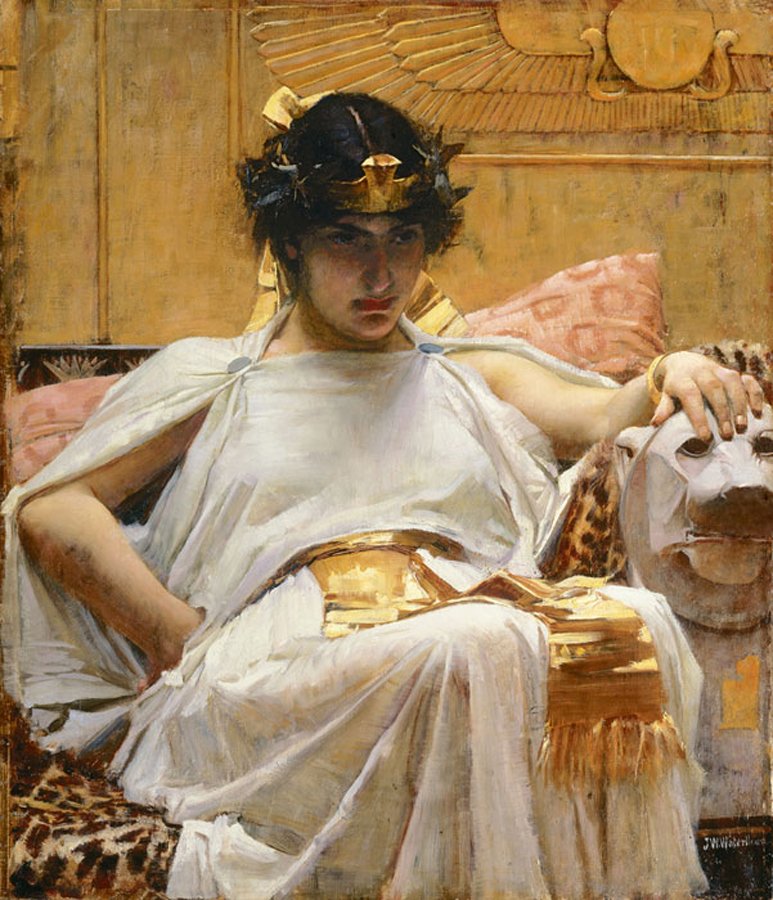
Cleopatra VII Philopator (born 69 BCE in Alexandria, Egypt—died August 30, 30 BCE, in Alexandria) was the last active ruler of the Ptolemaic Kingdom of Egypt. She became queen in 51 BCE and ruled during a period of growing Roman power and political conflict. Known for her political intelligence, diplomatic skills, and relationships with Julius Caesar and Mark Antony, Cleopatra worked to protect Egypt’s independence and strengthen her family’s position. Her death marked the end of the Ptolemaic dynasty and the beginning of Roman rule over Egypt.
Early Life and Family Background
Cleopatra was born in Alexandria, the capital of Ptolemaic Egypt. Her family, the Ptolemies, had ruled Egypt since the death of Alexander the Great in 323 BCE. The dynasty was founded by Ptolemy I Soter, one of Alexander’s generals, who took control of Egypt and established a Greek-speaking royal family.
Although the Ptolemies ruled Egypt, they were of Macedonian Greek origin. They adopted many Egyptian royal customs and presented themselves as traditional Egyptian pharaohs. Greek remained the main language of the royal court and government, while Egyptian culture and religion continued to shape daily life throughout the kingdom.
Cleopatra’s father was Ptolemy XII Auletes, who ruled Egypt during a time of financial problems and growing Roman influence. Her mother’s identity is uncertain, although some historians believe she may have been Cleopatra V Tryphaena, another member of the Ptolemaic family.
Cleopatra grew up in the royal court of Alexandria, a major center of trade, education, and culture in the ancient Mediterranean world. The city was home to the famous Library of Alexandria and attracted scholars, merchants, and visitors from different regions.
She received an education suited to a member of the ruling family. She likely studied Greek literature, philosophy, mathematics, politics, and public speaking. Ancient accounts also describe her as highly skilled in conversation and diplomacy.
Unlike many earlier Ptolemaic rulers, Cleopatra learned to speak Egyptian. Ancient sources also credit her with knowledge of several other languages, although the full extent of her language skills is difficult to establish. Her ability to communicate directly with different groups helped distinguish her from previous rulers of her family.
Becoming Queen of Egypt
Cleopatra’s father died in 51 BCE, leaving the throne to Cleopatra, then about 18 years old, and her younger brother Ptolemy XIII, who was approximately 10. According to the family’s established customs, the two siblings became joint rulers and were also married.
In practice, the arrangement created a struggle for control. Cleopatra initially held considerable authority, but powerful advisers around her younger brother sought to control the government and limit her influence.
Among these advisers were the royal officials Pothinus and Achillas. They played important roles in the political conflict that developed between Cleopatra and Ptolemy XIII.
By 48 BCE, Cleopatra had been pushed out of power and forced to leave Alexandria. She gathered supporters and prepared to challenge her brother’s government.
At the same time, Egypt faced increasing pressure from Rome. The Roman Republic was experiencing a civil war between Julius Caesar and Pompey the Great. Because Egypt was wealthy and strategically important, both Roman leaders had strong interests in its political affairs.
Meeting Julius Caesar
In 48 BCE, Pompey fled to Egypt after losing a major battle against Julius Caesar. He hoped to find protection from the Egyptian government, but Ptolemy XIII’s advisers arranged for him to be killed shortly after his arrival.
Caesar soon reached Alexandria while pursuing Pompey. He was displeased by the killing and became involved in the dispute over the Egyptian throne.
Cleopatra recognized an opportunity to regain her position. According to a famous ancient account, she arranged to be brought secretly into Caesar’s presence, reportedly wrapped in a carpet or bedding. Although details of the story may have been embellished over time, Cleopatra successfully secured a private meeting with the Roman leader.
She presented her claim to the throne, and Caesar became involved in supporting her position. Their relationship developed into both a political alliance and a personal romance.
Ptolemy XIII and his supporters resisted Caesar’s involvement. The disagreement soon turned into open fighting in Alexandria, known as the Alexandrian War.
During the conflict, Caesar’s forces faced serious difficulties. A fire in the harbor area damaged ships and spread to parts of the city. Later stories connected the fire to the destruction of the Library of Alexandria, but the extent of the damage to the library remains uncertain.
Roman reinforcements eventually arrived, allowing Caesar to defeat the forces supporting Ptolemy XIII. The young king died during the fighting, although the exact circumstances are unclear.
Caesar restored Cleopatra to the throne and appointed her younger brother Ptolemy XIV as her new co-ruler. Their relationship also resulted in the birth of a son, Ptolemy XV Caesar, commonly known as Caesarion, in 47 BCE.
Cleopatra’s Visit to Rome
In 46 BCE, Cleopatra traveled to Rome with Caesarion and stayed in the city as Caesar’s guest. Caesar had become Rome’s leading political figure after winning the civil war, and his support gave Cleopatra greater security on the Egyptian throne.
Her presence in Rome attracted attention. She lived in Caesar’s villa across the Tiber River and maintained a relationship with him while he continued his political activities.
Caesar also placed a golden statue of Cleopatra in the Temple of Venus Genetrix, a temple connected to his family. The gesture demonstrated the importance he attached to his relationship with the Egyptian queen.
However, Cleopatra’s position in Rome was complicated. Many Romans were suspicious of foreign monarchs and uncomfortable with Caesar’s growing personal power. His connection to Cleopatra added to concerns that he might seek to establish a monarchy.
On March 15, 44 BCE, Caesar was assassinated by a group of Roman senators who believed he had become too powerful. His death created another period of political instability.
Cleopatra was still in Rome when the assassination took place. She soon returned to Egypt, where she faced the challenge of protecting her son’s position and maintaining control of the kingdom.
Rule After Caesar’s Death
After returning to Egypt, Cleopatra continued ruling alongside Ptolemy XIV. However, her brother died in 44 BCE, and ancient accounts suggest that Cleopatra may have arranged his death to strengthen Caesarion’s position.
She then made Caesarion her co-ruler. This gave her son a formal place in the royal government and strengthened his claim as Caesar’s heir in Egypt.
The Roman world remained divided after Caesar’s assassination. Two major groups competed for control: the forces of Brutus and Cassius, who had participated in the assassination, and those of Mark Antony and Octavian, Caesar’s adopted heir.
Cleopatra faced difficult diplomatic choices. Egypt needed to maintain good relations with Rome because Roman military and political decisions could threaten its security.
In 42 BCE, Antony and Octavian defeated Brutus and Cassius at the Battle of Philippi. After the victory, Antony became responsible for managing Rome’s eastern territories and addressing political problems in the region.
This gave him considerable influence over Egypt and its neighboring kingdoms.
Relationship With Mark Antony
In 41 BCE, Mark Antony summoned Cleopatra to meet him at Tarsus in Cilicia, part of present-day Turkey. He wanted to question her about her actions during the Roman civil wars and her possible support for his enemies.
Cleopatra arrived with a carefully planned royal display. Ancient accounts describe her traveling in a richly decorated ship, presenting herself as the goddess Aphrodite. Her appearance and manner made a strong impression on Antony.
The two soon formed a personal and political partnership. Cleopatra provided financial and military support, while Antony offered protection and assistance in securing Egypt’s interests.
Their relationship developed into a lasting partnership, and they had three children together: twins Alexander Helios and Cleopatra Selene, born in 40 BCE, and a younger son, Ptolemy Philadelphus, born around 36 BCE.
Antony spent time in Alexandria with Cleopatra, where they enjoyed the royal court and its celebrations. Their relationship also became important to the political affairs of the eastern Mediterranean.
Cleopatra sought to strengthen Egypt by recovering territories that had once belonged to the Ptolemaic Kingdom. Antony helped her regain control of several areas, including parts of the eastern Mediterranean.
In 34 BCE, Antony held a public ceremony in Alexandria known as the Donations of Alexandria. During the event, he distributed titles and territories among Cleopatra and their children. Caesarion was presented as the son of Julius Caesar, while Antony’s children received royal titles and claims to different territories.
These actions strengthened Cleopatra’s family’s position but angered many Romans. Antony’s opponents argued that he was placing the interests of Cleopatra and her children above those of Rome.
Conflict With Octavian
By the early 30s BCE, Antony’s political relationship with Octavian had deteriorated. Although the two men had previously shared power, they increasingly competed for control of the Roman world.
Octavian used Antony’s relationship with Cleopatra to attack his reputation in Rome. He portrayed Antony as a Roman leader who had abandoned traditional Roman values and become controlled by a foreign queen.
This political campaign helped turn public opinion against Antony. Octavian also obtained Antony’s will, which reportedly included provisions concerning his burial in Egypt and the recognition of his children with Cleopatra.
In 32 BCE, the Roman Senate declared war on Cleopatra. Although Antony was the central military partner in the conflict, the declaration allowed Octavian to present the coming war as a struggle against Egypt rather than a Roman civil war.
Cleopatra and Antony prepared their forces for the confrontation. Their combined resources included ships, soldiers, and financial support from Egypt and other eastern territories.
However, their position became increasingly difficult as Octavian’s forces gained strength.
The Battle of Actium
The decisive confrontation took place on September 2, 31 BCE, near Actium on the western coast of Greece.
Antony and Cleopatra commanded a large naval force against Octavian’s fleet, led by his trusted commander Agrippa. The battle became one of the most important military events in the final years of the Roman Republic.
Octavian’s forces gradually gained the advantage. During the fighting, Cleopatra’s ships broke through the Roman lines and sailed away. Antony followed her with part of his fleet.
The reasons for their departure have been debated by historians. It may have been part of a planned escape strategy rather than a sudden abandonment of the battle. Nevertheless, their withdrawal contributed to the defeat of their remaining forces.
Antony and Cleopatra returned to Egypt, hoping to continue resisting Octavian. However, the defeat severely weakened their military and political position.
Octavian spent the following months preparing to invade Egypt. Antony attempted to rebuild his forces, but he struggled to regain the support and resources he had lost.
Final Days and Death
In 30 BCE, Octavian invaded Egypt and advanced toward Alexandria. Antony’s remaining forces were unable to stop the Roman army.
As Octavian approached the city, Antony received false information that Cleopatra had died. Believing that he had lost her, he attempted to take his own life by falling on his sword.
He did not die immediately and was taken to Cleopatra, who had withdrawn to a guarded building. Ancient accounts state that he was brought to her and died shortly afterward.
Cleopatra was now faced with the possibility of being taken to Rome as a prisoner. She reportedly tried to negotiate with Octavian to protect her children and preserve their positions, but she could not prevent Egypt from falling under Roman control.
On August 30, 30 BCE, Cleopatra died in Alexandria at the age of about 39. Ancient writers offered different explanations for her death. The most famous account says that she died from the bite of an Egyptian cobra, or asp, but this explanation cannot be confirmed. Poisoning, possibly by another method, is also considered possible.
Antony and Cleopatra were reportedly buried together, although the location of their tomb has never been conclusively identified.
Following Cleopatra’s death, Octavian took control of Egypt. Caesarion was captured and killed, while Cleopatra’s surviving children were taken into Roman custody. Their later lives unfolded under Roman authority.
Egypt became a Roman province, bringing the Ptolemaic dynasty to an end after nearly three centuries of rule. Cleopatra’s death also marked the final defeat of the political order that had governed the eastern Mediterranean during the Hellenistic period.