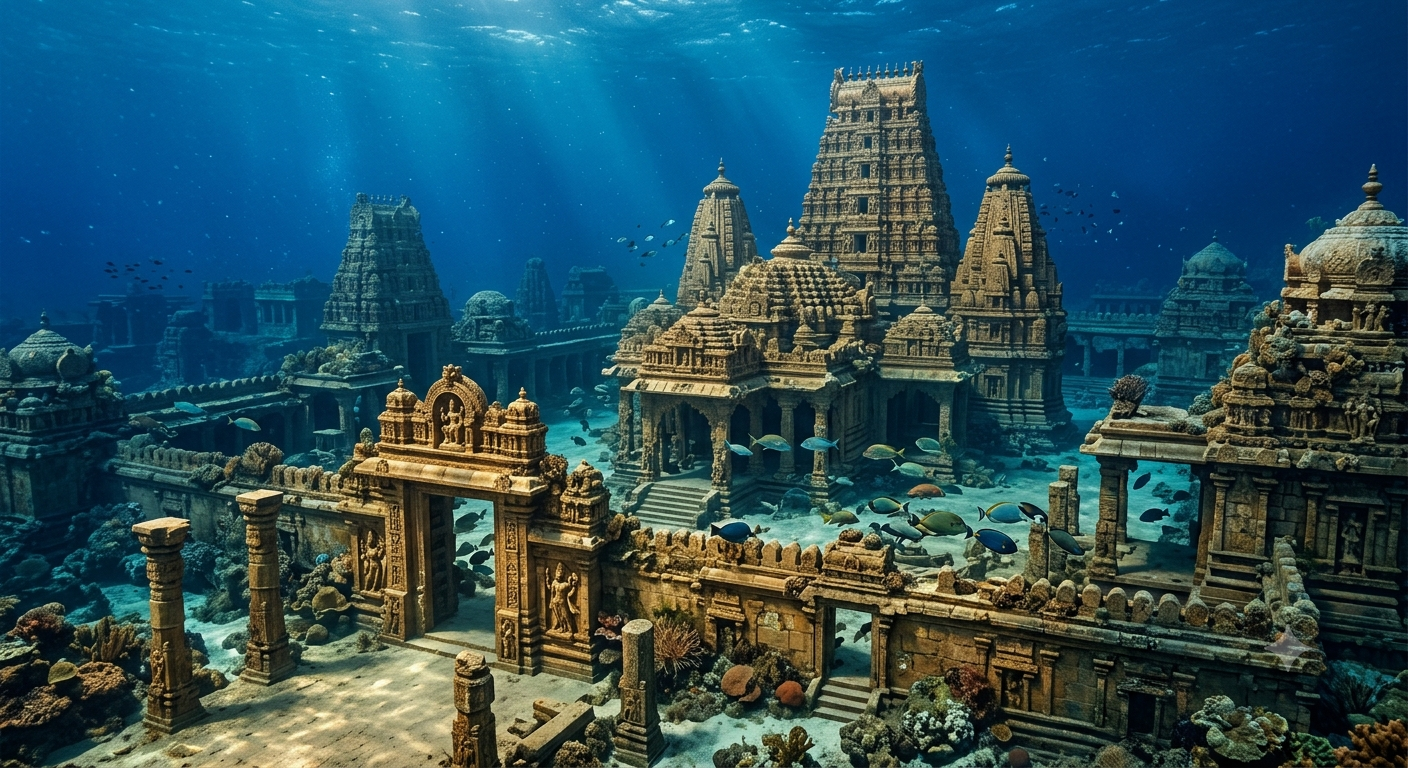
For thousands of years, stories of lost cities swallowed by the sea have fascinated humanity. Few such tales are as captivating as the story of Dwarka, the legendary kingdom associated with Lord Krishna. According to ancient Hindu texts, Dwarka was a magnificent city built on the western coast of India. It was a place of extraordinary beauty, immense wealth, and remarkable architecture. Yet after Krishna departed from the world, the city is said to have vanished beneath the waters of the Arabian Sea.
To many believers, Dwarka is not merely a legend. It is a sacred city whose story is deeply woven into the spiritual traditions of India. To historians and archaeologists, however, Dwarka presents a fascinating mystery. Could an ancient city really have disappeared beneath the sea? Are the underwater ruins discovered off India’s coast evidence of the legendary kingdom, or are they the remains of a different historical settlement?
The debate has continued for decades. Archaeological discoveries, ancient texts, geological studies, and underwater explorations have all contributed pieces to the puzzle. Yet no single discovery has completely solved the mystery.
The story of Dwarka lies at the crossroads of mythology, history, religion, archaeology, and marine science. It is a tale that invites us to explore not only the possibility of a lost city but also the complex relationship between ancient traditions and modern evidence.
The Legendary City of Krishna
The story of Dwarka begins in the sacred literature of Hinduism.
Ancient texts such as the Mahabharata, the Harivamsa, the Bhagavata Purana, and the Vishnu Purana describe Dwarka as the kingdom of Lord Krishna.
According to these traditions, Krishna initially lived in Mathura. However, repeated attacks by enemies threatened the safety of his people. To protect them, Krishna decided to establish a new capital far from danger.
The texts describe how a magnificent city was constructed on the western coast of India. Some accounts state that the divine architect Vishvakarma designed the city. The sea god granted land for its construction, and the result was a dazzling urban center unlike any other.
Dwarka was said to possess broad roads, grand palaces, beautiful gardens, defensive walls, and elaborate gateways. The city became the capital of Krishna’s kingdom and a center of prosperity.
For generations, it flourished.
Then came its dramatic end.
Ancient texts recount that after Krishna’s death, the sea gradually engulfed the city. Buildings disappeared beneath the waves, and Dwarka vanished from the surface of the earth.
The image is powerful: a glorious kingdom swallowed by the ocean, leaving only memories behind.
Dwarka in Ancient Literature
One reason the Dwarka mystery attracts so much attention is the detailed nature of its descriptions.
Unlike many mythical locations, Dwarka appears repeatedly in ancient literature. Different texts describe its geography, architecture, political importance, and eventual destruction.
The Mahabharata portrays Dwarka as a thriving coastal city connected to maritime trade and regional politics. It was not depicted as a vague or distant fantasy. Instead, it was presented as a real place inhabited by recognizable historical and legendary figures.
Several texts mention harbors, ships, and maritime activity. This detail has intrigued researchers because it suggests the possibility that the stories may preserve memories of actual coastal settlements.
Ancient literary traditions often combine historical events with religious symbolism. Determining where history ends and mythology begins is one of the greatest challenges in studying Dwarka.
Yet the consistency of references across multiple texts has encouraged scholars to investigate whether a historical foundation might underlie the legend.
The Modern City of Dwarka
Today, the city of Dwarka stands on the western coast of India in the state of Gujarat.
It is one of Hinduism’s most important pilgrimage destinations and is traditionally associated with Krishna’s kingdom.
Every year, thousands of devotees visit its temples, especially the famous Dwarkadhish Temple. For believers, the city represents a living connection to sacred history.
The modern city occupies a location that has been inhabited for centuries. Archaeological investigations have revealed evidence of multiple phases of settlement, indicating a long and complex history.
This continuity raises an intriguing possibility. Could the present city stand near the location of the legendary Dwarka described in ancient texts?
The question inspired one of the most ambitious underwater archaeological investigations ever conducted in India.
The Search Beneath the Sea
For centuries, the story of Dwarka remained largely within the realms of mythology and religious tradition.
Everything changed during the twentieth century.
Advances in marine archaeology made it possible to investigate submerged landscapes and ancient coastal settlements. Researchers began exploring the waters near modern Dwarka in search of evidence that might illuminate the city’s past.
The possibility was scientifically plausible.
Coastal cities around the world have been lost to erosion, earthquakes, tsunamis, rising sea levels, and changing shorelines. If ancient Dwarka existed near the coast, geological processes could potentially have submerged parts of it.
These considerations encouraged systematic exploration.
The search soon produced intriguing discoveries.
The Underwater Discoveries
Beginning in the late twentieth century, marine archaeologists conducted extensive surveys in waters near Dwarka and nearby locations.
Researchers identified various underwater features, including stone structures, blocks, anchors, and other objects that appeared to indicate human activity.
Some of these findings generated considerable excitement.
Divers reported discovering arrangements of stones that resembled walls, foundations, or other architectural remains. Ancient anchors suggested maritime activity in the region. Pottery fragments and artifacts hinted at long-standing human occupation.
To some observers, these discoveries seemed to confirm the ancient legends.
Newspapers and documentaries often described the findings as evidence of the lost city of Krishna.
The possibility captured public imagination.
For many people, it appeared that one of history’s greatest mysteries was finally being solved.
Yet archaeology is rarely that simple.
The Challenge of Interpretation
Finding objects underwater is only the beginning of archaeological investigation.
The greater challenge lies in determining what those objects actually represent.
Natural geological processes can sometimes create formations that resemble human-made structures. Rocks may appear arranged in patterns that seem artificial even when they are entirely natural.
Marine environments also complicate interpretation.
Currents, sediment movement, biological activity, and centuries of environmental change can alter underwater landscapes dramatically.
As a result, archaeologists must proceed carefully.
The underwater discoveries near Dwarka unquestionably demonstrate ancient human activity in the region. However, determining whether these remains belong specifically to the legendary city described in sacred texts is a much more difficult question.
The distinction is crucial.
Evidence of an ancient settlement does not automatically prove the existence of Krishna’s Dwarka exactly as portrayed in mythology.
Ancient Ports of Western India
The coast of Gujarat has a long and rich maritime history.
For thousands of years, communities along India’s western coastline participated in trade networks connecting South Asia with the Middle East, East Africa, and other regions.
Ancient ports flourished along this coast because of their strategic location.
Ships carried goods, ideas, technologies, and cultural influences across the Arabian Sea. Trade contributed to the growth of prosperous settlements and urban centers.
Archaeological evidence indicates that maritime activity in the region extends far into antiquity.
Consequently, the discovery of anchors, harbor structures, and other maritime artifacts near Dwarka is not entirely unexpected.
These findings confirm the historical importance of the coastline.
The challenge remains determining how these discoveries relate to the legendary narratives.
Marine Archaeology and New Possibilities
Marine archaeology has transformed our understanding of ancient civilizations.
For much of history, underwater sites were inaccessible. Valuable evidence remained hidden beneath oceans, lakes, and rivers.
Modern technology changed this situation dramatically.
Sonar mapping, underwater photography, remote sensing, diving equipment, and advanced dating techniques now allow researchers to investigate submerged landscapes in remarkable detail.
These tools have revealed ancient shipwrecks, drowned settlements, submerged harbors, and prehistoric coastlines around the world.
Dwarka became one of the most intriguing targets for such research.
Each new survey offered opportunities to uncover clues about the region’s past.
At the same time, the discoveries highlighted the importance of distinguishing between scientific evidence and popular interpretations.
Sea-Level Changes and Lost Coastlines
One of the most important scientific factors in the Dwarka mystery is sea-level change.
Earth’s coastlines are not fixed.
Over thousands of years, sea levels rise and fall in response to climatic and geological processes. Shorelines shift. Rivers change course. Coastal settlements may become submerged.
At the end of the last Ice Age, global sea levels rose significantly as massive ice sheets melted.
This process transformed coastlines worldwide.
Many ancient settlements that once stood near the sea now lie underwater.
Researchers studying Dwarka have considered whether similar processes may have affected the Gujarat coastline.
If ancient communities occupied coastal areas that later became submerged, traces of their settlements might survive beneath the sea.
This possibility provides a scientifically plausible explanation for underwater archaeological remains.
It does not require extraordinary assumptions. Similar examples exist in many parts of the world.
Geological Forces and Coastal Change
The western coast of India is shaped by dynamic geological processes.
Tectonic activity, coastal erosion, sediment deposition, storms, and sea-level fluctuations all influence the landscape.
Over long periods, these forces can dramatically alter shorelines.
Entire sections of coast may retreat or advance. Harbors can become silted up. Islands may emerge or disappear.
Such changes offer a potential explanation for why ancient settlements might become submerged or abandoned.
Geologists studying the region emphasize that natural environmental processes can account for significant coastal transformations over thousands of years.
The legendary submergence of Dwarka may therefore reflect real experiences of environmental change remembered and preserved in cultural traditions.
Could the Story Preserve Historical Memory?
Many scholars find this possibility particularly intriguing.
Human societies often preserve memories of significant events through stories, myths, and oral traditions.
A flood may become a tale of divine judgment.
An earthquake may evolve into a story about angry gods.
A submerged settlement may become a lost kingdom swallowed by the sea.
These transformations do not necessarily render the stories meaningless.
On the contrary, myths often contain valuable historical information encoded in symbolic form.
Some researchers suggest that the Dwarka legend may preserve memories of coastal flooding, shoreline changes, or the abandonment of ancient settlements.
Over generations, these memories could have become integrated with religious narratives surrounding Krishna.
The result would be a story that combines history, culture, faith, and mythology.
The Role of Krishna in the Mystery
Any discussion of Dwarka inevitably involves Krishna.
For millions of Hindus, Krishna is not merely a historical figure but a divine incarnation central to religious belief.
This spiritual significance influences how many people interpret archaeological discoveries.
For believers, evidence of ancient settlements near Dwarka may reinforce traditional narratives. The discoveries are viewed not simply as archaeological findings but as confirmations of sacred history.
Scientists approach the issue differently.
Archaeology can investigate material remains such as buildings, pottery, and artifacts. It cannot directly prove or disprove theological claims.
As a result, discussions about Dwarka often involve two distinct perspectives.
One focuses on faith and religious tradition.
The other focuses on historical and archaeological evidence.
These perspectives sometimes overlap, but they operate according to different principles.
Dating the Underwater Remains
One of the most important questions concerns the age of the underwater structures.
Researchers have used various methods to estimate the dates of artifacts recovered from the region.
Some findings indicate significant antiquity, suggesting occupation over long periods.
However, establishing precise dates for submerged sites can be difficult.
Artifacts may become displaced by currents or sediment movement. Objects from different periods can become mixed together.
Consequently, dating results must be interpreted carefully.
Most scholars agree that ancient settlements existed in the region for centuries or even millennia.
The greater challenge lies in determining whether any particular remains correspond to the era associated with the Krishna traditions.
This question remains the subject of ongoing debate.
Skeptical Perspectives
Not all researchers view the evidence as supporting the legendary Dwarka.
Skeptics argue that the underwater discoveries demonstrate only the presence of ancient coastal settlements, something already expected given the region’s history.
They note that no inscription has been found identifying the submerged structures as Krishna’s city.
No definitive archaeological evidence directly links the remains to specific events described in ancient texts.
Furthermore, many details found in religious narratives may reflect symbolic or literary elements rather than historical reporting.
From this perspective, the archaeological evidence is important but does not conclusively establish the existence of the legendary kingdom.
Skeptics emphasize the need for caution when connecting mythology with material remains.
Supportive Interpretations
Other researchers take a more optimistic view.
They argue that the combination of literary references, archaeological discoveries, and geological evidence deserves serious consideration.
The existence of ancient coastal settlements, evidence of maritime activity, and indications of shoreline change all align with aspects of the traditional narrative.
Supporters do not necessarily claim that every detail of the legend is historically accurate.
Instead, they suggest that the stories may preserve genuine memories of ancient urban centers affected by environmental changes.
According to this interpretation, mythology and archaeology complement one another.
The legends provide clues, while scientific investigation helps illuminate the historical realities behind them.
Dwarka and Other Lost Cities
The mystery of Dwarka belongs to a broader category of legendary lost cities.
Throughout history, stories have emerged about places that vanished through disaster, abandonment, or environmental change.
Some legendary locations eventually proved to have historical foundations.
Archaeological discoveries revealed that certain myths were inspired by real cities and civilizations.
This history encourages researchers to keep open minds.
Legends should not be accepted uncritically.
Neither should they be dismissed automatically.
Instead, they can serve as starting points for investigation.
Dwarka illustrates this approach beautifully.
The legend inspired exploration. Exploration produced evidence. Evidence generated new questions.
The process continues today.
The Cultural Significance of Dwarka
Whether or not the underwater remains correspond exactly to Krishna’s city, Dwarka occupies an extraordinary place in Indian culture.
Its significance extends far beyond archaeology.
For countless people, Dwarka represents devotion, faith, heritage, and spiritual identity.
Pilgrims travel great distances to visit the city. Stories of Krishna shape religious practices, festivals, literature, music, and art.
The legend has endured for thousands of years because it speaks to values and beliefs that remain meaningful across generations.
Archaeological discoveries add another dimension to this cultural importance.
They connect ancient traditions with tangible traces of the past.
What Science Can and Cannot Tell Us
Science is a powerful tool, but it has limits.
Archaeology can reveal settlements, artifacts, buildings, and environmental changes.
Geology can reconstruct ancient coastlines and natural disasters.
Marine surveys can map submerged landscapes.
These methods help us understand what happened in the physical world.
However, science cannot fully address questions of religious meaning or spiritual significance.
The legend of Dwarka exists partly within history and partly within sacred tradition.
As a result, some aspects of its importance lie beyond the reach of archaeological investigation.
Recognizing this distinction allows for a more balanced understanding of the mystery.
The Future of the Dwarka Investigation
Research continues.
New technologies promise increasingly detailed exploration of underwater sites.
High-resolution sonar systems, advanced imaging techniques, and improved dating methods may reveal information previously inaccessible.
Future discoveries could clarify the nature of the submerged structures and their relationship to ancient settlements on land.
Additional archaeological work may uncover inscriptions, artifacts, or architectural evidence that sheds new light on the region’s history.
Each new investigation has the potential to deepen our understanding of one of South Asia’s most intriguing mysteries.
Whether it ultimately confirms, modifies, or challenges traditional interpretations, the search itself remains valuable.
Mythical City or Underwater Reality?
The answer may not be as simple as choosing one possibility over the other.
Dwarka appears to occupy a fascinating middle ground between myth and reality.
The legendary city described in ancient texts undoubtedly contains religious symbolism, literary embellishment, and theological themes.
At the same time, archaeological and geological evidence demonstrates that ancient coastal settlements existed in the region and that environmental changes affected the shoreline over time.
Rather than viewing myth and reality as opposites, it may be more accurate to see them as interconnected.
Historical events can inspire myths.
Myths can preserve memories of real places.
Stories can carry fragments of truth across centuries.
Dwarka may represent precisely such a fusion.
Conclusion
The mystery of the Sunken Kingdom of Dwarka remains one of the most fascinating intersections of mythology, archaeology, and history. Ancient texts describe a magnificent city built by Krishna, a thriving coastal kingdom that eventually disappeared beneath the sea. For centuries, this story existed primarily within the realm of sacred tradition.
Modern underwater exploration changed the conversation. Archaeologists discovered submerged structures, ancient anchors, artifacts, and evidence of long-standing human activity near the coast of Gujarat. These findings demonstrated that the region possesses a rich and complex maritime history.
Yet the discoveries have not provided a definitive answer. While the evidence supports the existence of ancient coastal settlements and shoreline changes, it does not conclusively prove that the underwater remains are the exact city described in religious texts.
Perhaps the greatest lesson of Dwarka is that myths and history are not always completely separate. Ancient stories may preserve memories of real events, transformed through generations of storytelling and cultural meaning. The legend of a city swallowed by the sea may contain echoes of genuine environmental changes experienced by people long ago.
Whether viewed as a sacred kingdom, a historical mystery, or a combination of both, Dwarka continues to inspire wonder. Beneath the waters of the Arabian Sea lies a story that connects faith, science, memory, and imagination. It reminds us that the past is often more complex than it first appears and that some of history’s most intriguing mysteries may never be fully solved.
The waves that wash against the coast of Dwarka today conceal many secrets. Among them may lie fragments of an ancient city, memories of forgotten generations, and clues to a story that has captivated human curiosity for thousands of years.