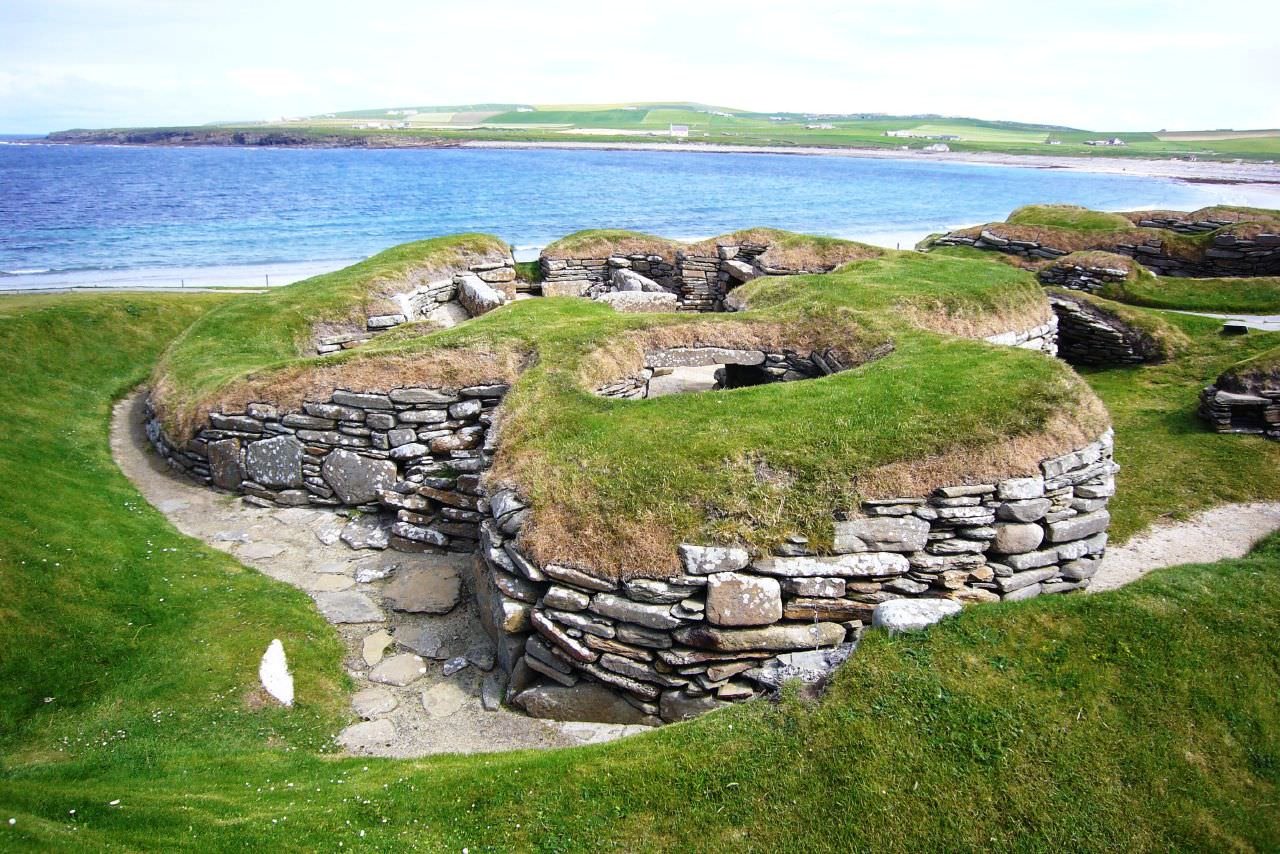
On the windswept western coast of the Orkney Islands in northern Scotland lies one of the most extraordinary archaeological sites ever discovered. At first glance, it does not seem particularly dramatic. There are no towering pyramids, no massive temples, and no colossal statues rising toward the sky. Instead, Skara Brae consists of a small cluster of stone houses partially sunk into the earth.
Yet this humble village has transformed our understanding of prehistoric life.
More than 5,000 years ago, long before the construction of the Egyptian pyramids and centuries before the famous stones of Stonehenge were erected, people lived, worked, slept, cooked, and raised families in Skara Brae. The village offers an astonishingly intimate glimpse into everyday life during the Neolithic period, an era when agriculture was spreading across Europe and human societies were undergoing profound changes.
What makes Skara Brae especially fascinating is not merely its age but its remarkable state of preservation. Archaeologists have uncovered stone furniture, household tools, workshops, and evidence of daily activities that seem almost frozen in time. Walking through the site today creates the uncanny sensation of entering a village whose residents departed only yesterday.
For generations, one mystery has captured the imagination of visitors and researchers alike. Why was Skara Brae abandoned? Did its inhabitants leave gradually as conditions changed, or were they forced to depart suddenly by a powerful storm or environmental disaster?
The idea that the village was abandoned in a hurry has become one of the most intriguing aspects of its story. Although modern archaeology has challenged some of the earlier dramatic interpretations, the mystery remains a compelling part of Skara Brae’s enduring appeal.
The story of Skara Brae is not simply the story of an ancient settlement. It is the story of ordinary people whose lives, preserved beneath layers of sand for millennia, continue to speak to us across the vast gulf of time.
Discovery After a Violent Storm
For thousands of years, Skara Brae remained hidden beneath a large mound of sand known locally as a “skerrabra.”
The Atlantic Ocean constantly battered the coastline, while winds piled layer upon layer of sand over the ancient settlement. Gradually, the village disappeared from view and from memory.
Everything changed during the winter of 1850.
A powerful storm struck Orkney with exceptional force. Fierce winds and crashing waves tore away part of the grassy mound that concealed the ancient remains. When the storm subsided, local landowner William Watt noticed strange stone structures emerging from the exposed earth.
What he had discovered would eventually become one of Europe’s most important prehistoric sites.
Initial excavations revealed several interconnected stone houses. However, archaeology was still a developing discipline during the nineteenth century, and early investigations lacked the scientific methods used today.
Despite these limitations, researchers quickly realized they had uncovered something extraordinary.
The structures appeared remarkably intact. Stone walls still stood. Internal furnishings remained in place. Passages connected buildings together in a carefully planned layout.
The village seemed astonishingly complete.
Yet no one initially understood just how old it was.
Dating a Forgotten Community
When Skara Brae was first excavated, scholars believed it belonged to the Iron Age.
This assumption seemed reasonable because few people imagined that such sophisticated stone houses could be thousands of years older.
The true age of the village remained unknown until advances in scientific dating techniques transformed archaeology during the twentieth century.
Radiocarbon dating eventually revealed a startling truth.
The settlement had been occupied roughly between 3200 BCE and 2500 BCE.
This meant Skara Brae was older than Stonehenge in its iconic form and older than the Great Pyramid of Giza.
The discovery dramatically altered perceptions of Neolithic Britain.
Rather than primitive communities struggling for survival, archaeologists now saw evidence of organized societies capable of constructing substantial settlements and managing complex social networks.
Skara Brae became a powerful reminder that ancient people were often far more sophisticated than earlier generations had assumed.
Life in Neolithic Orkney
To understand Skara Brae, it is necessary to imagine the world in which its inhabitants lived.
The Orkney Islands were already occupied by farming communities. Agriculture had transformed human life. Instead of constantly moving in search of food, people increasingly settled in permanent communities.
Fields were cultivated. Livestock were raised. Food surpluses became possible.
These developments allowed larger and more stable populations to emerge.
The climate during much of Skara Brae’s occupation appears to have been relatively favorable. Farming and animal husbandry supported village life, while nearby coastal waters provided abundant marine resources.
The people of Skara Brae lived in a world without metal tools, written language, or wheeled vehicles.
Yet they possessed considerable knowledge of construction, craftsmanship, and environmental management.
Their village reflects careful planning and impressive engineering skills.
The Remarkable Design of the Village
One of the most striking features of Skara Brae is its sophisticated layout.
The houses were built using locally available stone. Because trees were scarce in Orkney, timber was not a major building material. Instead, stone became the foundation of nearly every aspect of construction.
The homes were partially dug into large heaps of domestic waste known as middens. These accumulations of discarded shells, bones, ash, and organic material provided insulation against the harsh northern climate.
The result was surprisingly effective.
The thick walls and earth-covered structures helped maintain relatively stable indoor temperatures despite strong winds and cold weather.
Covered passageways connected the houses, allowing residents to move between buildings while remaining sheltered from the elements.
Far from being random structures scattered across the landscape, the buildings formed a carefully organized community.
The village demonstrates an impressive understanding of architecture and environmental adaptation.
Homes That Feel Surprisingly Modern
Perhaps the most astonishing aspect of Skara Brae is how familiar its houses appear.
Upon entering one of the homes, visitors immediately notice a large stone dresser positioned directly opposite the doorway.
This feature seems to have held special significance. It was likely the first thing seen by anyone entering the house.
Stone beds occupied the sides of the room.
A central hearth provided heat and light.
Storage compartments and shelves offered places for household belongings.
In many ways, the interior resembles a simplified version of a modern home.
There was a designated sleeping area.
There was a place for cooking.
There was furniture.
There was storage.
The arrangement reflects a clear concern for organization, comfort, and daily practicality.
These people were not merely surviving. They were creating homes.
The Mystery of the Stone Furniture
Because wood was scarce, the inhabitants crafted furniture from stone.
Beds, dressers, shelves, cupboards, and storage boxes were all constructed using carefully shaped slabs.
The survival of this furniture contributes enormously to Skara Brae’s importance.
Wooden furnishings would have decayed long ago, leaving little evidence behind.
Stone endured.
As a result, archaeologists can reconstruct domestic interiors with remarkable detail.
The stone dresser found in each house remains one of the site’s most iconic features.
Its exact purpose remains uncertain.
Perhaps it displayed valuable possessions.
Perhaps it served ceremonial functions.
Perhaps it simply stored everyday objects.
Whatever its role, its consistent placement suggests cultural significance beyond mere practicality.
Daily Life in the Village
The inhabitants of Skara Brae likely spent much of their time engaged in activities familiar to farming communities throughout history.
Fields required cultivation.
Animals required care.
Food required preparation.
Tools required maintenance.
Excavations have uncovered evidence of grain processing, animal husbandry, fishing, and craft production.
People made tools from stone, bone, and antler.
They produced pottery for cooking and storage.
They created jewelry and decorative items.
The archaeological evidence reveals a society that was productive, skilled, and highly organized.
Life was undoubtedly challenging.
Weather conditions could be severe.
Crop failures posed risks.
Resources required careful management.
Yet the village appears to have supported its residents successfully for centuries.
Art, Craftsmanship, and Creativity
Skara Brae reveals more than practical survival.
It also demonstrates creativity.
Archaeologists have discovered carved stone objects featuring geometric designs and decorative patterns.
These artifacts suggest that artistic expression played an important role in community life.
The craftsmanship displayed in tools and ornaments indicates considerable skill.
Certain objects appear to have possessed symbolic or ceremonial significance.
Although the meanings of these artifacts remain uncertain, they remind us that Neolithic people were not solely concerned with food and shelter.
They also engaged with beauty, symbolism, and cultural identity.
Like people today, they sought meaning beyond basic survival.
Connections Across Orkney
Skara Brae was not an isolated settlement.
It formed part of a broader Neolithic landscape that included monuments, ceremonial sites, and other communities.
Nearby archaeological treasures demonstrate that Orkney was an important cultural center during the Neolithic period.
Massive stone circles, chambered tombs, and ceremonial complexes indicate sophisticated social organization.
The inhabitants of Skara Brae likely participated in regional networks involving trade, rituals, and shared cultural traditions.
Their village was one piece of a much larger social world.
Understanding this context helps explain the community’s apparent prosperity and stability.
Skara Brae was not a lonely outpost at the edge of civilization.
It was part of a vibrant and interconnected society.
The Famous “Abandoned in a Hurry” Theory
One of the most enduring stories associated with Skara Brae emerged during the early twentieth century.
Some archaeologists noticed objects apparently left behind inside the houses.
Tools remained in place.
Furniture remained intact.
Household items appeared undisturbed.
These observations inspired a dramatic interpretation.
Perhaps a catastrophic event had forced residents to flee suddenly.
According to this theory, a violent storm may have struck the settlement, threatening lives and making continued occupation impossible.
The villagers might have abandoned their homes quickly, leaving possessions behind.
This image captured public imagination.
The idea of an ancient community suddenly driven from its homes by nature’s fury felt both tragic and compelling.
For decades, the story became closely associated with Skara Brae.
Reexamining the Evidence
Modern archaeology has taken a more cautious approach.
While some evidence initially appeared to support sudden abandonment, closer examination suggests a more complex picture.
Many of the supposedly abandoned possessions were not especially valuable.
Some objects once thought to have been left behind in haste may actually represent ordinary archaeological deposits accumulated over time.
Researchers now believe the village’s decline may have been gradual rather than instantaneous.
Environmental changes, shifting coastlines, economic pressures, or social transformations could have contributed to abandonment.
The dramatic “one-night disaster” scenario remains possible but lacks definitive proof.
Instead, the evidence suggests a slower process of change.
Yet even if abandonment occurred gradually, the mystery remains deeply fascinating.
The Growing Threat of Sand
One factor that may have contributed to Skara Brae’s abandonment was increasing sand encroachment.
Coastal environments are dynamic.
Wind continually moves sand across landscapes.
Over time, drifting dunes can overwhelm fields, alter coastlines, and disrupt human activities.
Some researchers suggest that changing environmental conditions gradually made life more difficult.
Farmland may have become less productive.
Buildings may have required constant maintenance.
Access to resources may have changed.
Eventually, residents may have decided that remaining in the village was no longer practical.
If this interpretation is correct, Skara Brae’s end reflects a familiar human experience: adapting to environmental change.
Climate and Environmental Challenges
Climate fluctuations have shaped human history repeatedly.
Even relatively modest environmental changes can have significant consequences for agricultural societies.
Researchers studying Skara Brae continue investigating how climate may have influenced village life.
Shifts in temperature, rainfall, storm frequency, or coastal conditions could have altered local ecosystems.
Such changes rarely produce immediate collapse.
Instead, they gradually increase pressures on communities.
People adapt where possible.
Sometimes they relocate.
Sometimes settlements are abandoned.
The story of Skara Brae may reflect this long-term process of environmental adaptation.
The Final Days of Occupation
The precise circumstances surrounding Skara Brae’s abandonment remain uncertain.
What seems clear is that occupation eventually ceased around 2500 BCE.
After generations of continuous habitation, the houses fell silent.
Fires no longer burned in the hearths.
Beds remained empty.
Passageways stood unused.
Gradually, windblown sand began covering the settlement.
The same natural forces that may have contributed to abandonment helped preserve the village.
Layers of sand protected structures from weathering and human disturbance.
Century after century passed.
Empires rose and fell.
Civilizations appeared and disappeared.
Meanwhile, Skara Brae slept beneath the dunes.
Preservation Through Burial
Ironically, the village owes its survival to the very forces that concealed it.
Burial beneath sand created an environment that shielded the settlement from destruction.
Stone walls remained standing.
Furniture stayed in place.
Artifacts remained protected.
Many archaeological sites suffer extensive damage from later human activity.
Skara Brae largely escaped this fate because it vanished from memory.
Its isolation preserved an extraordinary snapshot of Neolithic life.
Few sites anywhere in Europe offer such detailed evidence of everyday domestic existence.
The village provides a rare opportunity to study ordinary people rather than kings, warriors, or elites.
What Archaeologists Have Learned
Excavations at Skara Brae have transformed understanding of prehistoric Britain.
The site demonstrates that Neolithic communities could build durable, comfortable, and carefully planned settlements.
It reveals sophisticated approaches to architecture and environmental adaptation.
It provides evidence for social organization, craft production, and regional interaction.
Most importantly, it humanizes the distant past.
Archaeological discoveries often focus on monumental structures or elite burials.
Skara Brae focuses attention on ordinary households.
Its residents cooked meals, cared for children, repaired tools, and gathered around hearth fires.
Their lives were separated from ours by five thousand years, yet many aspects feel surprisingly familiar.
The Wider Neolithic World
Skara Brae existed during a transformative period in human history.
Across Europe, farming communities were expanding.
Monuments were being constructed.
Trade networks were growing.
New technologies and social structures were emerging.
The Neolithic era marked a turning point in humanity’s relationship with the environment.
People increasingly shaped landscapes rather than simply adapting to them.
Permanent settlements became more common.
Population densities increased.
Cultural traditions spread across vast regions.
Skara Brae represents one chapter in this broader story of human development.
A UNESCO World Heritage Treasure
Today, Skara Brae forms part of the UNESCO World Heritage Site known as the Heart of Neolithic Orkney.
This designation recognizes the extraordinary importance of the region’s prehistoric monuments.
Visitors from around the world travel to Orkney to experience the site firsthand.
Standing among the ancient houses creates a powerful emotional connection to the past.
Unlike many archaeological sites consisting only of foundations or scattered ruins, Skara Brae feels remarkably complete.
The village invites people to imagine real lives unfolding within its stone walls.
New Technologies and Ongoing Research
Research at Skara Brae continues today.
Modern archaeological methods allow scientists to investigate questions unimaginable to earlier generations.
Microscopic analyses reveal dietary information.
Environmental studies reconstruct ancient landscapes.
Advanced dating techniques refine chronologies.
Digital technologies create detailed models of structures and artifacts.
Each new discovery adds another piece to the puzzle.
Although many mysteries remain unresolved, our understanding of Skara Brae grows steadily more sophisticated.
The site continues to teach lessons about prehistoric life, environmental change, and human resilience.
Why Skara Brae Still Captivates Us
Part of Skara Brae’s appeal lies in its extraordinary preservation.
Another part lies in the mystery surrounding its abandonment.
But perhaps its greatest strength is its humanity.
The village does not tell the story of rulers or conquerors.
It tells the story of ordinary people.
The stone beds, hearths, and dressers create an immediate sense of familiarity.
Visitors can easily imagine families gathering around fires on cold evenings.
They can picture children playing within the houses.
They can envision daily routines repeated across generations.
The site reminds us that despite differences in technology and culture, the fundamental human experience remains remarkably consistent.
People have always sought shelter, security, companionship, and meaning.
Conclusion
Skara Brae stands among the most remarkable archaeological discoveries ever made. Hidden beneath sand for thousands of years, the village preserves an unparalleled glimpse into Neolithic life. Its stone houses, furniture, tools, and carefully planned layout reveal a sophisticated community thriving long before many of the ancient world’s most famous monuments were built.
The mystery of its abandonment continues to inspire curiosity. Earlier generations imagined a dramatic evacuation triggered by catastrophe, while modern researchers favor more gradual explanations involving environmental change and shifting conditions. Yet regardless of how the village was ultimately abandoned, its story remains compelling.
Skara Brae offers something rare in archaeology: an intimate connection to ordinary people from the distant past. It allows us to step inside homes occupied five millennia ago and glimpse the rhythms of daily life preserved with astonishing clarity.
The winds that once buried the village beneath layers of sand inadvertently protected it for future generations. Today, those ancient stone rooms continue to tell their story. They remind us that history is not only about great empires and famous leaders. It is also about families, communities, and the countless ordinary lives that shaped the human journey.
In the quiet stone houses of Skara Brae, the voices of a vanished world still echo across five thousand years, inviting us to listen, wonder, and remember.