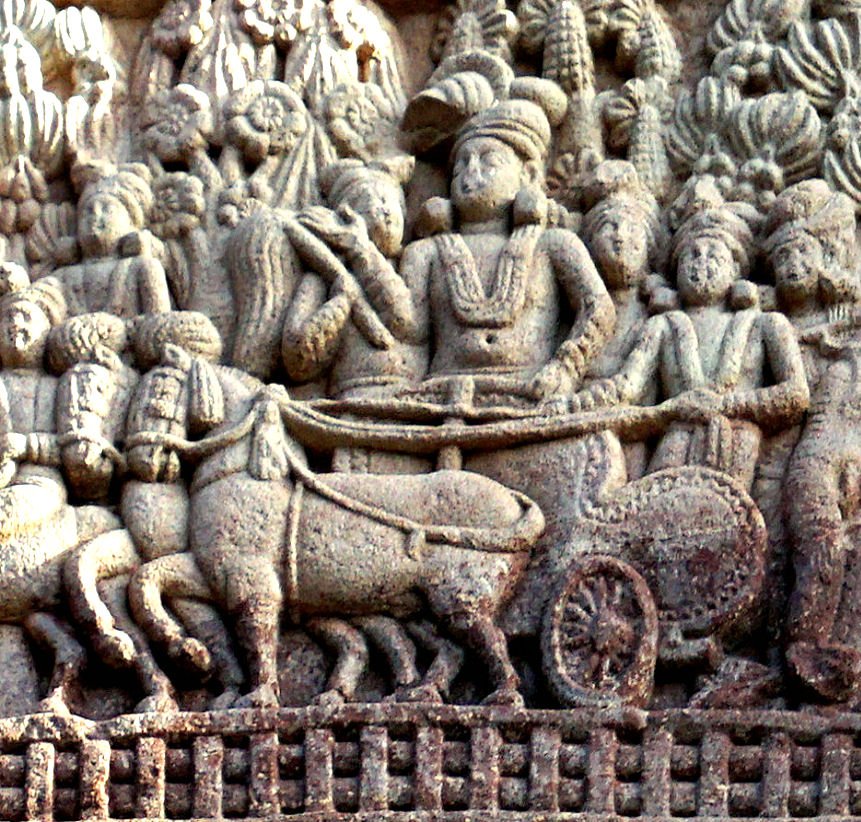
Ashoka the Great (born approximately 304 BCE—died approximately 232 BCE) was an Indian emperor of the Maurya dynasty who ruled much of the Indian subcontinent from about 268 to 232 BCE. Born into the royal family of the Mauryan Empire, he expanded his kingdom through military campaigns before turning toward Buddhism and adopting a policy of peace, compassion, and religious tolerance. He is best known for his transformation following the bloody conquest of Kalinga, his efforts to promote moral conduct and public welfare, and his support for the spread of Buddhism beyond India.
Early Life and Family Background
Ashoka was born around 304 BCE during the reign of his grandfather, Chandragupta Maurya, who founded the Maurya Empire. His father was Bindusara, the second Mauryan emperor, who continued expanding the kingdom established by Chandragupta. His mother is traditionally identified as Subhadrangi, although accounts of Ashoka’s family background differ among historical and religious sources.
Ashoka grew up in the royal household during a period when the Mauryan Empire was one of the most powerful states in the ancient world. Its territories covered large areas of the Indian subcontinent, supported by a strong administration and a substantial military.
As a prince, Ashoka was expected to learn the responsibilities of government, military leadership, and royal administration. Ancient Buddhist accounts describe him as an ambitious and capable young man who demonstrated considerable strength as a military commander. However, many details of his childhood and education remain uncertain because reliable contemporary records about his early years are limited.
Ashoka reportedly served as a provincial governor before becoming emperor. Traditional accounts associate him with important administrative centers such as Ujjain and Taxila. These responsibilities likely gave him experience managing distant territories and dealing with political unrest.
Rise to Power and Becoming Emperor
After Bindusara’s death, around 273 BCE, Ashoka became involved in a struggle over succession. Ancient Buddhist traditions describe a conflict among the royal princes, with Ashoka eventually defeating his rivals and securing the throne.
Some accounts suggest that his rise involved considerable violence, but the precise details are uncertain. Stories about the number of brothers he killed or the cruelty he supposedly displayed should be treated cautiously because they come from later religious traditions rather than reliable contemporary records.
Ashoka is generally believed to have begun his reign around 268 BCE, several years after his father’s death. His coronation marked the beginning of a new period in Mauryan history.
As emperor, he inherited an extensive kingdom with an established system of government. Its capital was Pataliputra, located near present-day Patna in the Indian state of Bihar. From there, the imperial administration managed provinces, collected taxes, maintained roads, and supervised officials responsible for governing different regions.
Ashoka initially continued the expansionist policies of his predecessors. Like other rulers of his time, he relied on military strength to maintain control and increase his territory.
Expansion of the Mauryan Empire
During the early part of his reign, Ashoka strengthened Mauryan authority over the territories inherited from Bindusara. His empire already included much of northern and central India, but some neighboring regions remained outside direct Mauryan control.
One of his most important military campaigns was the conquest of Kalinga, a powerful kingdom along the eastern coast of India, mainly in the region of present-day Odisha.
Kalinga was strategically important because of its coastal location, trade connections, and independent political position. Its conquest would extend Mauryan influence over an important part of the eastern coastline.
Ashoka launched the campaign approximately eight years after his coronation, around 261 BCE. The Mauryan army defeated Kalinga after a major and destructive war.
Although the conquest expanded the empire, it came at an enormous human cost. Ashoka later described the suffering caused by the campaign in one of his rock inscriptions. He referred to approximately 100,000 deaths, many more deaths from related causes, and the deportation of 150,000 people.
These figures are presented in Ashoka’s own inscription and reflect the scale of suffering he wished to acknowledge. They should not automatically be treated as independently verified modern casualty estimates.
The destruction caused by the war became a turning point in Ashoka’s life.
The Kalinga War and His Change of Heart
The conquest of Kalinga deeply affected Ashoka. In his Major Rock Edict XIII, he expressed regret over the suffering caused by the war, particularly the deaths, deportations, and separation of families.
He also acknowledged the pain experienced by people who had not directly participated in the fighting, including religious teachers, ordinary families, and others affected by the invasion.
Ashoka described his remorse in unusually personal terms for an ancient ruler. Rather than celebrating the military victory, he emphasized the human consequences of conquest.
The experience changed the direction of his rule. He increasingly rejected military expansion as a desirable way to increase imperial power and began promoting what he called conquest through dhamma, a term referring to moral conduct and righteous living.
This did not mean that Ashoka immediately abandoned his responsibilities as a ruler or eliminated the military. His government continued to maintain authority and enforce laws. However, his public policies placed greater emphasis on restraint, compassion, and the welfare of his subjects.
The transformation following Kalinga became one of the defining events of his reign.
Conversion to Buddhism
Following the Kalinga War, Ashoka became increasingly interested in Buddhism. Traditional Buddhist accounts describe his conversion as a major personal transformation, although the exact timing and circumstances are not entirely clear.
Buddhism had developed in northern India several centuries earlier through the teachings of Siddhartha Gautama, known as the Buddha. Its teachings emphasized the causes of human suffering, the importance of ethical behavior, self-discipline, compassion, and the path toward spiritual liberation.
Ashoka became a supporter of the Buddhist community, known as the Sangha. His inscriptions indicate that he developed a close relationship with Buddhist teachings and encouraged people to practice kindness, moderation, and respect for living beings.
However, Ashoka’s understanding of dhamma was broader than the formal teachings of Buddhism. His public messages were intended for people with different religious and philosophical beliefs. They focused on shared moral principles rather than requiring everyone in his empire to become Buddhist.
He encouraged respect for parents and elders, kindness toward servants, generosity toward religious communities, honesty, and restraint in personal behavior.
Ashoka’s support for Buddhism also included material assistance to Buddhist institutions and the promotion of pilgrimage sites associated with the Buddha’s life.
His Policy of Dhamma
After the Kalinga War, Ashoka made dhamma a central part of his approach to government. He used this term to describe a practical system of moral behavior that could help people live peacefully and responsibly.
His understanding of dhamma included several important principles.
He encouraged nonviolence and compassion toward humans and animals. He asked people to avoid unnecessary killing and cruelty, practice generosity, speak respectfully, and treat others fairly.
He also emphasized family responsibilities. Respect for parents, kindness toward children, and proper treatment of teachers and elders appeared repeatedly in his inscriptions.
Religious tolerance was another important part of his policy. Ashoka advised people not to insult other religious groups or praise their own beliefs by unfairly criticizing others. He believed that respectful discussion could strengthen understanding between different communities.
His policy did not establish Buddhism as a compulsory state religion. Instead, it encouraged ethical conduct across religious boundaries.
Ashoka used official inscriptions to communicate these principles throughout his empire. These messages were placed on rocks, pillars, and other public locations where people could encounter them.
Rather than relying only on traditional royal announcements, he presented his moral instructions as an important responsibility of government.
Administration and Public Welfare
Ashoka continued the administrative system developed by earlier Mauryan rulers while introducing policies that placed greater attention on public welfare.
The Mauryan Empire was too large for the emperor to govern every region directly. It depended on provincial officials, local administrators, tax collectors, and other government representatives.
Ashoka appointed officials known as dhamma-mahamatras, or officers responsible for promoting dhamma. Their duties included encouraging moral conduct, addressing public concerns, and supporting the welfare of different communities.
He also directed government officials to pay attention to the treatment of ordinary people. His inscriptions suggest that he wanted public servants to perform their duties fairly and respond to the needs of the population.
Public health and infrastructure received attention during his reign. Ashoka’s inscriptions describe arrangements for medical treatment for both humans and animals. They also mention the planting of medicinal plants and the development of useful public facilities.
He supported the planting of trees along roads, the digging of wells, and the construction of rest facilities for travelers. These projects helped make travel more convenient and provided practical benefits to people moving through the empire.
His concern for animal welfare was also reflected in restrictions on certain forms of animal killing and the promotion of more compassionate treatment.
Ashoka did not eliminate all punishment or violence from the legal system. His inscriptions indicate that he continued to exercise judicial authority but encouraged greater restraint. In particular, he introduced measures intended to give some condemned prisoners time to appeal or prepare for death.
These policies show how he attempted to combine the practical responsibilities of imperial government with his growing commitment to moral principles.
Spread of Buddhism Beyond India
Ashoka played an important role in helping Buddhism spread beyond its original centers in northern India.
He supported Buddhist religious communities and encouraged the teaching of Buddhist principles in different parts of his empire. Buddhist traditions also credit him with supporting missionary activities in neighboring regions.
One of the most important examples involves Sri Lanka. According to the traditional account preserved in Sri Lankan Buddhist chronicles, Ashoka sent his son Mahinda to the island to introduce Buddhist teachings to King Devanampiya Tissa and his court.
The mission helped establish Buddhism in Sri Lanka, where it became an important part of religious and cultural life. Buddhist traditions also associate Ashoka’s daughter Sanghamitta with bringing a branch of the sacred Bodhi tree to the island and helping establish an order of Buddhist nuns.
These accounts are important to the traditional history of Buddhism, although some details cannot be independently confirmed.
Ashoka’s inscriptions also refer to diplomatic and religious contacts with rulers in regions west of his empire, including Hellenistic kingdoms that emerged after the conquests of Alexander the Great.
The inscriptions mention rulers such as Antiochus, Ptolemy, Antigonus, Magas, and Alexander. They suggest that Ashoka sought to communicate his moral ideas beyond his immediate territories.
His efforts helped give Buddhism a wider geographical presence and contributed to its later development as a major religious tradition in Asia.
The Edicts of Ashoka
One of the most important sources of information about Ashoka’s reign is a collection of inscriptions known as the Edicts of Ashoka.
These inscriptions were carved into rocks, large stone pillars, and other durable surfaces across different parts of the Mauryan Empire. They contain messages about morality, government, religious tolerance, public welfare, and the emperor’s understanding of his responsibilities.
The edicts are particularly valuable because many were issued during Ashoka’s lifetime. Unlike later historical stories, they provide direct evidence of how the emperor presented his policies and ideas.
Most of the inscriptions were written in Prakrit, a group of languages used in ancient India. Many were recorded using the Brahmi script, while inscriptions in the northwestern regions also used Kharosthi. Some versions appeared in Greek and Aramaic in areas with different linguistic communities.
The inscriptions reveal that Ashoka wanted his messages to reach people across a large and culturally diverse empire.
They also show his personal concern with the consequences of the Kalinga War. In several edicts, he discusses the importance of moral conduct, the treatment of prisoners, religious harmony, and the responsibilities of officials.
Ashoka often referred to himself in the inscriptions as Devanampiya Piyadasi, generally understood as a royal title meaning something like “Beloved of the Gods” and “He Who Looks with Affection.”
For many centuries, scholars were unable to identify this ruler confidently with Ashoka because his name did not appear clearly in most of the inscriptions. In the 19th century, the decipherment of ancient Indian scripts helped researchers connect the inscriptions with the historical emperor.
The Ashoka Pillars
Ashoka’s stone pillars are among the most recognizable surviving monuments associated with his reign.
These pillars were made from carefully shaped stone, often polished to produce a smooth surface. Many carried inscriptions describing the emperor’s policies and moral instructions.
The pillars were distributed across different parts of the empire and served as lasting public statements of royal authority and ethical guidance.
Several pillars featured elaborate animal capitals, including lions, bulls, and elephants. These sculptures demonstrated the artistic and technical abilities of Mauryan craftsmen.
The Lion Capital of Ashoka, originally placed atop a pillar at Sarnath, is especially well known. It features four lions standing back to back above a decorated circular base.
After India gained independence in 1947, the Lion Capital was adopted as the country’s national emblem. The wheel shown on its base, known as the Ashoka Chakra, also became part of the Indian national flag.
The original pillar at Sarnath remains an important archaeological monument and a reminder of Ashoka’s patronage of public stone architecture.
Later Years and Death
Ashoka ruled the Mauryan Empire for approximately four decades. During his later years, he continued promoting dhamma and supporting Buddhist institutions.
His inscriptions suggest that he remained personally involved in matters of government and public welfare. He also continued encouraging officials to act responsibly and treat people fairly.
Buddhist traditions describe him as a generous supporter of monasteries, religious teachers, and Buddhist communities. Some later accounts also tell stories about his extensive donations and the difficulties that developed within the royal household during his final years.
However, these stories vary considerably, and the historical details of his later life are not well documented.
Ashoka died around 232 BCE, probably in the Mauryan capital region, although the exact date and place of his death are not known with certainty.
Following his death, the Mauryan Empire continued under his successors but gradually weakened. Political divisions, succession difficulties, and the challenges of governing such a large territory contributed to its decline.
The dynasty eventually came to an end around 185 BCE, when the last Mauryan ruler, Brihadratha, was killed by his military commander Pushyamitra Shunga.
Ashoka’s reign had ended decades earlier, but his inscriptions, monuments, and support for Buddhist communities preserved important records of his life and government.