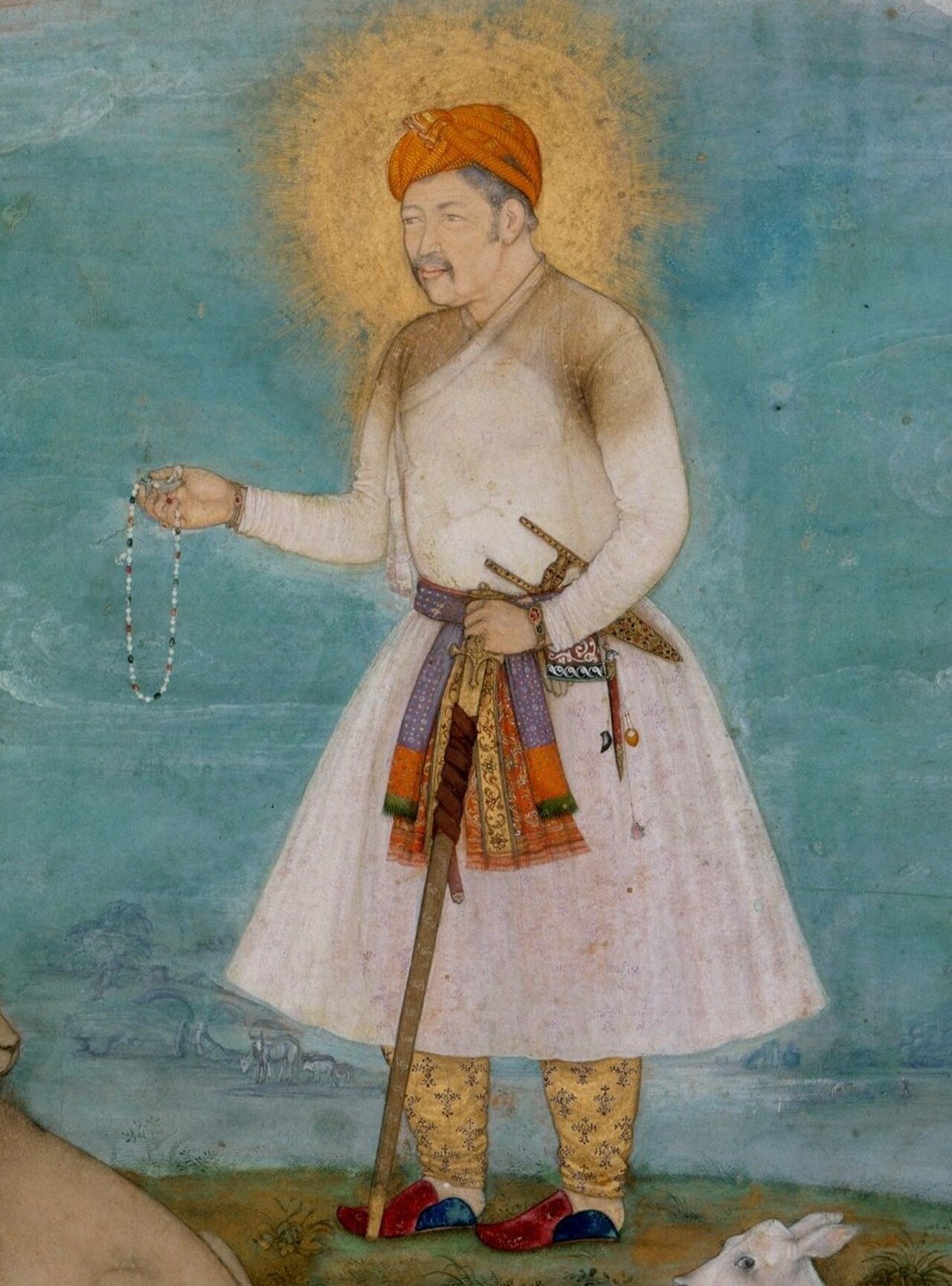
Akbar (born October 15, 1542, in Umarkot, Sindh, in present-day Pakistan—died October 27, 1605, in Agra, India), whose full name was Abu’l-Fath Jalal-ud-din Muhammad Akbar, was the third Mughal emperor of India. He ruled from 1556 until his death in 1605 and became known for expanding the Mughal Empire, strengthening its government, encouraging trade and cultural development, and promoting cooperation among people of different religious backgrounds. His reign established many of the political and administrative foundations that shaped the Mughal Empire for generations.
Birth and Family Background
Akbar was born during a difficult period in his family’s history. His father, Humayun, was the second Mughal emperor, while his mother, Hamida Banu Begum, came from a Persian family. At the time of Akbar’s birth, Humayun had lost control of much of his territory and was living in exile after being defeated by the Afghan ruler Sher Shah Suri.
Akbar’s birthplace, Umarkot, was a small kingdom in the Sindh region. Its local ruler, Rana Prasad, provided shelter to Humayun and his family during their difficult circumstances. Akbar’s birth took place far from the royal centers that had once been under his father’s control.
His early years were shaped by political uncertainty and frequent movement. Humayun spent years trying to regain his lost territories, and the family could not always remain together. Akbar therefore experienced a childhood very different from that of a prince raised in a secure royal palace.
Akbar was also connected to several important Central Asian and Persian royal traditions through his family. His grandfather, Babur, had founded the Mughal Empire in India in 1526. Babur’s family had connections to the Mongol and Timurid ruling traditions, while his descendants also inherited Persian cultural influences.
These family connections later became important in shaping the Mughal court, its military organization, and its cultural traditions.
Childhood and Early Education
Akbar spent much of his childhood in difficult political and military circumstances. His father continued his efforts to recover the Mughal throne, eventually receiving support from the Persian ruler Shah Tahmasp I.
During these years, Akbar lived in different places under the care of relatives and trusted members of the royal household. His education was not as conventional as that of many princes. Historical accounts suggest that he did not become skilled at reading and writing, although he received instruction in other areas of princely training.
Instead, Akbar developed practical abilities through hunting, horse riding, military exercises, and the handling of weapons. He became particularly interested in physical activities and demonstrated considerable skill in managing horses and elephants.
His upbringing also exposed him to different languages, customs, and traditions. Persian culture was influential in the Mughal household, while the political environment of northern India introduced him to a wide range of regional communities.
Akbar’s early experiences helped prepare him for the responsibilities of leadership, although he had little opportunity to enjoy a peaceful childhood.
Return of Humayun and Akbar’s Rise to Power
In 1555, Humayun successfully regained control of Delhi and restored Mughal rule in northern India. His victory ended the period of exile that had kept the family away from the empire’s main political centers.
Akbar was appointed governor of important territories in the Punjab region and placed under the guidance of Bairam Khan, an experienced military commander and trusted supporter of Humayun.
However, Humayun’s restoration was short-lived. In January 1556, he died after falling down the stairs of his library in Delhi.
Akbar was only 13 years old when his father died. At the time, he was in the Punjab region with Bairam Khan, who helped secure his position as the new emperor.
Akbar was formally crowned at Kalanaur, in present-day Punjab, in February 1556. Because he was still a child, Bairam Khan became his regent, meaning that he managed the government and military affairs on the young emperor’s behalf.
The new ruler inherited a fragile empire. Mughal authority was not firmly established across northern India, and several regional powers were ready to challenge the young emperor.
The Second Battle of Panipat
One of the most serious challenges to Akbar’s early rule came from Hemu, a powerful military commander who had gained control of Delhi and Agra.
Hemu had served the rulers of the Sur dynasty, which had displaced the Mughals during Humayun’s exile. After a series of military successes, he captured Delhi in 1556 and assumed royal authority.
His advance threatened to end the Mughal restoration before Akbar had a chance to establish himself.
The two sides met at the Second Battle of Panipat on November 5, 1556. Akbar’s forces were commanded by Bairam Khan, while Hemu led his own army.
During the battle, Hemu was struck in the eye by an arrow and became unable to command his troops effectively. His forces lost their organization, and the Mughal army won the battle.
Hemu was captured and killed after the defeat. The victory allowed Akbar to regain control of Delhi and Agra and strengthened the Mughal position in northern India.
The battle was a turning point in Akbar’s early reign. It gave the young emperor the opportunity to rebuild his father’s empire and begin establishing his own authority.
Akbar Takes Control of the Government
Although Bairam Khan had played an essential role in securing Akbar’s throne, the relationship between the young emperor and his regent eventually became difficult.
Bairam Khan exercised considerable influence over government decisions and military appointments. As Akbar grew older, he became increasingly interested in directing the empire himself.
In 1560, Akbar decided to end Bairam Khan’s regency. He dismissed him from his position and instructed him to undertake a pilgrimage to Mecca.
Bairam Khan initially resisted the decision and briefly raised a rebellion. However, he eventually surrendered and accepted Akbar’s authority. The emperor treated his former guardian with respect and allowed him to continue his journey.
Bairam Khan was killed in 1561 by an Afghan who had a personal grievance against him.
After ending the regency, Akbar gradually removed other powerful figures who had exercised influence over the government. He established a more direct system of imperial control and began appointing officials based on their abilities and loyalty.
His early years as an independent ruler were also influenced by members of his household, including his foster mother Maham Anga. However, Akbar increasingly took personal responsibility for important political and military decisions.
Expansion of the Mughal Empire
A major part of Akbar’s reign was devoted to expanding Mughal territory. He understood that a large and secure empire required control over important cities, trade routes, agricultural regions, and military centers.
After strengthening his position in northern India, he began expanding into neighboring kingdoms and regions.
In 1561, Mughal forces invaded Malwa, a strategically important kingdom in central India. The campaign brought the region under Mughal control and strengthened the empire’s position in central India.
Akbar also turned his attention toward the Rajput kingdoms of northwestern India. The Rajputs were a collection of warrior clans that ruled several powerful kingdoms and controlled important forts and territories.
Rather than relying entirely on military conquest, Akbar used a combination of diplomacy, political agreements, and warfare to bring many Rajput rulers into his empire.
The marriage of Akbar to a Rajput princess from Amber, commonly identified as Harkha Bai, was an important part of this approach. She later became known as Mariam-uz-Zamani. Their marriage helped establish a lasting political relationship between the Mughal court and the ruling family of Amber.
Akbar allowed many Rajput rulers to retain their local territories and positions in exchange for accepting Mughal authority and supporting the empire. Several Rajput nobles became important commanders and government officials.
Not all Rajput kingdoms accepted Mughal rule peacefully. The kingdom of Mewar continued to resist Mughal expansion, leading to a prolonged conflict.
In 1567–1568, Akbar captured the major Rajput fort of Chittor after a lengthy siege. In 1569, Mughal forces also captured Ranthambore, another important fortress.
Despite these victories, Mewar remained independent under the leadership of Maharana Pratap, who continued resisting Mughal control. Their conflict included the Battle of Haldighati in 1576, fought between Maharana Pratap’s forces and an imperial army led by Man Singh I, a Rajput commander serving Akbar.
The battle did not end the resistance of Mewar, and Maharana Pratap continued fighting for much of his life.
Akbar also expanded the empire toward Gujarat, which he conquered in 1572–1573. Gujarat was important because of its commercial cities and access to major maritime trade routes.
He later expanded into Bengal, Bihar, and parts of eastern India. These conquests brought important agricultural areas and trade centers under Mughal authority.
Further campaigns extended Mughal influence into Kashmir, Sindh, and parts of the northwestern frontier.
By the end of his reign, Akbar controlled a vast territory covering much of northern and central India, along with important regions in the west and east. His empire was considerably larger and more organized than the one he had inherited from his father.
Government and Administrative Reforms
As the Mughal Empire expanded, Akbar recognized the need for a government capable of managing large territories and diverse populations.
He developed a centralized administrative system that placed important responsibilities under the emperor while allowing local officials to manage regional affairs.
The empire was divided into large administrative provinces called subahs. Each province had officials responsible for military matters, revenue collection, and maintaining law and order.
Akbar appointed governors to oversee these provinces, but he also created separate offices to prevent any single official from gaining excessive power.
One of his most important administrative systems was the mansabdari system. The word mansab referred to a rank or position. Under this system, imperial officials and military commanders received ranks that determined their status, responsibilities, and obligations to the emperor.
Mansabdars were expected to provide soldiers and horses for imperial service. Their rank also influenced their salaries and the rewards they received.
This arrangement allowed Akbar to organize the empire’s military and civil administration through a common system. It also helped him bring nobles from different ethnic, religious, and regional backgrounds into imperial service.
Many officials received revenue assignments from particular territories instead of owning those lands outright. These assignments helped pay their salaries and maintain their military responsibilities.
Akbar also reorganized the collection of land revenue, which was the main source of government income.
Under the leadership of his finance minister Raja Todar Mal, the administration developed more systematic methods for measuring agricultural land, estimating crop production, and assessing taxes.
The system known as zabt used information about land and average crop prices to establish revenue demands in areas where it could be applied effectively.
The administration also developed the dahsala system, which calculated revenue assessments using average agricultural prices and production over a period of ten years.
These reforms aimed to make taxation more predictable and improve the government’s ability to collect revenue. However, actual conditions varied across the empire, and tax collection could still create difficulties for farmers.
Akbar’s administrative reforms helped establish a more stable system of imperial government and strengthened the relationship between the central administration and regional officials.
Religious Tolerance and Relations Among Communities
Akbar ruled over a population that included Muslims, Hindus, Jains, Christians, Zoroastrians, and followers of other religious traditions.
He understood that governing such a diverse population required more than military strength. Religious conflict and discrimination could weaken the empire, while cooperation could strengthen political stability.
One of his important decisions was to remove certain taxes imposed on non-Muslims.
In 1563, he abolished the pilgrimage tax that had been collected from Hindu pilgrims visiting religious sites. In 1564, he abolished the jizya, a tax historically imposed on non-Muslim subjects under certain Islamic governments.
These decisions helped improve relations between the Mughal government and many Hindu communities.
Akbar also appointed Hindus to important positions in the administration and military. Rajput nobles, including Raja Man Singh I, became leading figures in imperial service.
His approach did not mean that all religious differences disappeared or that every community enjoyed equal treatment in every situation. However, his government generally encouraged cooperation across religious boundaries.
Akbar became particularly interested in understanding different religious beliefs. He invited Muslim scholars, Hindu religious leaders, Jain teachers, Zoroastrian representatives, and Christian missionaries to discuss questions about religion and philosophy.
His interest in religious discussions reflected a personal search for understanding as well as a political desire to manage a diverse empire.
The Ibadat Khana and Religious Discussions
In 1575, Akbar established the Ibadat Khana, or House of Worship, at his capital in Fatehpur Sikri.
The building became a meeting place where religious scholars and thinkers gathered to discuss questions about faith, morality, philosophy, and the nature of God.
At first, the discussions mainly involved Muslim scholars from different traditions. However, disagreements and arguments among participants encouraged Akbar to invite representatives of other religions.
Hindu scholars, Jain teachers, Zoroastrians, and Christian missionaries eventually took part in these gatherings.
Akbar listened to different arguments and questioned religious authorities about their beliefs. He became increasingly dissatisfied with the idea that one religious group should have complete control over questions of spiritual truth.
These discussions influenced his personal religious outlook and encouraged a more inclusive approach to government.
In 1579, Akbar issued a document known as the Mahzar, which addressed his authority in resolving certain religious disagreements when Muslim scholars differed in their interpretations.
The document did not make him a prophet or establish him as a new religious messenger. Rather, it strengthened his position as the ruler responsible for making certain decisions involving religious law and public authority.
Din-i Ilahi
Akbar’s interest in different religious traditions eventually led to the creation of Din-i Ilahi, meaning Divine Faith.
Introduced around 1582, it was a small spiritual and ethical movement centered on the emperor’s court.
Din-i Ilahi drew ideas from several religious and philosophical traditions. It emphasized moral conduct, loyalty, self-control, kindness, and respect for life.
Akbar encouraged some of his closest courtiers to participate, but the movement never became a popular religion or a major institution across the empire.
It had very few followers and did not replace Islam, Hinduism, or other established religions.
The exact nature of Din-i Ilahi has been debated by historians. It is generally understood as a limited court-centered spiritual movement rather than a fully developed religion with a large community of believers.
Akbar’s interest in religious ideas continued throughout his later years, although his policies remained focused primarily on maintaining political stability and governing a diverse empire.
Marriage and Family Life
Akbar’s marriages were closely connected to the political and social relationships of the Mughal court.
He married women from several royal and noble families, including Muslim and Rajput households. These marriages helped establish alliances and strengthen relationships between the emperor and influential families.
His marriage to Harkha Bai of Amber was particularly important because it strengthened cooperation between the Mughals and the Rajput ruling family.
She became the mother of Akbar’s son Salim, who later ruled as Emperor Jahangir.
Akbar had several children, although not all survived childhood. His sons included Salim, Murad, and Daniyal.
Salim was born in 1569 and became Akbar’s most important surviving heir. Murad and Daniyal also received positions and responsibilities within the empire.
Akbar’s relationship with his sons was sometimes difficult. As they grew older, disagreements over authority and political independence created tensions within the royal family.
His relationship with Salim became particularly strained during the later years of his reign.
Despite these family difficulties, Akbar devoted considerable attention to arranging the education, military training, and political responsibilities of his sons.
Fatehpur Sikri and the Imperial Court
Akbar was not only a military ruler and administrator but also an active supporter of architecture, art, literature, and learning.
One of his most important architectural projects was Fatehpur Sikri, a new imperial city built near Agra in present-day Uttar Pradesh.
Construction began in the 1570s, and the city became an important center of Mughal government and court life.
Akbar chose the location partly because of its association with the Sufi saint Sheikh Salim Chishti. The emperor had visited the saint while hoping for a male heir, and the birth of his son Salim strengthened the site’s personal importance to him.
Fatehpur Sikri included palaces, courtyards, administrative buildings, mosques, and other structures.
Among its best-known buildings are the Buland Darwaza, the Jama Masjid, the Diwan-i-Khas, and the tomb of Sheikh Salim Chishti.
The city’s architecture combined influences from Persian, Central Asian, and Indian building traditions. Red sandstone was widely used, and many structures featured detailed carvings and carefully designed courtyards.
Although Fatehpur Sikri served as the imperial capital for a relatively short period, it remained one of the most recognizable architectural achievements of Akbar’s reign.
Akbar also supported construction and renovation projects in other parts of the empire, including Agra Fort, which was rebuilt as a major imperial fortress and residence.
Art, Literature, and Cultural Development
Akbar’s court became an important center of artistic and intellectual activity.
He supported painters, musicians, writers, historians, architects, and scholars. His interest in different cultural traditions helped encourage the development of a distinctive Mughal court culture.
Mughal painting grew significantly during his reign. Artists combined Persian painting techniques with Indian artistic traditions, creating detailed illustrations of historical events, royal life, hunting scenes, and literary works.
The imperial painting workshop employed artists who worked together on large illustrated manuscripts. Among the notable artists associated with Akbar’s court were Basawan and Daswanth.
Literature also received considerable attention. Persian remained the main language of administration and high-level court culture, but Akbar encouraged translations of important Sanskrit works into Persian.
The Mahabharata was translated into Persian under the title Razmnama, meaning Book of Wars. Other works, including parts of the Ramayana, were also translated.
These projects helped introduce important Indian literary traditions to Persian-speaking readers at the Mughal court.
Akbar also supported music. One of the most famous musicians associated with his court was Tansen, who became renowned for his musical skill and contributions to Hindustani classical music.
The emperor’s court attracted talented individuals from different parts of India and beyond, helping create an environment where artistic traditions could influence one another.
The Navratnas of Akbar’s Court
Akbar is often associated with a group of nine distinguished courtiers known as the Navratnas, meaning Nine Gems.
The group is traditionally said to have included some of the most talented figures of his reign, such as:
- Abu’l-Fazl: A historian and writer who produced the Akbarnama, an important account of Akbar’s reign.
- Faizi: A Persian poet and scholar who was the brother of Abu’l-Fazl.
- Raja Todar Mal: A leading finance official who helped organize the empire’s land revenue system.
- Raja Man Singh I: A prominent Rajput military commander and imperial official.
- Tansen: A celebrated musician who contributed to the development of Mughal court music.
- Birbal: A courtier known for his intelligence, wit, and close relationship with Akbar.
- Abdul Rahim Khan-i-Khanan: A military commander, administrator, and poet.
- Mulla Do-Piyaza: A figure associated with popular stories about Akbar’s court, although his historical status as one of the nine is uncertain.
- Fakir Aziao-Din: A religious figure traditionally associated with Akbar’s court.
The idea of nine exceptional courtiers remains popular in Indian historical storytelling. However, there is no firm evidence that Akbar officially established a fixed group of exactly nine advisers with this name.
Several individuals traditionally included among the Navratnas were important historical figures, but the familiar list combines documented court personalities with later traditions.
Akbar’s Military Organization and Leadership
Akbar recognized that a large empire required a strong and well-organized military.
He maintained a powerful army equipped with cavalry, infantry, artillery, and war elephants. Cavalry played a particularly important role in Mughal warfare because it allowed armies to move quickly across large territories.
The mansabdari system helped organize military service by assigning ranks and responsibilities to commanders and officials.
Akbar also strengthened the use of firearms and artillery, which had become increasingly important in warfare across the region.
Military campaigns were supported by a network of forts and supply centers. Control of important fortresses helped the emperor maintain authority over distant territories.
Akbar often combined military force with diplomacy. He offered favorable positions to rulers who accepted Mughal authority and made use of their military experience in imperial campaigns.
This approach allowed him to expand his empire without having to replace every local ruling family.
His military system also depended on regular supervision. He introduced measures to reduce fraud in military records and ensure that officials provided the required horses and soldiers.
These arrangements helped the Mughal government maintain a large military establishment while keeping its commanders connected to the emperor.
Relations with Foreign Powers
Akbar’s reign also involved relationships with powers outside the Indian subcontinent.
The Mughal Empire maintained diplomatic and commercial connections with Persia, Central Asia, and other regions.
The relationship with the Safavid Empire of Persia was particularly important because both empires had interests in territories near the northwestern frontier.
One major issue involved control of Kandahar, a strategically important city located between the Mughal and Persian spheres of influence. The city changed hands during the period of Mughal and Safavid competition.
Akbar also encountered European traders and missionaries who had begun establishing a stronger presence along India’s coast.
Portuguese merchants controlled important trading centers on the western coast and maintained a powerful maritime presence in the Indian Ocean.
In 1579, Portuguese Jesuit missionaries arrived at Akbar’s court in Fatehpur Sikri after being invited to participate in religious discussions.
They explained Christian beliefs and presented religious texts to the emperor. Akbar showed interest in their arguments and encouraged conversations between Christian missionaries and scholars from other traditions.
However, he did not convert to Christianity or adopt the religion as the official faith of the empire.
These contacts reflected the growing connections between the Mughal court and the wider world.
Challenges During the Later Years of His Reign
Although Akbar had built a large and powerful empire, his later years were not free from political difficulties.
The administration had to manage distant provinces, regional resistance, military expenses, and disagreements among members of the royal family.
One of his most difficult personal challenges involved his son Salim.
As Salim grew older, he became dissatisfied with the influence exercised by some of his father’s advisers and wanted greater independence.
In 1599, Salim began a rebellion against Akbar’s authority and established himself as an independent ruler in Allahabad.
The rebellion created a serious division within the royal family and threatened the stability of the succession.
Akbar was particularly troubled by the death of Abu’l-Fazl in 1602. Abu’l-Fazl was one of his closest advisers and the author of the Akbarnama. He was killed while returning to the imperial court by men working for Salim.
Despite these tensions, Akbar did not permanently disinherit his eldest surviving son. The emperor eventually accepted Salim’s position as his likely successor.
The later years of Akbar’s reign also involved continued military activity and administrative supervision. He remained actively involved in the affairs of the empire even as his health began to decline.
Death of Akbar the Great
Akbar died on October 27, 1605, in Agra, after a period of declining health. He was 63 years old.
His death ended a reign of nearly 50 years, during which the Mughal Empire had grown from a relatively insecure kingdom into one of the largest and most powerful states in the Indian subcontinent.
Before his death, the question of succession had become increasingly important because of disagreements among his sons and members of the royal court.
Salim succeeded him and took the imperial title Jahangir.
Akbar was buried at Sikandra, near Agra, where his tomb was constructed as a major Mughal architectural monument. The complex combines features of different architectural traditions and reflects the artistic development of the period.
His death marked the end of one of the longest and most influential reigns in early Mughal history, while the government, court institutions, and imperial territories he had developed continued under his successors.