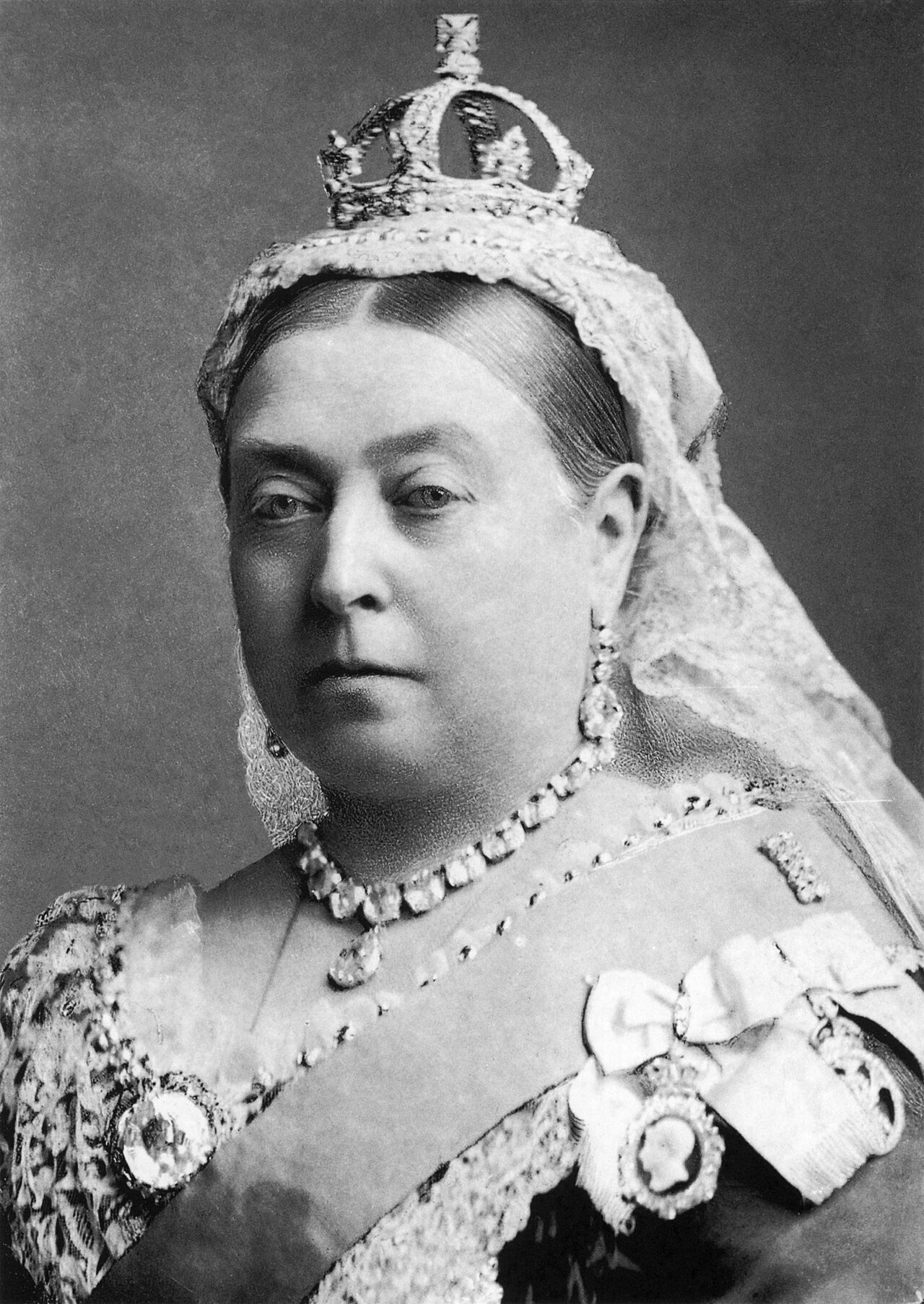
Queen Victoria (born May 24, 1819, Kensington Palace, London, England—died January 22, 1901, Osborne House, Isle of Wight, England) was Queen of the United Kingdom of Great Britain and Ireland from 1837 until her death in 1901. She was also Empress of India from 1876. Her 63-year reign, known as the Victorian era, was marked by industrial growth, scientific discoveries, expanding British power, and major social changes. She became one of the most recognizable monarchs in British history and was the longest-reigning British monarch until Queen Elizabeth II surpassed her record in 2015.
Early Life and Family Background
Victoria was born Alexandrina Victoria on May 24, 1819, at Kensington Palace in London. She was the only child of Prince Edward, Duke of Kent and Strathearn, the fourth son of King George III, and Princess Victoria of Saxe-Coburg-Saalfeld, a German princess. Her father died when she was only eight months old, leaving her mother responsible for her upbringing.
Victoria grew up during a period of uncertainty in the British royal family. Her grandfather, King George III, had died in 1820, and her uncles George IV and William IV later ruled without leaving surviving legitimate children who could inherit the throne. As a result, Victoria became increasingly important in the line of succession.
Her childhood was closely controlled by her mother and her mother’s adviser, Sir John Conroy. They followed what became known as the Kensington System, a strict set of rules intended to keep Victoria dependent on her mother and limit her contact with people outside their household. She was rarely allowed to be alone and had little freedom to make independent decisions.
Despite these restrictions, Victoria received a broad education. She studied history, geography, religion, languages, music, drawing, and other subjects. She learned English, French, German, and Italian. Her education also included lessons about the responsibilities of monarchy and the political system of Britain.
Victoria was especially close to her governess, Louise Lehzen, who provided emotional support during her childhood. She kept a diary from an early age, recording her thoughts, experiences, and observations. These diaries later became an important source of information about her personal life and reign.
Although she spent much of her childhood under strict supervision, Victoria developed a strong personality and a desire for independence. When she learned more about her position in the royal succession, she began preparing herself for the possibility of becoming queen.
Becoming Queen in 1837
On June 20, 1837, King William IV died at the age of 71. Victoria, then 18 years old, became queen because she was his closest legitimate successor. Her accession marked the beginning of a new period in British royal history.
She received the news early in the morning and soon met with senior officials to learn about the king’s death and her new responsibilities. One of her first decisions was to establish a separate household, reducing her mother’s influence over her private and official affairs.
Victoria’s coronation took place on June 28, 1838, at Westminster Abbey. Large crowds gathered in London to witness the ceremony. As a young woman taking the throne, she attracted considerable public attention and became a symbol of a new generation of monarchy.
Her early years as queen were shaped by her relationship with Lord Melbourne, the Whig prime minister. He became an important adviser and helped her understand government, political debates, and constitutional responsibilities. Victoria trusted him deeply and valued his guidance.
However, her close relationship with Melbourne also created political difficulties. Critics believed that she relied too heavily on him and that his political views influenced her decisions. As she gained experience, Victoria gradually became more confident in handling her royal duties.
One early political challenge involved the Bedchamber Crisis of 1839. After Melbourne’s government resigned, Conservative leader Robert Peel was asked to form a new administration. Peel wanted the queen to replace several women in her personal household because they were closely connected to the outgoing Whig government. Victoria refused, viewing the request as an attack on her personal independence. The disagreement prevented Peel from taking office at that time, and Melbourne returned as prime minister.
The incident showed how difficult it could be for a young monarch to balance personal preferences with political expectations. It also demonstrated that Victoria would not easily surrender control over her household.
Marriage to Prince Albert
Victoria married her first cousin, Prince Albert of Saxe-Coburg and Gotha, on February 10, 1840, at the Chapel Royal in St. James’s Palace, London. Their marriage followed several years of acquaintance and growing affection.
Although royal marriages were often arranged for political reasons, Victoria chose Albert because she genuinely loved him. Since she was queen, she proposed to him rather than waiting for him to make the proposal.
Albert was intelligent, well educated, and interested in science, art, education, and public affairs. He soon became an important part of Victoria’s personal and family life. Their relationship was affectionate, although they sometimes disagreed over household matters and the responsibilities of government.
The couple had nine children: Victoria, Edward, Alice, Alfred, Helena, Louise, Arthur, Leopold, and Beatrice. Their children later married into several European royal families, connecting the British monarchy with royal houses across the continent.
Albert played a major role in organizing family life and supporting Victoria’s work as monarch. He also became increasingly involved in public affairs, particularly matters involving education, technology, industry, and the arts.
At first, his position was uncertain because he held no formal constitutional office. Victoria, however, gradually secured greater recognition for his role. He became Prince Consort in 1857.
The marriage brought Victoria considerable personal happiness. She admired Albert’s intelligence and judgment, and the two developed a close partnership that influenced both their family life and their approach to public responsibilities.
Family Life and Responsibilities as Queen
Victoria took motherhood seriously and was deeply attached to her children, although her relationship with them was not always easy. She expected them to follow strict standards of behavior and often expressed frustration when they failed to meet her expectations.
Her parenting style reflected the values of discipline, duty, and self-control that she believed were essential to family life. She also took a strong interest in her children’s marriages and frequently tried to influence their choices.
Albert helped manage the family’s daily affairs and encouraged the children to receive a broad education. He wanted them to develop practical knowledge and a sense of responsibility rather than simply rely on their royal status.
The family spent time at several royal residences, including Buckingham Palace, Windsor Castle, and Balmoral Castle in Scotland. Balmoral became especially important to Victoria and Albert, who enjoyed its countryside and the privacy it provided.
Victoria developed a lasting affection for Scotland. She appreciated its landscape, traditions, and people, and her visits helped strengthen the royal family’s connection with the country.
Her public duties continued alongside family responsibilities. She met ministers, reviewed government papers, attended official ceremonies, and received foreign visitors. Although Britain was becoming increasingly democratic, the monarch remained an important public figure whose views could influence political life.
Political Challenges and Constitutional Monarchy
During Victoria’s reign, Britain experienced major political changes. The country was gradually moving toward a system in which elected representatives and ministers exercised most political power, while the monarch’s role became increasingly constitutional.
Victoria did not govern as an absolute ruler. She worked with prime ministers and other ministers, received reports about government affairs, and offered advice. Her political influence depended on her experience, judgment, and relationships with those in power.
She worked with many important political leaders, including Lord Melbourne, Sir Robert Peel, Lord John Russell, Lord Palmerston, Benjamin Disraeli, and William Gladstone.
Her relationships with these politicians varied. She particularly disliked Gladstone’s manner and often found his political approach difficult to accept. In contrast, she developed a close personal relationship with Disraeli, who treated her with warmth and respect.
Disraeli helped strengthen Victoria’s public position during the later part of her reign. She appreciated his attention to royal interests and his support for expanding the monarchy’s ceremonial role.
Victoria also experienced periods of political tension involving Ireland, European affairs, and Britain’s overseas territories. She generally believed in the importance of maintaining Britain’s position as a major world power, although she did not always agree with the decisions made by her ministers.
Over time, her experience helped her understand the limits of royal authority. She learned that a monarch could express opinions and offer guidance but could not normally impose personal decisions on an elected government.
The Great Exhibition of 1851
One of the major public events during Victoria’s early reign was the Great Exhibition of 1851, held in London’s Hyde Park. Prince Albert played a leading role in organizing the event, which displayed industrial products, inventions, machinery, art, and scientific achievements from Britain and other countries.
The exhibition was housed in the Crystal Palace, an enormous glass-and-iron structure designed by Joseph Paxton. Its size and construction attracted widespread attention.
Victoria and Albert strongly supported the exhibition because they believed that scientific progress, manufacturing, and international cooperation could improve society. The event also demonstrated Britain’s industrial strength during a period of rapid economic development.
Victoria visited the exhibition several times with her family. She was impressed by the displays and considered the event a major success.
The Great Exhibition helped establish Albert’s reputation as a supporter of science, industry, and education. It also became one of the most memorable public events of the early Victorian period.
The Crimean War and Personal Concerns
The Crimean War, fought from 1853 to 1856, was another important event during Victoria’s reign. Britain joined France and the Ottoman Empire in fighting Russia over disputes involving influence in the Ottoman territories and the wider balance of power in Europe.
The war exposed serious problems in British military organization, medical care, and supply systems. Reports about poor conditions among soldiers caused public concern.
Victoria took a personal interest in the welfare of wounded servicemen. She visited military hospitals, supported efforts to improve medical treatment, and encouraged the recognition of soldiers who had shown courage.
In 1856, she established the Victoria Cross, Britain’s highest award for military bravery in the face of the enemy. The decoration was intended to recognize acts of courage regardless of a person’s social background or rank.
The war also affected Victoria emotionally because she worried about the soldiers serving abroad. Her involvement in military matters reflected her interest in the armed forces and her sense of responsibility toward those fighting in Britain’s name.
Death of Prince Albert in 1861
Victoria’s life changed dramatically when Prince Albert died on December 14, 1861, at Windsor Castle. He was 42 years old. His death followed an illness that had developed over several weeks.
Albert’s death devastated Victoria. She had depended on him for emotional support, family guidance, and advice on public affairs. She struggled to accept his absence and withdrew from many public activities.
After his death, she wore black for the rest of her life and maintained many of his personal rooms and belongings as they had been during his lifetime. She also continued to commemorate him through memorials and public projects.
One of the best-known memorials was the Albert Memorial in Kensington Gardens, London. Commissioned by Victoria, it was designed to honor his life and achievements.
Victoria’s prolonged mourning affected her public image. For years, she appeared less frequently at official ceremonies, leading to criticism from people who believed that the monarchy had become too distant from public life.
She continued to perform many official responsibilities, but her withdrawal created a gap between the royal family and the public. Her gradual return to public appearances helped restore the monarchy’s visibility.
Later Children and Family Relationships
After Albert’s death, Victoria’s relationship with her children became more complicated. She continued to guide their lives and remained closely involved in their marriages, careers, and family responsibilities.
Her eldest son, Albert Edward, known as Bertie, became Prince of Wales and heir to the throne. Victoria was often disappointed with his behavior and believed that he did not always show the seriousness expected of a future king.
Her daughters also married into European royal families. Princess Victoria married the future German Emperor Frederick III, while Princess Alice married Louis IV, Grand Duke of Hesse. Other children formed connections with royal families in Russia, Denmark, and other European countries.
Victoria maintained correspondence with many of her children and grandchildren. She was particularly interested in European royal affairs because family relationships often overlapped with political alliances.
Her descendants became connected to several major European ruling families. This extensive network later contributed to her popular association with the royal families of Europe.
Return to Public Life
During the 1870s, Victoria gradually became more active in public affairs and royal ceremonies. Her return was helped by growing support from political leaders and members of the public who wanted to see the monarchy more visibly represented.
Benjamin Disraeli, who served as prime minister during much of this period, helped strengthen her public standing. He understood her interest in royal status and encouraged her involvement in national ceremonies.
In 1876, Victoria was given the title Empress of India through legislation passed during Disraeli’s government. The title reflected Britain’s control over India following the transfer of authority from the East India Company to the British Crown in 1858.
Victoria took an interest in India and developed a particular fascination with Indian culture. She employed Indian servants and later learned some Hindustani from Abdul Karim, an Indian attendant who became an important figure in her household.
Her relationship with Karim caused tension within the royal family and household because some members disliked his growing influence. Nevertheless, Victoria valued his company and continued their relationship until her death.
The Expansion of the British Empire
During Victoria’s reign, the British Empire expanded across parts of Africa, Asia, and the Pacific. Britain already controlled a large overseas empire when she became queen, but its reach and influence increased significantly during the 19th century.
British power grew through trade, military campaigns, colonial settlement, political agreements, and direct rule. Industrial development and naval strength helped Britain maintain influence across major sea routes and international markets.
India became the most important part of the empire. Following the Indian Rebellion of 1857, the British government ended the East India Company’s rule and transferred control of India to the Crown in 1858.
Victoria issued a proclamation promising religious tolerance and stating that Indians would be treated fairly under British rule. However, colonial administration continued to place political power in British hands, and many Indians experienced discrimination, economic pressure, and restrictions on self-government.
The expansion of the empire was also associated with conflicts and resistance in different regions. British involvement in Africa and Asia often involved military force and the loss of local political independence.
Victoria’s personal role in imperial policy was limited by constitutional government, but she supported the idea of a powerful British Empire. Her title as Empress of India became an important part of her public identity.
The Victorian Era and Changes in Society
The period of Victoria’s reign became known as the Victorian era. It was a time of major changes in British society, including industrialization, urban growth, improvements in transportation, and advances in communication.
Factories and manufacturing centers expanded, drawing large numbers of people from rural areas into growing cities. Railways connected towns and industrial regions, while steamships made international travel and trade faster.
The telegraph transformed communication by allowing messages to travel over long distances much more quickly than before. New developments in medicine, engineering, and science also changed everyday life.
However, industrial growth created serious social problems. Many workers faced long hours, low wages, unsafe working conditions, and crowded housing. Child labor remained widespread for much of the period, although laws gradually restricted the employment of children in factories and mines.
Public health also became a major concern. Overcrowded cities often lacked clean water, proper drainage, and effective waste disposal. Disease outbreaks caused widespread suffering.
During Victoria’s reign, reformers campaigned for better education, safer workplaces, improved housing, and greater political rights. Parliament passed laws that gradually addressed some of these problems.
The queen’s personal involvement in these social changes varied, but she lived through a period in which Britain was transformed from a largely agricultural society into a major industrial and urban nation.
Personal Interests and Daily Life
Victoria’s private interests included writing, painting, music, and family activities. Her diaries provide a detailed record of her experiences, thoughts, relationships, and daily routines.
She enjoyed spending time outdoors and developed a particular love for the Scottish Highlands. Her residence at Balmoral offered an escape from the demands of court life.
She also enjoyed drawing and painting, especially landscapes and family scenes. Her artistic interests were encouraged by Albert, who shared her appreciation for the arts.
Victoria’s personality could be affectionate and emotional, but she was also strong-willed and sometimes demanding. She valued loyalty and disliked people she believed had treated her unfairly.
Her religious beliefs were important to her. She identified strongly with the Church of England and viewed her position as monarch as a responsibility that carried moral obligations.
Although she lived a highly public life, she valued personal relationships and often relied on trusted family members and attendants for emotional support.
The Golden Jubilee of 1887
In 1887, Victoria celebrated 50 years on the British throne. The event became known as her Golden Jubilee and was marked by celebrations across Britain and the empire.
Royal ceremonies, public gatherings, and special events honored her long reign. Representatives from different parts of the empire attended celebrations in London.
Victoria appeared at several official events, and the anniversary helped strengthen public interest in the monarchy. It also demonstrated how much her position had changed since the difficult early years following Albert’s death.
The Golden Jubilee gave the public an opportunity to recognize her long service as queen and her association with decades of national change.
The Diamond Jubilee of 1897
Victoria reached another major milestone in 1897 when she celebrated 60 years as monarch. Her Diamond Jubilee became a large public celebration involving military processions, royal ceremonies, and representatives from across the British Empire.
The queen traveled through London in a procession that attracted enormous crowds. Troops and officials from different parts of the empire participated, reflecting the worldwide reach of British imperial power at the time.
Victoria was 78 years old and had become an increasingly familiar national figure. Her long reign had made her one of the most recognized monarchs in the world.
The celebrations were among the final major public events of her life. Although her health was gradually declining, she continued to carry out important royal duties.
Final Years and Death
During the final years of her life, Victoria spent much of her time at Osborne House on the Isle of Wight and at Balmoral Castle in Scotland. She continued to receive government officials, review state papers, and maintain correspondence with members of her family.
Her health gradually weakened as she grew older. She also experienced the deaths of several close relatives and friends, including members of the European royal families to which her children were connected.
Victoria remained queen through the final years of the 19th century, witnessing changes in technology, transportation, politics, and international relations that had transformed Britain during her lifetime.
She died on January 22, 1901, at Osborne House, aged 81. Her eldest son, Albert Edward, succeeded her as King Edward VII.
Victoria’s funeral took place with military and royal ceremonies, and she was buried beside Prince Albert in the Royal Mausoleum at Frogmore, near Windsor. Her death brought her 63-year reign to an end and marked the close of the Victorian era.