Hammurabi (c. 1810–1750 BCE) was a king of Babylon who ruled from approximately 1792 to 1750 BCE and established one of the most powerful kingdoms in ancient Mesopotamia. He is best known for the Code of Hammurabi, a collection of laws that addressed crime, trade, property, family relationships, labor, and other aspects of daily life. Through military campaigns, political organization, and legal reforms, Hammurabi expanded Babylon’s influence and helped make it a leading center of power in the ancient Near East.
Early Life and Background
Hammurabi was born around 1810 BCE, although the exact date and place of his birth are not known. He belonged to the First Dynasty of Babylon, a royal family that ruled the city-state of Babylon in southern Mesopotamia, an ancient region located mainly in present-day Iraq.
At the time of his birth, Mesopotamia was divided among several competing kingdoms and city-states. Babylon was an important settlement, but it was not yet the dominant political power in the region. Other kingdoms, including Larsa, Eshnunna, Mari, and Assyria, controlled important cities, farmland, and trade routes.
Hammurabi was the son of King Sin-Muballit, who ruled Babylon before him. His father governed during a period of political competition and military conflict. As a royal heir, Hammurabi would have been expected to learn about government, warfare, religion, diplomacy, and the responsibilities of kingship.
Little reliable information survives about his childhood, education, or personal experiences before he became king. Most of what is known about his early life comes from royal inscriptions, administrative records, and other surviving documents from the period.
Becoming King of Babylon
Hammurabi became king of Babylon around 1792 BCE after his father left the throne. He inherited a kingdom that had some regional influence but faced powerful neighbors and continued political challenges.
His early reign focused on strengthening Babylon’s defenses, improving its administration, and maintaining relationships with neighboring rulers. He also supported religious institutions, construction projects, and agricultural activities.
Religion played an important role in Mesopotamian government. Kings were expected to respect the gods, maintain temples, and protect the people under their authority. Hammurabi presented himself as a ruler chosen by the gods to establish order and provide justice.
One of his important religious responsibilities was supporting the worship of Marduk, the principal god of Babylon. As Babylon grew in political importance, Marduk also became increasingly important in Mesopotamian religious life.
Hammurabi’s early years as king involved careful political decisions. Rather than immediately attempting to conquer every neighboring kingdom, he built alliances, strengthened his position, and waited for opportunities to expand his territory.
Military Campaigns and Expansion
Hammurabi’s rise to power was closely connected to his military campaigns. During the first part of his reign, he dealt with competing rulers and worked to secure Babylon’s position among the kingdoms of Mesopotamia.
He initially maintained diplomatic relationships with some neighboring powers. These relationships helped protect Babylon while allowing Hammurabi to focus on strengthening his kingdom.
Over time, he began expanding his territory through military action. He gained control over important cities and regions, increasing Babylon’s access to farmland, waterways, trade routes, and other valuable resources.
One of his major achievements was the defeat of Rim-Sin I, the powerful ruler of Larsa. Larsa had controlled much of southern Mesopotamia and had long been one of Babylon’s strongest rivals. Hammurabi’s victory over Rim-Sin allowed him to bring large areas of southern Mesopotamia under Babylonian control.
He also defeated the kingdom of Eshnunna and brought other important territories under his authority. His campaigns extended Babylon’s influence across much of Mesopotamia.
Another major achievement was his victory over Mari, a prosperous kingdom located along the Euphrates River in what is now Syria. Mari was an important political and commercial center. Its capture strengthened Hammurabi’s control over important trade and transportation routes.
Hammurabi’s military successes transformed Babylon from a relatively limited kingdom into a major regional empire. However, maintaining control over such a large territory required more than military strength. He also needed officials, laws, administrative systems, and reliable sources of information to govern distant cities.
Government and Administration
As Babylon expanded, Hammurabi faced the challenge of governing different communities with their own customs, traditions, and political histories.
He relied on officials and local administrators to manage the kingdom. These officials helped collect taxes, supervise agricultural production, maintain public works, resolve disputes, and carry out royal decisions.
Agriculture was central to the Mesopotamian economy. Much of the population depended on farming, and successful harvests required organized irrigation systems. Rivers and canals supplied water to fields, while local authorities and workers maintained the channels needed to distribute it.
Hammurabi paid attention to irrigation and agricultural management. His government worked to maintain canals, protect farmland, and address problems that could threaten food production.
He also communicated with officials through written messages. Thousands of clay tablets from the Old Babylonian period provide information about government activities, legal disputes, business arrangements, and everyday life.
One particularly valuable collection of documents comes from Mari. These records include diplomatic correspondence and reports that help historians understand Hammurabi’s political relationships and administrative methods.
His government combined royal authority with local administration. Although Hammurabi was the highest political authority, effective rule depended on the cooperation of officials, soldiers, religious leaders, merchants, and local communities.
The Code of Hammurabi
Hammurabi is most famous for the Code of Hammurabi, a collection of approximately 282 legal provisions associated with his reign. It is one of the best-known surviving examples of written law from the ancient world.
The code was created to establish rules for different aspects of society and explain the consequences of breaking them. It addressed matters such as theft, assault, marriage, divorce, inheritance, debt, wages, business agreements, property ownership, and professional responsibilities.
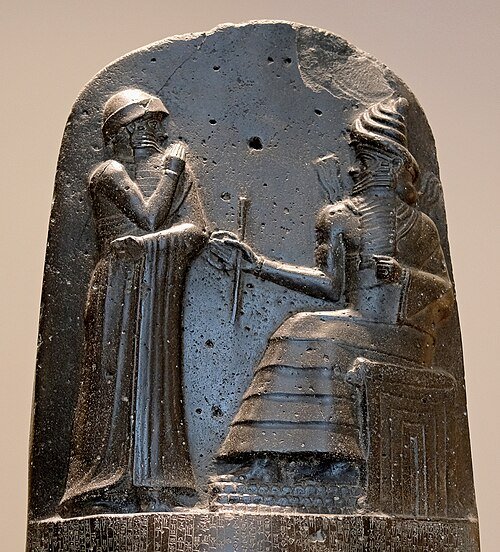
The laws were written in Akkadian, the language commonly used in Babylonian administration. They were carved in cuneiform, a writing system made with wedge-shaped marks pressed into clay or carved into stone.
The best-known surviving version appears on a large black stone monument, often called a stele. The monument shows Hammurabi standing before Shamash, the Mesopotamian god associated with the sun and justice. Shamash is depicted granting symbols of authority to the king.
The monument is now held at the Louvre Museum in Paris, France.
The image and accompanying inscription presented Hammurabi as a ruler whose authority came from the gods and whose responsibility was to protect the weak and establish justice.
What the Laws Covered
The Code of Hammurabi addressed many practical problems that could arise in a complex society.
Its provisions covered several major areas:
- Property and theft: The laws established punishments for stealing property, damaging possessions, and handling stolen goods.
- Family relationships: They addressed marriage, divorce, inheritance, adoption, and responsibilities between family members.
- Business and trade: The code regulated loans, debts, commercial agreements, and the responsibilities of merchants and other businesspeople.
- Agriculture: Some laws dealt with farmland, irrigation, livestock, and the responsibilities of agricultural workers.
- Employment: The code established rules concerning wages, labor agreements, and the responsibilities of workers.
- Professional services: Certain provisions addressed the duties and possible negligence of builders, doctors, and other skilled workers.
- Criminal offenses: The laws established punishments for offenses such as assault, theft, and false accusations.
These provisions show that Babylonian society had developed complex economic and social relationships. People needed rules to settle disagreements, protect property, regulate business, and define personal responsibilities.
The Principle of Retribution
One of the most recognizable features of the code is the principle often summarized as “an eye for an eye, a tooth for a tooth.”
This principle is known as lex talionis, meaning that punishment should correspond to the injury or offense. Under certain provisions, someone who caused a particular injury could receive a similar injury in return.
However, the code did not apply identical punishments to everyone. Penalties often depended on a person’s social position and the status of the victim.
Babylonian society was divided into different social groups, including people of higher status, ordinary free people, and enslaved people. The legal consequences of an offense could vary depending on the groups involved.
For example, causing injury to a person of high social standing could result in a different punishment from causing the same injury to someone of lower status.
The code therefore reflected the social inequalities of ancient Babylon rather than establishing equal legal treatment for everyone.
How the Code Was Used
The Code of Hammurabi is often described as one of the earliest written legal codes, but it was not the first collection of laws in human history.
Earlier Mesopotamian rulers had also established written legal collections. These included the laws associated with Ur-Nammu and Lipit-Ishtar.
The exact way Hammurabi’s code was used in everyday legal cases remains uncertain. Historians do not know whether every provision was regularly enforced or whether the monument primarily served as a public statement of royal authority and justice.
Surviving legal documents show that Babylonian judges and officials handled disputes involving property, marriage, debt, trade, and other matters. Some decisions resemble the principles found in the code, although legal practice was not necessarily limited to its written provisions.
The monument also communicated an important political message: the king was responsible for maintaining order and protecting people from injustice.
Daily Life in Hammurabi’s Babylon
Hammurabi’s kingdom contained farmers, merchants, craftsmen, soldiers, priests, government officials, and enslaved people. Their lives depended on agriculture, trade, family relationships, religious practices, and the authority of the king.
Most people lived in towns or rural settlements and depended on farming or related activities. Barley was a major crop, while dates, vegetables, and other agricultural products were also important.
Livestock, including sheep, goats, cattle, and donkeys, supported farming, transportation, and food production.
Cities served as centers of government, religion, and commerce. Markets provided places where people exchanged agricultural products, textiles, tools, livestock, and other goods.
Merchants conducted business within Mesopotamia and with distant regions. Trade networks connected Babylon to areas that supplied timber, metals, stones, and other materials that were not readily available in southern Mesopotamia.
Family relationships were important in Babylonian society. Marriage, inheritance, and household responsibilities were regulated by social customs and legal expectations. The Code of Hammurabi provides evidence of how these relationships were understood and governed.
Enslavement was also part of the economic and social system. Enslaved people could work in households, agriculture, and other activities. The legal code recognized slavery and included provisions concerning the treatment, status, and responsibilities of enslaved people.
Religious beliefs influenced nearly every part of daily life. People worshipped numerous gods and goddesses, visited temples, participated in religious ceremonies, and sought divine protection for their families and communities.
Religion and Hammurabi’s Rule
Religion was closely connected to political authority in ancient Babylon. Kings were expected to demonstrate that their rule was supported by the gods and that they fulfilled their responsibilities toward the people.
Hammurabi presented himself as a ruler who had received divine authority to govern and establish justice. His legal monument reflected this belief by showing him receiving symbols of kingship from Shamash.
Marduk, the principal god of Babylon, also held an important place in Hammurabi’s kingdom. His growing importance reflected the rising political position of Babylon itself.
Hammurabi supported temples and religious institutions, which served as centers of worship, economic activity, and administration. Temples owned land, employed workers, stored agricultural products, and participated in the organization of local communities.
Religious beliefs also shaped how people understood illness, natural events, political success, and personal misfortune. Priests and other religious specialists performed rituals and interpreted signs believed to communicate the intentions of the gods.
By supporting religious institutions and presenting himself as a divinely authorized ruler, Hammurabi strengthened the connection between Babylon’s government and its religious traditions.
Hammurabi’s Later Years
After decades of military expansion and administration, Hammurabi spent his later years maintaining the large kingdom he had established.
His responsibilities included protecting borders, supervising officials, managing agricultural resources, and addressing political problems within the empire.
Although he had defeated several powerful neighboring kingdoms, controlling distant territories remained difficult. Local rulers and officials sometimes required close supervision, and political conditions could change quickly.
Hammurabi continued to issue royal orders and support construction and irrigation projects. His government also maintained communication with regional officials to monitor conditions throughout the kingdom.
He died around 1750 BCE after ruling Babylon for approximately 42 years. His son, Samsu-iluna, succeeded him as king.
Following Hammurabi’s death, Babylon remained an important political power, but the empire faced growing challenges. Some territories became difficult to control, and conflicts weakened Babylon’s authority over time.
Samsu-iluna inherited the kingdom his father had built and attempted to preserve its territories and political strength. However, the empire gradually lost much of the power it had achieved during Hammurabi’s reign.