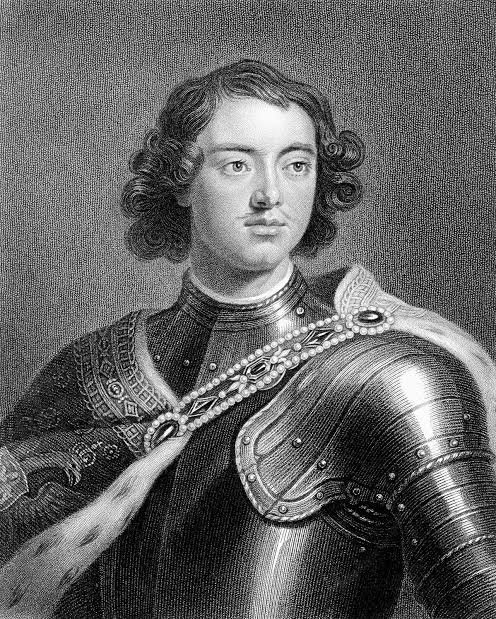
Peter the Great (born June 9, 1672, Moscow, Russia—died February 8, 1725, St. Petersburg, Russia) was a Russian ruler who served as tsar from 1682 and as emperor from 1721 until his death. A member of the Romanov dynasty, he is best known for transforming Russia into a major European power through military expansion, government reforms, modernization, and the development of a powerful navy. He founded St. Petersburg, introduced major changes to Russian society and administration, and helped establish the Russian Empire.
Early Life and Family Background
Peter was born Pyotr Alekseyevich Romanov in Moscow on June 9, 1672. He was the son of Tsar Alexis I and his second wife, Natalya Naryshkina. He was the youngest son of Alexis and had several older half-siblings from his father’s first marriage.
Peter’s childhood was shaped by conflict within the royal family. His father died in 1676, leaving the throne to Peter’s older half-brother, Fyodor III. Because Fyodor was frequently ill and had no surviving children, questions about the future succession became increasingly important.
Peter grew up in a period when Russia was still governed by traditional customs and a powerful noble class. The country had limited contact with Western European developments compared with many other European states. Its government, military, economy, and social institutions followed practices that Peter would later attempt to change.
During his childhood, Peter spent considerable time at royal estates outside central Moscow. He received a relatively limited formal education but developed a strong interest in practical subjects, including mathematics, military equipment, shipbuilding, and engineering. He also enjoyed physical activities and working with tools.
These interests became important parts of his personality. Rather than concentrating only on court ceremonies and traditional royal responsibilities, Peter showed curiosity about how machines, weapons, ships, and foreign technologies worked.
Becoming Tsar of Russia
In 1682, Fyodor III died without an heir. Peter was chosen as tsar, but his older half-brother Ivan V was also declared tsar because of a dispute over the succession. Since both were children, their older half-sister Sophia Alekseyevna became regent and effectively controlled the government.
Sophia’s rise to power was supported by the Streltsy, a military force that served the Russian rulers. Their involvement in the succession crisis led to violent unrest in Moscow. Several members of Peter’s family and supporters were killed during the disturbances, leaving a lasting impression on the young tsar.
Peter and Ivan formally shared the throne, while Sophia governed as regent. Peter spent much of this period away from the main royal court, particularly in the villages of Preobrazhenskoye and Semenovskoye near Moscow.
As he grew older, Peter began organizing groups of young men for military exercises. What started as childhood military games developed into more organized training units. These groups eventually became the foundation of important regiments in his future army.
In 1689, Peter gained enough political support to challenge Sophia’s authority. She was removed from power and sent to a convent. Although Peter and Ivan remained joint tsars, Peter increasingly controlled the government.
Ivan died in 1696, leaving Peter as Russia’s sole ruler.
Marriage and Personal Life
Peter married Eudoxia Lopukhina in 1689, when he was still a teenager. The marriage was arranged according to royal tradition rather than based on a romantic relationship.
They had three sons, including Alexei Petrovich, who was born in 1690. However, their marriage became increasingly unhappy. Peter preferred military activities, travel, and technical projects, while Eudoxia represented the traditional royal society that he increasingly rejected.
In 1698, after returning from his European journey, Peter forced Eudoxia to enter a convent. Their son Alexei remained in Russia and was raised largely outside his father’s immediate influence.
Peter later became involved with Martha Skavronskaya, a woman of humble background who eventually became Catherine I. She converted to Russian Orthodoxy and married Peter in 1712. The couple had several children, including two daughters who survived into adulthood: Anna and Elizabeth.
Peter’s relationships were often complicated by his demanding personality and political responsibilities. His family life was also affected by his determination to control the future of the Russian monarchy.
The Grand Embassy and Journey Through Europe
One of the most important experiences of Peter’s early reign was his journey through Western Europe between 1697 and 1698, known as the Grand Embassy.
Peter wanted to understand how European countries developed their military strength, built ships, organized governments, and expanded trade. He also hoped to establish alliances against the Ottoman Empire, which controlled important territories near Russia’s southern borders.
Unlike many monarchs, Peter traveled under an assumed identity as an ordinary member of the Russian delegation. This allowed him to observe European institutions and work with specialists more directly.
He visited several countries, including the Dutch Republic, England, and parts of the German states. In the Netherlands, he studied shipbuilding and worked in a shipyard. The Dutch had one of the strongest commercial fleets in Europe, and Peter was particularly interested in their shipbuilding methods.
In England, he observed naval technology, manufacturing, scientific activities, and government institutions. He met skilled workers and specialists and learned about developments that could be useful in Russia.
Peter also recruited foreign engineers, military officers, shipbuilders, and other professionals to work in his country.
The journey was interrupted in 1698 when he received news of another Streltsy uprising in Russia. He returned home and ordered a severe investigation. The rebellion was suppressed, and many participants were executed or punished.
The experience strengthened Peter’s determination to reduce the influence of traditional military groups and bring Russian institutions under tighter royal control.
Modernizing Russia
After returning from Europe, Peter began introducing changes that affected nearly every part of Russian government and society.
He believed Russia needed stronger institutions, modern military equipment, better technical education, and closer connections with European trade and technology. His reforms were intended to make the country more competitive with powerful European states.
One of his early changes affected the appearance of Russian noblemen. Peter encouraged men in the upper classes to adopt Western European clothing and shave their traditional long beards. Those who wanted to keep their beards were sometimes required to pay a special tax.
He also changed court customs and encouraged greater participation in social gatherings that included women. Traditional Russian society generally kept women more separate from public social activities, but Peter promoted European-style gatherings and entertainment among the upper classes.
Education became another important concern. Peter supported schools that taught mathematics, navigation, engineering, and other practical subjects. He wanted Russia to produce its own specialists rather than depend entirely on foreign experts.
In 1701, he established a school of mathematics and navigation in Moscow. Other educational institutions followed, particularly those connected with military and technical training.
Peter also encouraged the development of printing, scientific knowledge, manufacturing, and specialized workshops. He brought foreign experts into Russia and sent Russian students abroad to learn useful skills.
These changes were not equally available to everyone. They primarily affected the nobility, military, government officials, and people working in important industries.
Government and Administrative Reforms
Peter reorganized the Russian government to make it more efficient and better suited to supporting a large military and expanding state.
In 1711, he established the Governing Senate, which was intended to oversee government affairs when he was away on military campaigns. It gradually became an important administrative institution.
He also reorganized the country into larger administrative territories, known as governorates, to improve taxation, military recruitment, and local government.
In 1717, Peter began replacing older government departments with a system of specialized boards, which became fully established in the following years. Each board handled a particular area of government, such as foreign affairs, military administration, or finances.
These reforms reduced the independence of traditional institutions and increased the authority of the central government.
Peter also changed the relationship between the monarchy and the Russian Orthodox Church. After the death of Patriarch Adrian in 1700, he did not allow another patriarch to be appointed. In 1721, he established the Holy Synod, a government-supervised body that managed church affairs.
This arrangement placed the Orthodox Church under much closer state control than before.
Another important change came in 1722, when Peter introduced the Table of Ranks. This system organized military, civil, and court positions into a hierarchy of ranks. Advancement was intended to depend more on service and ability than simply on noble birth, although family connections and social privilege continued to matter.
The reforms made the Russian government more centralized and gave the ruler greater control over public institutions.
Military Reforms and the Growth of the Russian Navy
Peter understood that Russia could not become a major European power without a strong military. He therefore devoted enormous attention to reorganizing the army and developing a modern navy.
Before his reign, Russia relied heavily on traditional military formations, including the Streltsy and various noble cavalry forces. Peter introduced a more permanent army based on European military organization and training.
He expanded the use of firearms, improved artillery, established military schools, and developed a system of recruitment that required communities to provide men for military service.
Military service could be extremely demanding. Soldiers often served for many years, and recruitment placed heavy burdens on ordinary Russian families.
Peter’s naval ambitions were equally important. Russia had limited access to major European trade routes, and its lack of a powerful fleet restricted its ability to influence surrounding seas.
During the 1690s, he began developing a navy in connection with Russia’s efforts to gain access to the Sea of Azov. He encouraged shipbuilding and created facilities for training sailors and naval officers.
The establishment of a permanent navy became one of the most important features of his military program. Russian shipyards expanded, foreign specialists were recruited, and Russian officers received training in navigation and naval warfare.
These developments eventually gave Russia the ability to challenge established maritime powers in the Baltic region.
The Great Northern War
One of the defining events of Peter’s reign was the Great Northern War, fought from 1700 to 1721.
The conflict involved Russia, Denmark-Norway, and Saxony-Poland against Sweden, which was then a major European military power. The main goal of the alliance was to weaken Swedish control over territories around the Baltic Sea.
At the beginning of the war, Russia suffered a major defeat at the Battle of Narva in November 1700. Swedish forces under King Charles XII defeated the Russian army, exposing serious weaknesses in its training, organization, and equipment.
Peter responded by continuing his military reforms. He expanded the army, improved artillery, and developed Russia’s military production capacity.
In 1703, Russian forces captured territory near the mouth of the Neva River, where Peter founded St. Petersburg. The location provided access to the Baltic Sea and became a central part of his plans for Russia’s future.
The most important Russian victory came at the Battle of Poltava in 1709. Peter’s army defeated Charles XII’s forces in what became a turning point in the war. The Swedish king escaped to Ottoman territory, while Sweden’s military position weakened considerably.
The conflict continued for more than a decade. Russia fought further campaigns and eventually secured control over important Baltic territories.
The Treaty of Nystad, signed in 1721, formally ended the war. Sweden recognized Russia’s control over several territories, including Estonia, Livonia, Ingria, and part of Karelia.
The victory gave Russia access to the Baltic Sea and greatly increased its influence in northern Europe.
The Founding of St. Petersburg
In 1703, Peter founded the city of St. Petersburg on land captured from Sweden during the Great Northern War.
He chose the location near the Baltic Sea because he wanted Russia to have a major port connected to European trade and naval routes. The city was also intended to represent the country’s growing connections with Western Europe.
Construction began in difficult conditions. The surrounding area included marshes, islands, and waterways, making building projects challenging.
Peter ordered workers, soldiers, and laborers to take part in construction. Many people were forced to work under harsh conditions, and thousands died from disease, exhaustion, and other hardships.
The city developed around important government buildings, military facilities, shipyards, and commercial centers. Peter encouraged foreign architects and engineers to help shape its design.
In 1712, St. Petersburg became the capital of Russia, replacing Moscow as the center of government.
Peter also built a residence at Peterhof, outside the new capital, which later became famous for its palaces, gardens, and fountains.
The city remained a central symbol of Peter’s ambitions throughout the rest of his life.
Economic and Social Changes
Peter’s military and government reforms required enormous financial resources. To support these efforts, he encouraged the growth of manufacturing, mining, trade, and other industries.
He promoted iron production, weapons manufacturing, textiles, shipbuilding, and the development of factories. Many of these industries were established to supply the army and navy.
The government offered financial support and privileges to certain manufacturers and recruited foreign specialists to improve production methods.
Peter also worked to expand Russia’s commercial connections with Europe. The new Baltic port of St. Petersburg helped increase trade and provided a stronger base for naval activities.
However, the economic changes placed heavy pressure on ordinary people. The government increased taxes and expanded compulsory labor and military service.
In 1718, Peter introduced a household-based tax system that was intended to improve revenue collection. It was later replaced by a poll tax, which was assessed on male members of the taxable population rather than on households.
The burden of these policies fell especially heavily on peasants, who already faced restrictions on their freedom and were required to support the landowning class.
Peter’s reforms also affected the nobility. Noblemen were expected to serve the state in military or civil positions and were increasingly required to receive practical education.
Although some opportunities for advancement expanded, the social structure remained highly unequal. Serfdom continued, and the government’s demand for labor often strengthened the control landowners exercised over peasants.
Conflict With His Son Alexei
Peter’s relationship with his eldest surviving son, Alexei Petrovich, became increasingly troubled.
Alexei was raised in a more traditional environment and did not share his father’s enthusiasm for Western European reforms and military expansion. Peter became dissatisfied with his son’s lack of interest in the responsibilities expected of a future ruler.
Their disagreements grew more serious as Alexei reached adulthood. Peter wanted him to support the state’s modernization program, but Alexei preferred a quieter life and appeared unwilling to follow his father’s political direction.
In 1716, Alexei fled Russia and sought protection in the Austrian territories. Peter considered this a serious threat to the future of the monarchy.
After negotiations, Alexei returned to Russia in 1718. He was forced to renounce his claim to the throne and was questioned about his departure and alleged supporters.
The investigation became a major political affair. Alexei was accused of plotting against his father and was sentenced to death.
He died in prison in June 1718, after being subjected to questioning and torture. The exact circumstances surrounding his death have been the subject of historical discussion, but he died before the sentence could be carried out publicly.
The loss of his son deeply affected the question of royal succession, which remained unresolved during the final years of Peter’s reign.
Becoming Emperor of Russia
Following the victory in the Great Northern War, Peter’s political position grew stronger.
In 1721, the Russian Senate and other officials formally granted him the titles of Emperor of All Russia and Father of the Fatherland. Russia was no longer officially a tsardom but an empire.
The new title reflected the country’s increased military and political power following its victory over Sweden.
Peter continued to reorganize the government and strengthen the institutions he had created. His attention remained focused on military development, trade, administration, and expanding Russia’s international influence.
His government also continued pursuing interests in the Caspian region. In 1722, Peter launched a campaign against territories along the western and southern shores of the Caspian Sea.
The campaign resulted in Russian control over several important coastal areas, although maintaining them would remain a challenge.
By the final years of his reign, Russia had become a major force in European politics, with a modernized military, a growing navy, and a new capital connected to Baltic trade.
Final Years and Death
Peter’s final years were affected by ongoing political responsibilities, military planning, and personal health problems.
He continued traveling, overseeing government projects, and taking an active interest in technical and industrial developments. His working habits remained demanding, and he often involved himself directly in matters that other rulers might have left to their officials.
In 1724, he arranged for his wife, Catherine, to be crowned empress. This decision strengthened her position but did not formally establish her as his successor.
Peter had not clearly settled the question of who would inherit the throne. His son Alexei was dead, and his remaining children did not provide an obvious male heir.
In late 1724, Peter became seriously ill after reportedly entering the cold water of the Gulf of Finland to help rescue sailors from a stranded boat. He developed a severe bladder and urinary tract illness.
His condition worsened during the following months. Despite medical treatment, he died in St. Petersburg on February 8, 1725, at the age of 52.
Peter was buried in the Peter and Paul Cathedral in St. Petersburg. His wife, Catherine I, succeeded him as ruler of Russia, beginning a new period in the history of the Romanov dynasty.