For most of human history, the search for life beyond Earth focused almost entirely on planets. Moons were seen as secondary objects—icy companions circling larger worlds, inert and lifeless. That view has changed dramatically in the last few decades. As spacecraft have explored the outer solar system in increasing detail, a startling realization has emerged: some of the most promising environments for life may not be planets at all, but moons.
These worlds are shaped by forces very different from those acting on Earth. Instead of sunlight alone driving geology and chemistry, many of these moons are energized by gravity itself. Tidal forces generated by massive planets stretch and squeeze their moons, producing internal heat that can melt ice, drive geological activity, and sustain vast underground oceans. In the darkness far from the Sun, these hidden seas may provide stable environments where life could arise and persist.
What makes these moons especially compelling is not speculation, but evidence. Multiple lines of observation suggest the presence of liquid water, organic molecules, and energy sources—the three fundamental ingredients for life as we understand it. The following five moons stand out as the most intriguing and scientifically credible candidates for harboring life in our solar system.
1. Europa: The Ocean World Beneath the Ice
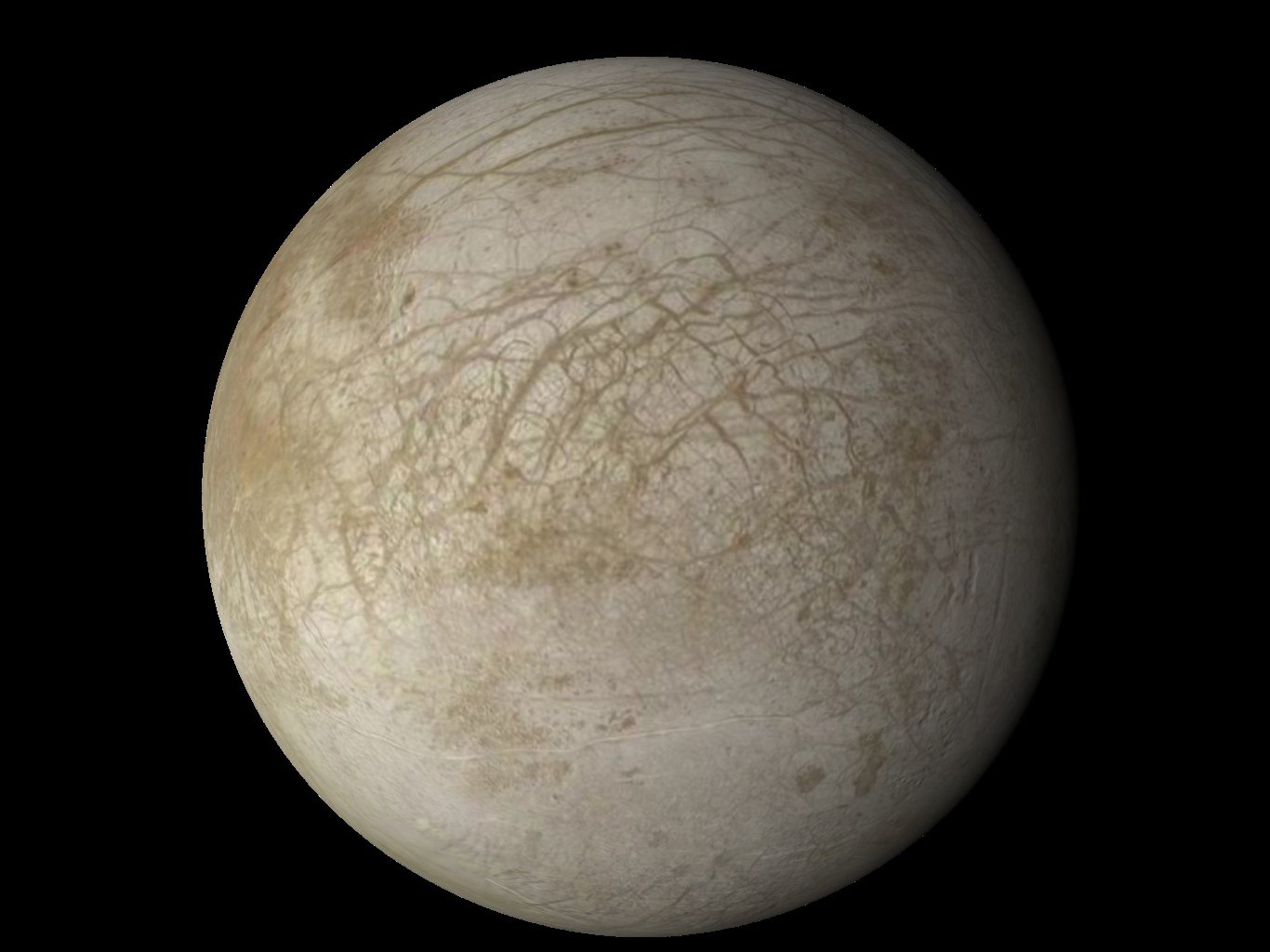
Europa, one of Jupiter’s largest moons, has long been regarded as one of the most promising places to search for extraterrestrial life. At first glance, Europa appears to be an unremarkable ball of ice, its surface crisscrossed by dark, reddish lines. Yet beneath that frozen exterior lies a world of astonishing complexity and potential.
Europa’s surface is composed primarily of water ice, but it is unlike the thick, immobile ice sheets found on Earth. The surface is geologically young, with relatively few impact craters, suggesting that it is constantly being renewed. This renewal is driven by tidal heating. As Europa orbits Jupiter, the planet’s immense gravity stretches and compresses the moon, generating internal heat that prevents its interior from freezing solid.
Scientific measurements strongly indicate that Europa harbors a global subsurface ocean of liquid water beneath its icy shell. This ocean is thought to be tens to perhaps over a hundred kilometers deep, containing more water than all of Earth’s oceans combined. The ice crust above it may be relatively thin in places, possibly only a few kilometers thick, allowing interactions between the surface and the ocean below.
The chemistry of Europa further strengthens its case for habitability. Observations suggest the presence of salts and other minerals on the surface, likely originating from the ocean beneath. These materials imply ongoing exchange between the interior and the surface, a crucial factor for sustaining chemical complexity. Additionally, Europa’s ocean is believed to be in contact with a rocky mantle, allowing water-rock interactions similar to those that support life in Earth’s deep-sea hydrothermal vents.
Energy, the final requirement for life, is provided through tidal heating and possibly chemical reactions within the ocean. On Earth, ecosystems thrive in complete darkness around hydrothermal vents, powered not by sunlight but by chemical energy. Europa’s ocean could host similar environments, making it one of the most compelling locations for life beyond Earth.
Europa is mysterious not because it is unknown, but because what is known points toward extraordinary possibilities. It is a silent, frozen world that may conceal a warm, dynamic ocean—a hidden habitat waiting to be explored.
2. Enceladus: A Small Moon with a Powerful Secret
If Europa is a world of quiet promise, Enceladus is a world of dramatic revelation. This small moon of Saturn, barely 500 kilometers in diameter, has transformed our understanding of where life might exist. Despite its modest size, Enceladus has proven to be one of the most active and intriguing bodies in the solar system.
Enceladus is covered in bright, reflective ice, but its south polar region is marked by deep fractures known as “tiger stripes.” From these cracks, towering plumes of water vapor, ice particles, and organic compounds erupt into space. These geysers were directly observed by spacecraft, providing unambiguous evidence of liquid water beneath the surface.
The source of these plumes is a subsurface ocean located beneath Enceladus’s icy crust. Like Europa, this ocean is maintained by tidal heating generated as Saturn’s gravity flexes the moon’s interior. What makes Enceladus especially remarkable is that its ocean is actively venting material into space, allowing scientists to analyze its composition without drilling through kilometers of ice.
Chemical analysis of the plumes has revealed water, salts, simple organic molecules, and molecular hydrogen. The presence of hydrogen is particularly significant because it suggests ongoing hydrothermal activity at the ocean floor, where hot water interacts with rock. On Earth, such environments are rich in chemical energy and support diverse microbial life.
The ocean of Enceladus is also thought to be in direct contact with a rocky core, creating conditions favorable for complex chemistry. The combination of liquid water, organic molecules, and a continuous energy source places Enceladus among the most compelling habitats for life beyond Earth.
Emotionally, Enceladus reshapes expectations. It demonstrates that even small, seemingly insignificant moons can harbor environments of astonishing richness. It is a reminder that life does not require a planet-sized world or proximity to the Sun—only the right balance of conditions, quietly sustained over time.
3. Titan: A World Where Chemistry Runs Wild
Titan, Saturn’s largest moon, stands apart from every other moon in the solar system. It is not just an icy body with a hidden ocean; it is a world with a dense atmosphere, complex weather, and a surface shaped by flowing liquids. Titan feels less like a moon and more like an alien version of Earth.
Titan’s atmosphere is thick and nitrogen-rich, with a pressure at the surface greater than that of Earth. Suspended within it are organic molecules formed through chemical reactions driven by sunlight and energetic particles. These compounds give Titan its hazy, orange appearance and rain down onto the surface over time.
At Titan’s surface temperatures, water behaves like rock, frozen solid and immobile. Instead, the liquids that flow across Titan’s surface are hydrocarbons, primarily methane and ethane. Rivers carve channels, lakes pool in lowlands, and rain falls from the sky, creating a complete weather cycle based on chemistry unfamiliar to Earth.
Beneath this exotic surface, Titan is believed to host a subsurface ocean of liquid water mixed with ammonia. This ocean is kept warm by internal heat and possibly tidal interactions with Saturn. While separated from the surface by a thick ice shell, this hidden ocean could provide a more Earth-like environment for life based on water chemistry.
Titan’s uniqueness lies in its chemical richness. Organic molecules on Titan are abundant and complex, forming a natural laboratory for studying the building blocks of life. Even if life does not exist there today, Titan may resemble the chemical environment of early Earth before life emerged.
The possibility of life on Titan challenges assumptions. It suggests that life may not be limited to environments that closely resemble Earth’s surface conditions. Titan invites scientists to consider alternative forms of biochemistry, expanding the definition of habitability and deepening our understanding of life’s potential diversity.
4. Ganymede: The Largest Moon with a Hidden Ocean
Ganymede, Jupiter’s largest moon, is the largest moon in the entire solar system, even exceeding the planet Mercury in size. Yet despite its scale, Ganymede often receives less attention than Europa. This is surprising, given the compelling evidence that Ganymede also harbors a subsurface ocean and possesses unique physical characteristics.
Ganymede’s most distinctive feature is its intrinsic magnetic field, the only known moon to generate one. This magnetic field indicates a complex interior structure, including a liquid, electrically conductive layer. Measurements suggest that beneath Ganymede’s icy surface lies a vast ocean of saltwater, possibly layered between different phases of ice.
Unlike Europa’s ocean, which is thought to be in direct contact with rock, Ganymede’s ocean may be separated from the rocky mantle by layers of high-pressure ice. This separation could limit chemical interactions, potentially reducing the ocean’s habitability compared to Europa or Enceladus. However, the sheer size and stability of Ganymede’s ocean make it scientifically intriguing.
Ganymede’s magnetic field interacts with Jupiter’s powerful magnetosphere, creating complex electromagnetic environments. These interactions may influence the movement of charged particles and contribute to internal heating. While the energy available may be lower than in more geologically active moons, it could still support long-term stability.
Ganymede represents a quieter kind of mystery. It is a world of immense scale and subtle activity, where conditions may be less dramatic but more enduring. Its ocean, shielded beneath layers of ice, could have existed for billions of years, offering a stable environment in which life, if it arose, might persist over geological timescales.
5. Callisto: The Ancient and Undisturbed Candidate
Callisto, another of Jupiter’s large moons, is often described as geologically dead. Its surface is heavily cratered, preserving a record of impacts from the early solar system. For a long time, this apparent inactivity led scientists to dismiss Callisto as a candidate for life. More recent evidence has changed that perspective.
Measurements of Callisto’s magnetic properties suggest the presence of a subsurface ocean beneath its icy crust. This ocean is likely composed of salty water, which can conduct electricity and explain observed magnetic interactions with Jupiter’s magnetosphere. Unlike Europa or Enceladus, Callisto shows little evidence of active geology or surface renewal.
This lack of activity may actually be an advantage. Callisto’s interior appears to have remained relatively undisturbed for billions of years, providing a stable environment over immense spans of time. Stability is a crucial factor in the development of life, allowing chemical processes to proceed without catastrophic disruption.
The ocean within Callisto is thought to be buried deep beneath thick layers of ice, making interactions with the rocky interior less certain. As a result, available energy sources may be limited compared to other moons. However, even low-energy environments on Earth support life, particularly microbial ecosystems that rely on slow chemical reactions.
Callisto represents the possibility that life does not require dramatic geological activity, only persistence. It is a reminder that habitability is not defined by spectacle, but by the quiet endurance of suitable conditions across deep time.
Conclusion: Why Moons May Be the True Havens for Life
The five moons explored here—Europa, Enceladus, Titan, Ganymede, and Callisto—reveal a profound truth about the solar system. Life-friendly environments may be far more common than once imagined, hidden beneath ice shells and sustained by gravitational energy rather than sunlight.
These moons challenge the traditional notion of a habitable zone defined solely by distance from a star. Instead, they demonstrate that internal heat, chemical complexity, and long-term stability can create life-supporting environments even in the cold outer reaches of a planetary system.
Emotionally, these worlds invite humility and wonder. They suggest that life’s story may not be confined to a single planet, and that the universe is more inventive than human imagination once allowed. As future missions probe these moons in greater detail, we may discover that life does not cling to the margins of possibility—but thrives wherever physics, chemistry, and time quietly conspire to make it so.