One day—far beyond the lifetimes of stars, planets, and even atoms—the universe will draw its final breath. The cosmic story that began with a blinding explosion of light and energy will, in some distant future, fall silent. Everything that exists—the galaxies swirling across the void, the light of a billion suns, the rhythm of time itself—will come to an end.
The thought is at once terrifying and beautiful. We live inside a living universe, full of creation and destruction, growth and decay. Stars are born, live glorious lives, and die in spectacular explosions. Galaxies collide, merge, and evolve. Yet every act of creation carries within it the seed of its own demise.
To ask what will happen when the universe ends is to ask about the destiny of everything that ever was—and to confront our place in a cosmos that is both infinite in scale and finite in time.
The Memory of the Beginning
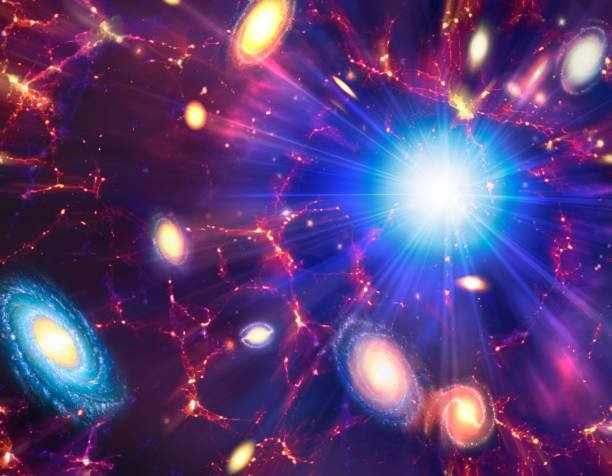
To understand the end, we must first return to the beginning. About 13.8 billion years ago, the universe was born in an event we call the Big Bang—a moment when all space, time, matter, and energy erupted from a singular, infinitely dense state. There was no “before” this moment, because time itself began with it.
In the earliest fractions of a second, the universe expanded faster than light, smoothing out space and scattering energy in all directions. As it cooled, particles formed—protons, neutrons, and electrons—eventually giving rise to atoms, stars, and galaxies.
That expansion has never stopped. Even now, galaxies drift farther apart, carried by the silent stretching of spacetime. The same cosmic expansion that gave birth to everything we know also ensures that, one day, everything will fade away.
The Expanding Universe and the Fate of Everything
For billions of years, astronomers believed gravity would slow the universe’s expansion. They imagined two possible futures: a universe that would expand forever but gradually cool, or one that would eventually collapse back in on itself in a fiery end known as the Big Crunch.
But in the late 1990s, a discovery transformed cosmology. By studying distant supernovae, scientists found that the universe’s expansion isn’t slowing down—it’s speeding up. Something unseen, a mysterious force we call dark energy, is pushing galaxies apart at an accelerating rate.
This revelation changed everything. It means that the universe’s fate is not just to expand—it is to do so ever faster, tearing itself apart in slow, inevitable isolation.
The Age of Stars
Right now, we live in what physicists call the Stelliferous Era—the age of stars. It began hundreds of millions of years after the Big Bang, when the first stars ignited from vast clouds of hydrogen and helium.
These stars forged the heavier elements—carbon, oxygen, iron—inside their fiery hearts, then scattered them into space through supernovae. Those atoms eventually formed new stars, planets, and, in at least one tiny corner of the cosmos, life itself.
But this age will not last forever. Stars are finite engines of fusion. They burn their fuel and eventually die. The most massive stars will explode in supernovae or collapse into black holes, while smaller stars, like our Sun, will swell into red giants and then fade into white dwarfs—hot, dense remnants that glow weakly for billions of years.
The age of light and warmth will end when the last stars flicker out.
The Death of the Sun
Our own Sun is about halfway through its life. In roughly 5 billion years, it will exhaust the hydrogen in its core and begin fusing helium. This process will cause it to swell into a red giant, engulfing Mercury and Venus, and possibly even Earth.
For a time, its outer layers will shimmer and pulse, painting the sky in waves of orange and crimson. Eventually, those layers will drift away, forming a glowing nebula—a cosmic tombstone marking the Sun’s transformation.
What remains will be a white dwarf: a small, dense, slowly cooling ember of what was once a star. Over trillions of years, that ember will fade into darkness, becoming a black dwarf—a corpse of frozen carbon in an empty sky.
The Slow Dimming of the Cosmos
As eons pass, galaxies will grow darker. The great spiral arms will lose their glittering stars. Only the faint red glow of long-lived dwarf stars will remain.
Trillions of years into the future, even those small stars will exhaust their fuel. The universe will enter a time of deep twilight—a Degenerate Era, dominated not by living stars but by the remnants of the dead.
White dwarfs, neutron stars, and black holes will drift silently through the blackness. The night sky, once ablaze with a billion points of light, will be dark. Galaxies will fade into ghostly shapes, their outlines dissolving into the infinite cold.
And yet, even then, physics continues its silent dance.
The Reign of Black Holes
Black holes will become the lords of the dark universe. They will roam through the cosmic night, swallowing stars, planets, and even other black holes. Each merger will send ripples through spacetime—gravitational waves, the final echoes of cosmic drama.
But even black holes cannot last forever. According to Stephen Hawking’s revolutionary insight, black holes slowly evaporate through a process known as Hawking radiation. They emit tiny amounts of energy, losing mass over time, until eventually they disappear completely in a final burst of radiation.
For the smallest black holes, this takes an unfathomable span of time—about 10⁶⁷ years for a solar-mass black hole, and far longer for the supermassive ones that anchor galaxies. But eventually, even they will die, leaving behind only a thin mist of radiation spreading through infinite emptiness.
When the last black hole evaporates, the universe will be a sea of fading particles and ghostly photons, forever expanding into the void.
The Era of Darkness
After the reign of black holes ends, the universe will enter its final and longest epoch—the Dark Era.
By then, all stars will be gone, all galaxies dissolved. The cosmos will consist mostly of elementary particles drifting apart in near-perfect stillness. Protons themselves may decay, transforming into lighter particles and radiation.
If that happens, the universe will become a thin, cold soup of electrons, neutrinos, and photons—each particle separated from the next by unimaginable distances. Temperatures will approach absolute zero. Motion itself will nearly cease.
This is not the fiery apocalypse of myth, but a slow, quiet fading—a cosmic winter without end.
The Heat Death of the Universe
Physicists call this final stage the heat death of the universe. It doesn’t mean the universe burns—it means it runs out of usable energy.
All processes—star formation, radiation, motion—require a difference in energy, a contrast between hot and cold, light and dark. When everything reaches the same temperature, no work can be done. Entropy, the measure of disorder, reaches its maximum.
In this final equilibrium, time loses its meaning. Nothing changes because there is no energy left to drive change.
The universe will not explode or collapse—it will simply fade into stillness, a silent, cold ocean of existence without memory or motion.
The Big Rip: A Universe Torn Apart
Yet the story may not end so quietly. If dark energy grows stronger over time, it could lead to an even more dramatic fate—the Big Rip.
In this scenario, the acceleration of cosmic expansion keeps increasing until it overcomes all forces holding matter together. First, galaxies drift apart. Then, stars are torn from galaxies, planets from stars. Eventually, the very atoms of matter are ripped apart by the stretching of spacetime itself.
When that happens, space and time themselves would unravel. The universe would end not in silence but in an ultimate shattering—a cosmic tearing of every bond that ever existed.
It would be the most catastrophic event imaginable: the unmaking of everything.
The Big Crunch: A Universe Reborn
There is another possibility—a more cyclical, almost poetic one. If, for some reason, dark energy changes behavior and gravity regains dominance, the expansion of the universe might one day slow, stop, and reverse.
Galaxies would begin to drift back toward one another. The sky would grow brighter as cosmic structures collapsed inward. Temperatures would rise again as matter compressed.
Eventually, all of space and time would collapse into a single, infinitely dense point—a mirror image of the Big Bang. This is the Big Crunch, the idea that the universe might one day die in fire as it was born in fire.
And from that final collapse, perhaps a new universe could emerge—a rebirth in an eternal cosmic cycle of expansion and contraction.
The Multiverse and Eternal Inflation
Some cosmologists believe that our universe might be only one bubble in a vast cosmic foam—a multiverse of endless other universes.
According to the theory of eternal inflation, new universes are constantly being born, each expanding within its own bubble of spacetime. In that case, the end of our universe might not be the end of everything, but just one chapter in an infinite story.
Perhaps the death of one cosmos is the seed of another. Perhaps every Big Bang is the echo of a prior collapse, and creation and destruction are eternally entwined.
In such a vision, the universe never truly ends—it transforms.
The Fate of Time Itself
Time is the most mysterious part of this story. If the universe ends in heat death, with no change or motion, does time still exist? If nothing ever happens, can there still be a “later” moment?
Many physicists believe that time is tied to change. Without change, time loses its meaning. In the final, frozen universe, the ticking of clocks will cease—not because they break, but because there will be nothing left to measure.
It will be as though the universe has fallen into an eternal pause—frozen forever in the silence after its last heartbeat.
The Human Connection to the Cosmic End
When we contemplate the end of the universe, it can feel unbearably bleak. The idea that everything—every dream, every life, every star—will one day vanish seems to erase meaning itself.
But physics offers another way to see it. The fact that we can understand the universe’s fate, that our minds can reach across billions of years and touch the edges of time, is itself a miracle.
We are made of stardust, forged in the same processes that will one day fade. We are temporary expressions of the universe’s own creativity. When we look up at the night sky, we are seeing our origins—and, in a sense, our destiny.
Our lives are short, but they are luminous. We shine briefly, like stars, in the great darkness.
Echoes of Light in the Endless Night
Even after the last stars fade, light will linger—weak, stretched by expansion, reduced to ghostly microwaves. These photons will carry with them the memory of everything that ever was, the afterglow of existence itself.
Every thought, every heartbeat, every sunrise will have been part of the same cosmic story that began in brilliance and ends in silence.
And yet, in that silence, there is a strange kind of peace. The universe will not rage against its ending; it will simply drift into tranquility, as though exhaling after an eternity of creation.
The Universe as a Poem of Impermanence
The end of the universe is not a tragedy—it is a reminder that impermanence is woven into the fabric of existence. Everything that begins must one day end, and in that ending lies the beauty of the journey.
Stars are born because earlier stars died. Planets form from the ashes of old worlds. Life arises in the spaces carved by destruction. The universe’s fate is not an error or a flaw—it is part of the same creative cycle that allows beauty, meaning, and consciousness to exist at all.
Even in its final moment, the universe will still be perfect in its completeness—a cosmic poem concluding on its last, silent verse.
The Final Whisper
Imagine the last instant of time. The universe, now cold and dark, stretches endlessly. No stars, no galaxies, no atoms—just faint radiation and the ghostly geometry of spacetime.
There will be no eyes to see it, no minds to comprehend it. But in that final stillness, every law of physics, every act of creation, every particle that ever existed will have played its part in the grandest story ever told.
Perhaps, in that instant, somewhere beyond, another universe will bloom.
Or perhaps the silence itself is the final word—a whisper of completion echoing through the void.
The Eternal Wonder
The universe may end, but wonder never does. Our curiosity, our longing to understand, our ability to feel awe—these are as eternal as the laws of nature themselves.
When you gaze at the night sky, you are looking not only backward in time but forward—to the ultimate destiny of all things. And though the stars will one day vanish, the light they leave behind—the knowledge, the love, the stories—will echo through every mind that dares to dream.
The universe will end. But its beauty, written in the hearts of those who gaze upon it, will never be lost.
Because even as everything fades, the story remains—the story of something that began as light, became life, and ended in peace.
The universe, in all its vastness, is not dying in despair. It is returning to silence.
And in that silence, perhaps, lies the purest form of eternity.