Are we alone—not just in the sense of life, but in the grander sense of existence itself? Is the universe that we see—the vast tapestry of stars, galaxies, and cosmic radiation—the only universe, or merely one bubble in a frothing ocean of infinite realities?
For centuries, human imagination has flirted with the idea of other worlds. From ancient myths of parallel heavens to modern physics’ daring equations, the dream of a multiverse has captured minds across time. Today, it stands not merely as speculation, but as one of the most intriguing—and controversial—questions in science.
The Multiverse Theory proposes that our universe might not be the totality of existence. Instead, we may live in just one “pocket” among countless others—each governed by its own laws of physics, its own constants of nature, perhaps even its own versions of reality.
The idea sounds fantastical, yet it arises naturally from the deepest frameworks of modern physics—from quantum mechanics to cosmology and string theory. What was once philosophical curiosity has become a scientific frontier, where mathematics hints at infinities beyond imagination.
But what does it truly mean to say that other universes might exist? Could there be infinite versions of you reading this same sentence, making different choices, living different lives? And if so, what does that say about reality, destiny, and meaning itself?
The Universe We Know—and the Mystery Beyond
Before diving into the multiverse, we must first appreciate the vastness of the universe we inhabit. Our observable cosmos stretches roughly 93 billion light-years across. It contains hundreds of billions of galaxies, each with billions of stars, and trillions of planets. To human intuition, that should be enough—a universe already almost infinite in scope.
And yet, physics tells us that what we can see is likely only a fraction of what exists. Beyond the horizon of visibility—beyond the reach of light that has had time to reach us since the Big Bang—space continues. There could be regions so far away that their light will never touch us, regions where matter, galaxies, and perhaps even laws of physics differ.
This realization opens the door to one of science’s most profound questions: what if our universe is just a single region within a much grander cosmic structure?
The Seeds of the Multiverse: Inflation and the Cosmic Dawn
To understand where the multiverse idea comes from, we must journey back to the dawn of time—13.8 billion years ago, when our universe was born in the Big Bang.
According to the theory of cosmic inflation, proposed by physicist Alan Guth in 1980, the universe began with a brief, staggering burst of exponential expansion. In a fraction of a second, space itself expanded faster than the speed of light, smoothing out irregularities and giving rise to the uniform cosmos we see today.
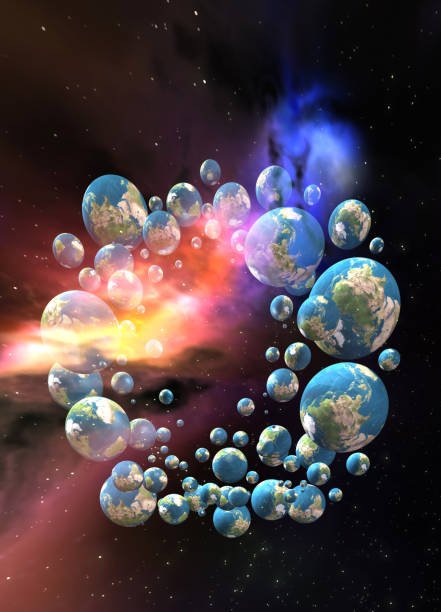
Inflation solved several cosmic puzzles, but it came with a surprising implication. According to some versions of inflationary theory, this expansion never completely stopped. In certain regions, space keeps inflating even now, endlessly spawning new “bubble universes.”
Each bubble—each “pocket universe”—emerges with its own physical conditions, its own constants, and perhaps its own dimensional makeup. In some, gravity might be stronger; in others, atoms might not form at all. Our universe could simply be one bubble in an eternal cosmic foam.
This idea is known as eternal inflation, and it’s one of the strongest physical motivations for the multiverse concept.
Quantum Possibilities and Parallel Realities
While inflation paints one version of the multiverse on a cosmic scale, another arises from the mysterious world of the quantum.
Quantum mechanics—the theory governing subatomic particles—reveals that nature is not deterministic. Instead, particles exist in a haze of probabilities, only “choosing” a definite state when observed or measured. But what if all possible outcomes happen—just in different universes?
This is the essence of the Many-Worlds Interpretation, first proposed by Hugh Everett III in 1957. According to this idea, every quantum event splits reality into multiple branches. When you flip a coin, one universe sees it land heads, and another sees it land tails. Both outcomes exist—each in its own version of reality.
These parallel worlds are not separate places in space but alternate dimensions of existence, each evolving independently after the split. They coexist invisibly, inaccessible to each other, yet just as real.
If this interpretation is true, then every decision you make, every random fluctuation of an atom, spawns a cascade of new universes—an unimaginable tree of realities where every possibility is played out.
The thought is staggering. Somewhere, another version of you took a different path, made a different choice, lived a different life. In the quantum multiverse, existence becomes an infinite tapestry of branching destinies.
The String Landscape: Universes from Vibrating Dimensions
Another compelling origin of the multiverse comes from string theory, the ambitious framework that seeks to unify all forces and particles under one elegant mathematical umbrella.
String theory posits that the fundamental building blocks of nature are not point-like particles but tiny, vibrating strings of energy. Their vibration patterns give rise to the particles and forces we observe.
But for the equations to work, string theory requires extra dimensions—beyond the familiar three of space and one of time. These hidden dimensions may be curled up in unimaginably small shapes known as Calabi–Yau manifolds.
The shape of these curled dimensions determines the physical laws of each universe—its constants, particle types, and interactions. And here’s where the astonishing part comes in: string theory allows for an almost inconceivable number of possible configurations—on the order of 10^500.
Each configuration could correspond to a different universe with its own laws of physics. This vast mathematical ensemble is called the string landscape, and if reality chooses randomly among these possibilities, we may indeed inhabit just one of countless distinct universes.
The implication is profound: the “fine-tuning” of our universe—the precise balance of forces that allows stars, planets, and life—might not be special design, but simply statistical happenstance in a vast cosmic lottery.
The Anthropic Principle: Why Our Universe Is Just Right
The multiverse theory raises a philosophical puzzle known as the anthropic principle. It asks: why does the universe appear so perfectly suited for life?
The laws of physics seem “fine-tuned” in delicate balance. If the strength of gravity or electromagnetism were even slightly different, atoms might not form, stars might not shine, and life as we know it would be impossible.
One explanation is that we live in a universe that happens to have the right conditions simply because we couldn’t exist in one that didn’t. In a multiverse containing countless universes with random parameters, most would be sterile—but in a few, like ours, life emerges, and conscious observers appear to notice.
This reasoning doesn’t prove the multiverse, but it gives a natural context for our existence without invoking special creation. We are, in a sense, cosmic survivors of probability—inhabitants of a universe where the dice happened to roll our way.
Levels of the Multiverse: The Many Faces of Infinity
Physicist Max Tegmark proposed that not all multiverses are the same; there may be levels of reality, each more exotic than the last.
The Level I Multiverse is the simplest: regions of space beyond our observable horizon. The universe may be infinite, and beyond the reach of light from Earth, there could be other “cosmic patches” that look different simply because initial conditions varied.
The Level II Multiverse arises from eternal inflation—each bubble universe with different physical constants or dimensions.
The Level III Multiverse corresponds to Everett’s Many-Worlds Interpretation of quantum mechanics, where all possible outcomes exist simultaneously.
And the Level IV Multiverse goes even further, suggesting that all mathematically possible realities exist. In this view, every self-consistent mathematical structure represents a real universe. Our physical world is just one among an infinite library of logical possibilities.
Each level stretches imagination and challenges what we mean by “existence” itself.
Evidence and the Challenge of Proof
The multiverse remains a bold idea—but can it ever be proven? Here lies its greatest challenge. By definition, other universes may be causally disconnected from ours, meaning we cannot directly observe or interact with them. If their light can never reach us, how can we know they’re real?
Some physicists argue that the multiverse is not a scientific hypothesis at all, since it cannot be tested. Others counter that indirect evidence could emerge—from patterns in cosmic microwave background radiation, or from the distribution of dark energy and matter hinting at interactions with other “bubbles.”
For example, some models predict that if two bubble universes collided early in cosmic history, they might leave subtle circular imprints in the background radiation. So far, none have been definitively found, but research continues.
Quantum mechanics, too, lends circumstantial support. The mathematics of quantum theory naturally allows many coexisting realities. While we cannot yet observe these other branches, the equations that predict them work flawlessly in every tested scenario.
In science, a theory’s worth lies not only in its testability but in its explanatory power. The multiverse elegantly addresses several puzzles: why the universe appears fine-tuned, why quantum mechanics works the way it does, and how cosmic inflation unfolds. It may not yet be proven, but it ties threads of physics together into a coherent vision.
The Philosophical Depth of Many Universes
Beyond physics, the multiverse carries deep philosophical and emotional resonance.
If there are infinite universes, then somewhere, every conceivable version of you might exist—one who took a different path, made a different choice, or never existed at all. The thought is both humbling and liberating.
It forces us to confront what it means to be real. If countless versions of “you” exist, each believing itself to be the original, then identity becomes less about individuality and more about perspective.
Yet, paradoxically, it also deepens the meaning of this life. Because in this particular universe, you are this version of yourself—experiencing this unique thread of reality. Among the infinite possibilities, your moment in this cosmos is utterly singular.
For some, the multiverse evokes existential unease. It suggests that our universe is not special, that meaning may be statistical rather than divine. But for others, it reveals a grandeur beyond comprehension—a universe so vast and creative that it births infinite worlds, each a unique expression of physical law and possibility.
The Multiverse and the Nature of God
The multiverse idea has also found unexpected dialogue with theology. Some thinkers see it as an extension of divine creativity: if a Creator exists, why would they make only one universe when infinite beauty is possible? Others see it as a way to remove the need for a Creator entirely—if infinite universes exist, then one like ours must arise by chance.
In both cases, the multiverse does not eliminate wonder—it magnifies it. Whether the source is divine or natural, the result is the same: a reality far richer and more mysterious than we can easily conceive.
The Emotional Universe: Awe, Fear, and Meaning
To contemplate the multiverse is to walk a razor’s edge between awe and vertigo. It expands our sense of what is possible but also reminds us of how small we are.
Standing beneath a starlit sky, we already feel the immensity of existence pressing on us. But to imagine that this entire cosmos is just one of countless universes—that there may be infinite skies, infinite galaxies, infinite versions of this moment—shatters even that vastness.
Yet within that infinitude lies something strangely comforting. If reality is infinite, then nothing is truly lost. Every possibility exists somewhere, every dream is realized in some corner of the multiverse, and every version of love, creation, and discovery unfolds eternally.
It transforms tragedy and triumph alike, suggesting that the story of existence never ends—it only branches, endlessly.
Scientific Skepticism: The Critics Speak
Of course, not all scientists embrace the multiverse idea. Some argue that it blurs the boundary between physics and philosophy, venturing into realms that can never be empirically verified.
Physicist Sabine Hossenfelder, for instance, cautions that the multiverse risks becoming a metaphysical distraction, untethered from observable science. Others, like Roger Penrose, argue that our universe may have a cyclical nature that explains its properties without invoking infinite others.
Still, even skeptics acknowledge that the equations of cosmology and quantum theory often point naturally toward multiverse-like structures. The debate, then, is not whether the math allows such realities—but whether those realities are physically real or simply mathematical abstractions.
This tension is healthy. It keeps physics honest, grounded in evidence while daring to dream beyond it. The multiverse remains a hypothesis on the horizon—beautiful, controversial, and deeply human.
Art, Imagination, and the Infinite
Beyond laboratories and equations, the multiverse has captured the imagination of artists, writers, and dreamers.
From science fiction to cinema, from literature to philosophy, the idea of parallel universes has become a powerful symbol of possibility. Stories like Doctor Strange in the Multiverse of Madness, Everything Everywhere All at Once, and Interstellar explore its emotional resonance—the idea that choices ripple through infinite worlds, and that love, loss, and meaning transcend dimensions.
Art gives us a way to feel what science describes. It turns abstract cosmology into human experience. Through storytelling, we glimpse what it might mean to live in a universe of infinite reflections—and perhaps find comfort in knowing that every version of us is still searching for understanding.
The Universe as a Question
Ultimately, the multiverse theory reminds us that physics is not just a catalog of facts—it’s a living, breathing exploration of mystery. Each discovery deepens the question rather than ends it.
Whether the multiverse exists or not, the act of asking changes us. It forces us to see beyond the boundaries of perception, to imagine existence without edges, to confront infinity not as an abstraction but as a possible truth.
Even if there is only one universe, the fact that it allows us to conceive of others is itself a miracle of consciousness. We are finite beings capable of imagining the infinite—a spark of awareness against the backdrop of eternity.
The Edge of Everything
Perhaps someday we will find evidence—mathematical, observational, or theoretical—that confirms the multiverse. Or perhaps we will learn that the universe we see is indeed the totality of reality. Either outcome will be extraordinary.
For now, the multiverse remains a bridge between science and imagination, between what we know and what we dream. It invites us to expand our concept of reality beyond comfort, to accept that existence might be far more creative, strange, and infinite than we ever dared to believe.
And maybe that is the true gift of the multiverse—not certainty, but wonder.
Because in the end, whether there are many universes or just one, we are still part of something vast beyond measure. We are stardust woven into awareness, gazing out into the infinite, asking the oldest question of all:
What if this isn’t all there is?
And somewhere, perhaps in another universe, another version of you is asking the same thing—whispering the same cosmic question into the endless dark.