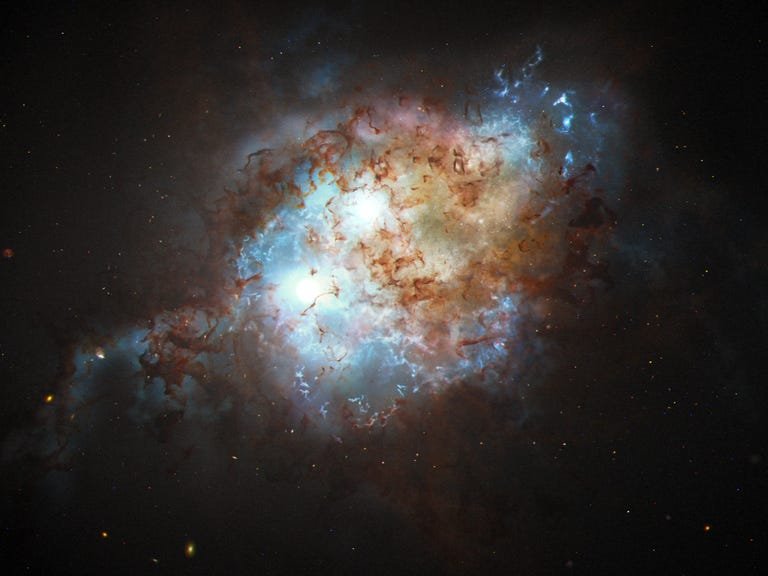
The universe is a theater of unimaginable power. Across its vast darkness, beyond the quiet shimmer of stars, lie objects so intense that even imagination struggles to contain them. They are the cosmic lighthouses—the roaring hearts of galaxies and the echoing remnants of dead stars. They are quasars and pulsars, two of the most powerful, awe-inspiring, and mysterious phenomena ever discovered.
To look upon them is to peer into the extremes of creation, where gravity and energy collide in their purest forms. A quasar can outshine entire galaxies, releasing more light than a trillion suns from a region smaller than our solar system. A pulsar, born from the death throes of a massive star, spins hundreds of times per second, firing beams of radiation with clockwork precision that rival the accuracy of atomic clocks.
These are not distant curiosities—they are the beating hearts of the universe’s story, telling us what happens when nature pushes itself to the brink of its own limits.
The Universe of Extremes
To understand quasars and pulsars, we must first accept that the universe does not play by the gentle rules we experience on Earth. Out there, gravity bends light, time slows, and energy erupts in torrents beyond comprehension.
Stars, those luminous furnaces that seem eternal to us, live finite lives. When massive ones reach their end, their death throes give birth to the strangest and most powerful objects in existence. Some collapse into black holes—gravitational abysses where even light cannot escape. Others compress into neutron stars—stellar corpses so dense that a teaspoon of their material would weigh billions of tons.
From these remnants come the two titans of astrophysical spectacle: quasars, powered by ravenous black holes at the centers of galaxies, and pulsars, the spinning neutron stars that sweep the cosmos with beams of radiation like celestial lighthouses.
They are opposite sides of a cosmic coin—one feeds on destruction, the other endures through death.
The Birth of Quasars
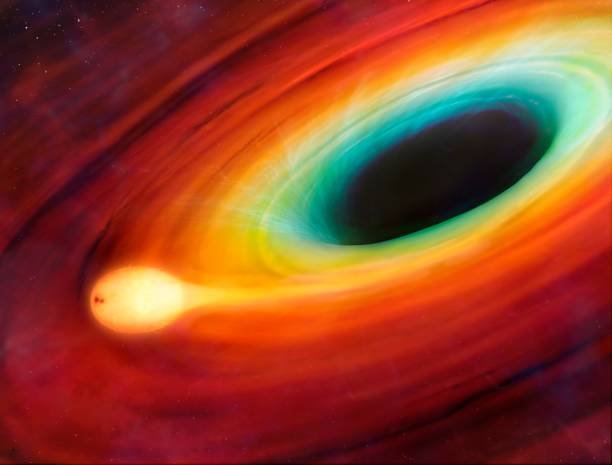
Imagine a galaxy, vast and ancient, its center hiding a black hole millions or even billions of times more massive than the Sun. Surrounding it lies a disk of gas, dust, and stellar debris spiraling inward, drawn by the irresistible gravity of that invisible giant.
As the matter falls, it compresses and heats, reaching temperatures of millions of degrees. The friction and magnetic fields within this swirling inferno release tremendous energy—not quietly, but in blinding brilliance. The resulting radiation can outshine every star in the galaxy combined.
This blazing beacon is a quasar, short for “quasi-stellar radio source.” The name reflects the confusion of the astronomers who first discovered them in the 1950s and 60s. Through early telescopes, quasars appeared like faint stars, yet their radio emissions were thousands of times stronger than anything a normal star could produce.
When their light was analyzed, it carried strange fingerprints—spectral lines shifted far toward the red end of the spectrum. This redshift meant that quasars were not nearby, but staggeringly distant, billions of light-years away. Given their faintness and distance, the only possible explanation was that they were radiating an almost inconceivable amount of energy.
The Engines of Galaxies
At the heart of every quasar lies a supermassive black hole, consuming matter with ferocious appetite. But paradoxically, it is not the black hole itself that shines. The light we see comes from the material just before it vanishes into oblivion—the accretion disk, a maelstrom of plasma and radiation swirling around the black hole’s event horizon.
This disk converts gravitational energy into light with astonishing efficiency. While a fusion reaction in a star like the Sun transforms less than 1% of mass into energy, an accretion disk can convert up to 40%. That means quasars are among the most efficient power sources in the universe, second only to the annihilation of matter and antimatter.
The result is a spectacle that defies human comprehension: a single quasar can emit more light than all the stars in 10,000 galaxies combined. Yet, the light emerges from a region no larger than our solar system.
The Light That Crosses Time
Because quasars are so distant, the light reaching us today left them billions of years ago. When we observe them, we are looking back into the deep past of the universe—when galaxies were young and the cosmos was still forming its grand architecture.
Many quasars we detect today no longer exist as they once were. Their central black holes have long since quieted, the fuel that fed their brilliance consumed. In a way, quasars are ancient fossils of cosmic adolescence, relics of an era when the universe burned with youthful intensity.
This makes them invaluable to cosmology. Quasars serve as beacons illuminating the vastness of intergalactic space. Their light, stretched and scattered by clouds of gas, reveals the composition of the early universe and the distribution of matter across billions of light-years.
To study quasars is to trace the cosmic history written in starlight—a record of how galaxies, and perhaps life itself, came to be.
Jets of Fury
But the story of quasars grows even more dramatic. Many of them unleash relativistic jets—streams of particles accelerated to nearly the speed of light, shooting out from the poles of the black hole’s accretion disk.
These jets can extend for millions of light-years, piercing through the surrounding galaxy and beyond. The exact mechanism that launches them remains one of astrophysics’ greatest mysteries. It likely involves intense magnetic fields threading the accretion disk and the rotation of the black hole itself.
These cosmic jets carve colossal structures in space, shaping galaxies and regulating star formation. They may even influence the evolution of entire clusters of galaxies by spreading energy and matter far into intergalactic space.
When viewed through radio telescopes, these jets appear as ghostly tendrils of light stretching across the universe—visible evidence of the titanic power hidden within quasars.
The Discovery of Pulsars
While quasars dominate the farthest reaches of space, another breed of cosmic powerhouse lives closer to home—pulsars.
Their discovery, like that of quasars, was an accident born of curiosity. In 1967, a young graduate student named Jocelyn Bell Burnell, working at the University of Cambridge, noticed a peculiar, repeating signal in her radio telescope data. The signal pulsed with incredible regularity—once every 1.33 seconds.
At first, it seemed so artificial that the team jokingly labeled it “LGM-1,” for “Little Green Men.” But soon, other pulsating sources were found across the sky, proving they were natural, not alien. The age of pulsar astronomy had begun.
The Death That Creates Life
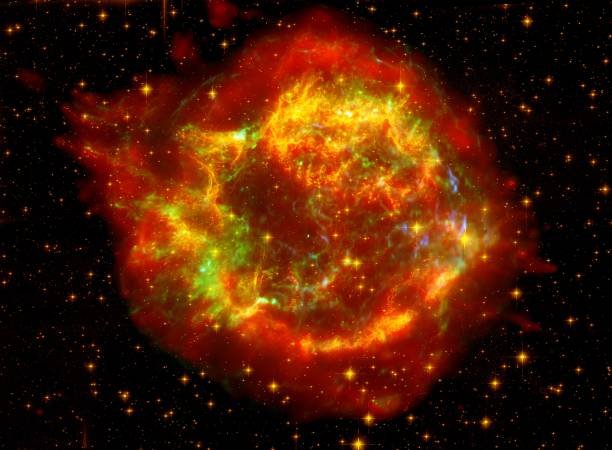
A pulsar begins its story in the death of a massive star. When a star much larger than the Sun exhausts its nuclear fuel, it can no longer support itself against gravity. Its core collapses in a violent implosion, triggering a supernova explosion—a burst so bright it can outshine an entire galaxy for days.
What remains after the explosion is the stellar core, crushed under such immense pressure that protons and electrons combine into neutrons. The result is a neutron star, a city-sized object with the mass of the Sun packed into a sphere barely 20 kilometers across.
In this unimaginably dense remnant, matter exists in a form unlike anything on Earth—a superfluid of neutrons, squeezed so tightly that quantum forces hold the star together against further collapse.
The Cosmic Lighthouse
If the neutron star retains some of the parent star’s rotation and magnetic field, it becomes a pulsar. As the core collapses, its rotation speeds up dramatically—like an ice skater pulling in her arms. Some pulsars rotate hundreds or even thousands of times per second.
Their magnetic fields, among the strongest in the universe, channel streams of charged particles along their poles, creating beams of electromagnetic radiation—often in radio, X-ray, or gamma-ray wavelengths.
As the star spins, these beams sweep through space. If Earth lies in their path, we detect a pulse of radiation each time the beam points our way—hence the name pulsar.
To an observer, it’s as if a cosmic lighthouse is spinning in the dark, sending regular flashes across the void.
The Clockwork of the Stars
Pulsars are astonishingly precise. Their pulses arrive with such consistency that they rival atomic clocks in accuracy. Some pulsars lose only a few billionths of a second per year.
This stability makes pulsars invaluable tools in modern astrophysics. By timing their pulses, astronomers can detect subtle effects such as the warping of spacetime by gravity, the existence of planets orbiting neutron stars, and even the faint ripples of gravitational waves passing through the galaxy.
Pulsars have become not just curiosities but instruments—natural cosmic laboratories that allow us to test Einstein’s theories under conditions impossible to replicate on Earth.
The Sound of a Dying Star
To truly appreciate a pulsar, one must listen. When astronomers convert the radio pulses into sound waves, they create an eerie, rhythmic beat—like the ticking of a cosmic metronome.
Some pulsars pulse every few seconds, others hundreds of times per second. Each one is unique, a celestial signature of a once-mighty star’s final heartbeat.
There’s something deeply poetic in this: the death of a star, an act of destruction, becomes a source of perfect rhythm, a steady pulse echoing through eternity.
Magnetars: The Monsters Among Pulsars
Among the family of neutron stars, a few stand apart as true monsters—magnetars. These are pulsars with magnetic fields a thousand times stronger than normal, up to a quadrillion times that of Earth.
When their magnetic fields twist and snap, magnetars unleash colossal bursts of energy—sometimes emitting more power in a single second than the Sun does in 100,000 years.
These flares can disrupt satellites, affect radio communications, and even be detected across the galaxy. If one were close enough, it could strip the atmosphere from Earth. Thankfully, the nearest known magnetars are thousands of light-years away.
Magnetars remind us that even among extremes, there are hierarchies of power—and that the universe never runs out of ways to astonish us.
Two Sides of Cosmic Power
Quasars and pulsars might seem vastly different—one a supermassive black hole devouring galaxies’ hearts, the other a tiny remnant of a single star—but they share a common essence. Both are born from collapse, both emit immense energy, and both are powered by the most fundamental forces in the cosmos: gravity, rotation, and magnetism.
Quasars reveal the birth and growth of galaxies. Pulsars record the deaths of stars. Together, they tell the universe’s story of creation and destruction—of matter cycling through forms of unimaginable beauty and violence.
Seeing the Invisible
Much of the wonder of quasars and pulsars lies in their invisibility to the naked eye. They are detected not through light we can see, but through radio waves, X-rays, and gamma rays.
With radio telescopes, astronomers map pulsars across the Milky Way, detecting their rhythmic signals that pierce the interstellar darkness. With space observatories like the Hubble Space Telescope and the Chandra X-ray Observatory, we glimpse the blazing hearts of quasars billions of light-years away.
These instruments act as our extended senses, translating the invisible into images and sounds we can comprehend. Through them, we see not just stars, but the architecture of energy itself.
Time Machines of Light
Every observation of a quasar or pulsar is also a journey through time. The light from a quasar that reaches us today began its journey when life on Earth was microscopic. The pulses from a neutron star may have started their rhythm before humans ever walked the planet.
In this sense, quasars and pulsars are time machines, allowing us to witness the ancient history of the cosmos. They remind us that the night sky is not a static picture but a dynamic, living chronicle of time stretching back to the dawn of existence.
The Role They Play in the Universe
Quasars are more than bright curiosities—they are engines of galactic evolution. The immense energy they release can blow away surrounding gas and dust, regulating the birth of new stars. This process, known as feedback, shapes the size, structure, and lifespan of galaxies.
Pulsars, meanwhile, enrich the cosmos with heavy elements. The supernovae that create them scatter carbon, oxygen, and iron into space—the very materials from which planets and life are made.
In a profound sense, we owe our existence to the violent processes that produce pulsars. The atoms in our bodies were once forged in the hearts of dying stars. The universe recycles its matter through fire and gravity, weaving life from the ashes of its own destruction.
The Mysteries That Remain
For all we know, the universe still hides many secrets about these powerful objects. We do not fully understand how quasars launch their jets or how their immense energy affects the galaxies around them. We cannot yet explain every aspect of pulsar magnetism or the exact interior structure of neutron stars—whether they contain exotic forms of matter, perhaps even quark-gluon plasma.
Each discovery opens new questions, deeper and more mysterious. Yet this is what makes physics and astronomy so compelling: the closer we come to truth, the more infinite the universe appears.
Humanity’s Cosmic Connection
When we look up at the night sky, most of what we see are quiet stars. But beyond them, hidden in the darkness, lie the true engines of the cosmos—quasars blazing in distant galaxies, pulsars ticking in the shadows of death.
To understand them is to understand our place in the grand design. These objects show us the universe not as something serene and static, but as a living, evolving system—wild, creative, and deeply interconnected.
The energy that powers a quasar, the magnetism that drives a pulsar, are not alien to us. They are the same physical laws that govern our own atoms and hearts. We are, in every sense, made of the same fabric that births these wonders.
The Poetry of Power
There is something profoundly poetic in knowing that light from a quasar billions of years old can still reach us, whispering across time. Or that a pulsar’s heartbeat continues, steady and eternal, long after its star has died.
They remind us that even in death, there is rhythm and beauty. That the universe, though vast and indifferent, sings with patterns of meaning we can learn to hear.
When we observe these cosmic beacons, we are not merely gazing into the abyss—we are hearing the echoes of creation, the rhythm of destruction, and the symphony of existence itself.
The Endless Journey
Our understanding of quasars and pulsars has transformed in just a few decades, but the journey is far from over. Future telescopes—like the James Webb Space Telescope, the Square Kilometre Array, and next-generation X-ray observatories—will reveal even more.
We may discover quasars from the earliest ages of the universe, born when the first black holes ignited. We may detect pulsar signals bent by gravitational waves, rippling from colliding black holes.
Each revelation will bring us closer to answering the ultimate question: What is the universe trying to tell us through its most powerful voices?
The Final Light
In the grand cosmic scale, quasars and pulsars are fleeting phenomena. Galaxies evolve, stars die, and even black holes will one day fade. But their light, once released, travels forever—crossing billions of years to reach eyes that can appreciate it.
In that way, they are like humanity itself—brief, yet capable of producing beauty that endures across time.
When you look into the night sky, remember: somewhere out there, a quasar is still blazing with the power of a trillion suns, and a pulsar is still beating its steady pulse through the dark.
They are the heartbeats of the universe—proof that even in the cold silence of space, there is rhythm, power, and life.
We are the witnesses, the listeners, the dreamers who give that rhythm meaning. Through quasars and pulsars, the universe speaks, and through us, it finally hears its own voice.