Far beyond the quiet blue of our skies, in the depths of intergalactic darkness, two titanic galaxies are slowly, inexorably drifting toward one another. One is our home—the Milky Way, a sprawling spiral of hundreds of billions of stars, dust, and dreams. The other is our cosmic neighbor, Andromeda, a majestic spiral galaxy more massive and just close enough for our telescopes to reveal its delicate arms.
They are separated by a yawning gulf of 2.5 million light-years, yet gravity is pulling them together in a slow, magnificent dance that has lasted billions of years. One day, roughly four billion years from now, this dance will end in an embrace—a colossal merger that will reshape the night sky, the stars, and perhaps even the fate of our solar system.
The future collision between Andromeda and the Milky Way is not just an astronomical prediction—it is a love story written in gravity, an inevitable union between two ancient giants whose paths were always meant to cross.
The Giants of the Local Group
To understand the scale of this coming event, we must first understand who these galaxies are. The Milky Way and Andromeda are the two largest members of a small cosmic neighborhood called the Local Group—a family of more than fifty galaxies bound together by gravity. Most of the others are dwarfs, small and faint, but these two dominate the group like twin monarchs overseeing their domain.
Our Milky Way stretches across about 100,000 light-years, home to between 200 and 400 billion stars. Its elegant spiral arms cradle the birthplace of suns and planets, while its center hides a supermassive black hole named Sagittarius A*, weighing four million times the mass of the Sun.
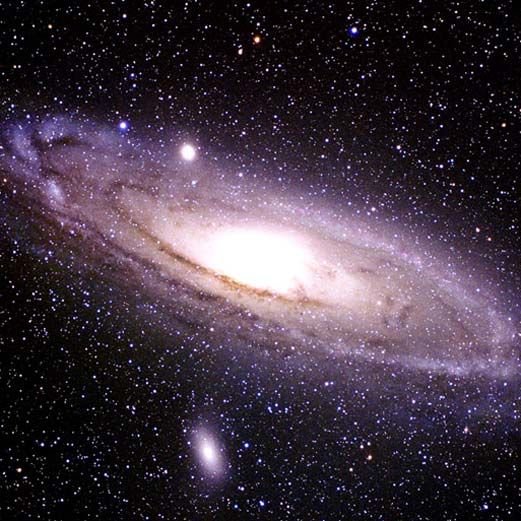
Andromeda—also known as Messier 31 or M31—is even grander. With an estimated trillion stars, it spans over 220,000 light-years, making it the largest galaxy in the Local Group. Its central black hole is far more massive than ours, containing about 100 million solar masses.
For billions of years, these two galaxies have coexisted peacefully, each orbiting the common center of gravity of the Local Group. But peace in the cosmos is never permanent. Slowly, imperceptibly, the gravitational attraction between them has been pulling them closer.
Measuring a Cosmic Approach
For centuries, Andromeda appeared to be a static patch of light in the sky, a faint blur that could be seen with the naked eye on clear nights. It wasn’t until the early 20th century that astronomers realized Andromeda was not a nearby cloud but an entire galaxy beyond our own.
Using advanced instruments, scientists later discovered that Andromeda is not standing still—it is racing toward us. The Doppler shift in its light reveals a blue tint, the telltale signature of motion toward Earth. This discovery was astonishing, because almost every other galaxy in the universe is moving away from us as the cosmos expands.
Andromeda is one of the rare exceptions—its local gravitational pull is strong enough to overcome the expansion of space itself. With the help of the Hubble Space Telescope and later the Gaia mission, astronomers have refined these measurements. Andromeda is closing in at a breathtaking speed of about 110 kilometers per second—roughly 250,000 miles per hour.
That sounds fast, but on the cosmic scale, it’s a gentle drift. Even at this speed, it will take about four billion years for Andromeda and the Milky Way to meet. The universe, it seems, moves at its own rhythm—grand, patient, and unstoppable.
What Happens When Galaxies Collide
The phrase “galactic collision” conjures images of cataclysm—worlds shattering, stars exploding, chaos consuming the heavens. But the truth is both more subtle and more beautiful.
Galaxies are mostly empty space. The stars within them are separated by vast distances, so when two galaxies merge, it’s not like two solid bodies crashing—it’s more like two ghostly clouds passing through one another, their stars gliding silently past, guided by gravity’s invisible hand.
When Andromeda and the Milky Way finally collide, their stars will dance around new gravitational centers. Some will be flung out into intergalactic space; others will merge into dense new regions of starlight. Vast waves of gas and dust will compress, igniting bursts of star formation—millions of newborn suns lighting up the darkness.
Our Sun and its planets will likely survive the merger, but their position in the galaxy will change dramatically. Some simulations suggest that our solar system could be cast into a distant orbit, drifting farther from the galactic core. Others predict that we might find ourselves in a new, glowing region filled with newly formed stars.
There will be no fiery collision between stars, no apocalyptic destruction—only transformation. Gravity will sculpt a new masterpiece, slowly blending two spirals into a single, elliptical galaxy, larger, brighter, and more serene than before.
The Celestial Timeline
The great collision is not a sudden event—it’s a saga that unfolds over billions of years. Here’s how astronomers believe it will happen, step by patient step.
In about four billion years, Andromeda will fill our night sky, appearing as a majestic spiral larger than the full Moon. Over millions of years, its shape will grow clearer as the galaxies draw nearer. The gravitational pull between them will stretch their arms, distorting them into long tidal tails of stars and dust.
Around 4.5 billion years from now, the first close pass will occur. The two galaxies will interpenetrate, their stars weaving through one another in a slow-motion ballet. Immense tidal forces will send ripples of gas and stars flying outward. From Earth’s perspective—if Earth still exists—it will be one of the most spectacular sights imaginable: twin galaxies merging, their cores glowing like twin suns in the night.
After the first encounter, the galaxies will drift apart again, then fall back together, drawn by their mutual gravity. Over the next few hundred million years, they will merge completely, their spiral structures dissolving into an elliptical halo of starlight.
By five to six billion years from now, the merger will be complete. The result will be a new galaxy—astronomers call it Milkomeda or Milkdromeda. It will be a massive, elliptical galaxy shining brighter than either of its progenitors. The night sky from any planet orbiting within it will be ablaze with countless stars, closer and denser than those we see today.
The Fate of Our Solar System
For us, the great question is personal: what will happen to the Sun, to Earth, and to any descendants of humanity who may still exist?
Our solar system sits about 27,000 light-years from the Milky Way’s center. As Andromeda approaches, gravitational tides will tug at our galaxy, reshaping orbits on a grand scale. But because the distances between stars are enormous, direct stellar collisions are almost impossible.
Simulations show that the Sun will likely be thrown into a new orbit, farther from the galactic core, possibly wandering among the outer edges of the merged galaxy. To the distant descendants of our civilization—if they endure—the night sky will transform dramatically.
They would see Andromeda’s spiral arms growing in size and brilliance over millions of years until it dominates the heavens. As the galaxies interlock, streaks of glowing gas will illuminate the sky, and two galactic centers will appear as brilliant points of light.
However, by this time, the Sun itself will have evolved. In about five billion years, it will swell into a red giant, engulfing Mercury and Venus, and possibly scorching Earth into a barren ember. Life as we know it will not witness the full beauty of the merger—but perhaps, somewhere else in the cosmos, new forms of life will.
A Universe of Collisions
Though the Milky Way–Andromeda collision feels monumental, it’s not rare. In fact, it’s part of the universe’s normal life cycle. Galaxies grow by merging, consuming smaller companions in a process called galactic cannibalism.
The Milky Way itself has been shaped by countless mergers. Our outer halo is littered with the remnants of dwarf galaxies torn apart and absorbed over billions of years. Even now, streams of stars like the Sagittarius Dwarf Galaxy are being stretched and swallowed by our spiral arms.
Andromeda, too, bears the scars of ancient collisions. Its faint outer rings and disturbed structure suggest a violent past, where smaller galaxies were shredded and assimilated.
The coming merger, therefore, is not a catastrophe but a continuation of cosmic evolution. Galaxies are like living organisms on astronomical timescales—they are born, they grow, they merge, and they evolve. Through these collisions, the universe renews itself.
The Role of Dark Matter and Gravity
At the heart of this cosmic encounter lies one force—gravity. It is the sculptor of galaxies, the silent architect of orbits and collisions. Yet gravity alone is not the full story.
Both the Milky Way and Andromeda are embedded in enormous halos of dark matter, the mysterious, invisible substance that makes up about 85% of all matter in the universe. Though we cannot see it, we feel its pull. It surrounds galaxies like a vast cocoon, shaping their structure and motion.
As the galaxies approach, their dark matter halos will meet first, overlapping long before the visible stars do. These halos will merge and slow the galaxies down, ensuring their eventual union.
Dark matter is the glue that holds the cosmos together, and it plays a vital role in this dance of giants. Without it, the galaxies might simply drift apart forever. But with it, they are destined to merge, guided by invisible threads that bind the universe from end to end.
The Spectacle in the Sky
If any eyes—human or otherwise—are there to witness the merger, the view will be extraordinary beyond imagination.
At first, Andromeda will appear as a faint patch, as it does today. Over millions of years, it will swell into a vast, glowing spiral, filling half the sky. As the galaxies draw close, bright star clusters and nebulae will streak across the heavens like brushstrokes of light.
When the two galaxies’ cores approach one another, they will blaze in the sky as twin orbs—two brilliant hearts locked in gravitational embrace.
Eventually, after the merger, the sky will transform into something utterly alien. Instead of a thin, misty band like the Milky Way, the sky will be filled with a luminous haze—a dense field of stars stretching in every direction. The universe will appear more crowded, more alive, and more intimate.
It will be, perhaps, the most beautiful sight any civilization could ever witness.
The Birth of a New Galaxy
Once the collision settles, the newborn galaxy—Milkomeda—will take shape. Its structure will be less organized than today’s spirals. Instead of neat arms winding around a central bulge, it will be a more rounded, elliptical system of stars, glowing with a soft, diffuse light.
Star formation will initially surge as clouds of gas collide and collapse, giving rise to clusters of new stars. Over time, as the gas runs out, star birth will slow, and the galaxy will grow older and redder.
In this future galaxy, the relics of both Andromeda and the Milky Way will coexist—their stars mingled, their histories intertwined. The supermassive black holes at their centers will spiral together, losing energy through gravitational waves until they merge into a single, colossal black hole.
This cataclysmic event will release an enormous burst of gravitational radiation—ripples in spacetime that will echo through the cosmos, announcing the union of two galaxies to the universe itself.
The Distant Future Beyond the Merger
In the far future, long after the collision has settled, Milkomeda will stand alone in an expanding universe.
Due to cosmic acceleration driven by dark energy, distant galaxies will continue to move away faster and faster. Billions of years after the merger, all other galaxies will slip beyond the observable horizon. From within Milkomeda, the rest of the universe will vanish into darkness.
Future astronomers—if any exist—will look out and see only their own galaxy, unaware of the grand cosmos that once surrounded them. The evidence of the Big Bang, the cosmic microwave background, and the expansion of space will fade from view. The universe will seem eternal and static once again.
And yet, within that galaxy, life and light may continue. New stars will form, planets will emerge, and perhaps beings will look up at their sky and wonder about their origins, never knowing they are the children of two galaxies that once collided in beauty and silence.
Humanity and the Cosmic Perspective
The coming merger may be billions of years away, but its story reminds us of something profound about our place in the universe.
The cosmos is not a distant abstraction—it is our home, our ancestry, and our destiny. Every atom in your body was born from stars that lived and died long before the Milky Way existed. You are the product of cosmic collisions, of the relentless creativity of nature.
When you gaze at the faint smudge of Andromeda in a clear night sky, you are seeing the future. That faint glow is a message sent across time and space, a promise that one day, your galaxy and that one will become one.
It is a reminder that change, even on a galactic scale, is not destruction but transformation.
The Poetry of Collision
The meeting of the Milky Way and Andromeda is more than an event—it is a metaphor for the universe itself. It is the embodiment of cycles: birth and decay, order and chaos, separation and reunion.
When they collide, no boundaries will remain between them. Their stars will mingle, their dark matter will merge, their cores will spiral together and become one. Out of two great structures, a single, luminous being will emerge—a new galaxy, vast and radiant.
In that act of cosmic union lies a truth as old as time: that from collision comes creation, and from chaos, beauty.
The Eternal Dance of the Cosmos
The story of Andromeda and the Milky Way is a chapter in a much larger saga—the eternal dance of galaxies that has shaped the universe since its birth. From the first faint clouds of hydrogen after the Big Bang to the glittering galaxies we see today, everything has been moving, merging, and evolving.
Gravity is the rhythm; time is the melody; and the galaxies are the dancers. The universe is not still—it is a grand ballet of motion, where collisions are not endings, but beginnings.
And so, in four billion years, when Andromeda’s spiral fills the sky, when the stars of two galaxies interweave in a luminous embrace, it will not be a catastrophe, but a cosmic celebration.
The night will blaze with starlight. The universe will hold its breath. And two ancient galaxies—after a journey spanning all of time—will finally become one.
A Universe in Motion
Even as we read these words, the motion has already begun. The gravitational whispers have been pulling at both galaxies for eons. Though we cannot see it happen in a single lifetime, it is as real and certain as the turning of the Earth.
We live in a universe that is alive with motion, where nothing stands still—not stars, not galaxies, not even time itself. Everything is part of the same unfolding story, from the smallest particle to the grandest supercluster.
And when the Milky Way and Andromeda meet, they will write one of the most magnificent chapters in that story—a testament to the power, beauty, and inevitability of change.
The stars will remember. The light will carry the tale across the universe. And even after both galaxies are gone, their merger will echo in the structure of space itself, as ripples of gravity moving endlessly through the dark.
The universe, as always, will continue to dance.