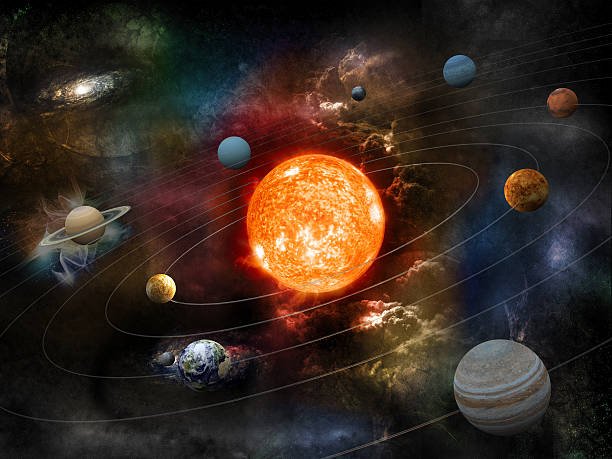
There is no question more ancient, more haunting, or more deeply human than this: Where did everything come from? Long before science, before telescopes or equations, humanity stood beneath the endless night and wondered. We saw stars scattered like diamonds across a cosmic ocean, the pale glow of the Moon, the fiery rise of the Sun—and we knew, somehow, that we were part of something vast, beautiful, and mysterious.
The origin of the universe is not merely a scientific puzzle; it is a spiritual and emotional journey. To understand it is to reach for the roots of existence itself—to trace everything we know and everything we are back to a single, breathtaking moment when reality began.
For centuries, people turned to myth and religion for answers. Every culture crafted its own story of creation: gods forging worlds from chaos, cosmic eggs cracking open into being, sacred words breathing life into the void. Yet as our curiosity deepened, so did our tools for exploring truth. Telescopes replaced temples as instruments of awe. Equations became modern hymns to the order behind the stars. And through science, humanity began to unravel the true story of how the universe was born.
It is a story not of divine hands but of physical laws—of energy, matter, and time unfolding in perfect harmony. Yet it remains as poetic, mysterious, and awe-inspiring as any ancient myth.
This is the story of how nothing became everything.
The Discovery of an Expanding Universe
For much of human history, people believed the universe was eternal and unchanging. The stars seemed fixed, the heavens immutable—a grand cosmic stage upon which the drama of life unfolded. Even great thinkers like Aristotle and Newton imagined a static universe, infinite and eternal.
But in the early twentieth century, everything changed. In 1915, Albert Einstein published his general theory of relativity, a mathematical masterpiece that redefined space and time. His equations described gravity not as a force pulling objects together but as the curvature of spacetime itself—a flexible fabric that could bend, stretch, or ripple under the influence of mass and energy.
When Einstein applied his equations to the universe as a whole, they predicted something astonishing: the cosmos could not remain static. It must either expand or contract. Troubled by this result, Einstein introduced a “cosmological constant” to keep the universe still. Later, he would call that addition the greatest mistake of his life.
Then came Edwin Hubble. In the 1920s, working at Mount Wilson Observatory in California, Hubble peered deep into the sky and made a discovery that forever changed our understanding of existence. He observed distant galaxies—entire islands of stars far beyond the Milky Way—and noticed that their light was stretched toward the red end of the spectrum. This “redshift” meant they were moving away from us.
The universe was expanding.
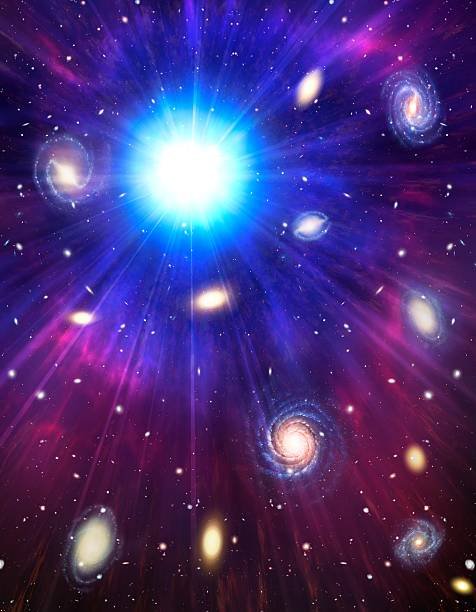
That realization was revolutionary. If the universe is expanding today, it must have been smaller in the past. Extrapolate far enough back in time, and all the galaxies, all the matter, all the energy in existence would once have been compressed into a single, unimaginably dense and hot point.
That idea became known as the Big Bang—the moment when the universe burst into existence.
The Moment of Creation
So what was the Big Bang? It is not an explosion in space; it is an explosion of space. It is the moment when space and time themselves began, when all the energy and matter that would ever exist came into being.
Around 13.8 billion years ago, everything we now see—every star, every planet, every atom—was once packed into a singularity, a state so dense and hot that our current laws of physics can barely describe it. At that moment, the universe began expanding, not into empty space, but creating space itself as it grew.
In the first fraction of a second, the universe was a searing ocean of energy. Temperatures soared above a trillion degrees. Particles of matter and antimatter flickered in and out of existence, colliding and annihilating each other in bursts of radiation. Time itself had only just begun to tick.
Then, in less than a heartbeat, the universe underwent an astonishing phase called cosmic inflation. In a trillionth of a second, it expanded exponentially—so fast that distances smaller than an atom grew to cosmic proportions. This inflation smoothed out the early chaos, setting the stage for the ordered cosmos we see today.
As the universe expanded, it cooled. Within seconds, the first subatomic particles—protons, neutrons, and electrons—began to form. Within minutes, these combined to create the first atomic nuclei, mostly hydrogen and helium.
The universe, once pure energy, was now matter.
The First Light
For hundreds of thousands of years, the young universe remained dark. Though filled with hot plasma—a mix of charged particles and light—it was opaque, like the interior of a star. Photons, the particles of light, scattered constantly off free electrons, unable to travel far.
But as the cosmos continued to expand and cool, a remarkable transition occurred. Around 380,000 years after the Big Bang, the temperature dropped enough for electrons to combine with nuclei, forming neutral atoms. Suddenly, light could travel freely through space.
That ancient light still fills the universe today. We know it as the cosmic microwave background radiation—a faint glow detectable in every direction, a ghostly afterimage of the universe’s birth. It is the oldest light we can see, the universe’s first whisper of illumination.
Discovered accidentally in 1965 by Arno Penzias and Robert Wilson, this radiation provided irrefutable evidence for the Big Bang theory. It is, in a sense, the universe’s birth certificate, written in the language of light.
By studying tiny variations in the microwave background, scientists can trace the seeds of galaxies and cosmic structures—the fingerprints of creation itself. These ripples in density would later grow, under the pull of gravity, into the stars and galaxies that fill the cosmos.
The Age of Darkness and the Birth of Stars
After the release of the first light, the universe entered what astronomers call the cosmic dark ages. There was light everywhere, but no new sources of it. Space was vast and expanding, filled mostly with hydrogen and helium gas.
Slowly, gravity began to weave its spell. Slightly denser regions of gas started to collapse under their own weight, forming the first stars and galaxies. When those first stars ignited, they unleashed brilliant radiation that ended the cosmic darkness forever.
These early stars were titans—massive, short-lived, and fierce. They forged the first heavier elements in their cores: carbon, oxygen, iron—the building blocks of life. When they exploded as supernovae, they scattered these elements across space, enriching the cosmos and seeding the birth of new stars and planets.
Every atom in your body—every carbon in your cells, every calcium in your bones, every iron in your blood—was born in one of those ancient stellar furnaces. You are, quite literally, made of stardust.
The universe was no longer a simple expanse of hydrogen and helium. It had become complex, dynamic, and creative.
The Formation of Galaxies and Cosmic Architecture
Over millions of years, gravity continued its grand dance, drawing matter into vast clusters. Galaxies began to form—spiraling islands of stars, gas, and dark matter.
Our own galaxy, the Milky Way, took shape around 13 billion years ago. It now stretches over 100,000 light-years across and contains hundreds of billions of stars. Each of those stars may host its own planetary systems, some perhaps harboring life, others silent and empty.
But galaxies do not exist in isolation. They cluster together, forming immense webs of structure that span the cosmos. Modern telescopes reveal that the universe is not random; it has a grand architecture—filaments of galaxies stretching across billions of light-years, separated by vast voids of darkness.
It is a cosmic web, and we are a single luminous thread within it.
The Mystery of Dark Matter and Dark Energy
Even as we map the stars and galaxies, we have discovered that most of the universe remains invisible. Observations show that the motions of galaxies cannot be explained by the matter we see. There must be something else—an unseen substance providing the gravitational glue that holds the cosmos together.
We call it dark matter. It neither emits nor absorbs light, but its gravitational influence is undeniable. It makes up about 27% of the universe, compared to just 5% for ordinary matter—the stuff that forms stars, planets, and people.
But the true enigma lies in what drives the universe’s expansion. In the late 1990s, astronomers observing distant supernovae made a shocking discovery: the expansion of the universe is not slowing down due to gravity—it is speeding up.
Some unknown force, dubbed dark energy, is pushing space itself apart. It accounts for roughly 68% of the total energy content of the universe. We have no clear idea what it is. It may be a property of space itself, or something deeper, perhaps linked to quantum fluctuations in the vacuum.
Together, dark matter and dark energy dominate the cosmos, yet remain among the greatest mysteries in science. The visible universe—the stars, the planets, the glowing galaxies—represents only the faintest fraction of what truly exists.
The Arrow of Time and the Evolution of the Cosmos
The universe is not static; it evolves. From its fiery beginning, it has expanded and cooled, creating ever more complex structures. But it also follows an inescapable direction: forward.
This flow of time is intimately connected with a concept called entropy, the measure of disorder in a system. The universe began in a state of extremely low entropy—highly ordered, dense, and uniform. As it expands, entropy increases. Stars burn, galaxies form and fade, and energy spreads out.
This gradual drift toward disorder gives time its arrow. It is why we remember the past but not the future, why heat flows from hot to cold, and why stars eventually die.
In billions of years, the universe as we know it will change dramatically. The stars will exhaust their fuel, galaxies will grow dim, and black holes will slowly evaporate. The cosmos may drift into a cold, dark state—an era some physicists call the heat death of the universe.
Yet even in this distant fate, there is poetry. The energy that once burst forth from the Big Bang will continue to flow, diffusing into the infinite fabric of spacetime—a final echo of creation reverberating forever.
The Quest to Understand the Beginning
Though the Big Bang theory describes the evolution of the universe from its earliest moments, it does not fully explain the moment of origin itself. What caused the Big Bang? Why did the universe begin at all?
Some scientists explore the idea that our universe emerged from quantum fluctuations—a spontaneous event in a timeless quantum field, where energy briefly appeared and inflated into reality. Others suggest that the universe may have no true “beginning” at all, that time itself began with the Big Bang, making the question “before” meaningless.
Still others propose that our universe is part of a vast multiverse—a cosmic landscape filled with countless other universes, each with its own physical laws and constants. In this view, our Big Bang was just one of many cosmic births, a spark among infinite fires.
Quantum cosmology, string theory, and loop quantum gravity all seek to describe these deepest mysteries, to unite the physics of the very large (general relativity) with the physics of the very small (quantum mechanics). The answer may lie in a theory that transcends both—one that reveals how space, time, and matter themselves emerge from something even more fundamental.
From Cosmic Dust to Consciousness
As the universe evolved, so did complexity. In the quiet corners of galaxies, stars gave birth to planets, and on at least one of them—our Earth—matter began to dream.
It took billions of years for stardust to assemble into oceans, continents, and life. Through the chemistry of carbon, nitrogen, and oxygen, simple molecules formed chains, cells, and eventually organisms capable of thought. Physics gave rise to chemistry, chemistry to biology, and biology to consciousness.
When you look at the night sky, you are not merely observing the universe—you are the universe observing itself. The light from distant galaxies travels for billions of years to reach your eyes, carrying messages from the beginning of time. In that act of perception, the circle of existence closes: from the birth of matter to the birth of mind.
We are children of the cosmos, woven from its elements, bound by its laws, and destined to return to its dust. The atoms in our hearts were once forged in the cores of dying stars. The hydrogen in our blood was born in the first seconds of creation.
The story of the universe is the story of us.
The Future of Cosmic Discovery
Today, humanity stands on the edge of a new era in cosmology. Space telescopes like the James Webb peer deeper into time than ever before, capturing light from the first galaxies. Particle accelerators probe the fundamental forces that shaped the early universe. Gravitational wave detectors listen to the ripples of spacetime created by colliding black holes.
With every discovery, we come closer to answering the most profound questions: What is the ultimate nature of reality? Why is there something rather than nothing?
Yet, the deeper we go, the more we realize how much remains unknown. The universe is not a solved riddle but an unfolding story. Each answer opens new questions, each revelation deepens the mystery.
Perhaps that is the true beauty of the cosmos—that it never ceases to surprise us, that its wonders are infinite.
The Poetry of the Beginning
When we speak of the origin of the universe, we are really speaking of the origin of meaning. Science gives us equations and data, but beneath them lies something ineffable—a sense of belonging, of awe, of cosmic kinship.
The Big Bang was not just the birth of matter and energy; it was the birth of potential—the potential for stars to shine, for life to awaken, for consciousness to ask questions like this one.
To understand the origin of the universe is to glimpse the profound unity of existence: the way energy becomes matter, matter becomes life, and life becomes awareness.
Every human story, every work of art, every act of love or curiosity is part of this vast continuum that began in that first incandescent moment. We are the descendants of the Big Bang, carrying its fire in our hearts and its mystery in our minds.
The Universe Within
There is a quiet symmetry between the cosmos and the soul. Just as the universe expanded from a point of pure potential, so too does every human life begin in darkness and grow toward light. Within each of us is a miniature cosmos—a reflection of the infinite.
Our neurons spark like tiny galaxies; our thoughts ripple like waves in spacetime. The same physical laws that govern stars govern us. The same energy that ignited the universe burns within our cells.
When you look up at the night sky, you are seeing your own origin story. The light that travels across billions of years to reach your eyes connects you to everything that ever was. In that moment of wonder, the boundary between the self and the universe dissolves.
The cosmos is not out there—it is within you.
The Endless Beginning
Thirteen point eight billion years have passed since the birth of the universe, yet in many ways, creation is not over. Stars continue to be born. New worlds form. Life emerges and evolves. The story of existence is still being written, moment by moment, atom by atom.
And perhaps it will never end. Perhaps, in some distant epoch, when our universe fades into silence, another will ignite—a new Big Bang, a new cosmos, a new chance for consciousness to awaken and wonder again.
Physics may one day describe it perfectly, but words will never fully capture its beauty. The origin of the universe is not just a scientific fact; it is the most profound poem ever written—a poem in which we all have a line.
For from the first flash of light to the beating of your heart, the message of the cosmos has always been the same:
From nothing, comes everything.
From darkness, comes light.
And from the silence of the void, the universe sings.