There are few things in the universe as mysterious, terrifying, and breathtakingly beautiful as a black hole. It is a place where gravity reigns supreme, where time and space themselves bend, twist, and finally collapse into a singular point of infinite density. A black hole is not simply an object—it is an experience, a phenomenon that pushes the limits of human understanding and challenges our very sense of reality.
At first glance, the idea seems absurd. How can something so dense, so powerful, exist that even light—the fastest thing in the universe—cannot escape its pull? Yet this is not fantasy; it is a fact of nature, confirmed by the sharp eyes of telescopes and the precise instruments of space observatories.
To gaze into a black hole is to stare into the universe’s deepest secret—a place where physics breaks down and mystery begins. But what exactly is a black hole? How do these cosmic monsters form, and what do they tell us about the nature of space, time, and reality itself?
The answer is as profound as it is poetic. For in the darkness of a black hole lies not just destruction, but the very blueprint of cosmic evolution.
The Birth of a Black Hole
The story of a black hole begins with a star. Not an ordinary star like our Sun, but one much more massive—perhaps ten, twenty, or even a hundred times heavier. Like all stars, it burns its nuclear fuel to resist the inward pull of gravity. Deep within its core, hydrogen fuses into helium, releasing an incredible amount of energy that pushes outward and balances the star’s immense gravitational pressure.
But even stars have lifespans. When the nuclear fuel runs out, the delicate balance between pressure and gravity collapses. Without fusion to support it, the core of the star begins to implode under its own weight. The outer layers explode outward in a dazzling event called a supernova—a cosmic death cry visible across galaxies.
What remains after this explosion determines the star’s fate. If the remnant core is less than about three times the mass of the Sun, it becomes a neutron star—a city-sized sphere of ultra-dense matter. But if it is heavier still, gravity wins the final battle. The core collapses beyond all known limits, crushing itself into a point so small, so dense, that space and time can no longer contain it. A black hole is born.
In that moment, a region forms from which nothing—not even light—can escape. The boundary of this region is called the event horizon, and it marks the point of no return. Anything crossing this invisible threshold disappears from the visible universe forever.
The Event Horizon: The Edge of Forever
The event horizon is not a solid surface, but rather a boundary in spacetime. It’s the line that separates the possible from the impossible. Imagine a river flowing faster and faster toward a waterfall. If the flow exceeds the speed at which a fish can swim upstream, there’s no turning back—the fish will inevitably go over the edge. Similarly, within the event horizon, the “flow” of spacetime becomes so steep that not even light, moving at cosmic speed, can escape.
To an outside observer, anything falling toward a black hole seems to slow down as it approaches the event horizon. Its image stretches, fades, and eventually freezes in time—never quite crossing the edge. But from the falling object’s own perspective, it passes the horizon effortlessly, in finite time, plunging into the abyss.
This strange distortion of time is not an illusion; it’s a direct consequence of Einstein’s theory of general relativity. Near a black hole, gravity is so strong that it literally warps time itself. Clocks tick slower, space stretches, and the geometry of the universe bends toward the singularity at the center—a point where density becomes infinite, and all known laws of physics collapse.
The Singularity: The Point Where Physics Breaks
At the heart of a black hole lies a mystery so profound that even the greatest minds in science struggle to comprehend it—the singularity. It is the point where all the mass of the black hole is concentrated, infinitely dense and infinitely small. In theory, the singularity has no size but contains enormous mass and energy. It is the place where space and time end, where gravity becomes infinite, and where our current understanding of the universe ceases to make sense.
According to general relativity, all paths of matter and light are drawn inexorably toward this singular point once they cross the event horizon. Yet, quantum mechanics—the other great pillar of modern physics—suggests that such infinities should not exist. Somewhere in the union of these two theories lies the true nature of the singularity, waiting to be discovered.
Scientists believe that solving the mystery of the singularity may reveal the ultimate laws of reality—a “quantum theory of gravity” that unites the cosmic and the microscopic, Einstein and the quantum. In the singularity’s darkness may lie the light of the next great scientific revolution.
Time and Space Near a Black Hole
The closer you get to a black hole, the stranger reality becomes. Time slows down, light bends, and directions lose meaning. A second near the event horizon could equal thousands or even millions of years far away.
This is not science fiction; it’s been measured. When Einstein first proposed his theory of general relativity, one of its startling predictions was gravitational time dilation—the slowing of time in strong gravitational fields. Astronauts orbiting near a black hole would experience time very differently than observers on Earth.
This idea gained cinematic fame in Christopher Nolan’s film Interstellar, where a few hours near a supermassive black hole named Gargantua corresponded to decades on Earth. The scenario may be exaggerated, but the physics behind it is real.
Light itself is affected. As it climbs away from a black hole’s gravity, it loses energy and shifts to redder wavelengths—a phenomenon known as gravitational redshift. Even photons, massless as they are, cannot escape the influence of spacetime’s curvature.
To approach a black hole is to experience a universe where the familiar rules dissolve—a place where geometry is destiny and time becomes a malleable thread woven by gravity’s hand.
The Many Faces of Black Holes
Not all black holes are the same. They come in a wide range of sizes and types, each formed through different processes and inhabiting different corners of the cosmos.
The smallest known black holes are stellar-mass black holes, born from collapsing stars and weighing anywhere from a few to several dozen times the mass of the Sun. These black holes are scattered throughout galaxies, often detected through their interactions with nearby stars.
Then there are the supermassive black holes, cosmic giants millions or even billions of times the Sun’s mass. They sit at the centers of galaxies, including our own Milky Way, where one known as Sagittarius A* resides about 26,000 light-years away. These titans likely formed in the early universe, growing by devouring stars, gas, and even other black holes.
Between these extremes, astronomers have recently found evidence of intermediate-mass black holes, bridging the gap between stellar and supermassive. Their discovery offers clues to how the cosmic giants at galactic centers might have evolved.
And at the very edges of speculation are the primordial black holes—hypothetical relics from the Big Bang, formed not by stars but by fluctuations in the infant universe’s density. If they exist, they could help explain one of the greatest mysteries of all: the nature of dark matter.
The Invisible Behemoths
By their very definition, black holes emit no light. They are invisible against the cosmic backdrop. So how do we know they exist?
The answer lies in their gravitational influence. Though we cannot see black holes directly, we can see how they affect their surroundings. A black hole’s gravity can make nearby stars orbit in strange, rapid patterns. It can pull gas into swirling, luminous disks that shine with X-rays as matter heats up on its way in.
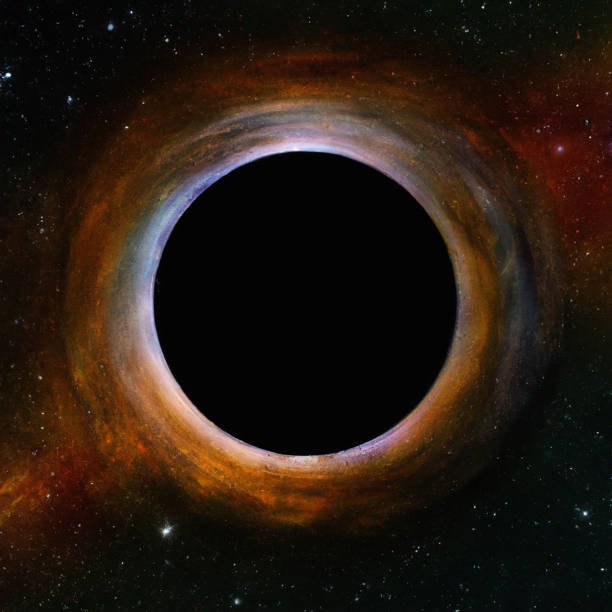
In 2019, humanity saw the unseeable. Using a network of telescopes around the world, known as the Event Horizon Telescope (EHT), scientists captured the first direct image of a black hole’s shadow. The glowing ring of light surrounding darkness, located in the galaxy M87, stunned the world. It was the first tangible proof that these cosmic monsters truly exist—not just in equations, but in the heavens.
What the image revealed was not the black hole itself, but its event horizon’s silhouette against the bright gas swirling around it. It was a portrait of gravity’s masterpiece—a visual testament to Einstein’s genius and to human curiosity’s power to peer into the unknown.
The Dance of Destruction: Accretion and Jets
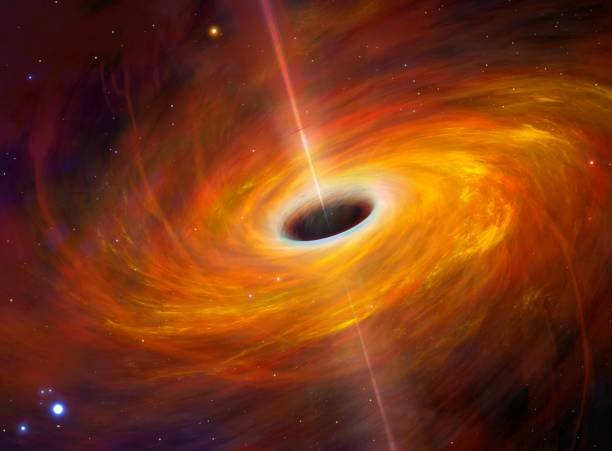
Around many black holes, there exists a deadly but spectacular environment—a swirling disk of superheated gas and dust known as an accretion disk. As matter spirals inward, friction and magnetic forces heat it to millions of degrees, causing it to glow in X-rays and gamma rays.
Paradoxically, black holes can be among the brightest objects in the universe. As they feed, they unleash immense energy, sometimes outshining entire galaxies. In some cases, powerful magnetic fields near the event horizon focus streams of particles into colossal jets that shoot across space at nearly the speed of light.
These jets can extend for thousands of light-years, sculpting galaxies and triggering new generations of star formation. Thus, black holes are not merely engines of destruction—they are cosmic architects, shaping the evolution of the very galaxies that host them.
When Two Black Holes Collide
In the silent depths of space, black holes can find each other. When two massive black holes orbit and spiral together, their immense gravitational fields warp spacetime, sending ripples across the cosmos known as gravitational waves.
Predicted by Einstein in 1916, these waves were first detected a century later, in 2015, by the LIGO observatory. The signal—lasting just a fraction of a second—was the death cry of two merging black holes, converting part of their mass into pure energy in the form of gravitational waves.
It was a historic moment. For the first time, humanity heard the universe. Gravitational waves opened a new window on the cosmos, allowing us to study black holes not by their light, but by the vibrations of spacetime itself.
Each new detection tells a story of colossal collisions billions of light-years away—cataclysms so powerful they momentarily outshine all the stars in the observable universe combined.
Hawking Radiation: When Black Holes Evaporate
For decades, black holes were thought to be eternal—objects that could never die. But in the 1970s, the brilliant physicist Stephen Hawking turned that idea upside down.
Using quantum theory, Hawking discovered that black holes are not entirely black. Tiny fluctuations in the vacuum near the event horizon allow particles to escape, carrying away energy. This process, now known as Hawking radiation, means that black holes can slowly lose mass and eventually evaporate over unimaginable timescales.
A stellar-mass black hole might take 10⁶⁷ years to evaporate completely—a number so vast it defies comprehension. Yet in the end, even black holes are mortal. They will fade away, leaving behind only faint whispers of radiation in the dark.
This revelation transformed black holes from eternal prisons into transient features of an evolving universe. It also bridged the gap between quantum mechanics and relativity, suggesting that the ultimate theory of physics must account for both gravity and quantum effects.
The Black Hole Information Paradox
But Hawking’s discovery created a new puzzle—the information paradox. In quantum mechanics, information (about the state of particles) can never be destroyed. Yet, if a black hole evaporates completely, what happens to all the information that fell inside?
Does it vanish forever, violating one of quantum theory’s most fundamental rules? Or does it somehow escape, encoded in the radiation itself?
This paradox remains one of modern physics’ greatest unsolved mysteries. Some theories suggest that information is preserved on the event horizon, stored in a two-dimensional “holographic” form—a radical idea known as the holographic principle. Others propose that black holes might be gateways to new universes, where information is not lost but reborn in another reality.
Whatever the truth, the information paradox represents the cutting edge of human understanding. Solving it may reveal the final theory that unites all of physics.
Black Holes and the Fate of the Universe
As the universe expands and ages, black holes may become its final rulers. Stars will burn out, galaxies will fade, and all matter may eventually be consumed by these dark giants. Over trillions of years, black holes will merge and grow, dominating the silent cosmos.
But even they cannot last forever. As Hawking radiation takes its slow toll, black holes will evaporate, one by one, until none remain. The universe will fade into darkness and cold, entering what physicists call the “heat death” era—an eternity of quiet entropy, where all energy is evenly distributed and nothing more can happen.
Yet, even in this distant vision of cosmic stillness, black holes tell us something profound: that creation and destruction are two sides of the same coin, that from collapse can come renewal, and that the universe’s end is merely another transformation.
The Human Connection to the Cosmic Abyss
It might seem that black holes are far removed from our daily lives—cold, distant, and indifferent. Yet, their story is also our story. The same laws that govern their birth and death shape the atoms in our bodies and the light in our skies.
When we study black holes, we are not merely exploring distant phenomena—we are exploring the boundaries of human thought. These cosmic enigmas mirror our own search for meaning, for the limits of knowledge, and for the courage to confront the unknown.
Every image captured, every equation solved, every theory proposed brings us closer to understanding not only the universe but our place within it.
Black Holes and the Mystery of Consciousness
Some thinkers have drawn bold parallels between black holes and consciousness itself. Both represent singularities of experience—points beyond which understanding breaks down. Just as the singularity lies beyond the event horizon, perhaps the core of awareness lies beyond the reach of physical description.
Though speculative, such ideas remind us that science and philosophy are not enemies but partners in wonder. Black holes challenge us to think not only about space and time but about perception, existence, and the mysterious link between mind and cosmos.
A Universe That Dreams of Itself
Black holes are not simply destroyers—they are creators of meaning. They shape galaxies, influence cosmic evolution, and test the boundaries of reality. In their darkness, we find light—the light of curiosity, imagination, and the human spirit that refuses to look away.
Every time we peer into the void, we are reminded that the universe is not separate from us. The same gravity that bends starlight binds us to Earth. The same spacetime that curves around black holes flows through our veins in the form of time’s pulse.
In seeking to understand black holes, we are the universe trying to understand itself.
The Endless Question
What is a black hole? It is the ultimate paradox—where nothing becomes everything, where endings become beginnings, where physics meets philosophy and silence speaks louder than light.
It is a mirror held up to the cosmos and to ourselves. In its depths, we glimpse not just the fate of stars, but the boundless power of curiosity—the force that drives us to question, to explore, and to reach for understanding even when the answers hide in the dark.
Perhaps, in the end, the greatest truth about black holes is not what they are, but what they make us become: beings who dare to look into infinity and whisper, I want to know.