There are few questions in the universe more haunting, more awe-inspiring, or more mysterious than this: What happens inside a black hole?
Black holes are the most extreme objects ever discovered—regions where gravity crushes matter, energy, and even the fabric of space and time itself. They are invisible monsters cloaked in shadow, devouring everything that crosses their boundary, and yet they are also the most fascinating laboratories for physics, where the known laws of nature are pushed to their breaking point.
At their heart lies a paradox, a place where everything we know about the universe—Einstein’s relativity, quantum mechanics, the very concept of time—ceases to make sense. The interior of a black hole is not simply dark; it is unknowable, a realm where reality bends into something beyond imagination.
To understand what happens inside a black hole, we must journey first to the edge of this cosmic abyss—to the boundary between the known and the unknowable, the place astronomers call the event horizon.
The Birth of Darkness
Black holes are not born in silence. They are forged in cosmic violence—the death throes of massive stars. When a giant star exhausts its nuclear fuel, the outward pressure that once supported it collapses, and gravity takes over. The star implodes in a titanic explosion called a supernova, blasting its outer layers into space while its core collapses inward.
If the remaining mass is more than about three times that of the Sun, no known force can resist gravity’s pull. The core’s collapse becomes unstoppable, crushing matter into an infinitely dense point—a singularity—and curving spacetime so dramatically that nothing, not even light, can escape.
This singularity is surrounded by the event horizon, the ultimate point of no return. Once anything crosses it—star, planet, photon, or astronaut—it is forever lost to the outside universe.
From the outside, black holes appear silent, featureless, and eternal. But inside, the story is far more extraordinary.
The Event Horizon: Gateway to the Unknown
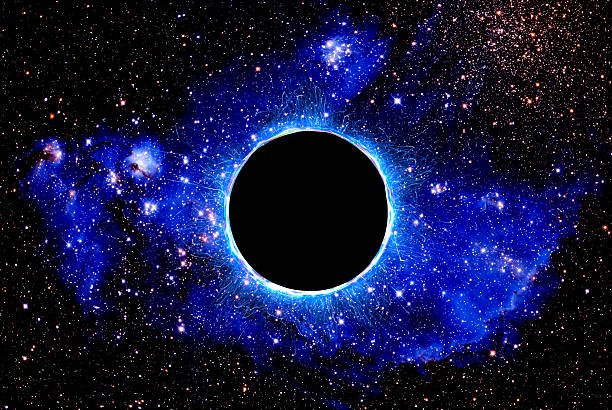
Imagine falling toward a black hole. At first, you would see it as a dark circle set against a distorted background of stars. As you approach, the black hole’s gravity would twist and stretch light from distant galaxies, wrapping it around the event horizon in a luminous halo known as the photon ring.
This is the edge of visibility, where light orbits endlessly before plunging into darkness. The closer you get, the stranger reality becomes. Time slows down. If someone were watching you from a safe distance, they would see you moving slower and slower, your image freezing at the edge, fading into red as light from you becomes more and more stretched by gravity.
To you, however, nothing feels unusual as you cross the event horizon. There is no wall, no sudden change—only a silent crossing into a region where escape is impossible. Space and time exchange roles: moving forward in time now means moving deeper inward. No matter how hard you try to escape, you can only move closer to the singularity.
The event horizon is not a physical surface but a boundary of destiny—a line that divides what can still communicate with the universe from what never will again. Beyond it, all paths lead inward.
Spaghettification: The Stretching of Space and Self
As you continue your descent, gravity grows monstrous. The pull on your feet is immensely stronger than on your head, stretching your body like a thread of cosmic silk. This process, grimly nicknamed spaghettification, is not poetic exaggeration—it’s the inevitable result of tidal forces so extreme that they can tear apart atoms themselves.
In smaller black holes, this stretching would destroy you long before you reached the horizon. But in supermassive black holes, like the one at the center of our galaxy, the event horizon is so vast that you could cross it unharmed. Only as you near the singularity would the tidal forces become fatal, shredding matter and energy into their fundamental components.
For light, the story is even stranger. Inside the horizon, all possible directions of movement point inward. Even photons, which normally move at the speed of light, cannot escape—they are dragged down by the curvature of spacetime itself. Light becomes trapped, swirling toward oblivion.
The Singularity: Where Physics Breaks
The singularity lies at the very core of the black hole—a point of infinite density, zero volume, and infinite curvature of spacetime. It is the ultimate collapse, the end of everything we understand.
In Einstein’s general theory of relativity, the singularity represents the breakdown of the laws of physics. Space and time lose their meaning. The equations that describe gravity and motion no longer produce finite answers. It is as if the universe tears its own script apart.
But physicists believe that the singularity may not be truly infinite. Instead, it could be the place where quantum mechanics—the physics of the very small—must take over. Unfortunately, we do not yet possess a complete quantum theory of gravity, one that unites Einstein’s smooth spacetime with the jittering uncertainty of quantum particles.
Until we do, the true nature of the singularity remains hidden—a secret that even the most powerful minds of science cannot yet unlock.
The War Between Relativity and Quantum Reality
Black holes are where the two great pillars of modern physics—general relativity and quantum mechanics—collide.
Relativity describes the grand stage of the universe: the smooth, curved fabric of spacetime that dictates how planets orbit and how light bends. Quantum mechanics, on the other hand, governs the microscopic world of particles and forces, where uncertainty and probability reign.
Both theories work with extraordinary precision in their own domains. Yet inside a black hole, they violently disagree. Relativity predicts a singularity—a point where gravity crushes everything into infinity. Quantum mechanics forbids such infinities, insisting that there must be some limit to compression.
This conflict is not just academic; it’s existential. Somewhere inside black holes lies the key to reconciling these two theories—to discovering the long-sought Theory of Everything.
Perhaps spacetime is not continuous but made of tiny quantum grains. Perhaps the singularity is not a point but a tangled web of quantum information. These are questions that touch the very foundations of existence itself.
The Firewall Paradox and the Fate of Information
For decades, physicists believed that anything entering a black hole was lost forever. Matter, energy, information—all vanished beyond the event horizon. But in the 1970s, Stephen Hawking introduced a profound twist.
He discovered that black holes are not entirely black. Quantum effects near the event horizon cause them to emit radiation—now called Hawking radiation. This radiation slowly leaks energy away, meaning that black holes can eventually evaporate over immense timescales.
But this discovery led to a terrifying question: if a black hole evaporates completely, what happens to the information that fell inside? In quantum mechanics, information—the exact details of a system’s state—can never be destroyed. Yet in relativity, the black hole erases it.
This clash became known as the black hole information paradox, one of the most vexing mysteries in modern science. If information is lost, the very foundation of quantum theory collapses. If it isn’t, then somehow the information must escape—a feat seemingly impossible.
Some theories suggest that information is encoded in the quantum ripples of the event horizon, like holographic pixels on a cosmic screen. Others propose that the interior of a black hole is connected to the outside world through quantum entanglement, or even through tiny wormholes linking distant regions of spacetime.
Another radical idea, known as the firewall hypothesis, argues that the event horizon is not smooth at all. Instead, it may be a wall of searing energy that annihilates anything trying to cross it—an idea that would shatter Einstein’s vision of gentle spacetime curvature.
The truth remains elusive. Yet these paradoxes have transformed black holes from objects of destruction into crucibles of cosmic understanding. They may hold the blueprint for the next revolution in physics.
The Inside from the Outside: Seeing the Unseeable
For most of history, black holes were purely theoretical—mathematical ghosts that existed only in equations. But in recent decades, technology has allowed us to peer closer than ever.
In 2019, humanity captured the first real image of a black hole: the supermassive monster at the center of galaxy M87, over 55 million light-years away. The Event Horizon Telescope, a network of radio observatories spanning the globe, revealed a glowing ring of light surrounding a dark center—the shadow of the event horizon itself.
That image was not just a scientific milestone; it was a moment of cosmic intimacy. For the first time, we had seen the edge of the unknowable.
Further observations, like those of Sagittarius A*, the black hole at the heart of our Milky Way, continue to confirm Einstein’s predictions with breathtaking precision. The orbits of nearby stars, the bending of light, and the timing of pulsars all point to the same conclusion: black holes are real, and their gravitational symphony plays exactly as physics foretold.
Yet what lies inside that darkness remains hidden forever, sealed behind the event horizon—a cosmic secret no telescope can unveil.
Inside the Mind of the Black Hole
Though we cannot see inside, mathematics lets us imagine what it might be like to journey beyond the horizon. The experience would be profoundly alien.
As you fall, space and time themselves warp in such a way that your path through the black hole becomes inevitable. You are no longer moving “downward”—you are moving forward in time toward the singularity. In this strange geometry, all possible futures end in the same place.
Some theories suggest that the interior might not be a singularity at all, but a wormhole—a tunnel connecting two regions of spacetime. Perhaps falling into one black hole leads to another universe, or another part of our own.
Mathematically, solutions like the Kerr metric, which describes rotating black holes, allow for such passages. A rotating black hole may have not one but two horizons—an outer event horizon and an inner Cauchy horizon—beyond which spacetime becomes even stranger. Inside, time could loop, directions could reverse, and cause and effect could blur into uncertainty.
But these possibilities are fragile. The slightest disturbance—a particle, a photon, a breath of radiation—might collapse them, sealing the wormhole forever. In reality, any traveler would be torn apart long before learning the truth. Still, the mathematics of black holes continues to tease us with visions of other worlds.
Black Holes and the Fabric of the Cosmos
Black holes are not just cosmic curiosities—they are fundamental to the structure and evolution of the universe.
At the hearts of galaxies, supermassive black holes millions or billions of times the Sun’s mass act as engines of creation. They shape galaxies, regulate star formation, and power the brilliant quasars that shine across the cosmos.
Their gravitational fields trap and heat matter into disks of swirling gas, releasing enormous energy as light and radiation. What we see as a black hole’s darkness is surrounded by some of the brightest phenomena in existence.
Even on the quantum level, black holes challenge our understanding of the universe’s ultimate nature. The holographic principle, inspired by black hole physics, suggests that all the information within a region of space can be encoded on its boundary—just as a three-dimensional image can be projected from a two-dimensional hologram.
If true, then the universe itself may be a vast hologram, with reality emerging from the information imprinted on cosmic horizons. In this view, black holes are not just destructive—they are the universe’s hard drives, storing and reshaping the very data of existence.
The Death and Rebirth of a Black Hole
Even black holes, the eternal symbols of darkness, have lifespans.
Through Hawking radiation, they lose energy slowly, one quantum particle at a time. The larger the black hole, the slower the process. A stellar-mass black hole could take longer than the current age of the universe to evaporate, while smaller ones might vanish more quickly.
As a black hole shrinks, its temperature rises, and the radiation intensifies. Near the end, it would explode in a final burst of energy—perhaps revealing, in its dying moment, the hidden information it once swallowed.
What happens then? Some physicists imagine that the black hole leaves behind a Planck-scale remnant—a tiny nugget of information that refuses to disappear. Others suggest that the information radiates out subtly during evaporation, encoded in quantum correlations.
Perhaps, in its death, a black hole gives birth to new structures of spacetime—maybe even a new universe budding from the ashes of its collapse. In the vast cycles of creation and destruction, black holes may not be endpoints but cosmic seeds.
Black Holes and the Human Soul
Why are we so fascinated by black holes? Why do these invisible abysses grip our imagination like few other cosmic wonders?
Perhaps because, in their mystery, they mirror our own longing for the infinite. A black hole is the ultimate frontier—a place where knowledge falters, where even light surrenders. Yet we cannot look away.
To study black holes is to confront the limits of human understanding. They force us to ask: what is reality? What is time? Can information truly vanish? They remind us that even in an age of dazzling science, there remain questions too vast for certainty—questions that whisper to the deepest parts of our consciousness.
Black holes teach humility. They remind us that the universe is not obligated to make sense to us. And yet, they also reveal the power of human curiosity—to reach, to imagine, to understand what cannot be touched or seen.
When we look at the image of a black hole, we are gazing into the mirror of eternity—and perhaps seeing a reflection of ourselves.
Beyond the Event Horizon of Knowledge
We may never know what truly happens inside a black hole. No signal, no message, no particle can return to tell the tale. And yet, through mathematics, observation, and imagination, we continue to reach across that horizon.
One day, a theory of quantum gravity may finally unite the fragmented pillars of physics, illuminating the singularity’s shadow. Perhaps then we will understand what lies beyond—whether the inside of a black hole is a point, a portal, or a paradox.
Until that day, the black hole remains both a mystery and a muse—the ultimate symbol of the unknown.
In the darkness of its heart, matter and energy dissolve into the pure geometry of spacetime, and time itself may come undone. Yet from that same darkness arises the light of understanding, the relentless curiosity that defines what it means to be human.
For in every black hole, the universe hides its deepest truth: that creation and destruction, light and shadow, knowledge and mystery are not opposites, but partners in the same eternal dance.
And as we gaze into the abyss, the abyss gazes back—not with menace, but with wonder.