Time—so constant, so familiar, and yet so profoundly deceptive. We live by it, measure it, and depend on it as though it flows evenly everywhere. Yet, physics tells us that time is not a universal rhythm. It bends, stretches, and slows, depending on where you are and how fast you move. It is not an absolute background upon which events unfold—it is a participant in the drama of the universe.
Nowhere is this more vividly expressed than in the realm of black holes—those enigmatic monsters of spacetime where gravity grows so intense that even light cannot escape. In their presence, the normal rules of existence begin to crumble, and the very flow of time distorts beyond recognition.
Time dilation, the slowing of time due to extreme speed or gravity, is one of the most astonishing predictions of Einstein’s theory of relativity. It tells us that time itself is elastic—that the ticking of clocks, the beating of hearts, and even the unfolding of thought are not the same everywhere. It is an idea that defies intuition but is confirmed again and again by experiment and observation.
To understand time dilation is to step beyond human perception and into the deeper fabric of reality—a place where gravity is not just a force, but a sculptor of time itself. And nowhere is that sculpting more extreme, more mesmerizing, and more terrifying than near a black hole.
Einstein’s Revolution: Time as a Dimension
Before Einstein, time was viewed as something absolute—a universal stage on which all events occurred. Newton’s universe was a precise clockwork: time ticked the same for everyone, everywhere. But in 1905, a young patent clerk named Albert Einstein shattered that comforting illusion.
Through his Special Theory of Relativity, Einstein proposed that time and space are woven together into a single continuum—spacetime—and that their geometry depends on motion and energy. He showed that the faster an object moves relative to another, the slower its clock ticks. Time is not fixed; it is relative.
Later, in 1915, Einstein expanded his theory to include gravity, unveiling his General Theory of Relativity. He proposed that massive objects don’t just attract other masses—they curve spacetime itself. And because time is part of that fabric, the flow of time slows down in regions where gravity is strong.
Imagine spacetime as a vast, flexible sheet. Place a bowling ball on it, and the sheet bends. That curvature tells smaller objects how to move—they roll toward the heavier ball not because of a mysterious pull, but because the space they move through is curved. Similarly, the stronger the gravity, the deeper the curve—and the slower time flows.
Einstein’s realization meant that gravity and time are intimately connected. In a very real sense, gravity is time distortion.
The Slow Clocks of the Cosmos
This idea of gravitational time dilation was no mere mathematical curiosity. It has been tested and confirmed countless times.
In 1971, physicists placed atomic clocks aboard airplanes and flew them around the world. When compared to clocks that remained on Earth, the airborne ones ticked slightly slower—just as Einstein predicted. Later, satellites orbiting Earth provided even stronger proof. The Global Positioning System (GPS) must correct for both velocity-based and gravitational time dilation; without these corrections, GPS errors would accumulate at the rate of kilometers per day.
Even at the scale of our planet, time does not flow uniformly. Your head ages slightly faster than your feet because it’s farther from Earth’s center of gravity. The difference is minuscule—fractions of a second over a lifetime—but it’s real.
Now, take that principle and magnify it a billion times. Venture near a black hole, where gravity is so extreme that spacetime itself twists into near-infinity, and time’s flow nearly halts.
To stand on the edge of a black hole is to stand at the edge of eternity.
The Birth of the Abyss
A black hole forms when gravity overwhelms all other forces. When a massive star exhausts its nuclear fuel, it can no longer resist its own weight. The star collapses inward, crushing its matter into an infinitely dense point known as a singularity—a region where the known laws of physics break down. Surrounding that point is the event horizon, the boundary beyond which nothing—not even light—can escape.
This is not a solid surface but a region where escape velocity exceeds the speed of light. To cross it is to vanish from the universe’s view. The black hole becomes a dark ghost, detectable only by its influence on nearby matter and the warping of light.
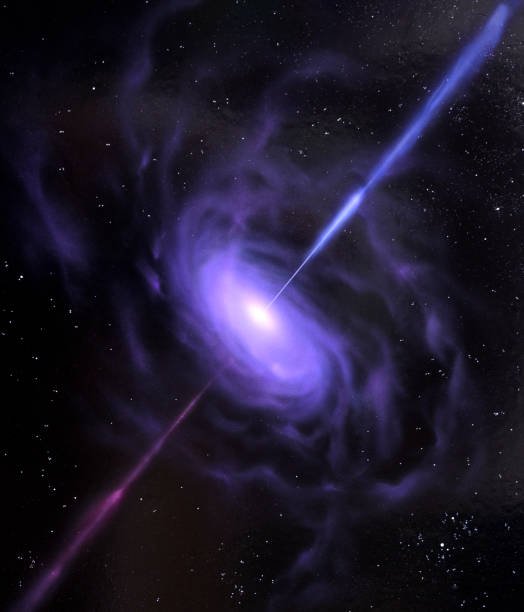
And yet, though invisible, black holes are far from passive. They are engines of transformation—factories of extremes. Around them swirl disks of superheated gas and dust, glowing with the light of annihilation. Jets of particles burst from their poles at nearly the speed of light, sculpting galaxies themselves.
But within their gravitational clutch, something even stranger happens: time slows almost to a stop.
Falling Toward Forever
Imagine an astronaut—call her Elena—falling toward a black hole. From her own perspective, her fall feels perfectly normal. Her clock ticks steadily. Her heartbeat keeps pace. She sees the universe rushing toward her as she accelerates downward.
But to a distant observer—say, her colleague David, safely aboard a spacecraft far from the black hole—Elena’s fall looks utterly different. As she nears the event horizon, David sees her movements slow. The signals from her radio stretch and redshift into lower frequencies. The light from her suit grows dimmer and redder, as though fading into the night.
From David’s point of view, Elena never quite reaches the event horizon. She appears to freeze in time, hovering on the edge forever. Her final moments play out infinitely slowly, her image fading until it merges with the black hole’s shadow.
Yet from Elena’s perspective, she feels no such freeze. She crosses the event horizon without noticing anything special at all—except, perhaps, an eerie silence, as light and communication from the outside universe fade into blackness. Inside, time continues for her—until it doesn’t.
The deeper she falls, the more violently spacetime curves. Within a fraction of a second, she approaches the singularity, where all paths lead inexorably inward. Here, tidal forces stretch her body—first gently, then catastrophically—in a process physicists grimly nickname spaghettification.
To the outside world, she has become a ghost of light frozen in time. To herself, she has lived her final heartbeat. Both are true, in their own frames of reference.
The Event Horizon: Where Time Ends
The event horizon is more than a boundary in space—it is a boundary in time. For anything falling in, the future is literally the singularity. All directions, including what we think of as “forward in time,” lead inward.
From the outside, the horizon represents the limit of visibility. From the inside, it represents the end of return. But in the mathematics of general relativity, something extraordinary happens: time and space switch roles. What we perceive as movement through space becomes movement through time. Once inside the horizon, going inward is as inevitable as going forward in time outside it.
This duality—the way black holes twist the meaning of space and time—is perhaps their most haunting feature. They are not objects in space; they are regions of spacetime where the future itself collapses inward.
In that sense, black holes are not so much holes in the universe as they are wells in time.
The View from the Edge
If you could hover safely near a black hole—say, at a safe distance just beyond the event horizon—you would witness a spectacle unlike anything else in the universe.
The gravitational field would warp light from distant stars, bending it into circular halos called Einstein rings. The sky would twist upon itself, showing you the back of your own head in an optical loop. And, most astonishingly, time for you would move far slower than for anyone far away.
Suppose you hovered there for an hour. When you returned to your ship in distant orbit, you might discover that years—or even centuries—had passed for the rest of the universe. You would have effectively traveled into the future, not by moving through space, but by sitting still in a gravitational field.
This is not fantasy—it is physics. The closer you are to intense gravity, the slower your clock runs. Black holes offer the most extreme form of this truth. They are natural time machines, though one-way only. You can move forward, but never back.
The Paradox of the Observer
Time dilation around black holes reveals a deeper paradox about reality itself. Whose time is “real”—the falling astronaut’s or the observer’s?
Einstein’s answer was radical: both are real, but reality depends on the observer. There is no universal clock ticking for everyone. The universe has as many timelines as it has observers, each valid within its own frame.
This principle lies at the heart of relativity: time is not a river flowing independently of its travelers—it is woven from their motion and their gravity.
Black holes, by amplifying this relativity to extremes, force us to confront how fragile our intuitions about reality truly are. They reveal that what we call “now” is a matter of perspective, and that the universe’s deepest truths may be beyond the reach of human perception.
The Infinite Redshift and the Death of Light
As light climbs out of a gravitational well, it loses energy, stretching into longer wavelengths—a process known as gravitational redshift. Near a black hole, this effect becomes profound.
Photons emitted from matter spiraling into a black hole lose more and more energy as they struggle to escape. To distant observers, this light appears increasingly red, then infrared, then radio, until it fades entirely.
At the event horizon, light becomes infinitely redshifted. It cannot climb out; it cannot even maintain its frequency. To an outside observer, the horizon glows faintly for an instant and then goes black, its photons frozen at the edge of escape.
This fading of light mirrors the fading of time itself. Both are victims of gravity’s infinite pull.
Hawking’s Revelation: Black Holes Are Not Eternal
For decades, physicists believed that black holes were absolute—cosmic prisons from which nothing, not even information, could ever emerge. But in the 1970s, Stephen Hawking made a discovery that changed everything.
By combining quantum mechanics with relativity, Hawking showed that black holes are not entirely black. Tiny fluctuations in the quantum vacuum near the event horizon allow pairs of virtual particles to appear briefly. Normally, they annihilate each other instantly. But near a black hole, one particle can fall in while the other escapes. To distant observers, this looks like the black hole emitting radiation—now known as Hawking radiation.
Over unimaginable timescales, this radiation causes black holes to lose mass and eventually evaporate. The ultimate destroyer of information, it turns out, is itself mortal.
This revelation raised new mysteries: if a black hole disappears, what happens to the information that fell inside? Quantum theory insists that information cannot be destroyed, but general relativity suggests it can vanish within the singularity. The tension between these two great theories—relativity and quantum mechanics—remains one of physics’ deepest puzzles.
The Singularity: The Edge of Knowledge
At the core of every black hole lies the singularity, a point where density becomes infinite and spacetime curvature diverges. Here, our equations lose meaning. Time and space, as we understand them, cease to exist.
Physicists do not believe singularities truly exist as literal infinities; rather, they mark the breakdown of our theories. To go beyond them, we need a quantum theory of gravity—a framework that unites the large-scale geometry of relativity with the microscopic probabilities of quantum physics.
Perhaps at that scale, the singularity dissolves into a “quantum foam,” or perhaps the interior of a black hole connects to another region of spacetime—a wormhole, a bridge to a distant universe. These ideas remain speculative, but they remind us that black holes are not the end of understanding—they are the gateway to the next revolution in physics.
Black Holes as Cosmic Laboratories
Though we cannot visit a black hole, the universe has given us glimpses of their power. The Event Horizon Telescope, a global network of radio telescopes, captured the first direct image of a black hole in 2019—the supermassive object in the galaxy M87. Its shadow, surrounded by a glowing halo of light, confirmed Einstein’s predictions with astonishing precision.
That image was more than a scientific achievement—it was a spiritual one. For the first time, humanity looked upon the boundary where time itself stops. We saw the edge of eternity.
Since then, we’ve discovered that nearly every galaxy harbors a supermassive black hole at its center, some billions of times the mass of our Sun. These cosmic giants regulate star formation, shape galactic evolution, and may even seed the structure of the universe itself.
In a paradox of creation and destruction, black holes—born from dying stars—help give rise to new ones.
Time Travel in the Shadow of Gravity
Time dilation near black holes has long inspired dreams of time travel. And in a limited sense, it is possible.
If you were to orbit a black hole at near-light speed or linger just outside its event horizon, time for you would move much more slowly than for the rest of the universe. When you finally returned, you would have aged only minutes or hours, while centuries could have passed elsewhere.
This is not science fiction—it is the logic of relativity. Gravity and motion both slow time, and near a black hole, both are extreme. In that sense, a black hole is a one-way portal to the future.
But as for traveling back in time—the laws of physics offer no comfort there. Even if wormholes exist, stabilizing them would require exotic matter with negative energy density—something yet undiscovered. Time’s arrow, guided by entropy, still points forward.
Still, the notion that time can flow differently in different places hints at a universe far stranger than we ever imagined.
The Human Perspective: Awe and Humility
Why do black holes captivate us so deeply? Perhaps because they embody the ultimate unknown. They are the edge of reality—the place where knowledge ends and mystery begins.
Standing on the brink of a black hole, we confront questions that are both scientific and existential. What is time? What does it mean for something to end? Can the universe itself have a horizon beyond which nothing can return?
In their silent darkness, black holes reflect our own quest for understanding. They remind us that every discovery reveals a deeper layer of mystery—that to know the universe is to realize how little we truly know.
The Universe as a Tapestry of Time
Time dilation and black holes are not separate phenomena but two aspects of the same truth: gravity shapes time, and time shapes reality. The universe is a vast, interconnected fabric, where matter tells space how to curve and space tells matter how to move.
From the ticking of a clock to the birth of a galaxy, everything that happens is bound to the geometry of spacetime. Black holes simply push that geometry to its limits, revealing its deepest secrets.
In their shadows, we see the malleability of time, the unity of physics, and the fragility of human perception.
The Enduring Mystery
As we continue to explore the cosmos—with telescopes, equations, and imagination—we edge ever closer to understanding what black holes truly are. Are they windows into other universes? Are they the seeds of cosmic rebirth? Do they encode every bit of information that falls into them on their shimmering horizons, as the holographic principle suggests?
Whatever the answers, one truth is certain: in studying black holes, we are studying time itself.
Time dilation is not just a phenomenon—it is a revelation. It tells us that the universe is not static but alive, dynamic, and profoundly strange. It tells us that our experience of time is just one local rhythm in an infinite cosmic symphony.
And it tells us, most beautifully, that in the deepest darkness of the universe, the very flow of time—the essence of existence—can come to a near stop, whispering to us across the void:
Even eternity can bend.