There are places in the universe where time itself slows to a crawl, where light can never return once it crosses a certain boundary, and where the known laws of physics unravel into mystery. These are black holes—gravitational abysses so dense and powerful that nothing, not even light, can escape their pull. Yet among these celestial beasts, one class reigns supreme: supermassive black holes, titanic objects that dwell in the hearts of galaxies, including our own Milky Way.
They are not merely cosmic curiosities. They are architects of galaxies, regulators of star birth, and engines of some of the most energetic phenomena in the cosmos. Their presence shapes the structure of the universe on scales so vast that our minds can barely comprehend them.
Supermassive black holes are both destroyers and creators. They swallow entire stars yet give rise to jets that stretch across millions of light-years. They are silent most of the time, invisible and still, but when they awaken, they blaze brighter than a trillion suns. To understand them is to peer into the universe’s most extreme frontier—a place where space, time, and gravity dance their most dramatic waltz.
What Lies Beneath the Darkness
At its core, a black hole is deceptively simple. Imagine compressing a mass equivalent to millions or billions of Suns into a region smaller than our Solar System. The resulting gravity is so intense that beyond a certain boundary—the event horizon—no information can escape. It is the ultimate one-way door in the cosmos.
According to Einstein’s general theory of relativity, mass curves spacetime. The more massive an object, the deeper the curvature it creates. A supermassive black hole curves spacetime so severely that it forms a bottomless pit—a singularity—where density and gravity become infinite, and our current understanding of physics ceases to apply.
But contrary to popular imagination, black holes are not cosmic vacuum cleaners devouring everything around them. Objects can orbit them safely, just as planets orbit stars. Only those that stray too close—the so-called point of no return—are doomed to be torn apart by the immense gravitational forces.
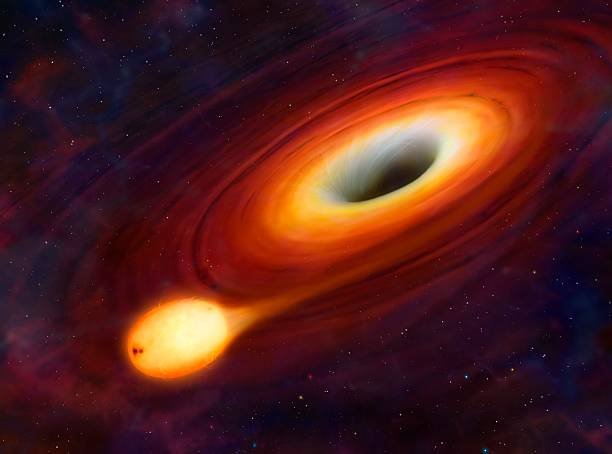
And yet, despite their name, black holes can shine. When matter falls toward the event horizon, it forms a swirling accretion disk that heats up to millions of degrees. This disk radiates powerful X-rays and visible light, turning the surroundings of a black hole into one of the brightest regions in the universe.
Seeds of Darkness: The Origins of Supermassive Black Holes
The question of how supermassive black holes form is one of the most intriguing in modern astrophysics. Stellar-mass black holes are born from the death of massive stars, collapsing under their own gravity after exhausting their nuclear fuel. But supermassive black holes, containing millions to billions of solar masses, are far too enormous to have formed this way alone.
Astronomers have proposed several possibilities. One idea suggests that the first generation of stars—enormous and short-lived giants called Population III stars—may have left behind black holes massive enough to serve as seeds. Over cosmic time, these seeds could have grown through the steady consumption of gas and the merging of smaller black holes.
Another theory points to direct collapse—where vast clouds of primordial gas, instead of forming stars, collapsed straight into black holes weighing tens of thousands of solar masses. These massive seeds would then have had a head start, growing rapidly in the early universe.
Observations from telescopes like the James Webb Space Telescope (JWST) have detected quasars—supermassive black holes actively feeding—when the universe was less than a billion years old. This challenges existing models of growth, suggesting that black holes must have formed and expanded much faster than we previously thought.
Whatever their origin, one fact remains: almost every large galaxy we observe today harbors a supermassive black hole at its center. It is as if these cosmic giants are a fundamental part of what it means to be a galaxy.
The Heart of the Milky Way: Sagittarius A*
Our own galaxy, the Milky Way, is no exception. Hidden behind clouds of dust and stars, about 26,000 light-years away, lies Sagittarius A* (pronounced “Sagittarius A-star”)—the supermassive black hole at our galactic center.
Sagittarius A* has a mass roughly 4.3 million times that of the Sun, yet it occupies a region no larger than the orbit of Mercury. For decades, astronomers suspected something massive was lurking there, but it wasn’t until the 1990s that its true nature became clear.
Using powerful infrared telescopes, researchers like Reinhard Genzel and Andrea Ghez observed the orbits of stars near the galactic core. One star, called S2, completes a full orbit around the invisible object in just 16 years—a cosmic blink. The speed and path of these stars could only be explained if an enormous, compact mass was hidden there: a black hole.
In 2022, the Event Horizon Telescope (EHT) collaboration released the first-ever image of Sagittarius A*, revealing a glowing ring of superheated gas encircling a dark shadow—the silhouette of the black hole itself. It was a moment of profound triumph for science, confirming what Einstein’s equations had predicted more than a century earlier.
Despite its immense mass, Sagittarius A* is relatively quiet. It feeds on small trickles of gas rather than devouring large quantities of matter. But every so often, it flares briefly in X-rays or radio waves, a reminder that even a sleeping monster occasionally stirs.
Quasars: The Brightest Beacons in the Universe
While our galaxy’s black hole is subdued, others across the universe blaze with unimaginable brilliance. These are quasars—the active, feeding versions of supermassive black holes. When a black hole consumes vast amounts of gas and dust, the material spirals inward, forming a blazing accretion disk. The friction and magnetic forces within the disk release immense energy, making quasars shine so brightly they can outshine entire galaxies.
Some quasars emit twin jets of charged particles that shoot out from their poles at nearly the speed of light, powered by magnetic fields twisting around the spinning black hole. These jets can extend for millions of light-years, influencing the intergalactic environment and even shaping the formation of nearby galaxies.
Quasars serve as cosmic lighthouses, visible across the vast expanses of space and time. Many of the quasars we observe today existed when the universe was in its infancy. By studying them, astronomers can peer into the distant past and learn how galaxies—and the supermassive black holes within them—evolved together.
The brightest known quasars are powered by black holes with masses exceeding ten billion Suns. Yet despite their violent nature, these cosmic furnaces have a strange beauty. They are reminders that destruction and creation often coexist in the universe.
The Cosmic Architects: How Black Holes Shape Galaxies
For many years, astronomers thought of black holes as cosmic parasites—objects that consumed matter but contributed little to their surroundings. Today, we know the opposite is true. Supermassive black holes are deeply intertwined with the galaxies that host them.
Observations reveal a striking relationship between the mass of a galaxy’s central black hole and the velocity of its stars—a connection known as the M–sigma relation. This suggests that black holes and galaxies evolve together, influencing each other’s growth.
When a black hole feeds actively, it releases powerful winds and radiation that can heat or even expel the surrounding gas. This process, called feedback, can suppress star formation, preventing galaxies from growing too large too quickly. In other cases, outflows from black holes may compress gas clouds, triggering bursts of star birth.
In this way, supermassive black holes act like cosmic regulators—controlling the rhythm of galactic evolution. Without them, the universe would look profoundly different. Galaxies might grow unchecked, forming stars until their gas ran dry. Instead, black holes ensure a balance between creation and destruction—a dance that has shaped the structure of the cosmos itself.
The Event Horizon: The Edge of the Possible
At the center of every black hole lies the most mysterious feature in all of physics—the event horizon. It is not a physical surface but a boundary in spacetime. Once something crosses it, escape is impossible. Even light, the fastest thing in the universe, cannot return.
To an outside observer, an object approaching the event horizon appears to slow down, its light redshifted to longer and longer wavelengths. To the falling object, however, time flows normally, and it plunges inward, crossing the horizon in a heartbeat.
What lies beyond the event horizon is a realm hidden from all observation. The laws of physics as we know them break down. At the very center, or so theory predicts, lies the singularity—a point of infinite density where space and time cease to have meaning.
But many physicists believe the singularity is not a true physical point but a sign that our theories are incomplete. A complete understanding will likely require a quantum theory of gravity—something that unites Einstein’s relativity with quantum mechanics.
Black holes are not just astronomical phenomena; they are laboratories for fundamental physics. They test our understanding of space, time, and the very fabric of reality.
When Stars Fall into Darkness
Few cosmic events are as dramatic as a tidal disruption event—when a star strays too close to a supermassive black hole. As the star approaches, the black hole’s gravity stretches it into a long stream of gas, tearing it apart in a process known as spaghettification.
Half of the star’s material is flung outward into space, while the rest spirals inward, forming a temporary accretion disk that blazes with X-rays and ultraviolet light. These events can outshine the entire galaxy for months or even years.
Such stellar deaths give astronomers rare opportunities to study black holes directly. By analyzing the light and radiation emitted during these outbursts, scientists can estimate the black hole’s mass, spin, and feeding habits.
Each tidal disruption is both a tragedy and a revelation—a reminder that even in destruction, the universe reveals its secrets.
The Paradox of Information and the Quantum Horizon
Black holes not only challenge our understanding of gravity—they also spark one of the deepest puzzles in theoretical physics: the information paradox.
According to quantum mechanics, information about the state of a system can never be truly lost. But when matter falls into a black hole, it seems to vanish forever beyond the event horizon. If the black hole eventually evaporates through Hawking radiation, as Stephen Hawking predicted, what happens to the information contained within it?
Hawking’s discovery was revolutionary. He showed that black holes are not entirely black—they emit faint radiation due to quantum effects near the event horizon. Over immense timescales, this radiation causes black holes to lose mass and eventually evaporate. But if they disappear, and the information they contained vanishes too, that would violate the fundamental principles of quantum theory.
Physicists have debated this paradox for decades. Some propose that the information is somehow encoded in the Hawking radiation itself; others suggest it remains preserved on the surface of the event horizon, in accordance with the holographic principle—the idea that all the information within a volume of space can be described by data on its boundary.
Whatever the answer, the information paradox is more than a technical problem—it’s a doorway to a new understanding of the universe, hinting that spacetime itself may be a holographic projection of deeper, unseen dimensions.
The Giants That Collide
When galaxies merge, their central black holes are drawn toward each other by gravity. Over millions of years, they spiral inward, releasing enormous amounts of energy as gravitational waves—ripples in the fabric of spacetime predicted by Einstein and first detected in 2015.
Eventually, the two black holes coalesce into a single, larger one, releasing a burst of gravitational radiation so powerful that it briefly outshines all the stars in the observable universe in gravitational energy alone.
Such cosmic mergers are among the most violent events imaginable. They reshape galaxies, trigger waves of star formation, and help supermassive black holes grow even more massive.
Future observatories, such as the Laser Interferometer Space Antenna (LISA), will be able to detect gravitational waves from supermassive black hole collisions across billions of light-years, opening an entirely new window into the universe.
The Shadow of a Monster: Seeing the Unseeable
For decades, black holes existed only in theory. But in 2019, the world saw something extraordinary: the first-ever image of a black hole’s shadow. The Event Horizon Telescope captured the supermassive black hole at the center of galaxy M87, 55 million light-years away.
The image revealed a glowing ring of gas encircling a dark void—the black hole’s event horizon. This observation confirmed, with breathtaking clarity, Einstein’s predictions about gravity and light. The M87 black hole is a true titan, with a mass of 6.5 billion Suns. Its shadow spans more than 40 billion kilometers across.
That image marked a turning point in human history. For the first time, we had seen one of the most enigmatic entities in existence. It was as though the universe had allowed us to look into its own eyes.
Black Holes as Time Machines
Black holes are not just objects of destruction—they may also be portals to new physics. According to Einstein’s equations, the immense warping of spacetime around a black hole could, in theory, allow for paths through time.
Inside a rotating (Kerr) black hole, some solutions suggest the possibility of “closed timelike curves,” where an object could theoretically return to its own past. However, such conditions are purely theoretical. In reality, any traveler approaching the event horizon would be torn apart long before they could test these ideas.
Still, the concept fascinates scientists and storytellers alike. Black holes stand at the intersection of science and imagination, where mathematics brushes against the edges of eternity.
Feeding the Darkness: The Hunger of Giants
Supermassive black holes grow by feeding on surrounding matter, a process known as accretion. Gas, dust, and even stars spiral inward, heating up as they approach the event horizon. When the inflow is steady, the black hole remains relatively quiet. But during major feeding episodes—perhaps triggered by a galactic merger—the accretion rate skyrockets, transforming the black hole into a blazing quasar.
This hunger shapes the life cycles of galaxies. When the black hole feeds too actively, it can generate winds that blow away the surrounding gas, shutting off further growth for both itself and its host galaxy. Eventually, the system settles back into balance until the next surge of cosmic appetite.
The dance of feeding and feedback is one of the great regulators of the universe’s evolution, linking the smallest scales of physics to the grandest structures in existence.
Beyond the Horizon: The Quest for a Unified Theory
Black holes are nature’s ultimate paradoxes. They are simple in form yet infinitely complex in behavior. They obey Einstein’s equations but also demand a quantum explanation. They are the boundary between the known and the unknowable.
Physicists believe that by understanding black holes, we may uncover a unified theory of everything—a framework that reconciles quantum mechanics with general relativity. String theory, loop quantum gravity, and holographic duality are all contenders in this quest, each offering glimpses of how spacetime might emerge from deeper principles.
Perhaps black holes are not singularities at all but gateways to new regions of the universe. Perhaps their interiors encode the fundamental structure of reality itself. The answers remain hidden, but humanity’s determination to uncover them is relentless.
The Immortal Giants
Supermassive black holes are among the longest-lived entities in the universe. They outlast their host galaxies, enduring for trillions upon trillions of years. As stars burn out and galaxies fade, black holes will remain—silent, dark remnants of a once-luminous cosmos.
Even when they eventually evaporate through Hawking radiation, the process will take longer than the age of the universe multiplied a thousand times over. In that distant future, when all stars have died and matter itself begins to decay, the last glow of the cosmos will be the faint whisper of evaporating black holes.
They are the final keepers of cosmic memory, the last embers of creation.
The Human Connection to the Infinite
To study supermassive black holes is to confront the limits of understanding and to stand in awe of the universe’s grandeur. They are symbols of both mystery and mastery—mystery because they embody the unknown, mastery because we can describe them with equations that bridge imagination and reality.
When we look at the image of M87’s black hole or measure the orbits of stars around Sagittarius A*, we are witnessing not just astrophysical phenomena but the triumph of human curiosity. Our species, born on a small blue planet orbiting an ordinary star, has reached across light-years to touch the very edge of spacetime.
Supermassive black holes remind us of our place in the grand story of the cosmos. They show us that we are part of something vast and interconnected—that the same physics that governs their event horizons governs our atoms, our hearts, our thoughts.
They are the universe’s most fearsome monsters and its most magnificent teachers.
The Eternal Darkness and the Light It Reveals
In the end, supermassive black holes are not merely holes in space; they are mirrors reflecting the depth of reality itself. Through them, we glimpse the universe’s extremes—creation and annihilation, light and darkness, time and eternity.
They challenge us to imagine, to question, and to dream. They humble us with their power, yet inspire us with their beauty. For even in their darkness, they illuminate our path toward understanding the cosmos.
Perhaps that is their greatest lesson—that knowledge, like light, may bend and falter, but never truly disappears. It continues to spread, illuminating the infinite mystery of existence.
Supermassive black holes are not the end of everything. They are the beginning of wonder itself.