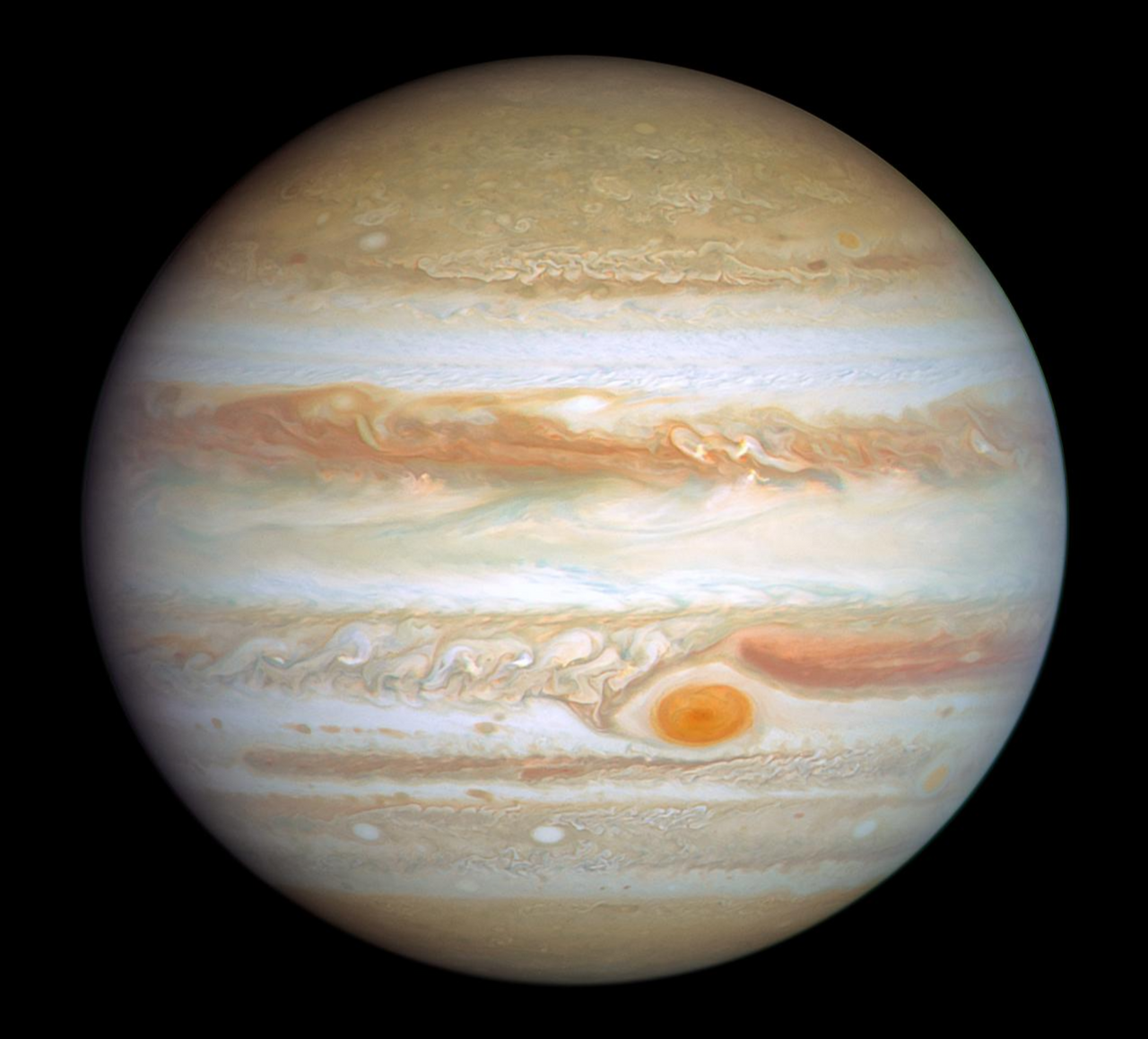
In the grand orchestra of the solar system, Jupiter is the booming drumbeat that anchors the melody of the planets. It is a colossal world, a storm-wrapped giant of gas and power, vast enough to swallow more than 1,300 Earths and yet still light enough to drift like a celestial balloon. Jupiter’s presence dominates the cosmic neighborhood—it is the heavyweight protector, the ancient sentinel that guards the inner planets from the chaos of deep space.
To gaze upon Jupiter through a telescope is to glimpse a world of motion and majesty. Its bands of red, brown, and white swirl like oil on water, its vast Great Red Spot a hurricane of unimaginable fury that has raged for centuries. Yet beneath its hypnotic beauty lies mystery—what exactly lurks beneath those churning clouds? Does Jupiter have a solid heart? What drives its storms? And how did this giant shape the history—and perhaps even the survival—of our own fragile world?
The King of the Planets
Jupiter is aptly named after the king of the Roman gods, known to the Greeks as Zeus, the thunder-wielder who ruled the heavens. And like its mythic namesake, the planet commands respect through its sheer power. With a diameter of nearly 143,000 kilometers, it is by far the largest planet in the solar system—so large that all the other planets could fit inside it, with room to spare.
Its mass is 318 times that of Earth, yet it spins faster than any other planet, completing a full rotation in just under 10 hours. This rapid spin stretches Jupiter into an oblate sphere—flattened at the poles and bulging at the equator—and gives rise to fierce jet streams that sculpt its colorful cloud bands.
If the Sun is the heart of the solar system, Jupiter is its beating pulse. Its gravitational influence extends like an invisible hand, tugging at asteroids, shepherding comets, and shaping the very architecture of planetary orbits. Without Jupiter’s immense gravity, the solar system we know might never have existed in its current harmony.
A Formation of Fire and Gas
To understand Jupiter is to journey back to the dawn of creation. Over 4.5 billion years ago, when the solar system was a swirling disk of gas and dust surrounding a newborn Sun, countless fragments collided and merged to form the first planets. In this cosmic nursery, Jupiter was the firstborn.
As the largest of the protoplanets, Jupiter gathered gas and dust with unstoppable appetite. Its immense gravity pulled in material from far and wide, and in the process, it likely grew fast enough to carve a protective gap in the disk, limiting how much material flowed inward to the Sun. Some scientists believe Jupiter’s rapid growth even prevented another giant planet from forming between it and Mars—changing the solar system’s destiny.
But Jupiter never ignited into a star. Though massive, it lacked the critical weight to trigger nuclear fusion in its core. If it had been about 80 times more massive, it could have become a second Sun, transforming our solar system into a binary star system. Instead, it became a “failed star,” glowing faintly with the residual heat of its birth.
That heat still escapes today, radiating into space. In fact, Jupiter emits more energy than it receives from the Sun—a reminder of the primal fire still lingering within.
The Endless Bands of Color and Chaos
When we look at Jupiter, we see not a solid surface but an ocean of clouds—a mesmerizing tapestry of motion that never rests. Its atmosphere, made primarily of hydrogen and helium, extends thousands of kilometers deep, blending gradually into its liquid interior.
The planet’s visible layers form dazzling stripes that stretch around the globe. These alternating light and dark bands—called zones and belts—are shaped by powerful jet streams racing in opposite directions at hundreds of kilometers per hour. The lighter zones are regions of rising gas and high clouds of ammonia ice, while the darker belts mark sinking gas rich in sulfur and phosphorus compounds.
The colors are not static; they shift and evolve as storms rise and fade. Through telescopes, Jupiter’s face looks alive, a swirling canvas painted by chemistry and turbulence. It’s a living world of clouds, lightning, and perpetual motion—a symphony of storms that has played for billions of years.
And among those tempests, one reigns supreme: the Great Red Spot.
The Great Red Spot: The Storm That Refuses to Die
Imagine a hurricane so vast it could swallow Earth whole. That is the Great Red Spot—a titanic vortex that has spun in Jupiter’s southern hemisphere for at least 400 years, perhaps far longer. When Galileo first pointed his telescope toward Jupiter in the 1600s, the storm was already there, raging beneath the planet’s banded clouds.
The Red Spot is a high-pressure system, the opposite of a hurricane on Earth. Winds within it roar at more than 400 kilometers per hour, circling a vast oval that once measured 40,000 kilometers across—though in recent decades, it has been slowly shrinking. The storm’s reddish hue remains a mystery; scientists suspect it arises from chemical reactions between sunlight and compounds in the planet’s atmosphere, producing complex organic molecules that tint the clouds red.
No one knows how long the storm will endure. Some models suggest it could fade within a century, merging into the chaotic cloudscape around it. Yet even if it vanishes, Jupiter’s atmosphere will remain restless, birthing new vortices in an eternal cycle of creation and destruction. The Great Red Spot is more than a storm—it is a symbol of Jupiter’s eternal power, a portrait of chaos that has outlasted empires and civilizations on Earth.
The Hidden Depths
Beneath Jupiter’s clouds lies a realm of mystery. As one descends into the planet, the pressure rises rapidly. Clouds of ammonia and sulfur give way to layers of water vapor and complex gases. Eventually, the pressure becomes so intense that hydrogen—normally a gas—transforms into a strange, metallic state.
This “metallic hydrogen” is one of the strangest substances in the universe. It conducts electricity like a metal but behaves like a fluid, swirling around the planet’s core and generating its enormous magnetic field. Jupiter’s magnetic field is the strongest of any planet—14 times more powerful than Earth’s—and it extends millions of kilometers into space, creating a vast magnetosphere that traps particles and emits deadly radiation.
At the planet’s heart may lie a dense core of rock, metal, and ice, perhaps 10 to 20 times the mass of Earth. But scientists are not certain. The boundary between Jupiter’s core and its surrounding layers may be blurred—more a gradient than a distinct surface. The deeper we imagine going, the stranger it becomes, until we reach pressures and temperatures that defy comprehension.
The Magnetic Titan
Jupiter’s magnetic field is a colossal force of nature. It is so vast that if it were visible to the naked eye, it would appear larger than the full Moon in our night sky, even though the planet itself lies hundreds of millions of kilometers away.
Generated by the movement of metallic hydrogen within its interior, this magnetic field creates a magnetosphere that stretches out millions of kilometers toward the Sun and even farther in the opposite direction, forming a gigantic tail that sweeps past Saturn’s orbit.
Within this field, charged particles are accelerated to near-light speeds, producing intense radiation belts. Any spacecraft venturing too close must be heavily shielded to survive. The field also funnels energetic particles into Jupiter’s polar regions, where they collide with the atmosphere and create spectacular auroras—rings of blue and ultraviolet light that encircle the poles. These auroras are the most powerful in the solar system, brighter and more energetic than any seen on Earth.
Jupiter’s magnetosphere is not just a shield—it is a living system, interacting constantly with the solar wind, its moons, and even its own volcanic satellite, Io, which spews material that becomes trapped in the magnetic field. The result is a cosmic engine of light, motion, and electricity on a planetary scale.
The Moons: A Miniature Solar System
Orbiting Jupiter is a family of moons so diverse and dynamic that it could be called a solar system in miniature. Over 90 moons have been discovered, ranging from tiny captured asteroids to worlds as large as planets themselves.
The four largest, known as the Galilean moons—Io, Europa, Ganymede, and Callisto—were first seen by Galileo Galilei in 1610. Their discovery was revolutionary, proving that not everything in the heavens orbited Earth. They remain some of the most fascinating objects in the solar system today.
Io is the most volcanic body in existence, its surface a fiery mosaic of sulfur and lava. Tidal forces from Jupiter’s immense gravity squeeze and stretch Io, generating internal heat that fuels constant eruptions. It is a world of fire, a place where the ground itself is alive.
Europa is an ice-covered enigma. Beneath its frozen crust lies a vast ocean of liquid water—more than all of Earth’s oceans combined. Scientists believe this hidden sea may harbor the conditions for life. The surface is etched with cracks and ridges, scars from the flexing of the icy shell. Europa may be one of the most promising places in the solar system to search for extraterrestrial biology.
Ganymede, the largest moon in the solar system, is even bigger than the planet Mercury. It possesses its own magnetic field—the only moon known to have one—and a complex surface of icy plains and ancient ridges. Like Europa, it likely hides a deep ocean beneath its crust, perhaps hundreds of kilometers below the surface.
Callisto is the ancient face of the solar system. Its heavily cratered surface has remained unchanged for billions of years, a record of cosmic history preserved in ice and rock. It may also harbor a subsurface ocean, though it is far less active than its siblings.
Together, these moons form a stunning portrait of diversity—fire, ice, magnetism, and ancient silence—all orbiting their giant master.
The Giant’s Protective Embrace
For all its beauty and ferocity, Jupiter may also be the reason life exists on Earth. Its immense gravity acts as a cosmic shield, capturing or deflecting countless comets and asteroids that might otherwise bombard the inner planets.
Over the eons, Jupiter has likely saved Earth from countless catastrophic impacts. Some scientists call it the “cosmic vacuum cleaner” of the solar system. When comets stray too close, Jupiter’s gravity can fling them into deep space or pull them into itself.
In 1994, the world watched as this protective role was dramatically demonstrated. The fragments of Comet Shoemaker–Levy 9, torn apart by Jupiter’s gravity, plunged into the planet’s atmosphere one by one. Each impact released energy equivalent to millions of nuclear bombs, leaving dark scars in the clouds that lingered for months. It was a breathtaking reminder of Jupiter’s power—and of the danger it diverts from us.
Without Jupiter’s gravitational influence, the early solar system might have been far more chaotic. The inner planets could have suffered far more impacts, possibly preventing the emergence of life. Jupiter is not just a planet; it is our guardian.
The Sound of Thunder: Lightning on Jupiter
Jupiter is not only a world of gas and storms—it is a planet alive with electricity. Its thunderstorms dwarf anything on Earth. Lightning bolts hundreds of kilometers long flash through its cloud layers, illuminating the depths like silent explosions.
NASA’s Juno spacecraft has recorded radio emissions from these lightning strikes—signals that echo through space like the crackle of distant thunder. These storms occur primarily near the planet’s poles, unlike on Earth, where lightning is concentrated near the equator.
The sheer scale of Jupiter’s storms is staggering. Some last for weeks, others for centuries. The interplay of heat, chemistry, and rotation creates weather patterns more complex than any on Earth. Even today, scientists are only beginning to unravel the forces that drive them.
The Juno Mission: A Journey into the Unknown
In 2016, NASA’s Juno spacecraft entered orbit around Jupiter, becoming humanity’s closest observer of the giant planet. Designed to withstand intense radiation and peer beneath the cloud tops, Juno has transformed our understanding of Jupiter’s interior and atmosphere.
It has revealed cyclones clustered around the poles like celestial hurricanes, and shown that Jupiter’s weather penetrates far deeper than expected. Its magnetic and gravitational measurements have offered new clues about the planet’s core—suggesting it may be partially dissolved and mixed into the surrounding layers.
Juno has also captured breathtaking images—views of swirling storms, turbulent clouds, and delicate ribbons of color that defy description. Each photograph reminds us that nature is both beautiful and chaotic, both artistic and mathematical.
Through Juno, we are learning that Jupiter is not just a planet but a world of immense complexity—a living laboratory for studying the forces that shaped all planetary systems.
The Influence Beyond Its Orbit
Jupiter’s influence stretches far beyond its own orbit. It shapes the asteroid belt, controls the trajectories of comets, and even affects the formation of new moons and rings.
Its gravitational power has also helped sculpt the orbits of neighboring planets. Some models suggest that Jupiter’s early migration toward and then away from the Sun played a key role in shaping Earth’s orbit and possibly in the formation of Mars’s smaller size.
Without Jupiter’s stabilizing presence, the solar system might be a place of chaos—planets colliding, orbits shifting unpredictably, and life struggling to find stability.
The Rings of Jupiter
Though often overshadowed by Saturn’s majestic bands, Jupiter, too, wears a system of rings—faint and delicate, made of dust rather than ice. Discovered by the Voyager 1 spacecraft in 1979, these rings are almost invisible from Earth. They are composed of fine particles ejected from its small inner moons when they are struck by meteoroids.
Unlike Saturn’s bright rings, Jupiter’s are dusky, ghostlike—a whisper of debris circling the giant. Yet they tell a story of constant motion and renewal. The rings are not ancient; they are continuously replenished by the collisions and interactions of the moons that orbit within them.
Even in its faint adornments, Jupiter reveals the dynamic interplay of gravity and matter that governs all planetary systems.
The Eternal Dance of Moons and Tides
The moons of Jupiter do not merely orbit in isolation; they interact in a rhythmic gravitational dance known as orbital resonance. Io, Europa, and Ganymede are locked in a precise 1:2:4 resonance—each time Ganymede completes one orbit, Europa completes two, and Io four.
This resonance keeps their orbits slightly elliptical, ensuring they are constantly flexed by Jupiter’s gravity. The resulting tidal heating drives volcanic eruptions on Io and keeps the subsurface oceans of Europa and Ganymede from freezing solid.
It is a delicate balance—a cosmic dance choreographed by gravity, in which energy flows between worlds. In this way, Jupiter’s influence extends beyond protection; it fosters geological and perhaps even biological activity on its moons.
A Beacon in the Night
For as long as humans have looked to the heavens, Jupiter has been a beacon of wonder. It is the fourth-brightest object in the sky, outshone only by the Sun, the Moon, and Venus. Its steady glow has guided sailors, inspired mythologies, and marked the passage of time.
Through telescopes, amateur astronomers can watch its storms evolve, its cloud bands shift, and its moons perform their nightly dance. Each observation is a connection across vast distances, a reminder that the solar system is not static but alive with motion and energy.
Jupiter is both a cosmic spectacle and a cosmic necessity. It is beauty and power, serenity and storm, chaos and order—all contained within one immense sphere.
The Legacy of the Giant
As we continue to study Jupiter, we realize how deeply its story intertwines with our own. It shaped the birth of the solar system, protected the fragile Earth, and continues to influence the destiny of other worlds.
It is a reminder of scale—of how small we are in the face of cosmic giants—and of how much we owe to forces beyond our control. Without Jupiter, the solar system might have been a very different place, perhaps one too dangerous for life to thrive.
To study Jupiter is to confront the raw power of creation itself. It shows us what gravity can build, what energy can sustain, and what beauty chaos can produce.
The Heart of a Guardian
In mythology, Jupiter (or Zeus) was both creator and destroyer, protector and punisher. The planet that bears his name embodies all these traits. It shields Earth from catastrophe, yet its storms could annihilate our world in moments if such power were unleashed nearby. It is a being of balance—both savior and tempest, order and fury.
But perhaps the truest power of Jupiter lies in what it represents: the enduring drive of nature to create complexity, to build and rebuild, to transform chaos into harmony. It is a cosmic guardian not because it was meant to be, but because its very existence fulfills that role.
When we look at Jupiter, we see more than a planet—we see the ancient story of our solar system, still unfolding. We see the breath of the cosmos, vast and eternal.
The Giant and the Human Heart
There is something deeply human about our fascination with Jupiter. We are drawn to what is immense and unknowable, to what reminds us of our own smallness yet invites us to dream beyond it. In Jupiter’s swirling clouds and endless storms, we see both the violence and the beauty of existence.
Every probe sent, every photograph captured, is an act of reverence—our way of reaching toward the divine in the language of science. Jupiter does not merely orbit the Sun; it orbits our imagination.
In its storms, we hear echoes of our own chaos. In its calm zones, we glimpse the possibility of peace. And in its vastness, we feel the humbling truth that even the mightiest worlds are but whispers in the cosmic symphony.
The Eternal Guardian
Jupiter will continue to circle the Sun long after humanity is gone, its storms still raging, its moons still dancing in rhythm. It will remain the great guardian, the ancient sentinel, watching silently over the inner planets.
Its gravity will continue to shape the fate of comets and asteroids, its auroras will continue to blaze across its poles, and its bands will continue to churn in endless motion. The universe will evolve, stars will die and be reborn, but Jupiter—the timeless giant—will endure.
When we lift our eyes to that bright point of light in the night sky, we are not just seeing a planet. We are witnessing a masterpiece of cosmic design, a protector of worlds, a monument to the grandeur of nature.
Jupiter is the guardian that keeps watch—the ancient king who still holds court in the heavens, his storms singing the eternal song of the solar system.
And through that song, across the void of space, the giant whispers a truth as old as time: that even in the vastness of the universe, there is balance, there is beauty, and there is purpose.