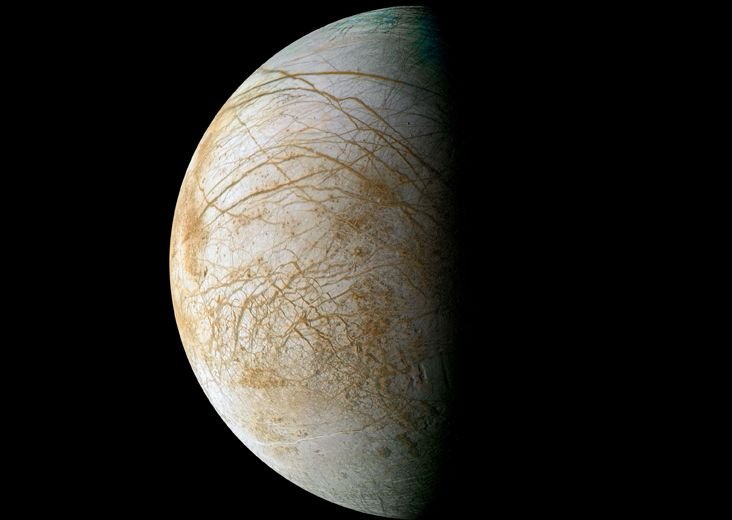
Far beyond Earth’s comforting warmth, past the red deserts of Mars and the swirling storms of Jupiter, there drifts a small, pale world wrapped in ice. It is not a planet, but a moon—Europa, one of Jupiter’s four largest companions. Through the eyes of spacecraft, it appears as a sphere of white and blue marble, etched with reddish scars that crisscross its surface like veins on glass.
At first glance, Europa seems lifeless—an airless, frozen rock orbiting a giant of storms. But hidden beneath its icy crust lies one of the most extraordinary secrets in the Solar System: a vast, global ocean of liquid water, sealed under kilometers of ice. It is a place of eternal night, warmed not by sunlight but by the invisible hand of gravity and energy from within.
Scientists now believe that this secret ocean may contain twice as much water as all of Earth’s oceans combined. And where there is water, there may be life. Europa has become one of the most compelling destinations in the search for life beyond our world—a cold moon that might hold warm, alien seas teeming with unknown forms of existence.
The Discovery of a World Within a World
When Galileo Galilei first turned his telescope toward Jupiter in 1610, he saw four small lights moving around the planet—Io, Europa, Ganymede, and Callisto. These “Galilean moons,” as they came to be known, were the first worlds ever discovered orbiting another planet. For centuries, they were mere points of light, their true nature hidden.
It wasn’t until the 20th century, when spacecraft like Voyager 1 and Voyager 2 flew past Jupiter, that Europa’s true face was revealed. The images they sent back stunned scientists. Instead of a cratered, rocky surface like most moons, Europa’s exterior appeared smooth and bright, crisscrossed by dark lines that stretched for thousands of kilometers.
This was unlike anything astronomers had ever seen. The absence of large craters meant the surface must be young and constantly renewed—perhaps by ice shifting and freezing again. Some suggested that beneath that shell of ice could lie a vast ocean, kept liquid by heat from tidal forces as Europa orbited Jupiter’s immense gravity.
Later, NASA’s Galileo spacecraft, which orbited Jupiter from 1995 to 2003, provided crucial evidence. It measured Europa’s magnetic field and found that it behaved as if a conductive layer—likely salty liquid water—lay beneath the ice. The moon’s surface also showed signs of movement and fractures consistent with floating ice plates.
The conclusion was as astonishing as it was thrilling: beneath Europa’s icy skin lies an ocean that may have existed for billions of years—a secret world of liquid water beneath a world of ice.
A Frozen Surface of Alien Beauty
Europa’s surface is one of the most beautiful and haunting landscapes in the Solar System. From space, it gleams like polished ivory, smooth yet scarred with reddish-brown streaks. These streaks, called lineae, resemble long cracks or fractures and are thought to be regions where the ice has broken apart and refrozen, allowing material from below to seep upward.
The reddish color of the lines may come from salts, sulfur compounds, or organic materials carried from the ocean below. If so, the surface of Europa may be dusted with chemical clues from its hidden sea—a message from the deep, waiting to be deciphered.
Some regions of the moon appear chaotic, filled with shattered ice blocks that seem to have floated and rotated before refreezing, creating terrain known as “chaos regions.” One of the largest of these, Conamara Chaos, looks like a mosaic of shattered glass, as if a frozen crust had broken apart to reveal the fluid beneath.
There are few large craters on Europa’s surface. This suggests that the ice continually renews itself, perhaps as warmer material rises from below, melts the surface, and then freezes again. The entire shell may be in slow motion, shifting and flexing like a living skin over the dark ocean beneath.
Tides Beneath the Ice
Europa’s secret ocean exists because of a delicate dance between the moon and its giant parent. As Europa orbits Jupiter, it is constantly pulled by the planet’s massive gravity. But its orbit is not a perfect circle—it’s slightly elliptical. This means the strength of Jupiter’s pull changes constantly, stretching and squeezing Europa as it moves.
This relentless flexing generates heat through friction inside the moon’s interior—a process known as tidal heating. It’s the same process that drives the intense volcanic activity on Io, another of Jupiter’s moons. On Europa, the heat doesn’t create volcanoes of fire but rather melts ice, keeping the hidden ocean from freezing solid.
This tidal energy might also create hydrothermal vents on Europa’s seafloor—openings where mineral-rich, heated water gushes into the ocean from the rocky mantle below. On Earth, such vents are oases of life, home to organisms that thrive in darkness, feeding not on sunlight but on the chemical energy released from the Earth’s interior.
If similar vents exist on Europa, they could provide both the energy and the chemistry necessary for life to emerge and survive, even in the absence of sunlight.
The Depth and Darkness of the Hidden Ocean
How deep is Europa’s ocean? Estimates suggest the ice crust may be between 15 and 25 kilometers thick, with the ocean beneath extending perhaps 100 kilometers or more. If these estimates are correct, the total volume of water is about twice that of all Earth’s oceans combined.
Imagine an entire global sea, encased in ice, stretching from pole to pole. The surface above is frozen solid, but below lies a vast, pitch-black abyss. No sunlight reaches those depths, only the faint red glow of heat from the interior and the chemical reactions that fuel alien chemistry.
In that darkness, currents may flow, tides may rise and fall, and chemical compounds may mix in a slow dance that has lasted billions of years. If life exists there, it would have evolved in total isolation, guided by chemistry, energy, and time.
What might such life look like? It would not resemble plants or animals as we know them, since no sunlight filters through the ice. Instead, it might consist of simple microorganisms, perhaps similar to bacteria, thriving near hydrothermal vents or feeding on nutrients delivered from the surface.
If multicellular organisms evolved, they might be translucent, adapted to the darkness, perhaps sensing the world through vibrations or faint glimmers of bioluminescence. The thought of alien creatures swimming in Europa’s deep, unseen waters is one of the most tantalizing ideas in modern astronomy.
The Evidence Written in Ice
The search for proof of Europa’s ocean and its potential habitability continues to this day. Spacecraft observations have revealed indirect evidence, but scientists hunger for direct confirmation.
In 2012, the Hubble Space Telescope detected faint plumes of water vapor erupting from Europa’s south pole—similar to the geysers seen on Saturn’s moon Enceladus. If these plumes are real and recurring, they could allow scientists to study the moon’s internal ocean without having to drill through the ice.
More recent observations have supported the presence of these plumes, though they appear to be intermittent. They may erupt when tidal stresses crack the ice, releasing bursts of water and vapor into space. If confirmed, these geysers could be sampled by future spacecraft flying through them, analyzing their composition for signs of organic molecules or other markers of life.
The reddish material seen on Europa’s surface also hints at chemistry from the deep. Spectral analysis suggests the presence of hydrated salts, which may have originated from the ocean and become frozen into the surface. Each patch of color may be a chemical fingerprint of what lies beneath.
Together, these clues form a portrait of a dynamic, living world—not biologically alive, perhaps, but geologically active, chemically rich, and endlessly intriguing.
A World of Extreme Forces
Europa’s beauty hides immense violence. The gravitational pull of Jupiter constantly stretches and compresses the moon, creating fractures that snake across the icy surface. Some of these cracks may open and close over time, allowing water or slush to seep upward and freeze.
The temperature on Europa’s surface hovers around –160°C near the equator and drops even lower near the poles. The radiation from Jupiter’s magnetic field bombards the surface with energetic particles, constantly altering its chemistry.
Yet beneath all this brutality, the ocean persists—protected by its thick shell, insulated from radiation, and stirred by the unseen hand of tidal forces. It is a paradoxical world: deadly on the outside, potentially nurturing on the inside.
Europa reminds us that life might not need sunlight or mild climates. It might thrive wherever there is water, energy, and chemistry—even in the cold darkness of space.
The Quest for Life Beyond Earth
The discovery of Europa’s ocean revolutionized our understanding of where life might exist in the universe. Before, scientists thought habitable worlds had to orbit within a “Goldilocks zone” around their stars—a region where temperatures are just right for liquid water.
Europa shattered that idea. It showed that even far from the Sun, moons can harbor oceans kept warm by internal heat, not by starlight. This means that the number of potentially habitable worlds in the universe could be far greater than we ever imagined.
If life could survive in Europa’s ocean, it might also exist on other icy moons, such as Enceladus, Titan, or even distant worlds orbiting giant exoplanets around other stars. The cosmos could be filled with hidden oceans and unseen forms of life, waiting beneath layers of ice and rock.
Europa thus stands as a symbol of possibility—a frozen world whispering that life might flourish in places we once thought impossible.
The Machines That Will Follow the Mystery
Humanity’s quest to explore Europa is entering a new age. NASA’s upcoming Europa Clipper mission, set to launch in the 2030s, will orbit Jupiter and make dozens of close flybys of Europa. It will carry instruments designed to study the moon’s ice, atmosphere, magnetic field, and composition.
Europa Clipper will search for evidence of plumes, analyze surface materials, and measure the thickness of the ice shell. It may even detect signs of organic molecules—chemical building blocks of life—within the ice or vapor.
The European Space Agency’s JUICE mission (Jupiter Icy Moons Explorer) will also study Europa and its neighboring moons, providing complementary data. Together, these missions will deepen our understanding of Europa’s ocean and its potential for habitability.
Future missions may go even further—perhaps sending landers to the surface or drills capable of melting through the ice to reach the ocean below. Such missions are technically daunting but not impossible. Humanity’s curiosity, once it fixes upon a mystery, tends to find a way.
The Physics of a Living Ocean
Europa’s ocean is more than just water. It is likely a salty, mineral-rich sea, constantly stirred by tidal forces. As Europa moves in its orbit, the flexing of its interior may create cracks that allow heat and minerals to flow into the ocean from the rocky mantle below.
This interaction between rock and water is vital. On Earth, it fuels hydrothermal vents where life thrives. The combination of heat, water, and minerals creates an environment rich in chemical energy—exactly the conditions that could support living organisms.
Moreover, Europa’s ocean is constantly in motion. Tides rise and fall beneath the ice, perhaps creating under-ice currents. These currents could distribute nutrients, mix chemicals, and shape the ocean’s structure in ways that promote stability and diversity—hallmarks of potential habitability.
If life began in such an environment, it could have endured for billions of years, evolving in isolation, untouched by the cosmos above.
Echoes of Earth Beneath the Ice
When scientists imagine Europa’s hidden ocean, they often look to Earth’s most extreme environments for comparison. Beneath Antarctica’s thick ice, for example, lies Lake Vostok—a dark, sealed-off body of water that has been isolated for millions of years. Yet even there, microbes have been found, surviving on nutrients from rock and trapped gases.
In the deep sea, hydrothermal vents host ecosystems that thrive without sunlight, relying entirely on chemical energy. Giant tube worms, bacteria, and strange fish live in these alien habitats—proof that life can flourish in total darkness.
If such life can exist on Earth, why not on Europa? The conditions are strikingly similar: darkness, water, heat, and chemistry. The parallels are so strong that many scientists believe it’s not a question of if Europa could support life, but whether it does.
The Poetry of a Hidden World
There is something deeply poetic about Europa—a world where life, if it exists, hides in eternal darkness beneath a frozen veil. No sunlight ever reaches its oceans; no eyes have ever seen its depths. And yet, somewhere under the ice, chemical reactions may be unfolding, energy may be flowing, and living cells may be dividing.
To imagine this is to glimpse the universality of life—the possibility that the spark that ignited on Earth might have also kindled in a distant moon around a gas giant. If true, it would mean that life is not rare but inevitable, a natural outcome of the universe’s chemistry and physics.
Europa becomes more than just a moon—it becomes a mirror, reflecting our deepest questions: Are we alone? Is life a cosmic accident, or a fundamental expression of the universe’s laws?
Each crack in Europa’s ice, each molecule of water vapor detected in its plumes, feels like part of an unfolding story—a mystery written in frost and gravity.
The Challenges of Reaching the Ocean
Exploring Europa’s hidden ocean will be one of humanity’s greatest technological challenges. The ice shell may be kilometers thick, the surface coated in radiation from Jupiter’s magnetic field, and communication with Earth delayed by nearly an hour round-trip.
A future mission might need to land on the surface, deploy a robotic probe, and melt its way through the ice using heat or lasers. Once it reaches the ocean, it could release a small submersible to explore the dark waters.
The idea sounds like science fiction, yet it’s entirely within the realm of possibility for the coming centuries. The payoff would be immeasurable: the discovery of life beyond Earth—a second genesis in the cold heart of the outer solar system.
That single revelation would transform our understanding of biology, philosophy, and humanity’s place in the cosmos.
The Symphony of Water and Stone
Europa’s story is not just one of science; it’s one of cosmic harmony. It is a reminder that even in the coldest, most distant places, the forces of nature work together to create complexity and possibility.
The moon’s ice acts as both barrier and protector, sealing in the ocean while shielding it from radiation. Jupiter’s gravity both torments and sustains it, flexing its interior to generate heat. The chemistry of water and rock creates the ingredients for life.
In every way, Europa is a living system—not in the biological sense, but in its motion, its balance, and its endless interplay of forces. It is a world that survives by the same physical poetry that shaped stars and galaxies.
Reflections Beneath the Ice
When we look at Europa, we are not just seeing another moon. We are witnessing a profound truth about the universe: that life, warmth, and mystery can exist even in the most unexpected places.
If we someday find living organisms beneath Europa’s ice—no matter how small—they will prove that life is not confined to Earth. The universe will become a living cosmos, filled with worlds where biology takes root in darkness and silence.
And even if Europa’s ocean is lifeless, its existence alone tells a story of possibility. It shows that water, the cradle of life, can persist under ice, sustained by energy from within. It teaches us that worlds can be far more complex and dynamic than they appear from the outside.
The Future Awaits Beneath the Frozen Waves
The coming decades will bring us closer to Europa than ever before. The Europa Clipper and JUICE missions will scan its ice, taste its atmosphere, and perhaps glimpse the breath of its hidden ocean. Each new piece of data will add to the grand puzzle, guiding us toward the truth beneath the frost.
Someday, human explorers—or their robotic emissaries—may descend through Europa’s icy crust and peer into the dark waters below. In that moment, humanity will cross one of the final frontiers—not just of distance, but of understanding.
Europa’s secret ocean calls to us, whispering through the void that the universe may be richer, stranger, and more alive than we ever dared to dream.
The Eternal Question
As Europa orbits Jupiter, reflecting sunlight like a pale lantern in the dark, it reminds us that beauty often hides in silence. Beneath its still, frozen surface lies a living heartbeat—the rhythm of tides, the pulse of heat, the endless churn of a hidden sea.
Whether that sea holds life or not, Europa has already transformed the way we see the cosmos. It has shown us that worlds we once thought barren may conceal wonders beyond imagination.
Europa’s secret ocean is more than a scientific mystery—it is a story of endurance, transformation, and hope. It is the reminder that even in the darkest corners of space, life may find a way.
And as we gaze across the gulf of space at that distant, icy world, we can almost imagine it gazing back—its unseen ocean stirring, waiting for us to listen to its silent, timeless song beneath the ice.