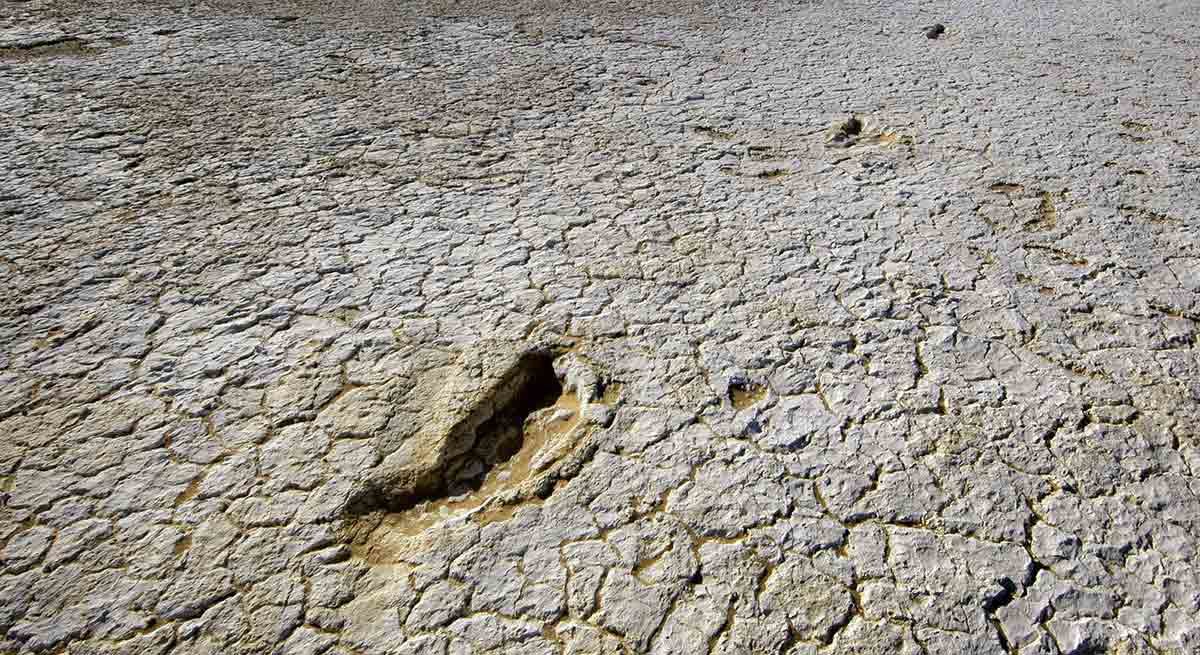
Long before writing, before cities, before even bones hardened into fossils, the Earth learned how to remember. It remembered through pressure. Through weight. Through the brief, fragile contact between a living body and soft ground. The first footprints on Earth are not just marks in stone; they are moments captured in time, the oldest physical records of life in motion. They are the silent witnesses of creatures that walked, crawled, ran, hesitated, hunted, fled, and lived in worlds that no longer exist.
These footprints are not dramatic like dinosaur skeletons or towering fossils displayed in museums. They are humble depressions, shallow impressions left in mud, ash, sand, or silt. And yet, they hold something bones cannot: behavior. They show us not just what lived, but how it lived. Direction, speed, interaction, fear, curiosity, even companionship can sometimes be read from these ancient marks. Beneath the first footprints lies a buried archive of life’s earliest journeys across solid ground, an archive that rewrites our understanding of evolution, ecosystems, and our own origins.
The First Steps Out of Water
For most of Earth’s history, life was bound to water. Oceans, lakes, and shallow seas cradled the earliest organisms, providing support, protection, and stability. The move onto land was not a single heroic leap, but a slow, hesitant negotiation with gravity, dryness, and danger. The first footprints record this negotiation with astonishing clarity.
Some of the earliest known trackways date back hundreds of millions of years, long before dinosaurs or mammals. They belong to creatures transitioning from aquatic to terrestrial life, animals with limbs still clumsy, bodies still adapted for swimming, and lungs or air-breathing structures still evolving. These footprints often appear in paired or staggered patterns, revealing the awkward gait of bodies not yet fully committed to land.
What makes these early footprints so powerful is that they sometimes predate skeletal fossils of similar animals. This means creatures were walking on land before their bones clearly show terrestrial adaptations. Footprints, in this sense, expose evolution in progress. They show behavior changing before anatomy fully catches up, reminding us that evolution is not a neat sequence but a messy, overlapping process.
Footprints as Frozen Motion
A footprint is motion made permanent. When a foot presses into soft ground, it displaces sediment, compresses layers, and creates a three-dimensional record of force and movement. If conditions are just right, that record can survive burial, compression, mineralization, and geological upheaval for hundreds of millions of years.
Unlike bones, which tell us about structure, footprints tell us about action. The depth of an impression can suggest body weight. The spacing between steps can indicate stride length and speed. The orientation of toes can reveal whether an animal walked upright or sprawled, whether it turned suddenly or moved steadily forward. In rare cases, overlapping footprints show multiple individuals moving together, offering glimpses of social behavior long before brains or DNA can speak for themselves.
Some trackways show hesitation, with irregular spacing that suggests stopping or turning back. Others show acceleration, with longer strides and deeper toe impressions indicating a sudden burst of speed. These details transform extinct animals from static museum specimens into living beings making choices in real time.
Landscapes That No Longer Exist
The ground that preserved the first footprints was very different from today’s landscapes. Ancient river deltas, tidal flats, volcanic ash fields, and coastal plains provided the soft, fine-grained sediments needed to capture impressions. Many of these environments have since vanished, reshaped by plate tectonics, erosion, and climate change.
When scientists uncover ancient footprints, they are not just finding traces of animals but reconstructing entire ecosystems. Ripple marks indicate shallow water nearby. Mud cracks suggest drying surfaces and changing seasons. Raindrop impressions sometimes appear alongside footprints, showing weather patterns frozen in stone. Together, these features allow researchers to rebuild scenes from deep time with remarkable detail.
In some cases, footprints appear alongside plant impressions, revealing interactions between early animals and terrestrial vegetation. These associations help scientists understand how plants and animals co-evolved, shaping each other’s survival strategies. The spread of plants stabilized soils, creating better surfaces for footprints and more hospitable environments for land-dwelling animals. In turn, animals helped disperse plant material and alter landscapes through movement and feeding.
The Emotional Weight of the Oldest Walks
There is something profoundly emotional about standing beside a fossilized footprint and realizing that a living being once stood there too. Not metaphorically, not symbolically, but physically. Its weight pressed into the same Earth that now supports us. Its body cast a shadow across the same sunlight, though under a sky filled with unfamiliar stars.
These footprints collapse time. They blur the boundary between past and present. When we see a sequence of ancient tracks, we instinctively follow them with our eyes, step by step, as if trying to catch up with the walker. This emotional response is not accidental. Humans are deeply attuned to footprints. We have tracked prey, followed companions, and read stories in the ground for tens of thousands of years. Fossil footprints speak to this ancient instinct.
For scientists, this emotional connection fuels careful analysis rather than fantasy. The goal is not to imagine stories without evidence, but to extract as much information as possible from each subtle contour. The emotional power of footprints does not weaken science; it strengthens the motivation to listen closely to what stone is trying to say.
Before Dinosaurs Left Their Mark
Dinosaurs dominate popular imagination when it comes to fossil footprints, but they were not the first to leave lasting marks on land. Long before dinosaurs walked upright, earlier reptiles and amphibians were already carving paths across ancient surfaces.
These pre-dinosaur footprints often reveal sprawling postures, with limbs extending outward from the body rather than directly beneath it. The trackways show alternating patterns that reflect side-to-side motion, very different from the straight, efficient strides of later bipedal animals. This difference is crucial. It shows how locomotion evolved gradually, with posture and gait changing over millions of years.
Some of these early trackways appear in places where skeletal fossils are rare or absent. This suggests that animals were present in environments where preservation of bones was unlikely, but footprints could still survive. As a result, footprints expand the known range of early land animals, pushing back dates and locations for terrestrial life.
Dinosaurs, Speed, and Social Clues
When dinosaurs finally appear in the footprint record, they arrive with confidence. Their tracks are often larger, deeper, and more organized. Some show long, narrow strides consistent with upright posture and efficient movement. Others reveal complex behaviors that skeletons alone could never confirm.
Parallel trackways moving in the same direction at similar speeds suggest group movement. This does not automatically prove herding or social structure, but it strongly implies coordinated behavior. In some sites, juvenile and adult tracks appear together, hinting at parental care or group protection. Elsewhere, predator and prey tracks intersect, capturing moments of pursuit or encounter.
Speed can sometimes be estimated by combining stride length with footprint size and spacing. These calculations suggest that some dinosaurs could move remarkably fast, while others favored steady, energy-efficient walking. Footprints thus challenge simplistic ideas of dinosaurs as either lumbering giants or constant runners, revealing a diversity of movement styles.
The First Human-Like Footprints
Among the most emotionally powerful footprints on Earth are those left by early human ancestors. These are not just records of extinct animals but direct traces of beings on our own evolutionary path. They show when and how upright walking became a defining feature of humanity.
Some ancient human-like footprints reveal arches, toe alignment, and stride patterns similar to modern humans. This suggests that efficient bipedal walking evolved earlier than once thought. Other footprints show variation, with features that hint at climbing ability or different movement styles, reflecting a period of experimentation in locomotion.
In some remarkable cases, footprints appear alongside those of other animals, showing early humans moving through shared environments, navigating the same dangers and resources. These tracks transform abstract evolutionary timelines into lived experiences. They show our ancestors not as distant concepts but as individuals taking steps across real ground.
Footprints Without Bones
One of the great scientific secrets buried beneath the first footprints is that life often leaves traces without leaving bodies. Bones require specific conditions to fossilize. Footprints require different ones. This means the footprint record sometimes reveals animals that have never been found as skeletal fossils.
This mismatch challenges assumptions about the completeness of the fossil record. It reminds scientists that absence of evidence is not evidence of absence. An animal may have lived, thrived, and gone extinct without ever leaving a bone behind, yet its footsteps may still survive.
These footprint-only species force researchers to infer anatomy from movement. Foot shape, pressure distribution, and stride offer clues about limb structure, muscle arrangement, and body size. While these inferences are cautious and constrained, they expand our understanding of ancient biodiversity.
How Footprints Survive Deep Time
The survival of a footprint is an extraordinary geological accident. It requires the right sediment, the right moisture level, the right timing of burial, and long-term stability. Too dry, and the impression crumbles. Too wet, and it collapses. Too exposed, and it erodes away.
Often, footprints are preserved when a second layer of sediment gently covers the first, protecting it from disturbance. Over time, minerals seep in, hardening the layers into rock. Pressure from above compresses the sediments, flattening and stabilizing the impressions. Millions of years later, erosion may peel away upper layers, revealing the ancient surface once more.
This delicate process means that every fossil footprint represents a narrow window of opportunity successfully passed. Countless footsteps were made, but only a tiny fraction became part of Earth’s permanent memory.
Reading Stone Like a Story
Interpreting footprints is a careful balance between imagination and restraint. Scientists must resist the temptation to tell stories unsupported by evidence while remaining open to what the data suggest. This requires detailed measurements, comparisons with modern animals, and an understanding of sediment behavior.
Modern animals provide valuable analogs. By studying how birds, reptiles, mammals, and amphibians leave footprints today, researchers learn how weight, speed, and posture affect track shape. These insights help decode ancient prints without projecting modern behavior where it does not belong.
Technology has enhanced this process. High-resolution imaging, 3D scanning, and digital modeling allow footprints to be analyzed without damaging them. Subtle features invisible to the naked eye can reveal weight shifts, toe flexibility, and even moments of slipping or correction.
Footprints and the Evolution of Behavior
Perhaps the deepest secret buried beneath the first footprints is that behavior evolved alongside bodies. Movement is not just a mechanical process; it reflects decision-making, sensory input, and adaptation to environment.
Footprints show when animals began to move efficiently on land, when they adopted new postures, and how they responded to predators, terrain, and climate. They capture the evolution of confidence, from tentative steps near water’s edge to long, purposeful journeys across open ground.
In this sense, footprints record the emergence of agency in the natural world. They show animals not just existing but acting, responding, and exploring. This behavioral perspective adds richness to evolutionary history, reminding us that survival is as much about how one moves through the world as what one is made of.
Climate Change Written in Tracks
Ancient footprints also reveal changing climates. The types of sediments that preserve tracks, the associated plant life, and the animals present all reflect environmental conditions. By studying track-bearing layers across different regions and time periods, scientists can infer shifts in temperature, rainfall, and sea level.
Some footprint sites show transitions from aquatic to terrestrial environments, mirroring broader climate-driven changes. Others record migrations, with trackways appearing in regions that later became inhospitable. These patterns show how life responded dynamically to a changing planet, offering long-term perspectives relevant to modern climate challenges.
Why the First Footprints Still Matter
The first footprints on Earth matter because they humanize deep time. They transform abstract ages into moments of contact between life and land. They remind us that evolution is not just a sequence of forms but a history of movements, choices, and risks taken step by step.
They also remind us of fragility. A footprint is easy to erase, yet under the right conditions, it can outlast mountains. This paradox mirrors life itself, brief in the moment, enduring in consequence.
By studying these ancient marks, we gain more than scientific knowledge. We gain perspective. We see ourselves as part of a long continuum of walkers, each leaving temporary impressions on a planet that remembers selectively but powerfully.
Standing Where Others Once Walked
To stand beside the first footprints is to feel both small and connected. Small because the time they represent dwarfs human history. Connected because the act of walking links us across hundreds of millions of years. Every step we take echoes a behavior older than humanity itself.
Beneath those first footprints lie secrets of adaptation, resilience, and transformation. They tell us that life did not conquer land in a single triumph but learned it slowly, one careful step at a time. And in those steps, pressed gently into ancient ground, the Earth began to tell a story it is still telling today.