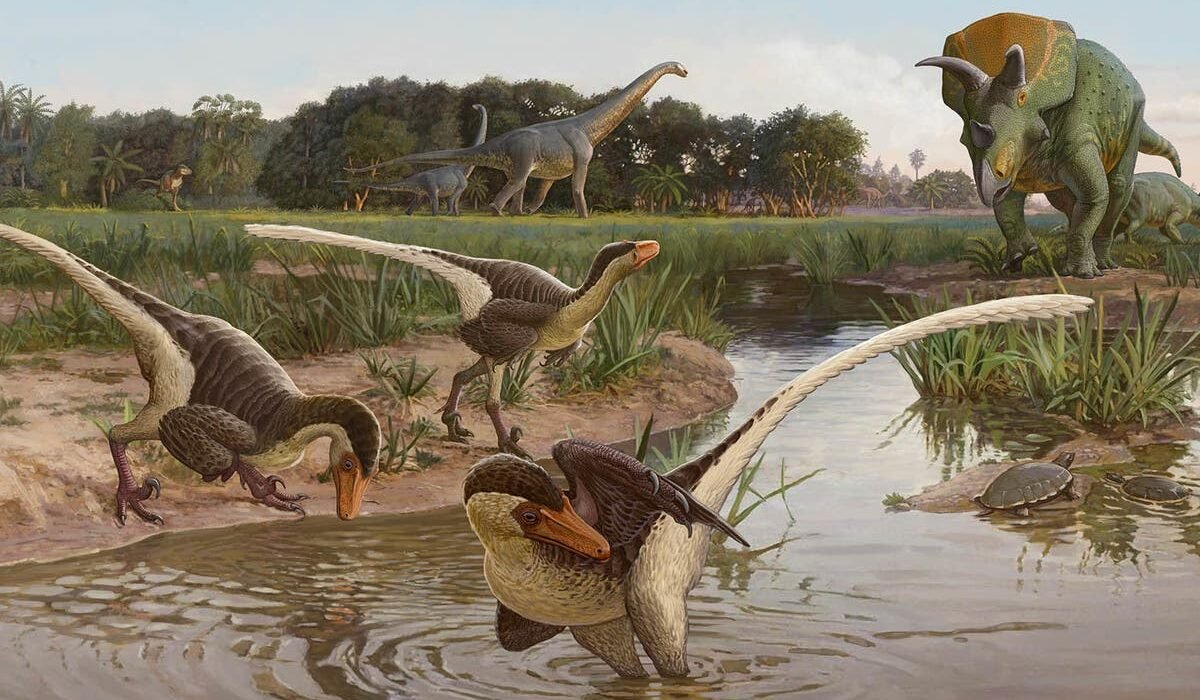
When we imagine ancient life on Earth, we often picture dinosaurs, woolly mammoths, or saber-toothed cats—creatures that feel exotic yet somehow understandable. But buried deeper in the fossil record are organisms so strange, so unexpected, that they seem to violate everything we think we know about how life should work. These are ancient creatures that, by modern biological logic, should not have existed at all. And yet they did. They lived, thrived, and in some cases ruled the planet for millions of years.
Their existence forces us to confront an uncomfortable truth about evolution and nature. Life is not guided by elegance or efficiency alone. It experiments recklessly. It explores bizarre pathways. It produces monsters, giants, hybrids, and designs that appear unstable or impossible—until the fossil evidence proves otherwise. These creatures are reminders that the world we know today is only one version of reality, shaped by countless extinctions and chance events.
To explore these ancient beings is to enter a lost universe, one governed by unfamiliar rules, where nature pushed biological limits far beyond what seems reasonable today.
The Cambrian Explosion and Life’s Wild First Experiments
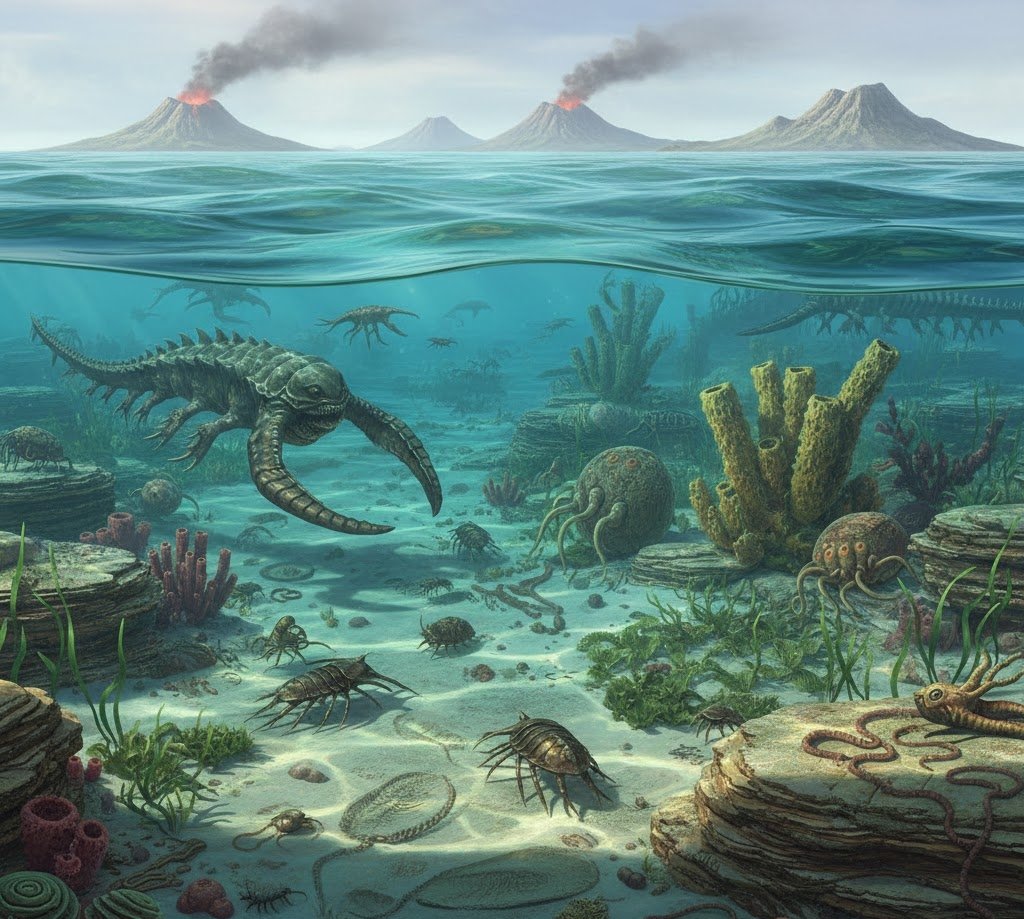
Over 500 million years ago, Earth experienced one of the most dramatic events in the history of life: the Cambrian Explosion. In a relatively short geological window, nearly all major animal body plans appeared. This was not a gentle unfolding of familiar forms but a chaotic burst of biological creativity.
Creatures from this era often look like science fiction nightmares. Many had no modern equivalents. Some possessed multiple eyes on stalks, spiked armor, circular mouths lined with teeth, or bodies segmented in ways that defy easy classification. Evolution had not yet settled into the patterns we recognize today. There were no proven designs, only experimentation.
Anomalocaris, one of the most famous Cambrian predators, looked like a creature assembled from mismatched parts. It had grasping appendages like shrimp arms, a circular toothed mouth, and large compound eyes with extraordinary visual power. For decades, scientists mistakenly reconstructed it as separate animals because its anatomy made no sense as a single organism. And yet it was real—and it was an apex predator.
These early animals should not have existed by modern standards because modern ecosystems favor efficiency and specialization. Cambrian ecosystems had neither. They were evolutionary testing grounds where strange designs were not only possible but successful.
Hallucigenia and the Problem of Orientation
Few creatures better represent the absurdity of early life than Hallucigenia. First discovered in the Burgess Shale of Canada, it was so strange that scientists could not even agree which way was up.
Hallucigenia had a worm-like body, a row of long, rigid spines on one side, and soft tentacle-like limbs on the other. For years, it was reconstructed upside down, walking on its spines with tentacles waving uselessly in the air. Only later did researchers realize the spines were defensive structures and the tentacles were its legs.
Even when properly oriented, Hallucigenia remains deeply unsettling. Its proportions feel wrong. Its anatomy appears inefficient and vulnerable. By modern evolutionary logic, such a creature should have been outcompeted immediately. Instead, it survived long enough to fossilize, proving that early ecosystems tolerated forms that would be impossible today.
Hallucigenia reveals that evolutionary success is context-dependent. What seems unworkable now may have been perfectly viable in a radically different world.
Giant Arthropods in an Oxygen-Rich World
Today, insects are small. Even the largest beetles and dragonflies are constrained by limits on oxygen delivery and structural support. But in the deep past, these limits were very different.
During the Carboniferous period, around 300 million years ago, Earth’s atmosphere contained significantly higher levels of oxygen than it does today. This allowed arthropods—creatures with exoskeletons and jointed limbs—to grow to sizes that now seem impossible.
Meganeura, a dragonfly-like insect, had a wingspan over two feet wide. Arthropleura, a millipede relative, grew longer than a car. These creatures crawled and flew through swampy forests, dominating ecosystems in ways that modern insects never could.
By modern biological rules, such sizes should not be feasible. Arthropods rely on passive diffusion to deliver oxygen through their bodies. In today’s atmosphere, giant insects would suffocate. But the ancient atmosphere rewrote the rules. What seems impossible now was once not only possible but normal.
Their extinction was not due to inherent flaw but environmental change. As oxygen levels dropped, these giants vanished, victims of a world that no longer supported their extraordinary forms.
Dunkleosteus and the Age of Living Armor
Long before dinosaurs dominated the land, the oceans belonged to monsters. Among the most terrifying was Dunkleosteus, a massive armored fish that lived around 360 million years ago.
Dunkleosteus had no teeth. Instead, its jaws were formed from sharpened bone plates capable of slicing through prey with incredible force. Its head and upper body were encased in thick armor, while its tail remained flexible for swift movement. This combination of speed and protection made it one of the deadliest predators of its time.
From a modern perspective, Dunkleosteus seems like an evolutionary dead end. Heavy armor reduces agility. Bone blades lack the regenerative advantages of true teeth. And yet Dunkleosteus thrived. It occupied a niche that no modern animal fills, proving that evolution does not aim for perfection, only for success within a specific context.
When environmental changes reshaped marine ecosystems, Dunkleosteus disappeared. Its design was not flawed; it was simply no longer relevant.
The Terror Birds That Ruled on Two Legs
Birds today are associated with flight, fragility, and song. But in prehistoric South America, birds became apex predators.
Known as terror birds, these massive flightless hunters stood up to ten feet tall and possessed enormous hooked beaks capable of crushing bone. They ran at high speeds, using powerful legs to chase down prey. With reduced wings and reinforced skulls, they resembled living weapons more than birds.
By modern standards, birds should not occupy this ecological role. Mammalian predators dominate large land-based hunting niches today. Yet in isolated ecosystems where mammals were scarce, birds took over. Terror birds demonstrate that evolutionary roles are not fixed. Any lineage, given the right conditions, can become monstrous.
Their eventual extinction likely resulted from competition with invading mammalian predators rather than any intrinsic weakness.
Helicoprion and the Circular Saw of Nightmares
Some ancient creatures look less like animals and more like mistakes. Helicoprion is one such example.
This prehistoric shark-like fish possessed a bizarre tooth whorl shaped like a circular saw embedded in its lower jaw. The teeth grew continuously, curling inward as new ones formed. For decades, scientists argued over where this structure was located, unable to imagine how it could function.
Modern sharks constantly replace their teeth, shedding old ones as new ones grow. Helicoprion did not. Its dental arrangement seems inefficient, awkward, and potentially self-destructive. And yet it survived for millions of years.
Recent reconstructions suggest the tooth whorl functioned like a slicing mechanism, pulling prey into the mouth while cutting it apart. It was strange, but it worked. Helicoprion reminds us that evolution does not optimize for aesthetics or intuition. It tests ideas that look ridiculous—until they succeed.
The Mammal-Like Reptiles That Blur Identity
Before dinosaurs ruled the Earth, a group of animals known as synapsids dominated land ecosystems. These creatures blur the line between reptiles and mammals, possessing features of both.
Some synapsids had sprawling reptilian bodies combined with mammal-like teeth and jaws. Others showed early signs of fur and warm-blooded metabolism. Creatures like Dimetrodon, often mistaken for a dinosaur, lived long before dinosaurs existed and bore a sail on its back for temperature regulation.
From a modern perspective, these transitional forms seem unstable. They appear unfinished, caught between two identities. But evolution thrives in such in-between states. Synapsids were not failures; they were pioneers. One lineage eventually gave rise to mammals, including humans.
Their existence challenges the notion that species evolve cleanly from one form into another. Evolution is messy, overlapping, and full of hybrids that defy classification.
Titanoboa and the Limits of Size
Snakes today are impressive, but none approach the scale of Titanoboa. This colossal serpent lived around 60 million years ago and grew over 40 feet long, weighing more than a ton.
Titanoboa’s size seems impossible by modern standards. Cold-blooded animals rely on environmental heat to regulate their metabolism, and today’s climate would not support a snake of such dimensions. But in the warm, humid Paleocene world, with higher global temperatures, Titanoboa thrived.
It hunted giant fish and crocodile-like reptiles, crushing them with overwhelming force. Its existence reveals how climate shapes biology at the most fundamental level. Change the temperature, and the rules of size, strength, and survival change with it.
Titanoboa vanished as the climate cooled, not because it was unsustainable, but because the planet moved on.
Ancient Whales That Walked on Land
Whales are symbols of the ocean, perfectly adapted for life in water. Yet their ancestors walked on land.
Early whales like Pakicetus and Ambulocetus looked more like wolves or crocodiles than marine giants. They had legs, functional hips, and lungs adapted for air breathing. Over millions of years, they transitioned into fully aquatic animals, losing their hind limbs and developing tails and flippers.
From a modern standpoint, this transition seems improbable. How does an animal evolve from running on land to navigating open oceans? Each intermediate step appears vulnerable and inefficient. And yet the fossil record documents this transformation in remarkable detail.
These ancient whales should not have existed by modern logic because their bodies appear poorly suited for either environment. But evolution does not demand immediate perfection. It tolerates awkwardness, inefficiency, and compromise—so long as survival remains possible.
The Reality These Creatures Reveal
Ancient creatures that should not have existed reveal something profound about life on Earth. Nature is not constrained by our expectations. The present is not a template for the past. Biological rules are flexible, shaped by atmosphere, climate, competition, and chance.
These animals were not mistakes. They were solutions to problems that no longer exist. Their extinction does not imply failure, only change. The world they inhabited was alien by today’s standards, and they were perfectly adapted to it.
Their fossils are messages from a deeper time, reminding us that reality is broader than imagination. They show us that the boundaries of possibility are far wider than what survives into the present.
Why These Creatures Still Matter
Studying these ancient beings is not an exercise in curiosity alone. They inform modern science in critical ways. They help us understand extinction, adaptation, and resilience. They warn us how sensitive life is to environmental change. They demonstrate that dominant species are temporary, no matter how successful they seem.
In a world undergoing rapid climate transformation, these lessons are more relevant than ever. Earth has seen monsters rise and fall before. Life will continue, but not necessarily in familiar forms.
Ancient creatures that should not have existed did exist. They ruled oceans, forests, and skies. They were real, powerful, and alive. And their stories remind us that the universe is under no obligation to make sense to us.