More than half a billion years ago, long before dinosaurs thundered across continents or forests whispered in the wind, Earth experienced one of the most extraordinary transformations in its history. For billions of years, life had existed mostly as simple, microscopic forms, quietly shaping the planet in ways barely visible to the naked eye. Then, in what seems like a geological heartbeat, the world changed. Oceans filled with unfamiliar shapes, hard shells appeared for the first time, eyes opened on living creatures, and movement became purposeful and dynamic. This dramatic evolutionary event is known as the Cambrian Explosion, and it marks the moment when complex animal life truly began.
The Cambrian Explosion is not just a chapter in Earth’s biological past; it is a turning point that explains why the modern world looks the way it does. Nearly all major animal groups alive today trace their origins to this brief but astonishing interval. To understand the Cambrian Explosion is to confront deep questions about evolution, environment, chance, and the nature of life itself.
Earth Before the Explosion
To appreciate the magnitude of the Cambrian Explosion, it is essential to imagine the world before it happened. For nearly four billion years after life first emerged, Earth was dominated by simple organisms. Bacteria and archaea ruled the planet, shaping its atmosphere and chemistry. Later, single-celled eukaryotes appeared, bringing internal complexity but still remaining microscopic.
By the late Precambrian era, some multicellular life had begun to appear, especially during the Ediacaran period, which immediately preceded the Cambrian. The Ediacaran seas were home to strange, soft-bodied organisms unlike anything alive today. These creatures lacked hard skeletons, jaws, or obvious organs. They lived anchored to the seafloor or drifted slowly, absorbing nutrients from the surrounding water.
This world was quiet and subdued. Predation, if it existed at all, was minimal. Movement was limited, and ecological interactions were simple. Life had persisted, but it had not yet experimented boldly with form and function. Then, something changed.
Defining the Cambrian Explosion
The Cambrian Explosion refers to a relatively short interval of geological time, beginning about 541 million years ago, during which an extraordinary diversity of animal life appeared in the fossil record. Within roughly 20 to 25 million years, a wide array of complex organisms emerged, many with hard shells, jointed limbs, sophisticated sensory organs, and active modes of life.
From a human perspective, this timespan seems unimaginably long. From a geological and evolutionary perspective, it is remarkably brief. Evolutionary innovation that would normally unfold over hundreds of millions of years appears compressed into a narrow window. This sudden appearance of complexity is what makes the Cambrian Explosion so striking and so intensely studied.
It is important to understand that the term “explosion” does not imply a literal instant creation of life. Evolution was still driven by gradual genetic changes and natural selection. What makes the Cambrian unique is the rapid diversification of body plans and ecological roles, many of which persist to this day.
The Fossil Record Comes Alive
One of the reasons the Cambrian Explosion appears so dramatic is the nature of the fossil record itself. Before the Cambrian, most organisms were soft-bodied and left few traces behind. Fossilization requires specific conditions, and soft tissues decay quickly. As a result, early life left a sparse and fragmentary record.
During the Cambrian, many organisms evolved hard parts such as shells, exoskeletons, and spines made of calcium carbonate or other minerals. These structures fossilized readily, preserving detailed snapshots of ancient life. Suddenly, the rocks began to tell vivid stories.
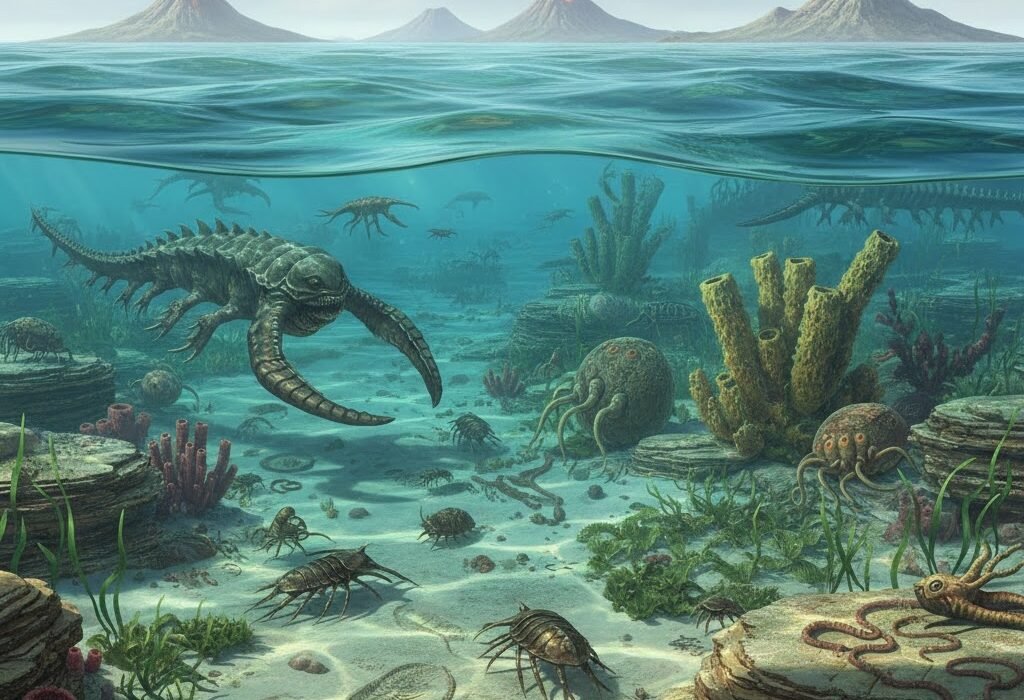
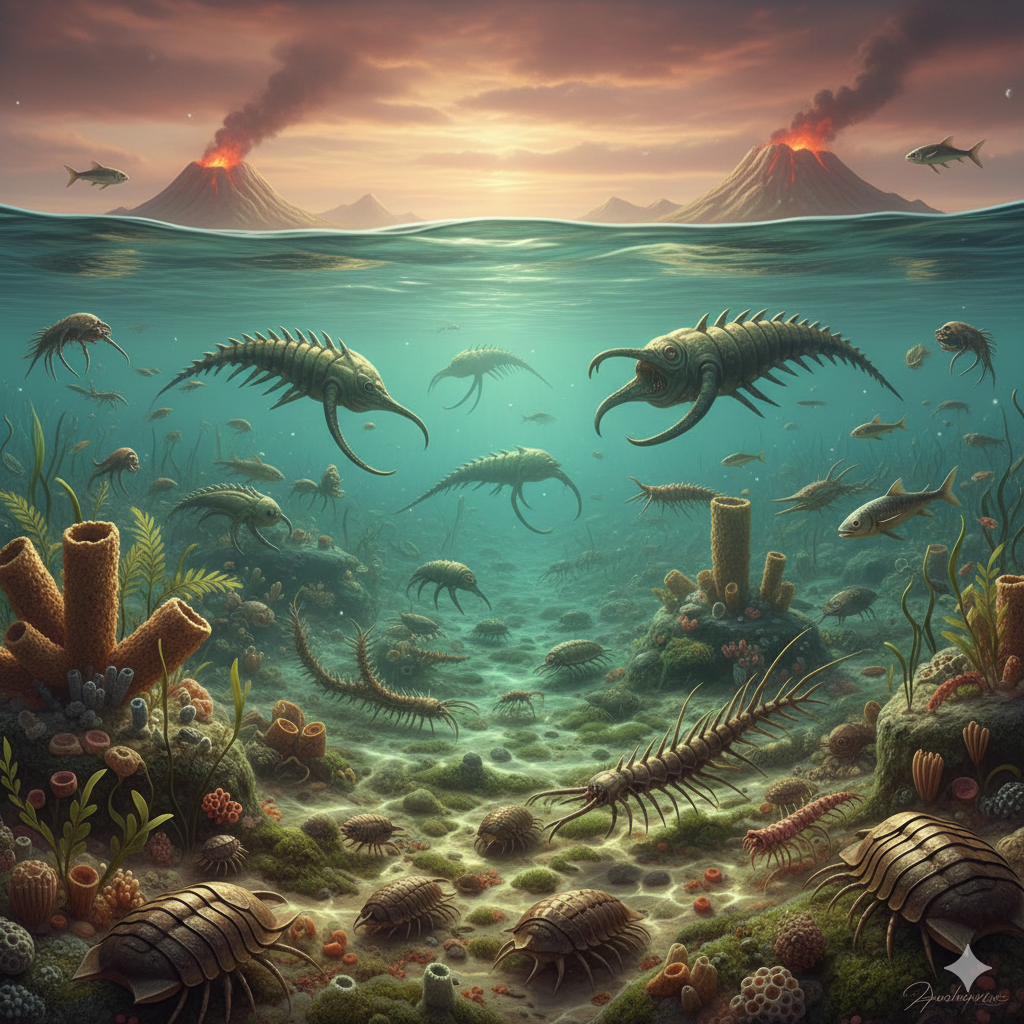
Sites such as the Burgess Shale in Canada and the Chengjiang fossil beds in China have revealed astonishingly well-preserved Cambrian organisms, including soft tissues like eyes, digestive tracts, and limbs. These fossils show creatures of breathtaking diversity, from early arthropods with multiple eyes to worm-like animals bristling with spines. The Cambrian seas were anything but simple.
The Rise of Body Plans
One of the most profound aspects of the Cambrian Explosion is the emergence of distinct body plans. A body plan is a fundamental structural blueprint that defines how an organism is organized. During the Cambrian, most of the basic body plans that characterize modern animals appeared for the first time.
These included arthropods with segmented bodies and jointed limbs, mollusks with muscular feet and shells, echinoderms with radial symmetry, and chordates, the group that would eventually give rise to vertebrates, including humans. Each body plan represented a unique solution to the challenges of survival, movement, feeding, and reproduction.
What is remarkable is not just the number of new forms, but their disparity. Cambrian animals were experimenting with radically different ways of being alive. Some designs flourished and persisted. Others vanished, leaving behind only fossils as evidence of evolutionary creativity.
Predation and the Arms Race of Life
One of the driving forces behind the Cambrian Explosion appears to have been the emergence of predation. Before this period, most organisms lived relatively unchallenged lives, absorbing nutrients or filtering particles from the water. With the arrival of active predators, the rules of survival changed dramatically.
Predators evolved the ability to move quickly, sense their environment, and capture prey. In response, prey species developed defenses such as shells, spines, camouflage, and burrowing behaviors. This evolutionary arms race accelerated innovation on both sides.
The first eyes likely evolved during this time, providing predators with a powerful advantage and forcing prey to adapt rapidly. Vision transformed the ocean into a dynamic arena of pursuit and escape. The Cambrian seas became places of constant interaction, competition, and adaptation.
The Role of Oxygen and Environmental Change
Environmental conditions played a crucial role in enabling the Cambrian Explosion. One of the most important factors was the rise in atmospheric and oceanic oxygen levels. Oxygen is essential for complex, energy-demanding life. Simple organisms can survive with little oxygen, but active animals with muscles and nervous systems require much more.
Geological evidence suggests that oxygen levels increased significantly toward the end of the Precambrian and into the Cambrian. This rise may have crossed a critical threshold, making large, mobile animals energetically possible for the first time.
Changes in ocean chemistry also mattered. Increased availability of calcium and other minerals made it easier for organisms to build hard skeletons and shells. Tectonic activity and climate shifts may have created new habitats and ecological opportunities, further promoting diversification.
Genetic Foundations of Complexity
Behind the visible explosion of forms lay invisible genetic changes. Advances in developmental biology have revealed that many of the genes responsible for building complex bodies existed long before the Cambrian. These genes, often called developmental control genes, regulate how an embryo grows and differentiates.
What appears to have happened during the Cambrian is not the sudden invention of new genes, but the novel use and regulation of existing ones. Small changes in gene expression can lead to large changes in body structure. Once these genetic systems were in place, evolution gained a powerful toolkit for experimentation.
This insight reshapes our understanding of the Cambrian Explosion. It was not a miracle or a violation of evolutionary principles, but a moment when genetic potential, environmental opportunity, and ecological interaction aligned in an extraordinary way.
The Ediacaran–Cambrian Transition
The transition from the Ediacaran world to the Cambrian was not a clean break but a complex overlap. Some Ediacaran organisms disappeared, possibly outcompeted or preyed upon by emerging Cambrian animals. Others may represent early experiments that paved the way for later success.
This transition period highlights the contingent nature of evolution. The Cambrian Explosion did not follow a predetermined script. It was shaped by chance events, extinctions, and feedback loops. If conditions had been slightly different, the outcome might have been radically altered, and the world today could look nothing like it does.
Strange Creatures of the Cambrian Seas
The Cambrian oceans were populated by organisms that challenge modern imagination. Some had five eyes and spiny appendages, others swam by flapping lateral lobes, and some crawled along the seafloor with armored bodies and grasping limbs.
Many of these creatures do not fit neatly into modern categories. They represent evolutionary experiments that explored forms and functions that no longer exist. Their extinction does not diminish their importance; instead, it highlights the vast creative range of evolution during this period.
These fossils remind us that today’s biodiversity is only a fraction of what has been possible. The Cambrian Explosion was a time of bold experimentation, when nature tested countless designs, keeping some and discarding others.
The First Steps Toward Vertebrates
Among the most significant developments of the Cambrian was the appearance of early chordates, the ancestors of all vertebrates. These small, fish-like animals possessed a notochord, a flexible rod that provided structural support, and a dorsal nerve cord.
Though modest in appearance, these features would eventually give rise to backbones, complex brains, and the capacity for sophisticated behavior. In these early chordates lie the distant roots of every mammal, bird, reptile, amphibian, and fish alive today.
The realization that human ancestry stretches back to these humble Cambrian creatures adds a deeply emotional dimension to the story. Our bodies, in their most fundamental architecture, are echoes of that ancient evolutionary moment.
Rethinking the Meaning of the Explosion
For many years, the Cambrian Explosion was seen as a challenge to evolutionary theory because of its apparent suddenness. However, modern research has shown that it fits well within evolutionary principles when viewed in context.
The explosion reflects a combination of improved fossil preservation, environmental change, genetic readiness, and ecological interaction. Evolution did not suddenly accelerate without cause; rather, conditions reached a tipping point that allowed complexity to flourish.
Understanding this nuance deepens, rather than diminishes, the wonder of the Cambrian. It shows how sensitive life is to its surroundings and how extraordinary transformations can arise from the interplay of gradual processes.
The Cambrian Explosion and Modern Life
The legacy of the Cambrian Explosion is all around us. The fundamental body plans established during this period underpin modern ecosystems. Arthropods dominate land and sea, mollusks inhabit oceans and freshwater, echinoderms patrol the seafloor, and chordates fill every imaginable niche.
Even the way ecosystems function today, with complex food webs and dynamic interactions, can be traced back to Cambrian innovations. Predation, mobility, sensory perception, and structural support all became central themes during this time.
In this sense, the Cambrian Explosion was not just an event but a foundation. It set the stage upon which all later evolutionary drama would unfold.
Philosophical Reflections on the Cambrian Moment
The Cambrian Explosion invites reflection on the nature of life and history. It shows that complexity is not inevitable, but neither is it impossible. For billions of years, life remained simple. Then, under the right conditions, it transformed itself in ways that would shape the future of the planet.
This realization carries a sense of fragility and wonder. If the Cambrian Explosion had not occurred, intelligent life might never have arisen. The universe could be silent, at least from our perspective. Our existence is tied to a sequence of ancient events that could easily have unfolded differently.
Ongoing Mysteries and Scientific Debate
Despite decades of research, the Cambrian Explosion still holds mysteries. Scientists continue to debate the relative importance of environmental, genetic, and ecological factors. New fossil discoveries regularly challenge existing interpretations, revealing unexpected complexity even earlier than previously thought.
As technology advances, tools such as molecular clocks, advanced imaging, and geochemical analysis are providing new insights. The Cambrian Explosion is no longer seen as an isolated puzzle but as part of a broader narrative of life’s evolving complexity.
The Emotional Power of Deep Time
Perhaps the most profound impact of studying the Cambrian Explosion is the sense of deep time it evokes. Human history spans thousands of years. Recorded civilization covers mere millennia. The Cambrian Explosion occurred over half a billion years ago, yet its influence is still present in our bodies and ecosystems.
This perspective can be humbling, even unsettling. It reminds us that we are recent arrivals in an ancient world. At the same time, it can be deeply comforting, connecting us to a vast, continuous story of life.
Conclusion: When the World Learned to Be Alive
The Cambrian Explosion marks the moment when life on Earth learned to be complex, dynamic, and interactive. It was the dawn of animals, of ecosystems rich with movement and struggle, of bodies capable of sensing and responding to the world.
This event was not a sudden miracle, nor was it a simple inevitability. It was the product of countless interactions between genes, environments, and chance. Its outcome shaped the trajectory of life in ways that still resonate today.
To study the Cambrian Explosion is to stand at the threshold of our own origins, to glimpse a world where the rules of life were being rewritten, and to recognize that the story of evolution is not just about survival, but about possibility.