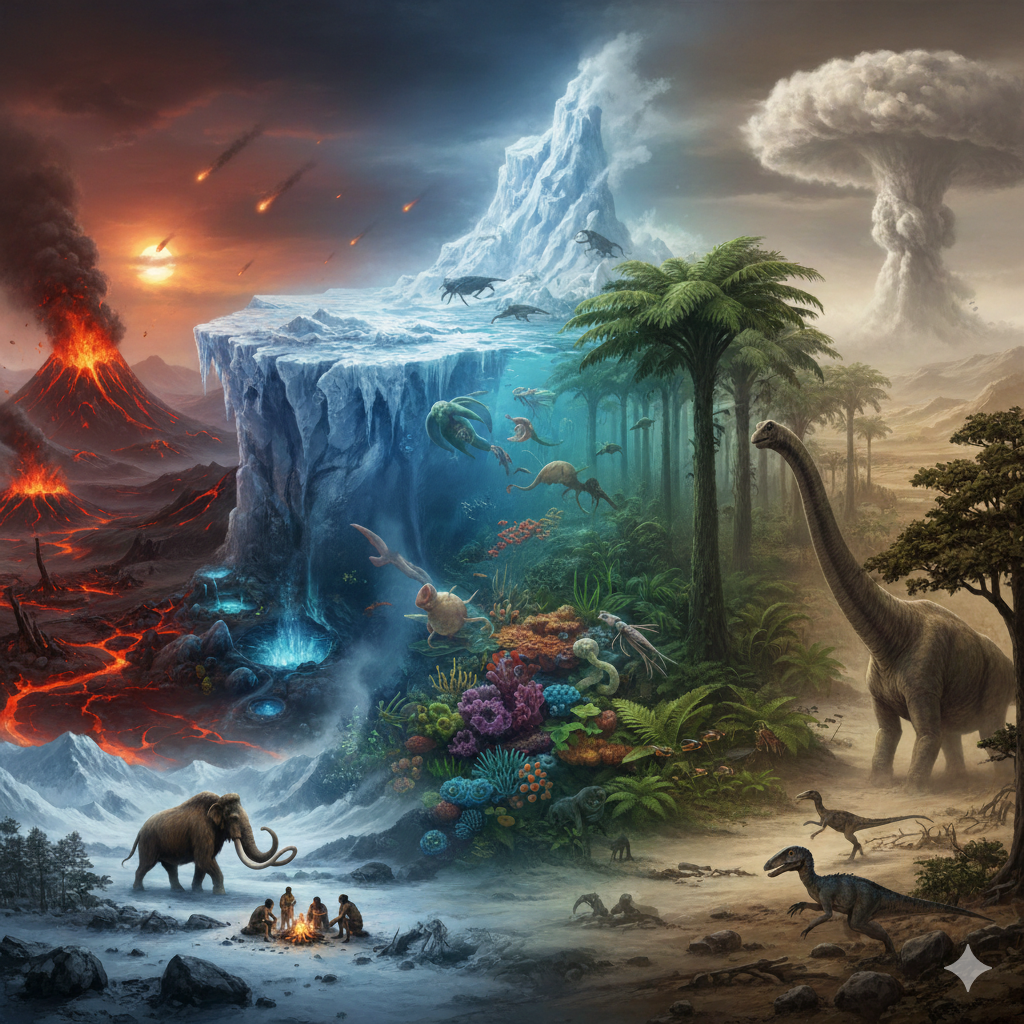
Long before cities rose, before written language, before even the first human thoughts flickered into existence, Earth was already a restless world. Continents drifted like slow ships across a molten sea. Oceans opened and vanished. Ice advanced and retreated with terrifying patience. The climate of prehistoric Earth was never stable, never gentle for long. It changed again and again, sometimes gradually, sometimes with brutal speed. Each shift rewrote the rules of survival, reshaped landscapes, and forced life to adapt, migrate, or disappear.
Prehistoric climate change was not a background detail in the story of life. It was the author. From the earliest microbes to the rise of mammals and eventually humans, climate shifts acted as relentless editors, cutting entire lineages, rewriting evolutionary paths, and occasionally opening astonishing new possibilities. To understand how life became what it is today, we must understand how ancient climates transformed the planet and everything living upon it.
The Early Earth and a Hostile Beginning
When life first emerged on Earth more than 3.5 billion years ago, the planet would have seemed utterly alien to modern eyes. The atmosphere lacked oxygen. Volcanic gases filled the air. Meteor impacts were common, and the Sun shone more faintly than it does today. Yet even in this hostile environment, climate played a decisive role.
Early Earth’s climate was shaped by a delicate balance between volcanic activity, atmospheric gases, and solar energy. Greenhouse gases such as carbon dioxide and methane trapped heat, preventing the oceans from freezing solid despite the weaker Sun. Without this warming effect, life may never have gained a foothold. Climate, even at this early stage, acted not as an enemy of life but as its unlikely guardian.
The earliest organisms were simple, microscopic, and resilient. They lived in oceans, hot springs, and beneath the seafloor, environments buffered against rapid temperature swings. Still, climate fluctuations influenced ocean chemistry, nutrient availability, and energy sources. Each subtle change nudged life toward greater complexity, setting the stage for one of the most profound transformations in Earth’s history.
The Great Oxygenation and a Climate Revolution
One of the most dramatic prehistoric climate shifts occurred around 2.4 billion years ago, during an event known as the Great Oxygenation. Tiny organisms called cyanobacteria had learned to harness sunlight through photosynthesis, releasing oxygen as a byproduct. For millions of years, this oxygen reacted with minerals and dissolved substances, leaving little trace in the atmosphere. Eventually, the planet’s sinks filled, and oxygen began to accumulate in the air.
This chemical shift triggered a climate revolution. Oxygen reacted with methane, a powerful greenhouse gas, reducing its concentration and weakening Earth’s heat-trapping blanket. The result was a dramatic global cooling, likely plunging the planet into its first major ice ages. Glaciers advanced toward the equator, oceans cooled, and life faced a crisis.
For many anaerobic organisms, oxygen was toxic. Entire ecosystems collapsed. Yet for others, this catastrophe was an opportunity. Oxygen enabled far more efficient energy use, paving the way for complex cells and, eventually, multicellular life. Climate change, driven by biological innovation, reshaped both the planet and the future of evolution.
Snowball Earth and Survival Against the Odds
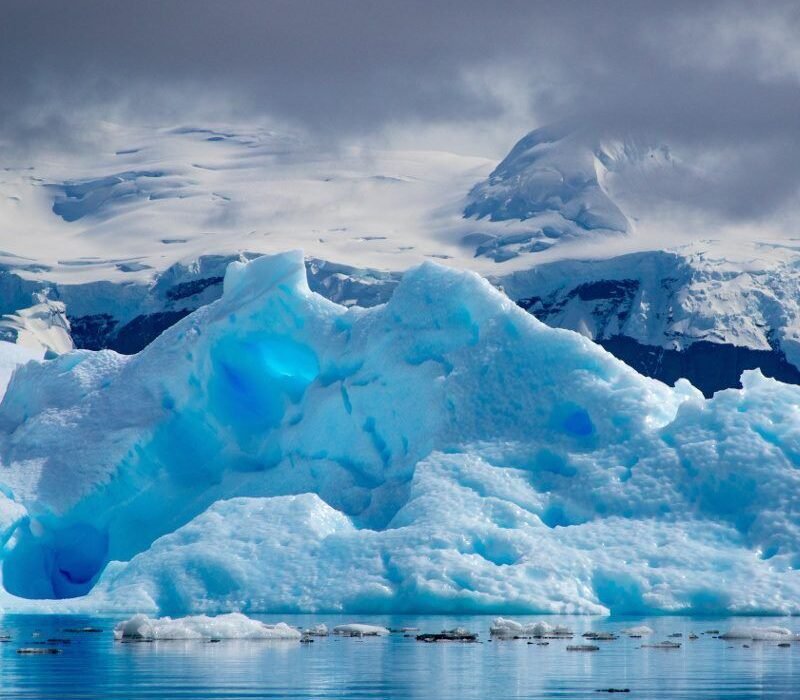
Several times between roughly 720 and 635 million years ago, Earth may have experienced extreme glaciations so severe that ice covered nearly the entire planet. These episodes, often referred to as “Snowball Earth,” represent some of the harshest climate shifts in prehistoric history.
During these periods, global temperatures plummeted. Ice sheets extended from the poles to the tropics. Oceans were sealed beneath thick layers of ice, drastically reducing sunlight penetration. To survive, life retreated to refuges such as hydrothermal vents, thin equatorial ice, or pockets of open water.
Yet life did not merely endure; it adapted. These extreme conditions may have driven evolutionary innovation, selecting for resilience and flexibility. When volcanic activity eventually released enough carbon dioxide to warm the planet and melt the ice, Earth emerged transformed. Nutrients washed into the oceans, oxygen levels rose, and life entered a new phase of diversification.
The end of Snowball Earth episodes may have helped set the stage for the emergence of complex multicellular organisms. Climate catastrophe, paradoxically, became a catalyst for biological creativity.
The Cambrian Explosion and a Warming World
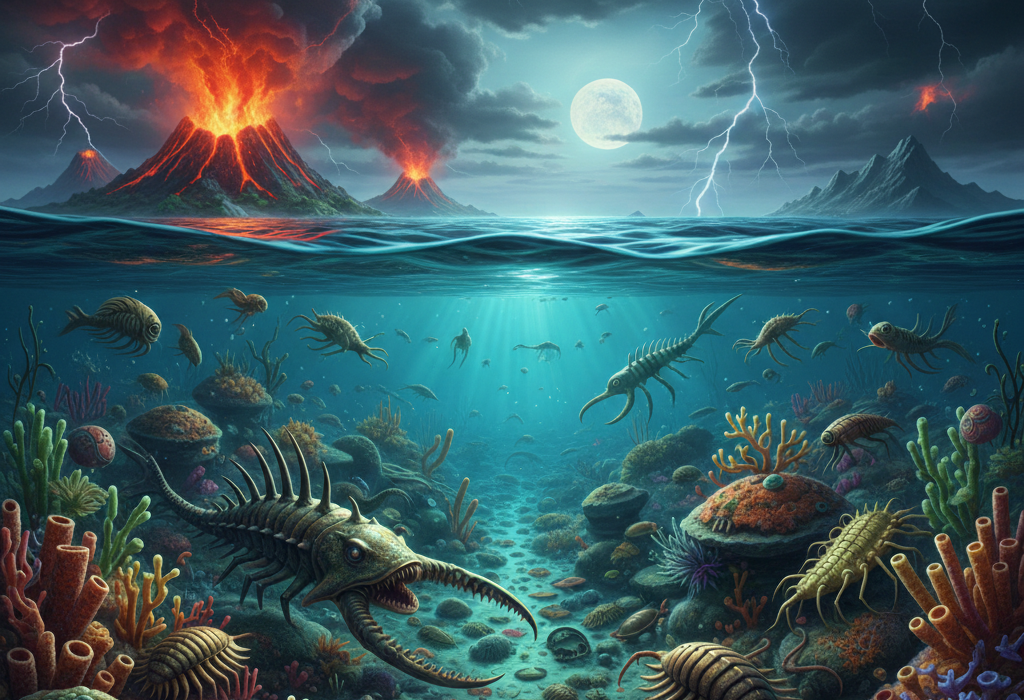
Around 541 million years ago, life underwent an extraordinary burst of diversification known as the Cambrian Explosion. In a relatively short geological time, most major animal groups appeared in the fossil record. This event did not occur in isolation. It was deeply connected to changes in climate, ocean chemistry, and atmospheric composition.
Rising oxygen levels supported higher metabolic rates and larger bodies. Warmer, more stable climates created expansive shallow seas, rich in nutrients and sunlight. These environments became evolutionary laboratories, where new body plans and ecological strategies could flourish.
Climate shifts did not dictate specific evolutionary outcomes, but they created conditions that made innovation possible. Life responded with astonishing creativity, filling new niches and establishing complex food webs. The Cambrian world demonstrated how climate can open doors, not just close them.
Climate Stability and the Rise of Ancient Ecosystems
Following the Cambrian, Earth experienced long periods of relative climatic stability, punctuated by fluctuations. These calmer intervals allowed ecosystems to mature and diversify. Coral reefs expanded. Forests took root on land. Arthropods, fish, and early vertebrates thrived in increasingly complex environments.
As plants colonized land, they transformed the climate themselves. By drawing carbon dioxide from the atmosphere and storing it in tissues and soils, they altered greenhouse gas levels and influenced global temperatures. Roots broke down rock, accelerating weathering and nutrient cycling. The land itself began to change color, texture, and chemistry.
Climate and life became tightly intertwined, locked in feedback loops. A warmer climate encouraged plant growth, which could then cool the planet by reducing atmospheric carbon dioxide. These interactions added new layers of complexity to Earth’s climate system, making it both resilient and vulnerable.
Ice Ages and the Testing of Life
Prehistoric Earth did not remain warm and stable forever. Repeated ice ages swept across the planet, reshaping habitats and challenging life in profound ways. During these colder periods, glaciers advanced, sea levels fell, and ecosystems fragmented.
Life responded through migration, adaptation, and extinction. Species that could tolerate cold or exploit new environments survived and spread. Others vanished, leaving empty niches behind. These cycles of contraction and expansion acted as evolutionary filters, favoring flexibility and innovation.
Ice ages also influenced ocean circulation and atmospheric patterns, redistributing heat and nutrients. These changes affected marine life as much as terrestrial ecosystems. Plankton communities shifted, altering the base of the food chain and echoing upward to larger organisms.
Each ice age was both an ending and a beginning, closing some evolutionary chapters while opening others.
The Permian World and the Greatest Climate Catastrophe
Approximately 252 million years ago, Earth experienced the most devastating mass extinction in its history, known as the end-Permian extinction. Up to 90 percent of marine species and a vast proportion of land organisms disappeared. Climate change lay at the heart of this catastrophe.
Massive volcanic eruptions released enormous quantities of carbon dioxide and other gases, driving rapid global warming. Oceans warmed and became more acidic. Oxygen levels in seawater plummeted, creating dead zones where complex life could not survive. On land, extreme heat and aridity devastated ecosystems.
This was not a sudden disaster but a prolonged crisis. Climate instability persisted for hundreds of thousands of years, preventing recovery. The world became a hostile place, where survival itself was an achievement.
Yet even from this near-total collapse, life rebounded. The aftermath of the Permian extinction reshaped evolution, clearing the way for new groups to rise.
Climate Shifts and the Age of Dinosaurs
The world that followed the Permian extinction gradually warmed and stabilized, ushering in the age of dinosaurs. For much of the Mesozoic Era, Earth experienced relatively warm climates with high carbon dioxide levels and little polar ice.
These conditions supported lush vegetation and high productivity, enabling large-bodied animals to thrive. Dinosaurs evolved a wide range of forms, from small feathered predators to colossal herbivores. Climate influenced their distribution, behavior, and physiology, shaping ecosystems on a global scale.
Fluctuations still occurred. Sea levels rose and fell. Regional climates shifted. These changes influenced migration patterns and evolutionary pressures, driving diversification within dinosaur lineages.
The dominance of dinosaurs was not simply a matter of biological superiority. It was also a product of climate conditions that favored their metabolic strategies and ecological roles.
The End-Cretaceous Shift and a World Transformed
About 66 million years ago, another profound climate shift brought the age of dinosaurs to an abrupt end. A massive asteroid impact triggered immediate devastation, but its longer-term effects on climate sealed the fate of many species.
Dust and aerosols injected into the atmosphere blocked sunlight, causing global cooling. Photosynthesis faltered. Food chains collapsed. What followed was a prolonged period of climatic instability, marked by cold, darkness, and ecological disruption.
Large, specialized animals struggled to survive. Smaller, adaptable organisms fared better. Among them were mammals, which had lived in the shadows of dinosaurs for millions of years. Climate-driven extinction reshaped the balance of life, ending one era and setting the stage for another.
Mammals, Climate Fluctuations, and New Opportunities
In the aftermath of the dinosaur extinction, Earth’s climate gradually recovered. Warm periods alternated with cooler intervals, creating a dynamic environment that favored adaptability. Mammals diversified rapidly, evolving new forms, behaviors, and ecological roles.
Climate shifts influenced body size, diet, and geographic distribution. Forests expanded and contracted. Grasslands emerged. These changing landscapes drove the evolution of grazing animals and the predators that followed them.
Mammals’ ability to regulate body temperature gave them an advantage in fluctuating climates. This physiological flexibility allowed them to exploit a wider range of environments, from tropical forests to cooler regions.
Once again, climate change acted not only as a destructive force but as a creative one, shaping the trajectory of life in lasting ways.
Ice Ages and the Shaping of Humanity
The most recent prehistoric climate shifts had a direct impact on human evolution. During the last few million years, Earth entered a cycle of repeated ice ages. Massive ice sheets advanced and retreated, reshaping continents and altering ecosystems.
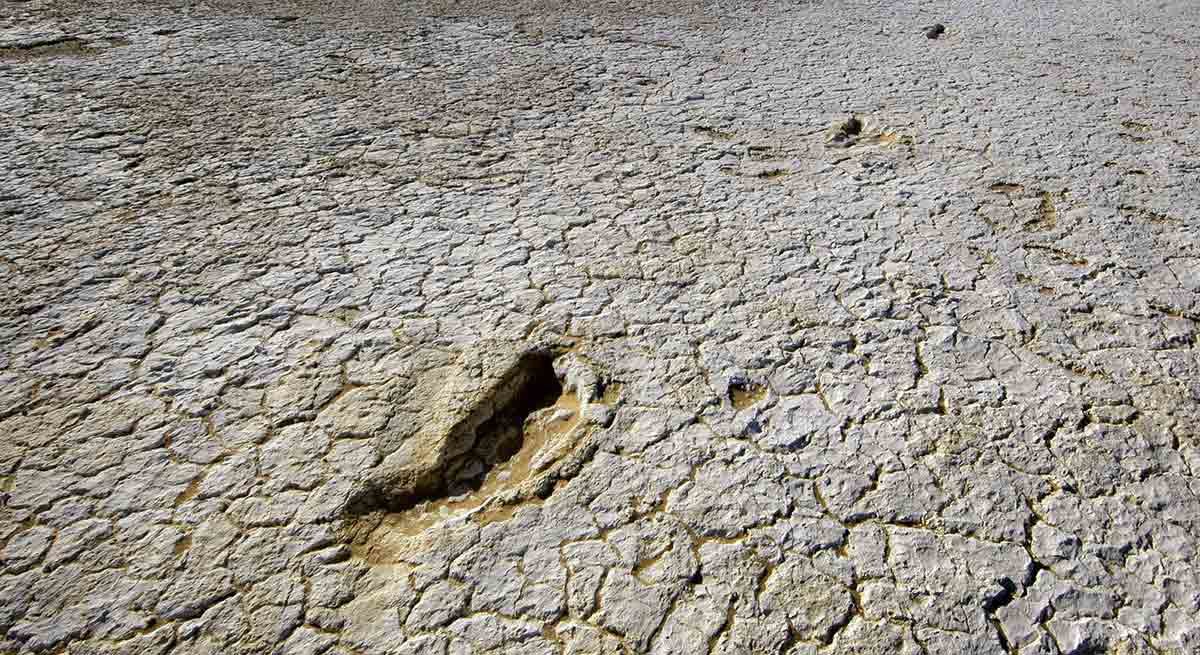
Early human ancestors evolved in this unstable world. Shifting climates transformed forests into grasslands, favoring bipedalism and new survival strategies. Changing food availability drove dietary flexibility and tool use. Migration followed retreating glaciers and expanding habitats.
Climate uncertainty selected for intelligence, cooperation, and adaptability. The ability to anticipate change, remember past conditions, and plan for the future became crucial survival traits. In this sense, prehistoric climate shifts did not merely influence human evolution; they helped create the conditions that made us human.
Climate as an Evolutionary Sculptor
Throughout prehistoric time, climate acted as an invisible sculptor, shaping life through pressure and opportunity. It determined where organisms could live, what they could eat, and how they reproduced. It rewarded resilience and punished rigidity.
Importantly, climate change did not act alone. It interacted with geological processes, biological innovations, and random events. Evolution is not a simple response to climate but a complex dance between chance and necessity. Still, without climate shifts, the story of life would be unrecognizable.
The fossil record is filled with reminders of this truth. Sudden disappearances mark moments of crisis. Bursts of diversification follow periods of recovery. Each pattern reflects the enduring influence of a changing planet.
Lessons from Deep Time
Prehistoric climate shifts changed life forever by proving that stability is the exception, not the rule. Life survives not by resisting change but by responding to it. Adaptation, migration, and innovation are the true constants of Earth’s biological history.
Understanding these ancient changes gives us perspective on the present. Climate has always shaped life, but the speed and scale of modern climate change are unprecedented in human history. The past shows that life will continue, but it also shows that rapid shifts come at a cost, measured in extinctions and upheaval.
Prehistoric Earth teaches us that climate is not just a backdrop to life’s story. It is a central character, powerful, unpredictable, and transformative. The world we inhabit today is the product of countless ancient climate shifts, each leaving an imprint on the fabric of life.
In the end, to understand how prehistoric climate shifts changed life forever is to recognize that change itself is the most enduring force on Earth. Life, in all its fragile beauty and stubborn persistence, is the planet’s answer to a world that never stands still.