Among all the wonders of the Solar System, the rings of Saturn stand apart as one of the most visually arresting and scientifically intriguing structures ever discovered. Suspended in the vacuum of space, spanning hundreds of thousands of kilometers yet often thinner than a mountain is tall, Saturn’s rings appear almost unreal—like a cosmic artwork carefully placed around a gas giant. For centuries, these rings have captivated astronomers, artists, philosophers, and the general public alike, symbolizing both the beauty and mystery of the universe.
At first glance, Saturn’s rings may seem simple: bright, flat bands encircling a planet. But modern science has revealed them to be dynamic, complex, and full of surprises. They are not solid structures, nor are they static. Instead, they are made of countless particles interacting through gravity, collisions, and resonances, forming patterns that constantly evolve. Each new observation, especially those from spacecraft like Voyager and Cassini, has deepened our understanding while also raising new questions.
This article explores ten mind-blowing, scientifically accurate facts about Saturn’s rings. Each fact reveals a different aspect of their nature, history, and behavior, offering a richer appreciation of why these rings are not just beautiful, but profoundly important to planetary science.
1. Saturn’s Rings Are Mostly Made of Ice, Not Rock
One of the most surprising and fundamental facts about Saturn’s rings is their composition. Despite their immense size and complex structure, the rings are made primarily of water ice. Scientific measurements indicate that the particles are composed of more than 90 percent ice, with small amounts of rocky material and dust mixed in.
This icy composition explains why Saturn’s rings are so bright and reflective. Ice is highly efficient at scattering sunlight, which gives the rings their striking white appearance when viewed through telescopes or spacecraft cameras. Compared to the darker, rockier rings of other giant planets such as Jupiter, Uranus, and Neptune, Saturn’s rings stand out dramatically.
The dominance of ice also provides clues about the rings’ origin. One leading hypothesis suggests that the rings may have formed from the destruction of an icy moon or comet that ventured too close to Saturn and was torn apart by tidal forces. Another possibility is that they formed from leftover material that never coalesced into a moon during the planet’s formation. In both cases, the abundance of ice points to an origin in the colder, outer regions of the Saturnian system.
Emotionally, this fact reshapes how we imagine the rings. Rather than being cold, lifeless rubble, they are vast, glittering fields of ice, catching sunlight and reflecting it back into space. In a very real sense, Saturn’s rings are frozen echoes of cosmic processes that unfolded billions of years ago.
2. The Rings Are Incredibly Thin Compared to Their Width
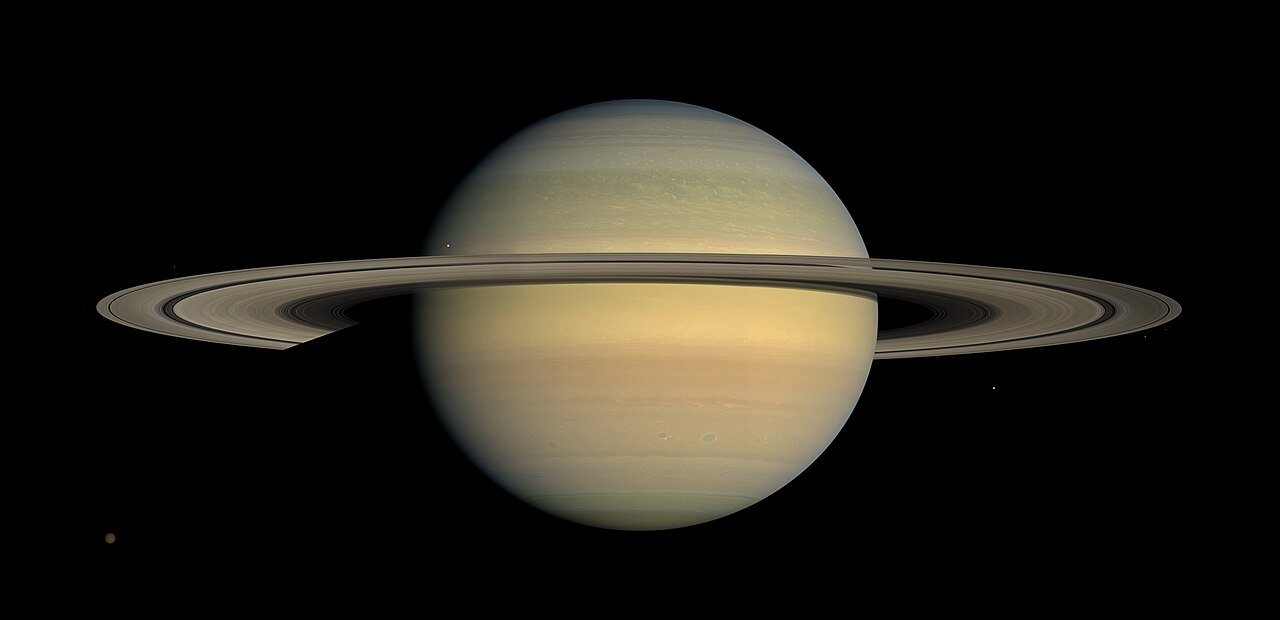
Saturn’s rings are among the most extreme examples of flatness in the natural world. While they stretch outward to a diameter of about 280,000 kilometers, their vertical thickness is astonishingly small. In many places, the rings are only about 10 to 100 meters thick, and some regions may be even thinner.
To put this into perspective, if the rings were scaled down to the size of a vinyl record, they would be thinner than a sheet of paper. This extreme thinness is not immediately obvious from images, which often exaggerate the vertical scale for clarity. In reality, the rings form a nearly two-dimensional disk around the planet.
The thinness of the rings is a consequence of physics. The particles that make up the rings orbit Saturn in nearly the same plane, known as Saturn’s equatorial plane. Collisions between particles gradually dampen out vertical motions, flattening the system over time. Gravity, collisions, and orbital mechanics work together to maintain this delicate structure.
There is something deeply poetic about this fact. A structure so vast that it can be seen from Earth with a small telescope is, at the same time, astonishingly thin. It challenges human intuition and reminds us that size and scale in the universe do not always align with our everyday expectations.
3. Saturn’s Rings Are Not Solid Bands but Countless Individual Particles
Although Saturn’s rings appear smooth and continuous from afar, they are actually composed of an enormous number of individual particles. These particles range in size from microscopic grains of dust to chunks as large as houses or even small buildings. Each particle follows its own orbit around Saturn, governed by gravity and influenced by interactions with neighboring particles.
There is no solid surface anywhere in the rings. If a spacecraft could somehow land within them, it would not touch down on a flat platform but would instead pass through a cloud of orbiting debris. The particles are spaced closely enough to create the appearance of a continuous ring, yet far enough apart that collisions are relatively gentle and frequent rather than catastrophic.
This particulate nature makes the rings behave in fascinating ways. Waves, gaps, and sharp edges emerge as collective phenomena, shaped by gravitational resonances with Saturn’s moons. In this sense, the rings resemble a cosmic laboratory where the physics of disks, collisions, and gravity can be studied in exquisite detail.
Emotionally, this fact transforms the rings from a static ornament into a living system. They are not frozen in time but constantly shifting, colliding, and reorganizing. Each tiny particle plays a role in shaping the larger structure, echoing a broader truth about the universe: immense complexity often arises from simple components interacting under basic physical laws.
4. The Rings Are Divided into Distinct Sections with Sharp Boundaries
Saturn’s rings are not a single, uniform structure. Instead, they are divided into several major sections, traditionally labeled the A, B, and C rings, along with fainter components such as the D, E, F, and G rings. These divisions are not arbitrary; they reflect real differences in particle density, composition, and dynamical behavior.
One of the most famous features is the Cassini Division, a dark gap that separates the A and B rings. First observed in the 17th century, this division is not completely empty but contains far fewer particles than the surrounding rings. Its existence is largely due to a gravitational resonance with the moon Mimas, which destabilizes particle orbits in that region.
Other boundaries are even sharper and more mysterious. Some ring edges remain remarkably well-defined despite the tendency for particles to spread out over time. These sharp edges are often maintained by the gravitational influence of nearby moons, known as shepherd moons, which confine ring particles through complex gravitational interactions.
Scientifically, these divisions provide critical insights into orbital dynamics and resonance phenomena. Emotionally, they add to the rings’ visual drama, creating patterns of light and dark that give Saturn its iconic appearance. Each boundary tells a story of balance and tension, where gravity sculpts matter into order amid constant motion.
5. Saturn’s Rings Are Surprisingly Young on Cosmic Timescales
For a long time, scientists assumed that Saturn’s rings formed at the same time as the planet itself, around 4.5 billion years ago. However, evidence gathered by the Cassini spacecraft suggests a far more surprising possibility: the rings may be relatively young, perhaps only a few hundred million years old.
This conclusion comes from measurements of how much non-icy material, such as dust from meteoroids, has accumulated in the rings. Over time, impacts from micrometeoroids should darken and contaminate the ice. The rings’ remarkable brightness implies that they have not been exposed to this process for billions of years.
If the rings are indeed young, their formation must have been a dramatic and relatively recent event in Saturn’s history. One possibility is that a large icy moon was torn apart by tidal forces, creating the rings we see today. Another is that multiple smaller bodies collided and fragmented within Saturn’s gravitational influence.
This idea carries a powerful emotional weight. It suggests that even in a mature Solar System, dramatic transformations can still occur. Saturn’s rings may be a temporary phenomenon, a fleeting adornment in cosmic terms, reminding us that the universe is not static but continually evolving.
6. The Rings Are Constantly Changing and Dynamically Active
Despite their serene appearance, Saturn’s rings are anything but calm. They are among the most dynamically active structures in the Solar System, constantly reshaped by gravitational forces, collisions, and resonances. Waves ripple through the rings like patterns on water, driven by the gravitational pull of Saturn’s moons.
Some of these waves are spiral density waves, where particles bunch together and spread apart in response to resonances. Others are bending waves, which cause vertical distortions in the ring plane. These features can propagate across vast distances, carrying information about the masses and orbits of moons that may be otherwise difficult to measure.
In addition to waves, transient features appear and disappear over time. Clumps form, dissipate, and reform. Edges sharpen or blur. Even seasonal changes, driven by Saturn’s long orbital period, can alter the rings’ appearance as sunlight strikes them at different angles.
This constant activity gives the rings a kind of vitality. They are not relics of the past but ongoing processes unfolding before our eyes. Emotionally, this dynamism invites a sense of connection, as though we are witnessing a living system rather than a static monument.
7. Some of Saturn’s Rings Are Fed by Its Moons
Not all of Saturn’s rings are made the same way or maintained by the same processes. Some of them are directly supplied by material from Saturn’s moons. A striking example is the E ring, a vast and diffuse ring that extends far beyond the main ring system.
The E ring is primarily composed of microscopic ice particles ejected from the moon Enceladus. This small, icy moon is geologically active, spewing plumes of water vapor and ice grains from its south polar region. These particles escape Enceladus’s gravity and spread out to form the E ring.
This connection between moon and ring reveals an intimate relationship within the Saturnian system. Moons are not isolated objects but active participants in shaping their environment. Material cycles between moons and rings, blurring the boundaries between different components of the system.
Emotionally, this fact is deeply evocative. It suggests a kind of cosmic ecology, where matter is exchanged and recycled. Saturn’s rings are not just remnants of past events but are continually renewed by ongoing processes, sustained by the activity of distant, icy worlds.
8. Saturn’s Rings Help Scientists Understand Planet Formation
Beyond their intrinsic beauty, Saturn’s rings serve as a natural laboratory for studying processes that occur throughout the universe. The same physical principles that govern the rings also operate in protoplanetary disks around young stars, where planets are born.
In both cases, countless particles orbit a central mass, collide, clump together, and respond to gravitational forces. By studying how structures form and evolve in Saturn’s rings, scientists gain insights into how planets grow, migrate, and interact with their surroundings.
The advantage of Saturn’s rings is their accessibility. Unlike distant protoplanetary disks, which can only be observed indirectly, the rings can be studied in extraordinary detail. Spacecraft data provide precise measurements of particle motion, density, and composition, allowing theories to be tested with real-world examples.
There is a profound emotional resonance in this connection. The rings around Saturn, so familiar and close, mirror processes that shaped Earth itself billions of years ago. By understanding them, we are, in a sense, looking back at the conditions that made our own existence possible.
9. The Rings Will Not Last Forever
As magnificent as Saturn’s rings are, they are not permanent. Over time, they are slowly losing material. Some particles spiral inward toward Saturn, while others are ejected outward or collide and fragment. One process contributing to this loss is known as “ring rain,” where charged particles are guided by Saturn’s magnetic field into the planet’s atmosphere.
Measurements indicate that material from the rings is falling into Saturn at a rate that, over long timescales, could significantly deplete them. Combined with other loss mechanisms, this suggests that the rings may disappear entirely in the distant future, or at least become far less prominent.
This impermanence adds a poignant dimension to our view of Saturn. We are living in a time when the planet’s rings are at their most spectacular. Future observers, if they exist, may see a very different Saturn, perhaps with only faint remnants of the rings we admire today.
Emotionally, this fact underscores the fleeting nature of cosmic beauty. Even the grandest structures are subject to change and decay. Saturn’s rings remind us to appreciate the universe not only for what it is, but for the brief moment in which we are able to witness it.
10. Saturn’s Rings Are a Testament to the Power of Gravity
At the deepest level, Saturn’s rings are a triumph of gravity. Every particle in the rings is locked in a delicate gravitational dance, influenced by Saturn, its moons, and neighboring particles. The intricate patterns we observe emerge from these countless interactions, governed by simple physical laws.
Gravity shapes the rings’ flatness, their divisions, their waves, and their long-term evolution. It determines which particles remain in orbit and which fall inward or drift away. In studying the rings, scientists see gravity not as an abstract concept, but as a creative force capable of sculpting matter into breathtaking forms.
This final fact brings us back to a fundamental truth about physics and the universe. Complex beauty does not require intention or design in the human sense. It can arise naturally from basic forces acting over time. Saturn’s rings are a vivid illustration of this principle, showing how elegance and complexity emerge from simplicity.
Conclusion
The rings of Saturn are far more than a visual spectacle. They are a dynamic, evolving system that encapsulates many of the most important principles of planetary science, from gravity and orbital mechanics to the life cycles of moons and planets. Each of the ten facts explored here reveals a different layer of their complexity, deepening our appreciation for what might otherwise seem like a simple adornment.
Emotionally, Saturn’s rings invite wonder, humility, and reflection. They connect us to processes that operate on scales far beyond human experience, while also reminding us of the impermanence and fragility of even the grandest cosmic structures. Scientifically, they continue to challenge and inspire, offering insights that reach far beyond Saturn itself.
In gazing at Saturn’s rings, we are not just looking at a planet’s decoration. We are witnessing a living system, shaped by time, gravity, and chance—a mind-blowing testament to the beauty and power of the universe.