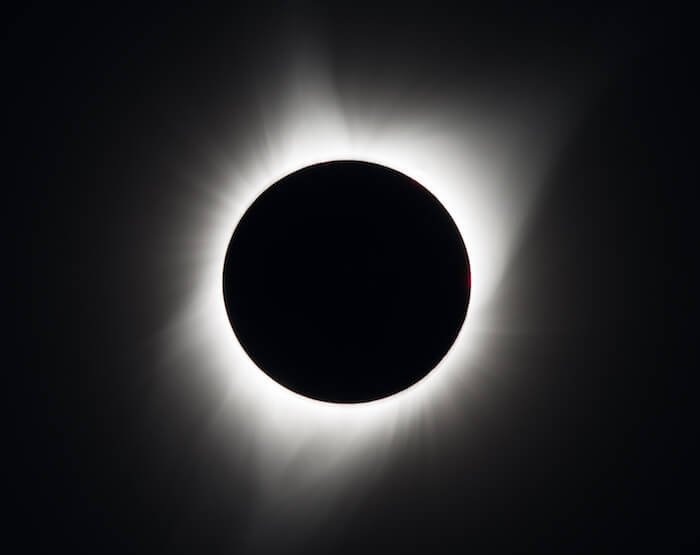
The Sun appears calm to the unaided eye: a steady, blinding disk that rises and sets with reassuring regularity. Yet this apparent serenity hides one of the most extreme and mysterious environments in the solar system. Surrounding the visible surface of the Sun is a vast, ghostly atmosphere known as the corona. Stretching millions of kilometers into space, the solar corona is hotter than the Sun’s surface, threaded by powerful magnetic fields, and responsible for space weather that can reach Earth itself. For centuries, the corona was visible only during rare total solar eclipses, appearing as a pearly white halo that seemed almost supernatural. Even today, despite advanced space telescopes and probes, it remains a region full of unanswered questions.
The Sun’s corona challenges intuition, defies simple explanations, and reveals how dynamic and alive our star truly is. Below are nine incredible secrets of the solar corona—each grounded in modern physics and observation—that together tell a story of energy, magnetism, and cosmic connection.
1. The Corona Is Millions of Degrees Hotter Than the Sun’s Surface
One of the most astonishing facts about the solar corona is its temperature. The visible surface of the Sun, known as the photosphere, has a temperature of about 5,500 degrees Celsius. The corona above it, however, reaches temperatures of one to several million degrees Celsius. This dramatic increase defies everyday expectations. On Earth, moving away from a heat source usually means cooling down. The Sun does the opposite.
This phenomenon, known as the coronal heating problem, has puzzled physicists for decades. The energy that heats the corona cannot come directly from simple thermal conduction, because heat does not naturally flow from cooler regions to hotter ones. Instead, scientists have identified the Sun’s magnetic field as the key player. The photosphere is in constant motion, with hot plasma rising and sinking. These motions twist and braid magnetic field lines that extend upward into the corona.
As magnetic field lines tangle and snap into new configurations, they release enormous amounts of energy. Some of this energy travels upward in the form of waves, while some is released suddenly through magnetic reconnection—an explosive process that converts magnetic energy into heat and motion. Although no single mechanism fully explains the extreme temperatures, a combination of wave heating and reconnection is strongly supported by observations.
The fact that the corona is so hot tells us something profound about the Sun. It is not a simple glowing ball, but a complex electromagnetic system where energy is transported, stored, and released in subtle ways. The corona’s heat is a visible signature of that hidden dynamism.
2. The Corona Is Sculpted Entirely by Magnetic Fields
Unlike the Sun’s surface, which is shaped largely by gravity and pressure, the corona is dominated by magnetism. The plasma in the corona is so hot and diffuse that magnetic forces overpower the motion of individual particles. As a result, coronal structures trace the invisible architecture of the Sun’s magnetic field.
This is why images of the corona show loops, arcs, streamers, and plumes rising high above the Sun. These shapes are not static. They evolve constantly as magnetic fields shift, reconnect, and reorganize. Coronal loops, for example, are giant arches of glowing plasma trapped along closed magnetic field lines. They can persist for hours or days, storing vast amounts of energy.
In regions where magnetic field lines open into space, the corona forms long streamers that stretch outward, becoming part of the solar wind. In areas of intense magnetic activity, such as sunspot regions, the corona becomes brighter and more complex, reflecting the stronger magnetic fields below.
Understanding the corona therefore requires understanding solar magnetism. The Sun’s magnetic field is generated by the motion of electrically charged plasma deep within its interior, through a process known as the solar dynamo. The corona is where the effects of that dynamo become most dramatically visible, turning invisible magnetic forces into luminous structures that span millions of kilometers.
3. The Corona Is the Birthplace of the Solar Wind
The solar corona is not a closed atmosphere. It continuously leaks matter into space in the form of the solar wind—a stream of charged particles, primarily electrons and protons, that flows outward through the solar system. This wind shapes the environment around every planet and defines the boundary of the Sun’s influence.
The solar wind originates in the corona, where the plasma is so hot that particles can escape the Sun’s gravity. In regions where magnetic field lines are open, coronal plasma accelerates outward, forming a steady outflow. This wind travels at speeds ranging from hundreds to over a thousand kilometers per second.
When the solar wind reaches Earth, it interacts with Earth’s magnetic field, creating phenomena such as auroras. Under strong conditions, it can disrupt satellites, power grids, and communication systems. Thus, events in the corona have direct consequences for modern technological civilization.
The existence of the solar wind was once controversial, but it is now well established through spacecraft measurements. Its origin in the corona highlights the Sun’s role not just as a source of light and heat, but as a dynamic engine that continually shapes the space environment throughout the solar system.
4. The Corona Is Visible Only Under Special Conditions
For most of human history, the corona was a fleeting and mysterious sight. It can be seen from Earth only during a total solar eclipse, when the Moon perfectly blocks the Sun’s bright disk and reveals the faint glow surrounding it. Early eclipse observers described the corona as a crown of silvery light, giving rise to its name, which comes from the Latin word for “crown.”
The difficulty of observing the corona arises from its extreme faintness compared to the Sun’s surface. The photosphere is millions of times brighter, drowning out the corona’s light. Modern astronomy overcomes this challenge using coronagraphs—instruments that artificially block the Sun’s disk to mimic an eclipse. Space-based coronagraphs avoid atmospheric interference, providing clearer views of coronal structures.
Despite these tools, eclipses remain scientifically valuable. They allow observations of the inner corona at resolutions and wavelengths that are difficult to achieve otherwise. Even today, total solar eclipses are carefully studied events, blending cutting-edge science with a sense of awe that connects modern observers to ancient skywatchers.
The corona’s elusive visibility reminds us that much of the universe exists just beyond the limits of our everyday perception, waiting for the right conditions—or the right technology—to reveal itself.
5. The Corona Is the Source of Solar Flares
Solar flares are sudden, intense bursts of radiation that erupt from the Sun’s atmosphere. They are among the most energetic events in the solar system, releasing as much energy in minutes as billions of nuclear bombs. These flares originate in the corona, where magnetic energy is stored and explosively released.
The process behind solar flares is magnetic reconnection. When twisted magnetic field lines in the corona become unstable, they can suddenly break and reconnect in a new configuration. This releases stored magnetic energy, heating plasma to tens of millions of degrees and accelerating particles to near-light speeds.
The radiation from solar flares spans the electromagnetic spectrum, from radio waves to X-rays and gamma rays. When directed toward Earth, this radiation can disrupt the ionosphere, interfere with radio communication, and pose risks to astronauts and satellites.
The corona’s role in solar flares underscores its importance as a region where the Sun’s magnetic energy is converted into powerful, sometimes disruptive events. It is a reminder that our star is not merely a passive source of light, but an active, occasionally violent cosmic engine.
6. The Corona Produces Coronal Mass Ejections
Even more dramatic than solar flares are coronal mass ejections, often abbreviated as CMEs. These are massive eruptions in which billions of tons of coronal plasma are hurled into space, carrying embedded magnetic fields with them. CMEs originate in the corona and can travel across the solar system.
A coronal mass ejection begins when large-scale magnetic structures in the corona become unstable. When they erupt, they release enormous clouds of charged particles. If a CME is directed toward Earth, it can trigger powerful geomagnetic storms, capable of damaging satellites and power infrastructure.
CMEs reveal the corona as a region of stored tension and sudden release. They also illustrate the Sun’s ability to influence space far beyond its visible surface. The study of CMEs is central to space weather forecasting, an applied science that seeks to predict and mitigate the Sun’s effects on human technology.
The fact that such colossal events originate in the faint, ethereal corona is one of the most striking examples of how appearances can be deceiving in astrophysics.
7. The Corona Is Continuously Changing
Despite its immense size, the corona is astonishingly dynamic. Its structures can change over minutes, hours, or days, responding to shifts in the Sun’s magnetic field. Loops brighten and fade, streamers stretch and collapse, and entire regions reorganize as the Sun rotates and evolves.
These changes follow the solar cycle, an approximately 11-year cycle of magnetic activity. During solar maximum, when sunspots are abundant, the corona becomes more complex and active, with numerous bright loops and frequent eruptions. During solar minimum, it appears smoother and more symmetric, dominated by large polar structures.
This variability makes the corona a laboratory for studying plasma physics under extreme conditions. Processes that are difficult or impossible to recreate on Earth occur naturally in the corona, offering insights into fundamental physics that apply throughout the universe.
The ever-changing corona challenges the idea of the Sun as a constant, unchanging presence. It reveals a star in perpetual motion, driven by deep internal processes that manifest far above its surface.
8. The Corona Extends Far Beyond What We Can See
Although the brightest parts of the corona lie close to the Sun, its influence extends far into space. The outer corona gradually merges with the solar wind, forming a vast region that fills the heliosphere—the bubble of space dominated by the Sun.
This extended corona interacts with planetary magnetic fields, comet tails, and interstellar material. It defines the space environment in which Earth and other planets move, shaping conditions that affect atmospheres, radiation levels, and even the long-term evolution of planetary systems.
Modern spacecraft have ventured into this extended coronal region, measuring particle densities, magnetic fields, and temperatures. These missions confirm that the corona is not a thin shell, but a sprawling, interconnected system that links the Sun to the rest of the solar system.
The realization that we live within the Sun’s extended atmosphere offers a humbling perspective. Earth is not isolated in space, but embedded in a continuous flow of solar material and energy.
9. The Corona Holds Clues to the Behavior of Other Stars
The Sun’s corona is not unique. Many stars possess hot, extended atmospheres shaped by magnetic fields. By studying the solar corona in detail, physicists gain insights into stellar behavior across the universe.
Observations of distant stars show flares and coronal emissions far more energetic than those of the Sun, suggesting that similar processes operate on different scales. The Sun serves as a nearby laboratory, allowing high-resolution study that cannot be achieved for other stars.
Understanding coronal heating, magnetic reconnection, and stellar winds has implications for planetary habitability around other stars. A star’s coronal activity can strip atmospheres from planets or bathe them in radiation, influencing the potential for life.
In this way, the secrets of the Sun’s corona extend far beyond our own star. They help us understand the physics of stars, the environments of exoplanets, and the broader workings of the cosmos.
Conclusion: The Corona as a Window Into Solar Power and Mystery
The Sun’s corona is a realm of extremes—extreme temperatures, extreme energies, and extreme beauty. It is hotter than the surface below it, shaped by invisible magnetic forces, and responsible for phenomena that reach across the solar system to affect Earth itself. Each secret of the corona reveals a Sun that is dynamic, complex, and deeply connected to space around it.
Far from being a decorative halo, the corona is a central player in solar physics. It is where magnetic energy is transformed into heat, motion, and radiation. It is where the solar wind is born and where explosive events originate. By studying the corona, we come closer to understanding not only our star, but the fundamental processes that govern stars throughout the universe.
In the shimmering light of a total eclipse or the data streams of a space probe, the corona reminds us that even the most familiar objects can hold profound mysteries. The Sun, which has risen over human history since before memory, still has secrets to teach us—and many of them are written in the glowing language of its extraordinary corona.