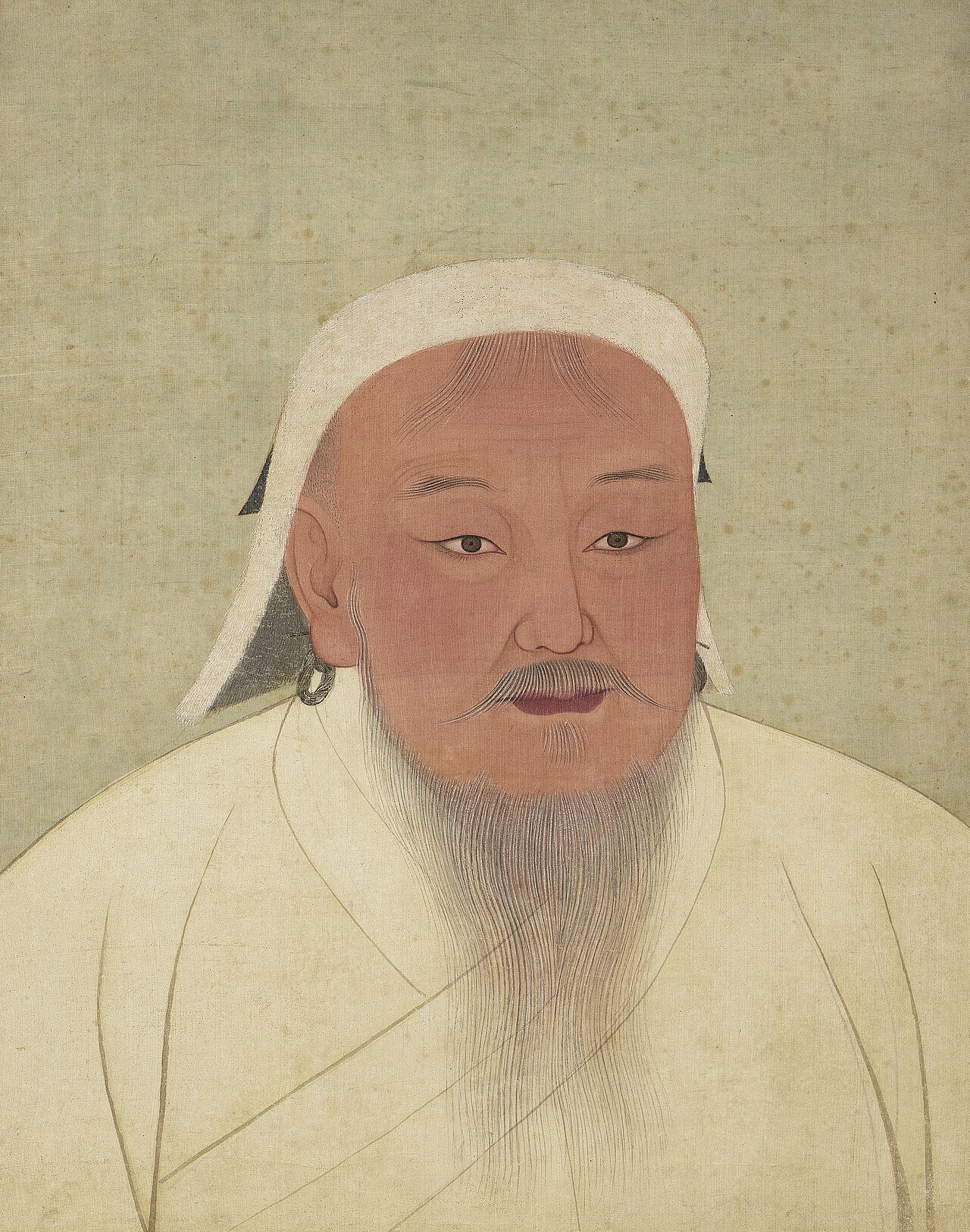
Genghis Khan (born around 1162, near the Onon River in what is now northeastern Mongolia—died August 18, 1227, in the territory of the Western Xia state in northwestern China) was a Mongolian ruler and military leader who founded the Mongol Empire, which became the largest contiguous land empire in history. Born Temujin, he united many of the divided Mongol tribes under his leadership and led military campaigns that brought large parts of Asia under Mongol control. He received the title Genghis Khan in 1206, after being recognized as the supreme leader of the Mongol people.
Early Life and Family Background
Genghis Khan was born Temujin into a Mongol family led by his father, Yesugei, a tribal chief. His mother, Hoelun, played an important role in raising him and his siblings. The family belonged to a society of nomadic herders who moved across the grasslands of Mongolia with their animals. Horses, livestock, hunting, and tribal relationships shaped everyday life.
Temujin grew up during a period of political division and frequent conflict among Mongol tribes. Different groups competed for territory, livestock, influence, and control of important trade routes. Alliances between families and tribes could change quickly, making life uncertain for people without strong political connections.
When Temujin was still a boy, his father arranged his marriage to Börte, who belonged to another Mongol family. During this period, Temujin stayed with Börte’s family according to local marriage customs. Before he could complete this arrangement, however, his father was poisoned by members of a rival Tatar group while returning from a gathering.
His father’s death changed the family’s circumstances dramatically. The people who had followed Yesugei abandoned his widow and children, leaving them without the protection and resources they had previously enjoyed. Hoelun struggled to support her family by gathering food and relying on the limited resources available to them.
Temujin spent much of his youth facing poverty, insecurity, and conflict. Traditional accounts describe disagreements within the family, including a serious incident in which he killed his older half-brother, Begter, during a dispute over food and authority. The incident reflected the difficult conditions in which the family lived.
These early experiences took place in a society where personal loyalty, family relationships, military strength, and the ability to form alliances often determined survival. Temujin gradually developed relationships with other young men and tribal leaders who would later help him build his political and military position.
Marriage to Börte and Early Alliances
Temujin eventually returned to Börte’s family and married her. The marriage strengthened an important family connection and gave him a foundation for rebuilding his position among the Mongol tribes.
Soon afterward, members of the Merkit tribe attacked his camp and abducted Börte. Temujin sought assistance from powerful allies, including Toghrul, a senior leader of the Kereit tribe, and Jamukha, a childhood friend who had become an important Mongol leader.
With their support, Temujin organized a military campaign against the Merkits and recovered Börte. The event strengthened his reputation and demonstrated his ability to attract support from influential leaders.
Börte remained his principal wife and became an important figure in his family and political life. Their children included four sons: Jochi, Chagatai, Ögedei, and Tolui. These sons later played major roles in the expansion and administration of the Mongol Empire.
Temujin also formed close relationships with several companions who became trusted members of his growing leadership group. One of the most important was Jamukha, with whom he had shared a traditional bond of brotherhood. Their relationship eventually broke down as both men sought greater authority over the Mongol tribes.
Rise to Power Among the Mongol Tribes
As Temujin gained supporters, his influence began to challenge established tribal leaders. Unlike many traditional chiefs, he increasingly built his following around personal loyalty and military service rather than relying entirely on family background or inherited status.
He attracted people from different tribes, including individuals who had previously belonged to rival groups. He rewarded loyalty, promoted capable followers, and created opportunities for men who demonstrated military ability.
His growing influence brought him into conflict with Jamukha. Although the two had once been close friends, their competing ambitions made cooperation increasingly difficult. Jamukha attracted support from traditional tribal leaders who viewed Temujin’s changing political structure with suspicion.
Their rivalry developed into a series of military confrontations. Temujin gradually gained the advantage by building stronger alliances and maintaining the loyalty of his followers. Several influential leaders also joined him after losing confidence in their existing alliances.
Temujin fought against the Tatars, Kereits, Naimans, and other Mongol groups. These campaigns involved both military force and political negotiation. Some tribes submitted after defeat, while others joined him through agreements or changes in leadership.
By the beginning of the 13th century, Temujin had defeated or brought under his control most of the major rival powers in the Mongolian steppe. His victory over the Naimans in 1204 was especially important because it removed one of the last major obstacles to his authority.
Becoming Genghis Khan in 1206
In 1206, Temujin gathered Mongol leaders at a large assembly known as a kurultai. At this meeting, he was formally recognized as Genghis Khan, the supreme ruler of the united Mongol people.
The title marked the beginning of a new political order. Instead of remaining divided among competing tribal groups, the Mongols now had a central leader with authority over a much larger confederation.
Genghis Khan reorganized the military and political structure of his people. He divided the army into units of tens, hundreds, thousands, and larger groups. These arrangements made it easier to organize soldiers, communicate orders, and maintain discipline.
He also weakened the traditional power of tribal aristocrats by assigning leadership positions based increasingly on loyalty and ability. Men from different backgrounds could rise to positions of authority if they proved themselves useful and dependable.
His government emphasized obedience, military discipline, and responsibility. Leaders were expected to follow orders, and betrayal or serious disloyalty could bring severe punishment.
Genghis Khan also developed a system of laws and regulations commonly associated with the name Yassa. Although the complete original text has not survived, historical accounts describe rules covering military duties, social conduct, loyalty, and the organization of Mongol society.
Early Military Campaigns Against China
After uniting the Mongol tribes, Genghis Khan turned his attention beyond the Mongolian grasslands. One of his first major targets was the Western Xia kingdom, a state located in what is now northwestern China.
The Western Xia kingdom controlled important territory along the routes connecting Mongolia with northern China and Central Asia. Genghis Khan launched campaigns against it beginning in 1205. Mongol forces attacked settlements, defeated military resistance, and forced the kingdom to accept Mongol demands.
The campaigns against Western Xia were followed by an invasion of the Jin dynasty in northern China. The Jin rulers controlled a large and wealthy territory, including major cities, agricultural regions, and fortified settlements.
In 1211, Genghis Khan began a major military campaign against the Jin Empire. Mongol forces entered northern China and defeated several Jin armies. Their mobility, coordination, and ability to operate across large distances gave them important advantages.
The Jin military relied heavily on fortified cities and established defensive positions. The Mongols initially had limited experience with large-scale siege warfare, which required specialized equipment and knowledge. However, they adapted by using engineers and specialists from conquered territories.
In 1215, Mongol forces captured Zhongdu, the Jin capital, located near present-day Beijing. The conquest marked a major turning point in the war, although the Jin dynasty continued to resist Mongol attacks for many years.
Campaigns in Central Asia
Genghis Khan’s expansion into Central Asia began after a serious diplomatic and commercial dispute with the Khwarazmian Empire, a powerful state covering parts of present-day Iran, Turkmenistan, Uzbekistan, Kazakhstan, and Afghanistan.
The Mongols initially sought peaceful trade and diplomatic relations with Khwarazm. Genghis Khan sent a commercial mission and later dispatched envoys to establish better relations with the empire’s ruler, Shah Muhammad II.
The situation deteriorated after a Mongol trade caravan was attacked and its members were killed in the Khwarazmian city of Otrar. The shah’s response to the Mongol diplomatic protest further increased tensions. Genghis Khan then prepared a large military invasion.
Beginning in 1219, Mongol forces entered the Khwarazmian Empire from several directions. Their attacks targeted major cities, including Otrar, Bukhara, Samarkand, and Urgench.
The Mongols used coordinated movements, intelligence gathering, psychological pressure, and military deception to overcome resistance. They frequently surrounded cities, cut off supplies, and demanded surrender. Cities that resisted could face devastating destruction after their defenses were overcome.
The campaign caused enormous loss of life and destruction across Central Asia. Many communities were devastated, agricultural systems were damaged, and populations were displaced. The exact number of people killed is unknown, and medieval accounts often contain exaggerated figures.
Shah Muhammad II fled from the Mongol advance and died in 1220 while in hiding. His son, Jalal al-Din Mingburnu, continued resistance but was eventually forced to retreat after suffering military defeats.
The conquest of the Khwarazmian Empire brought large areas of Central Asia under Mongol control and opened routes for further expansion toward the Middle East and eastern Europe.
Military Organization and Leadership
Genghis Khan’s military success depended on more than the ability of individual soldiers. He created an organized army capable of operating across enormous distances and adapting to different enemies.
Mongol soldiers were highly skilled horsemen. Many grew up riding and hunting, giving them experience with horses from an early age. A typical soldier could use a powerful composite bow while riding, allowing Mongol forces to attack from a distance without slowing their movement.
The Mongols often used hit-and-run attacks, false retreats, sudden changes of direction, and coordinated movements to confuse opponents. They could draw enemy forces away from defensive positions before turning around and attacking them.
Their army was organized into disciplined units, allowing commanders to coordinate large numbers of soldiers. Clear chains of command helped maintain order during long campaigns.
Genghis Khan also made use of information gathered by scouts, merchants, travelers, and local guides. Knowledge of roads, rivers, water supplies, enemy movements, and political divisions helped the Mongols plan their operations.
Another important feature was their willingness to adopt useful technology and skills from conquered peoples. Engineers from China and other regions helped build siege weapons and organize attacks against fortified cities.
Genghis Khan also rewarded military ability and loyalty. Some of his most trusted commanders came from groups that had once fought against him. This approach helped him build an army that extended beyond the traditional Mongol tribal system.
Treatment of Conquered Peoples
Genghis Khan’s rule could be extremely harsh, particularly toward communities that resisted Mongol demands. Cities that refused to surrender sometimes suffered mass killings, destruction, and forced displacement after being captured.
These campaigns were intended not only to defeat military opponents but also to discourage other communities from resisting. News of the consequences of refusing Mongol demands often spread ahead of the army, influencing the decisions of neighboring rulers.
However, the Mongols did not treat every conquered population in the same way. Communities that surrendered peacefully could retain local officials, continue religious practices, and maintain aspects of their existing social organization. Skilled workers, craftsmen, engineers, and administrators were often taken into Mongol service.
Genghis Khan generally allowed different religious communities to practice their faiths. His empire included Muslims, Christians, Buddhists, followers of traditional Mongolian beliefs, and other religious groups.
This approach helped the Mongols govern territories with different languages, customs, and traditions. At the same time, religious freedom did not protect communities from military demands, taxation, or punishment when they challenged Mongol authority.
Family Life and Personal Relationships
Although Genghis Khan spent much of his life on military campaigns, his family remained central to his political arrangements.
Börte was his principal wife and the mother of his four sons. She held an important position within the royal family, and her sons became leading figures in the empire.
Genghis Khan also had other wives and concubines, as was common among powerful rulers of the period. His descendants eventually formed a large ruling family whose members governed different parts of the expanding Mongol territories.
His relationship with his eldest son, Jochi, was complicated. Before Jochi’s birth, Börte had been held captive by the Merkits. This led to questions about Jochi’s paternity among some members of the family, particularly Chagatai. Genghis Khan nevertheless recognized Jochi as his son and gave him an important position within the empire.
The disagreements among his sons became significant when decisions had to be made about succession and the division of conquered territories.
Genghis Khan also maintained close relationships with trusted military commanders and advisers. These included Muqali, Subutai, Jebe, and other leaders who helped carry out his campaigns. Their experience and loyalty were important to the expansion of Mongol power.
Campaigns Toward Eastern Europe and the Caucasus
While Genghis Khan was expanding Mongol control across Central Asia, he also sent military forces westward. These expeditions explored new territories, defeated opposing armies, and gathered information about the regions beyond the Mongolian world.
One of the most important commanders involved was Subutai, an experienced Mongol general. Jebe, another leading commander, also played a major role in these operations.
Between 1220 and 1223, Mongol forces traveled through parts of Iran, the Caucasus, and the lands north of the Black Sea. They fought against several local rulers and encountered forces connected to the Georgian kingdom, the Cumans, and the principalities of Kievan Rus.
In 1223, Mongol forces defeated a coalition of Rus and Cuman troops at the Battle of the Kalka River. The victory demonstrated the Mongols’ ability to defeat opponents far from their original homeland.
These western campaigns were not yet a permanent conquest of eastern Europe. They were military expeditions that provided valuable information and demonstrated the reach of Mongol forces.
Final Campaign Against Western Xia
In the later years of his life, Genghis Khan returned his attention to the Western Xia kingdom. Although the kingdom had previously submitted to Mongol demands, its rulers had not provided the level of support expected during later military operations.
Genghis Khan launched another campaign against Western Xia in 1226. Mongol forces attacked settlements and military positions, gradually weakening the kingdom’s ability to resist.
The campaign was still underway when Genghis Khan died in 1227. Western Xia surrendered shortly afterward, and the kingdom was destroyed as an independent political state.
Death in 1227
Genghis Khan died on August 18, 1227, during the campaign against Western Xia. He was approximately 65 years old, although his exact birth date is uncertain.
The precise cause of his death remains unclear. Historical accounts offer different explanations, and there is no universally accepted account of the circumstances.
According to Mongol tradition, his burial place was kept secret. Later accounts describe efforts to prevent others from discovering the location of his grave, but its exact whereabouts remain unknown.
His death did not end the Mongol Empire. Before his death, he had arranged important aspects of succession and selected his son Ögedei to become the next Great Khan.
The Mongol leadership continued its expansion under Ögedei, who was formally elected Great Khan in 1229. Genghis Khan’s sons and other descendants went on to govern territories across Asia, establishing powerful branches of the ruling family.