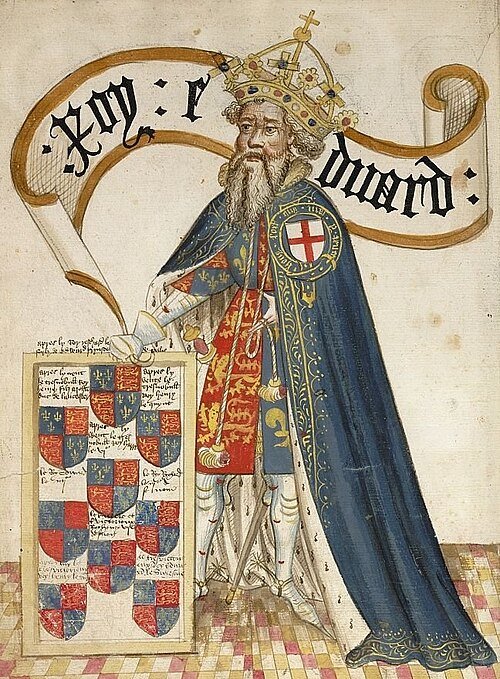
Edward III (born November 13, 1312, at Windsor Castle, Berkshire, England—died June 21, 1377, at Sheen Palace, Surrey, England) was King of England from 1327 until his death in 1377. He was the son of King Edward II and Isabella of France. Known for his military campaigns in France, his role in the Hundred Years’ War, and his efforts to strengthen the English monarchy, Edward III ruled for 50 years and helped shape England’s political and military development during the 14th century.
Early Life and Family Background
Edward III was born on November 13, 1312, at Windsor Castle during the reign of his father, Edward II. His mother, Isabella of France, was the daughter of King Philip IV of France and the sister of three successive French kings. Through his parents, Edward had connections to two of the most powerful royal families in Western Europe.
Edward was the eldest surviving son of Edward II and Isabella. He was born into a period of political tension in England, as his father’s rule faced growing opposition from powerful nobles. Disagreements over royal advisers, military failures, and the king’s relationship with influential members of his household weakened the monarchy.
As a young prince, Edward received an education suited to his royal position. He learned about government, military leadership, religion, and the responsibilities of kingship. Like other members of the medieval royal family, he was also expected to develop the skills needed to lead armies and manage relationships with nobles.
His childhood was shaped by the political struggles surrounding his parents. These conflicts eventually led to his father’s removal from power and changed the course of Edward’s life.
The Fall of Edward II and Edward’s Accession
In 1325, Edward’s mother, Isabella, traveled to France to help resolve a dispute between England and France over the English king’s lands in southwestern France. While there, she became closely associated with Roger Mortimer, an English nobleman who had opposed Edward II and fled the country.
Isabella and Mortimer gathered support against the king. In 1326, they invaded England with a small force and attracted growing support from nobles who were dissatisfied with Edward II’s government.
Edward joined his mother and Mortimer in the political movement against his father. As the king’s position collapsed, Edward II was captured and forced to surrender the throne.
On January 25, 1327, the young prince was formally recognized as king. He was crowned Edward III at Westminster Abbey on February 1, 1327, when he was just 14 years old.
Although Edward was now king, he did not initially control the government. Because of his age, Isabella and Mortimer exercised considerable authority in his name. Edward II was imprisoned and died in September 1327 at Berkeley Castle. The circumstances of his death have been debated by historians, and the exact details remain uncertain.
Edward III’s early reign was therefore marked by the influence of people who had helped bring him to the throne.
Rule Under Isabella and Roger Mortimer
During the first years of Edward III’s reign, Roger Mortimer became the dominant political figure in England. He held considerable power at court and influenced major government decisions. Queen Isabella also maintained an important position, benefiting from her son’s accession.
Mortimer’s growing authority created resentment among English nobles. Many believed he had gained too much influence and was using his position to enrich himself and strengthen his personal power.
Edward III gradually became dissatisfied with this arrangement. Although he had been crowned king, he wanted to exercise the authority expected of a monarch rather than remain under the control of his mother and Mortimer.
In October 1330, Edward acted against Mortimer. With the assistance of trusted supporters, he organized a surprise operation at Nottingham Castle. His men entered Mortimer’s chambers through a secret passage and arrested him.
Mortimer was subsequently tried and executed in November 1330. Isabella was removed from political power and spent much of the remainder of her life away from the center of government, although she was treated with respect as the king’s mother.
Edward was then able to take personal control of the government. He was 18 years old and had established himself as the effective ruler of England.
Marriage to Philippa of Hainault and Family Life
Edward III married Philippa of Hainault on January 24, 1328, at York Minster. Their marriage had been arranged partly for political reasons, helping England develop connections with territories in the Low Countries.
Philippa was the daughter of William I, Count of Hainault, Holland, and Zeeland. She became an influential queen and accompanied Edward during important periods of his reign.
The couple had a large family, with several children surviving into adulthood. Their sons included Edward of Woodstock, later known as the Black Prince; Lionel of Antwerp, Duke of Clarence; John of Gaunt, Duke of Lancaster; Edmund of Langley, Duke of York; and Thomas of Woodstock, Duke of Gloucester.
Their daughters included Isabella, Joan, Mary, and Margaret.
The royal children were raised within a court that placed great importance on family connections, political alliances, and marriage arrangements. Their marriages and descendants later played important roles in English and European politics.
Philippa was widely respected for her generosity and charitable activities. She also sometimes influenced her husband’s decisions. One famous account describes her pleading with Edward to spare the lives of the leading citizens of Calais after the English captured the town in 1347. The story became an important part of her reputation, although the details come from medieval accounts rather than modern eyewitness evidence.
Philippa remained Edward’s queen for almost 40 years. Her death in 1369 deeply affected the king.
Early Military Campaigns and Scottish Conflicts
After taking personal control of the government, Edward III turned his attention to Scotland. England and Scotland had been involved in repeated conflicts over Scottish independence, particularly following the death of Alexander III of Scotland in 1286.
Edward’s father had suffered a major defeat at the Battle of Bannockburn in 1314, when Scottish forces under Robert the Bruce defeated a much larger English army.
Edward III supported Edward Balliol, who claimed the Scottish throne against David II, the son of Robert the Bruce. In 1332, Balliol invaded Scotland with English support and briefly gained control of the kingdom.
Edward III became directly involved in the conflict. In 1333, English forces defeated a Scottish army at the Battle of Halidon Hill. The victory strengthened Balliol’s position, although Scottish resistance continued.
David II eventually regained control of Scotland with French assistance. The conflict demonstrated the difficulty of maintaining English influence over the neighboring kingdom.
These campaigns also increased tensions between England and France. The French crown supported Scotland as part of a political and military relationship intended to limit English power. This connection became known as the Auld Alliance.
The Scottish conflict was one of the important factors behind the growing hostility between Edward III and the French monarchy.
The Beginning of the Hundred Years’ War
Edward III’s most famous military struggle was the Hundred Years’ War, a long series of conflicts between England and France that began in 1337 and continued, with interruptions, until 1453.
The dispute had several causes. English kings held lands in southwestern France, particularly Aquitaine, but these territories were technically connected to the French crown through a system of feudal obligations. This created repeated disagreements over authority, loyalty, and control.
Another major issue concerned the French succession. In 1328, King Charles IV of France died without a surviving son. Edward III was a grandson of Philip IV of France through his mother, Isabella. He therefore had a family connection to the French royal line.
However, the French nobles and leading officials supported Philip of Valois, who became King Philip VI. They rejected Edward’s claim through his mother, partly because they did not accept that a woman could transmit a claim to the French throne.
Edward initially accepted Philip VI’s kingship but later challenged French authority more directly. In 1337, the French king confiscated Edward’s duchy of Aquitaine, increasing tensions between the two kingdoms.
Edward responded by asserting his claim to the French crown. This political dispute became a central reason for the outbreak of war.
The conflict was not a continuous series of battles. It included periods of major military activity, truces, diplomatic negotiations, and renewed fighting. Nevertheless, it became one of the defining struggles of Edward’s reign.
The Battle of Sluys and English Naval Power
One of Edward III’s first major victories against France came at the Battle of Sluys on June 24, 1340.
The battle took place off the coast of Flanders, in an area that was strategically important for controlling access to the English Channel. French forces had assembled a fleet that threatened English military movements across the sea.
Edward personally led the English fleet. English ships attacked the French vessels, and the battle ended in a major English victory.
The result weakened French naval power and gave England greater freedom to transport troops and supplies across the Channel.
Although the victory did not end the war, it strengthened Edward’s position and demonstrated the importance of naval strength in medieval military campaigns.
Edward also continued to face financial difficulties. Maintaining armies, ships, and overseas campaigns required large sums of money. He therefore relied on Parliament, taxation, and loans from wealthy merchants and financiers to support his military plans.
The Battle of Crécy
Edward III achieved one of his greatest military victories at the Battle of Crécy on August 26, 1346.
The campaign began when Edward invaded northern France with an English army. His forces moved through Normandy before advancing toward the French-controlled regions in the north.
The French army, led by Philip VI, pursued the English. The two sides eventually met near Crécy in northern France.
Edward chose a defensive position on rising ground. His soldiers included heavily armed men-at-arms and large numbers of longbowmen. The English longbow was a powerful weapon capable of firing arrows rapidly over considerable distances.
The French army launched repeated attacks against the English position. Its forces included mounted knights and crossbowmen, but the French assault was badly disrupted.
English longbowmen played an important role in the victory. Their arrows caused serious losses among the French troops and horses, while the English defensive position made it difficult for the attackers to advance effectively.
The French army suffered a major defeat, while the English maintained their position.
Edward’s victory demonstrated the effectiveness of disciplined infantry and coordinated archery against traditional cavalry attacks. It also strengthened his reputation as a military commander.
Edward’s eldest son, Edward of Woodstock, was present at the battle. The prince later became famous as the Black Prince and developed a distinguished military career of his own.
The Siege and Capture of Calais
Following the victory at Crécy, Edward III moved toward the important French port of Calais. The town had considerable strategic value because of its position near the English Channel and its importance for trade and military transport.
Edward began a siege in September 1346. Rather than attempting another immediate battle, the English surrounded the town and cut off its supplies.
The siege lasted nearly a year. The people of Calais faced severe shortages of food and other necessities as the English maintained their blockade.
In August 1347, the town surrendered.
According to the well-known account recorded by the French chronicler Jean Froissart, Edward demanded that six leading citizens of Calais come before him wearing simple clothing and carrying the keys to the town. They were expected to offer themselves for punishment in exchange for the safety of the remaining population.
Queen Philippa reportedly intervened and persuaded Edward to spare their lives.
The account became one of the most famous stories associated with Edward’s reign, although historians have questioned some details of the traditional version.
Calais remained under English control for more than two centuries. It became an important military base and commercial center for England on the European mainland.
The Black Death and Its Effects on Edward’s Reign
In 1348, the Black Death reached England. This devastating epidemic, caused by plague, spread rapidly through the country and killed a large part of the population.
The disease arrived in Europe from Asia through trade and travel networks. It spread across towns and villages, affecting people of different social classes.
England suffered enormous losses. Entire communities were disrupted, farmland was left uncultivated, and many workers, merchants, priests, and officials died.
Edward III also experienced personal losses during this period. His daughter Joan died of plague in 1348 while traveling to Spain to marry Peter of Castile.
The epidemic created serious economic problems. Because so many workers had died, labor became scarce. Surviving workers could demand higher wages and better conditions.
Edward’s government attempted to control these changes. In 1351, Parliament passed the Statute of Labourers, which sought to restrict wages and require able-bodied people to work under conditions based on those that existed before the plague.
The law reflected the government’s concern about labor shortages and rising costs. However, it was difficult to enforce consistently.
The Black Death permanently changed English society and affected the economy, population, and political relationships throughout the remainder of Edward’s reign.
The Order of the Garter
In 1348, Edward III established the Order of the Garter, one of England’s most important orders of chivalry.
The order brought together the king and a small group of leading knights. Its members were expected to uphold ideals of loyalty, military service, and personal honor.
The traditional story connects the order’s creation to an incident involving a lady’s garter at a royal gathering. According to the familiar version, Edward picked up the garter after it fell and responded to those who laughed by saying, in French, that those who thought badly of it would soon be honored to wear it.
However, historians cannot establish that this story explains the order’s actual creation.
The Order of the Garter was closely associated with Edward’s interest in knightly culture and royal ceremony. It strengthened the bonds between the king and his leading military supporters.
Its original members included prominent figures from the royal family and English nobility. The order became an enduring part of the English monarchy and continues to exist today.
Renewed Campaigns in France
After the victories at Crécy and Calais, Edward III continued military operations in France. However, the English faced difficulties maintaining control over conquered territory.
In 1355, Edward’s son, the Black Prince, led a major campaign through southwestern France. His forces carried out raids that weakened French authority and captured valuable supplies.
The following year, the prince led another campaign into central France. French forces attempted to stop him, resulting in the Battle of Poitiers on September 19, 1356.
The English army was smaller than the French force, but it occupied a strong defensive position. The French attacked repeatedly and suffered heavy losses.
The English captured King John II of France during the battle. His capture was a major political and military victory for Edward III.
John was taken to England and held as a prisoner while negotiations over his release continued.
The victory at Poitiers greatly increased English influence in France. It also created a serious crisis for the French monarchy, which had to govern while its king remained in captivity.
The Treaty of Brétigny
The military successes of Edward III eventually led to negotiations with France.
In 1360, England and France agreed to the Treaty of Brétigny. Under its terms, Edward was to receive extensive territories in France, including Aquitaine with greater independence from the French crown, as well as other lands.
In return, Edward agreed to give up his claim to the French throne, subject to the completion of the agreed transfer of territories and other conditions.
The treaty was intended to establish a lasting settlement, but the two sides continued to disagree over important details.
The transfer of territories and the renunciation of Edward’s French claim were never fully completed as originally intended. Fighting eventually resumed.
The agreement nevertheless provided a period of relative peace and allowed Edward to focus more attention on England’s domestic affairs.
Government, Parliament, and Domestic Policies
Edward III’s reign was marked by the growing importance of Parliament in English government.
The king needed financial support for his wars, particularly because military campaigns in France were expensive. Parliament became an important source of taxation and financial approval.
During Edward’s reign, Parliament increasingly developed a structure involving the House of Lords and the House of Commons. The Commons represented counties and towns, while the Lords included senior nobles and church leaders.
Edward worked with Parliament to raise revenue, pass laws, and address major political questions. Although the king retained considerable authority, he could not always govern effectively without cooperation from influential political groups.
His government also relied on royal officials, judges, and local administrators to maintain order throughout the kingdom.
Edward faced several financial problems during his reign. The cost of war encouraged borrowing, and the Crown sometimes struggled to repay its debts. The king also depended on loans from Italian banking families, particularly the Bardi and Peruzzi, whose financial difficulties became connected with England’s debts.
Domestic government was therefore closely linked to Edward’s military ambitions.
The Later Years of Edward III
During the 1360s, Edward III gradually became less involved in direct military leadership. His son, the Black Prince, continued to serve as an important commander, particularly in the English-controlled territories of southwestern France.
However, the prince’s health deteriorated after years of military service. He also became involved in the political affairs of Aquitaine, where his administration faced growing financial and political difficulties.
In 1369, Edward’s wife, Queen Philippa, died. Her death marked the end of a long marriage that had produced several children and strengthened the royal family’s political connections.
That same year, fighting between England and France resumed. The French king Charles V rejected important parts of the earlier peace settlement and worked to recover French territories.
English forces gradually lost control of several areas in France. The French avoided some major battles and instead relied on sieges and smaller military operations to weaken English positions.
The Black Prince returned to England in 1371 because of his declining health. He died on June 8, 1376, leaving Edward III without his eldest son.
The prince’s death was a major personal loss for the king and created uncertainty over the succession.
Political Problems and the Good Parliament
Edward III’s later years were also affected by political disagreements at court.
His health had declined, and he increasingly depended on advisers and members of his household. Some royal officials became unpopular because of allegations of corruption and misuse of royal authority.
In 1376, Parliament met in what became known as the Good Parliament. Members of the House of Commons criticized several royal advisers and accused them of abusing their positions.
The proceedings included efforts to remove influential figures from government through impeachment, a process in which Parliament formally accused public officials of serious wrongdoing.
Among those criticized was Alice Perrers, a woman who had become close to Edward III during his later years. She was accused of using her influence at court for personal advantage.
The Good Parliament attempted to limit the power of unpopular advisers and improve royal administration. However, its reforms did not remain fully effective after Edward’s political supporters regained influence.
The events revealed the growing tension between the monarchy and Parliament during the final period of Edward’s reign.
Death and Final Years
Edward III’s health continued to deteriorate during 1376 and 1377. He had already lost his wife and eldest son, and the political situation had become increasingly difficult.
His younger son John of Gaunt, Duke of Lancaster, remained an influential figure in government and played an important role in royal affairs.
Edward died on June 21, 1377, at Sheen Palace in Surrey, England. He was 64 years old and had ruled for 50 years.
He was buried at Westminster Abbey in London, where his tomb remains.
Edward was succeeded by his grandson Richard II, the son of the Black Prince. Richard was only 10 years old when he became king, beginning another period in which powerful nobles and royal advisers played a major role in governing England.