The ancient world is filled with mysteries that continue to capture the imagination of millions. Among these mysteries, few objects have sparked as much debate as the Saqqara Bird. At first glance, it appears to be a simple wooden artifact carved more than two thousand years ago. Yet for some people, this small object may represent something far more extraordinary. They believe it could be evidence that the ancient Egyptians understood the principles of flight long before modern aviation.
The idea sounds almost unbelievable. Could a civilization that flourished thousands of years before airplanes have possessed knowledge of flying machines? Did ancient engineers secretly experiment with gliders? Could a small wooden artifact hold clues to forgotten technological achievements?
These questions have inspired books, documentaries, television programs, and endless discussions among history enthusiasts. The Saqqara Bird has become one of the most famous archaeological objects associated with theories of lost ancient technology.
At the same time, most archaeologists and Egyptologists offer a far more ordinary explanation. According to mainstream scholarship, the artifact is simply a stylized bird, perhaps a toy, a ceremonial object, or a symbolic representation linked to Egyptian religion.
The debate surrounding the Saqqara Bird reveals something fascinating about human nature. We are drawn to mysteries. We want to believe that hidden secrets may still exist within the ancient world. We enjoy imagining possibilities that challenge accepted history.
But what does the evidence actually tell us?
To understand the mystery of the Saqqara Bird, we must travel back thousands of years into the world of ancient Egypt, examine the artifact itself, explore the arguments on both sides, and separate evidence from speculation.
The Discovery of the Saqqara Bird
The story begins in Egypt, one of the most remarkable civilizations in human history.
Ancient Egypt flourished for more than three thousand years along the banks of the Nile River. Its people built enormous pyramids, developed sophisticated religious beliefs, created stunning works of art, and left behind countless artifacts that continue to amaze researchers.
In 1898, archaeologists working at Saqqara made a discovery that would eventually become the center of a modern mystery.
Saqqara served as a vast necropolis, or burial ground, for the ancient Egyptian capital of Memphis. The site contains tombs, temples, pyramids, and countless artifacts spanning thousands of years.
During excavations, a small wooden object was found inside a tomb dating to approximately 200 BCE during the Ptolemaic period.
The artifact measured about 15 centimeters, or roughly six inches, in length.
At first, it did not attract much attention.
It was cataloged and stored along with many other discoveries.
For decades, it remained largely unnoticed.
Then, many years later, someone looked at it differently.
What Exactly Is the Saqqara Bird?
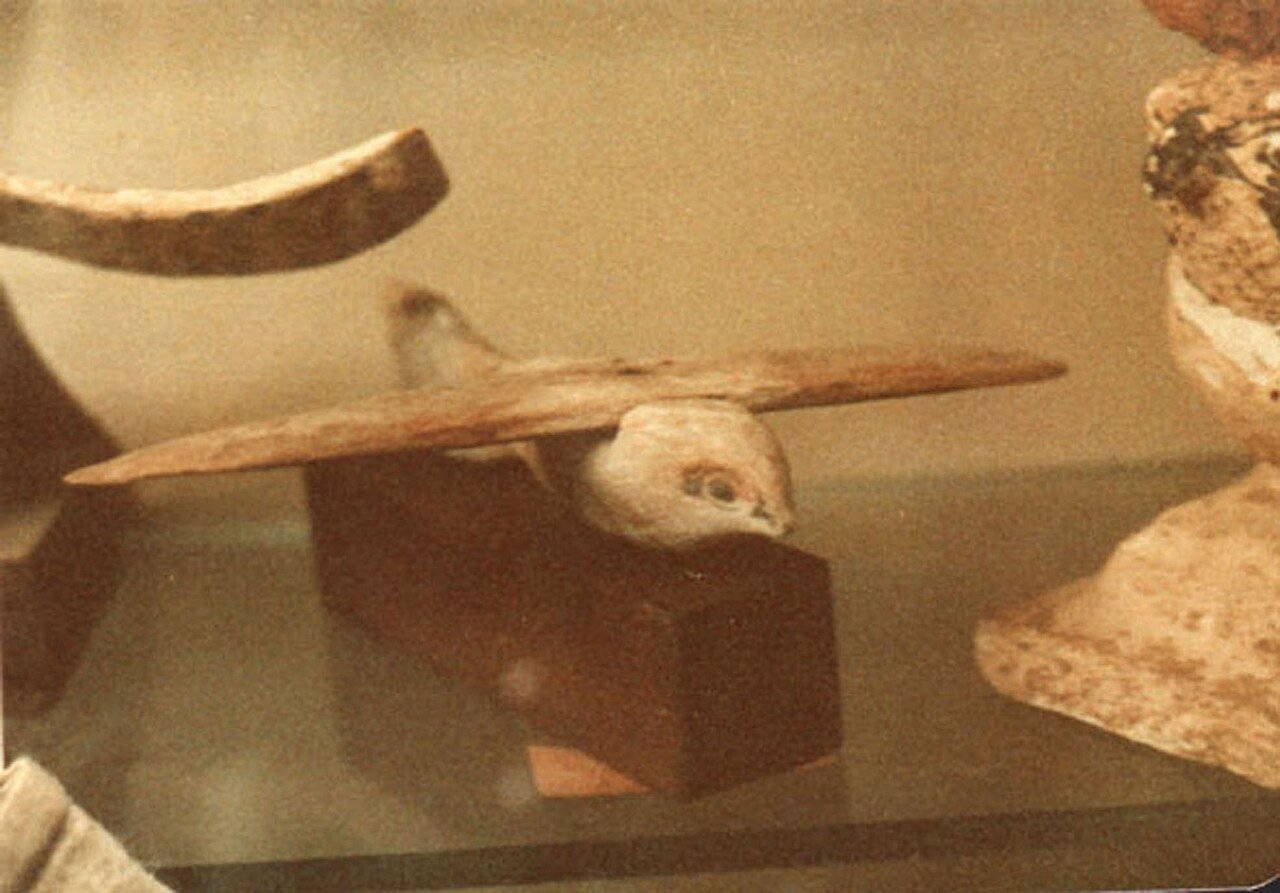
The artifact itself is carved from sycamore wood.
It resembles a bird with outstretched wings.
The body is streamlined, and the wings extend horizontally from either side.
Unlike most bird carvings from ancient Egypt, however, the Saqqara Bird possesses several unusual characteristics.
The wings appear relatively flat.
The tail is vertical rather than horizontal.
There are no detailed feathers carved into the wings.
The overall shape seems surprisingly aerodynamic.
These features led some observers to suggest that it resembles a modern aircraft more than a typical bird.
When viewed from certain angles, it can look remarkably similar to a glider.
This resemblance would eventually become the source of intense debate.
Was it merely a stylized bird?
Or was it something more?
The Rise of the Aviation Theory
The Saqqara Bird remained obscure until the twentieth century, when Egyptian physician and aviation enthusiast Dr. Khalil Messiha became interested in it.
Messiha believed the artifact was not simply a decorative bird.
Instead, he argued that it represented a model aircraft.
According to his interpretation, the object’s shape demonstrated an understanding of aerodynamic principles.
The streamlined body reminded him of an airplane fuselage.
The wings appeared designed to generate lift.
The vertical tail resembled the stabilizer found on modern aircraft.
Messiha became convinced that the artifact preserved evidence of ancient Egyptian knowledge of flight.
His theory attracted significant public attention.
The idea was thrilling.
If true, it would completely transform our understanding of ancient technology.
It suggested that aviation history might extend back more than two thousand years before the invention of modern airplanes.
For many people, the possibility was irresistible.
Why the Artifact Looks So Unusual
Part of the fascination surrounding the Saqqara Bird comes from its appearance.
Unlike many ancient bird carvings, it does not look exactly like a real bird.
Most birds have horizontal tail feathers.
The Saqqara Bird’s tail is vertical.
The wings are unusually straight and flat.
The body seems streamlined.
These characteristics make it easy to compare the artifact with modern aircraft.
Human brains naturally seek patterns.
When we see something that resembles a familiar object, we tend to interpret it through that lens.
Today, we live in a world filled with airplanes.
As a result, many modern observers immediately notice similarities between the Saqqara Bird and aviation technology.
Yet resemblance alone does not prove a connection.
A key challenge in archaeology is distinguishing between meaningful evidence and visual coincidence.
Ancient Egypt and the Dream of Flight
To evaluate the aviation theory fairly, it helps to ask an important question.
Did ancient Egyptians show any evidence of attempting human flight?
The answer is complicated.
Ancient Egyptians certainly observed birds carefully.
Birds played important roles in Egyptian religion, art, and mythology.
Many gods were associated with birds.
The sky itself held profound spiritual significance.
The god Horus, often depicted as a falcon, symbolized kingship and divine power.
Bird imagery appeared throughout Egyptian culture.
However, no known Egyptian texts describe flying machines.
No surviving documents discuss gliders.
No artwork clearly depicts aircraft.
No workshops, engineering plans, or aviation experiments have been discovered.
Given Egypt’s rich archaeological record, this absence of supporting evidence is significant.
If a sophisticated aviation tradition existed, researchers would expect to find additional clues.
So far, none have appeared.
Could the Saqqara Bird Actually Fly?
One of the most important questions concerns the object’s aerodynamics.
Could it fly?
Researchers have conducted various experiments using replicas of the artifact.
The results have been mixed.
Some replica models achieved short glides under specific conditions.
Others performed poorly.
A major problem involves stability.
Modern aircraft require careful balancing and control surfaces to maintain stable flight.
The Saqqara Bird lacks several features typically needed for efficient gliding.
In particular, many experts point out that the artifact lacks a horizontal tailplane.
This component plays a crucial role in stabilizing aircraft.
Without it, sustained flight becomes difficult.
Some supporters of the aviation theory argue that a missing tail component may once have existed and later broken off.
However, no direct evidence confirms this idea.
As a result, the question remains open to interpretation.
The Missing Tail Hypothesis
One of the central arguments made by proponents of the aviation theory involves a hypothetical missing piece.
According to this idea, the original artifact may have possessed a horizontal tail section that was lost over time.
If true, the completed design would look much more like a modern glider.
Some replica models built with reconstructed tailplanes have demonstrated improved flight characteristics.
These experiments are often cited as evidence that the ancient object was intended to fly.
However, critics raise an important objection.
The missing tail exists only as a hypothesis.
No surviving fragments support its existence.
No physical evidence shows that such a component was ever attached.
Without evidence, reconstructing the artifact based on modern expectations risks creating a circular argument.
Researchers may accidentally build an airplane because they already believe the object was meant to be one.
The Mainstream Archaeological View
Most Egyptologists reject the flying machine theory.
They view the Saqqara Bird as a stylized representation of a bird.
From their perspective, the artifact fits comfortably within the broader context of Egyptian art and symbolism.
Ancient Egyptian artists often created simplified or stylized forms.
Not every carving aimed for perfect realism.
Many objects emphasized symbolic meaning over anatomical accuracy.
The unusual tail and wing design may simply reflect artistic choices.
Some scholars suggest the object may have served as a toy.
Others believe it could have been a ceremonial item.
Still others interpret it as a weather vane, decorative ornament, or symbolic offering.
Importantly, these explanations align with what archaeologists know about Egyptian culture.
They require no lost technology or hidden aviation knowledge.
Understanding Ancient Toys
One possibility often overlooked is that the Saqqara Bird may have been a toy.
Children have always enjoyed toys.
Ancient civilizations were no exception.
Archaeologists have discovered numerous toys throughout Egyptian history, including dolls, miniature animals, wheeled objects, and game pieces.
A wooden bird would not be unusual.
In fact, its simple construction may support this interpretation.
If the artifact was designed to be thrown or played with, its aerodynamic shape could have arisen naturally.
Many toys accidentally display aerodynamic properties without being sophisticated aircraft models.
Paper airplanes provide a modern example.
Children often discover basic flight principles through play rather than scientific engineering.
The Saqqara Bird may represent something similar.
Birds in Egyptian Religion
To understand why a bird-shaped artifact might matter, we must examine Egyptian religion.
Birds held immense symbolic importance.
They connected Earth and sky.
They represented freedom, divine power, and spiritual transformation.
Certain birds were associated with specific gods.
Falcons symbolized Horus.
Ibises were linked to Thoth.
Vultures carried protective meanings.
The human soul itself was sometimes represented by a bird-like figure known as the ba.
This spiritual significance makes bird imagery extremely common in Egyptian culture.
The Saqqara Bird may therefore have possessed religious meaning rather than technological significance.
Its purpose could have been symbolic rather than practical.
Why Ancient Technology Theories Become Popular
The Saqqara Bird is not the only artifact linked to claims of advanced ancient technology.
Similar theories have emerged regarding pyramids, stone monuments, ancient maps, and various archaeological objects.
Why do such theories attract so much attention?
Partly because they offer excitement.
A simple wooden bird is interesting.
A secret ancient aircraft is extraordinary.
People naturally gravitate toward extraordinary possibilities.
These theories also appeal because they challenge conventional wisdom.
Many enjoy questioning accepted narratives.
The idea that history contains hidden secrets is deeply attractive.
It transforms archaeology into a detective story filled with mysteries waiting to be solved.
The Difference Between Possibility and Evidence
One of the most important lessons from the Saqqara Bird debate involves understanding the difference between possibility and evidence.
Many things are possible.
Ancient Egyptians may have observed aerodynamic principles.
They may have experimented with gliding objects.
They may have created toys that flew through the air.
These possibilities cannot be entirely ruled out.
However, possibility alone is not evidence.
Historical conclusions require supporting data.
Archaeologists rely on physical artifacts, written records, artwork, inscriptions, and contextual analysis.
The stronger the claim, the stronger the evidence must be.
A claim that ancient Egyptians possessed aviation technology is extraordinary.
Such a claim requires substantial supporting evidence.
At present, that evidence does not exist.
Experimental Archaeology and the Saqqara Bird
Experimental archaeology offers a fascinating way to study ancient objects.
Researchers create replicas and test how they function.
In the case of the Saqqara Bird, experiments have produced valuable insights.
Some replicas glide surprisingly well.
Others do not.
Small changes in weight distribution dramatically affect performance.
These experiments demonstrate that the artifact possesses certain aerodynamic qualities.
However, aerodynamic qualities alone do not prove it was designed as an aircraft model.
Many natural and artificial objects exhibit aerodynamic properties.
Seeds glide through the air.
Leaves drift on the wind.
Bird-shaped carvings may naturally generate lift under certain conditions.
The experiments are intriguing, but they do not provide definitive answers.
Could Ancient People Understand Aerodynamics?
An important question often gets overlooked.
Could ancient Egyptians have understood basic aerodynamic principles without inventing airplanes?
The answer is almost certainly yes.
People have observed flight for thousands of years.
Birds, insects, and seeds provide countless examples of aerodynamic behavior.
Ancient builders understood many practical engineering principles through observation and experimentation.
They did not need modern physics equations to recognize patterns in nature.
It is entirely possible that Egyptian craftsmen noticed how certain shapes moved through the air.
This would not require advanced aviation technology.
It would simply reflect careful observation of the natural world.
The Broader Context of Egyptian Engineering
Ancient Egypt was undoubtedly an impressive civilization.
Its engineers achieved remarkable feats.
They built pyramids, temples, obelisks, canals, and monumental statues.
They developed sophisticated techniques for stoneworking, construction, and transportation.
These accomplishments demonstrate extraordinary skill and ingenuity.
Yet none require knowledge of powered flight.
Sometimes people underestimate ancient achievements and then seek extraordinary explanations.
In reality, Egyptian accomplishments are already astonishing.
Their engineering successes stand on their own without requiring hidden aircraft technology.
The Problem of Missing Supporting Evidence
One of the strongest arguments against the flying machine theory involves the absence of supporting evidence.
Technological systems rarely exist in isolation.
If ancient Egyptians possessed aviation technology, researchers would expect related evidence.
There would likely be tools, workshops, diagrams, texts, or multiple models.
There might be artistic depictions showing aircraft in use.
There could be references in literature or religious texts.
Instead, the Saqqara Bird stands almost entirely alone.
When evaluating historical claims, context matters.
A single ambiguous artifact is rarely enough to rewrite history.
Ancient Aviation in Other Cultures
The Saqqara Bird is not unique in inspiring aviation theories.
Artifacts from other ancient cultures have sparked similar debates.
Some small gold objects from pre-Columbian South America have been compared to airplanes.
Certain mythological stories describe flying beings or celestial vehicles.
These examples reveal a recurring pattern.
People often interpret ancient objects through the lens of modern technology.
This does not necessarily mean ancient civilizations possessed those technologies.
Instead, it reflects our tendency to see familiar ideas in unfamiliar artifacts.
What the Saqqara Bird Teaches Us
Regardless of its original purpose, the Saqqara Bird teaches an important lesson about archaeology.
Artifacts do not speak for themselves.
Their meanings must be interpreted.
Different people can examine the same object and reach very different conclusions.
The challenge is determining which explanation best fits the available evidence.
This process requires patience, critical thinking, and a willingness to question assumptions.
The Saqqara Bird reminds us that history is not merely about discovering objects.
It is also about understanding them.
The Mystery That Refuses to Disappear
More than a century after its discovery, the Saqqara Bird continues to inspire debate.
New generations encounter photographs of the artifact and wonder whether it represents something extraordinary.
The mystery persists because the object occupies a fascinating middle ground.
It is unusual enough to provoke questions.
Yet it is ambiguous enough to resist definitive answers.
This combination keeps curiosity alive.
People continue examining it, testing replicas, and proposing new interpretations.
The discussion itself has become part of the artifact’s legacy.
Fact, Fiction, or Misunderstood Artifact?
So where does the evidence lead?
The most likely explanation is that the Saqqara Bird was not a model of an advanced flying machine.
Most experts view it as a stylized bird-shaped object, possibly a toy, ceremonial item, or symbolic artifact.
There is currently no convincing evidence that ancient Egyptians possessed aviation technology comparable to modern aircraft.
At the same time, the artifact remains genuinely intriguing.
Its unusual shape invites investigation.
Its aerodynamic characteristics are worthy of study.
Its mystery encourages people to engage with archaeology and ancient history.
Perhaps the true significance of the Saqqara Bird lies not in proving the existence of ancient aircraft but in reminding us how much we still have to learn about the past.
Conclusion
The Saqqara Bird is one of archaeology’s most fascinating and misunderstood artifacts. Discovered in an ancient Egyptian tomb and carved from wood more than two thousand years ago, it has inspired theories ranging from simple religious symbolism to evidence of forgotten aviation technology.
Its shape certainly raises interesting questions. The streamlined body, straight wings, and unusual tail have led some observers to compare it with modern aircraft. Experimental replicas have demonstrated that it possesses certain aerodynamic qualities, adding to the intrigue.
Yet when all available evidence is examined, the case for ancient Egyptian flying machines remains weak. No texts, diagrams, workshops, or additional artifacts support the existence of an aviation tradition. Most archaeologists conclude that the Saqqara Bird was likely a stylized bird, a toy, or a symbolic object connected to Egyptian culture and religion.
Still, the artifact continues to captivate people around the world. It reminds us that the ancient world was filled with creativity, ingenuity, and mystery. It challenges us to ask questions while also demanding careful evidence before accepting extraordinary claims.
Whether it was a toy, a religious symbol, or simply an artistic creation, the Saqqara Bird has achieved something remarkable. A small wooden object discovered in a forgotten tomb has sparked a conversation that continues more than a century later. And perhaps that enduring mystery is what makes the Saqqara Bird truly unforgettable.