For more than a century, one mysterious Egyptian artifact has terrified visitors, inspired ghost stories, appeared in newspapers, and fueled countless conspiracy theories. It has been blamed for mysterious deaths, unexplained accidents, financial ruin, strange illnesses, and even one of the greatest maritime disasters in history.
Many people know it simply as “The Cursed Mummy.”
According to the legend, everyone who came into contact with the ancient Egyptian coffin suffered terrible misfortune. Wealthy collectors supposedly died shortly after acquiring it. Photographers were said to lose their lives after taking its picture. Museum workers allegedly became ill for no apparent reason. Some stories even claimed the artifact boarded the RMS Titanic in 1912, bringing disaster to the famous ship before it struck an iceberg.
The story is chilling.
It is dramatic.
And it is one of the world’s most famous museum legends.
But there is one major problem.
Almost none of it is true.
The so-called “Cursed Mummy” is not even a mummy.
The famous object never sailed aboard the Titanic.
Most of the frightening stories appeared years after the artifact reached the British Museum, growing larger and more mysterious each time they were retold.
Yet despite overwhelming historical evidence, millions of people still believe the curse is real.
So how did an ordinary Egyptian coffin lid become one of history’s greatest supernatural mysteries?
The answer takes us into Victorian Britain, the golden age of archaeology, ancient Egyptian religion, sensational journalism, spiritualism, and the remarkable power of human imagination.
The real history is every bit as fascinating as the legend.
What Is the “Cursed Mummy”?
One of the biggest misconceptions begins with the artifact itself.
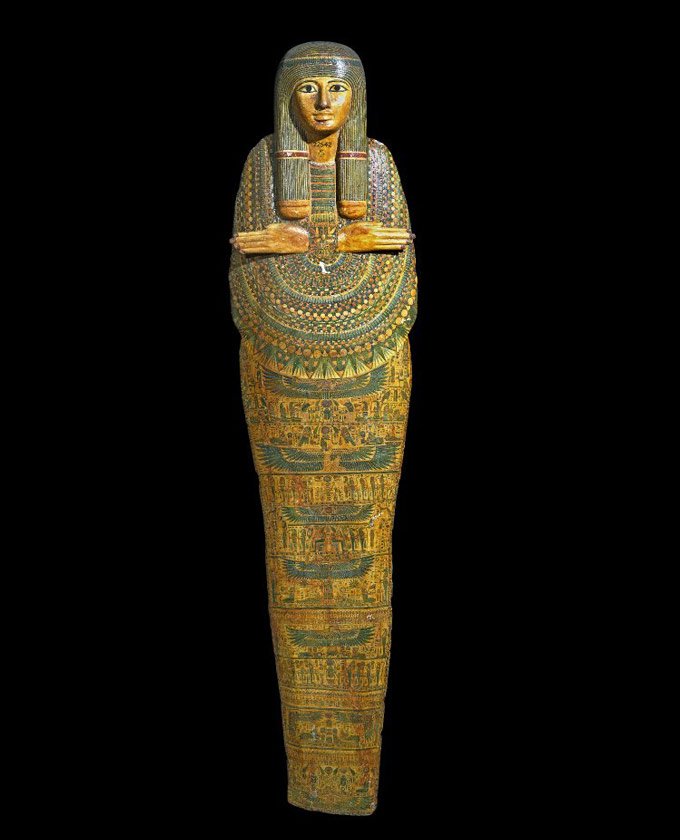
The famous object is not a mummy.
It is not even a complete coffin.
Instead, it is an elaborately decorated inner coffin lid, often called a coffin board.
The artifact belonged to an ancient Egyptian woman whose identity remains uncertain.
The inscriptions have been damaged, making her name difficult to determine with complete confidence.
She probably lived during Egypt’s Twenty-First or Twenty-Second Dynasty, roughly between 950 and 900 BCE.
The beautifully painted wooden coffin lid once covered her mummy, but the mummy itself has never been part of the British Museum’s collection.
Despite this, newspapers and popular writers repeatedly referred to the object as a mummy, and the misleading name remained.
Today, it continues to be known worldwide as the “Unlucky Mummy” or the “Cursed Mummy.”
Ancient Egypt’s Fascination With the Afterlife
To understand why the legend became so powerful, we first need to understand ancient Egyptian beliefs.
The Egyptians devoted enormous effort to preparing for life after death.
They believed death was not an ending but a transition.
A person’s soul needed a preserved body, magical protection, food offerings, prayers, and proper burial rituals.
Mummification helped preserve the body.
Decorated coffins protected the deceased.
Funerary texts guided the soul through the afterlife.
Amulets offered magical protection.
Tombs contained possessions believed useful beyond death.
Because burial held such sacred importance, disturbing ancient tombs naturally carried emotional and spiritual significance.
Although ancient Egyptians sometimes included protective inscriptions, these were usually intended to safeguard the deceased rather than punish future archaeologists.
Popular culture later exaggerated these beliefs into terrifying supernatural curses.
The Arrival in Victorian Britain
The famous coffin lid reached Britain during the nineteenth century.
This was an era when Egypt fascinated Europe.
Napoleon’s Egyptian campaign had introduced many Europeans to the wonders of ancient civilization.
Later archaeological discoveries created enormous public excitement.
Museums eagerly collected Egyptian antiquities.
Wealthy travelers purchased artifacts during visits to Egypt.
Private collections filled with statues, mummies, jewelry, and coffins became fashionable.
The British Museum acquired the coffin lid in 1889.
It entered the museum like thousands of other Egyptian artifacts.
Nothing unusual happened.
There were no immediate reports of mysterious deaths.
No supernatural incidents appeared in museum records.
The curse had not yet been invented.
The Birth of the Curse
So where did the frightening stories come from?
Most appeared years later.
Victorian society had developed a growing fascination with ghosts, séances, spiritualism, fortune tellers, and supernatural mysteries.
Newspapers quickly realized frightening stories sold newspapers.
Writers combined ancient Egypt’s mysterious reputation with popular ghost stories.
Gradually, rumors began circulating.
The coffin lid supposedly brought bad luck.
Owners allegedly suffered accidents.
Friends supposedly died unexpectedly.
Every coincidence became part of the growing legend.
As the story spread, new details appeared.
Each retelling made the curse even more terrifying.
The Story of the Four Friends
One famous legend claimed that four wealthy Englishmen purchased the coffin in Egypt.
According to the story, one disappeared into the desert.
Another accidentally shot himself.
A third lost his fortune.
The fourth became seriously ill.
The tale sounds dramatic.
Unfortunately, historians have never found reliable evidence that these events actually occurred.
No contemporary records support the account.
Researchers believe the story evolved through repeated retelling rather than historical fact.
Like many urban legends, it became more elaborate over time.
Strange Museum Accidents
The legend soon expanded.
Museum workers supposedly refused to approach the artifact.
Night guards allegedly reported mysterious sounds.
Visitors claimed the painted face seemed to change expression.
Photographers experienced technical problems.
Some employees reportedly became ill.
Again, careful investigation reveals little supporting evidence.
Large museums naturally experience occasional accidents, illnesses, and equipment failures.
Once people began believing the coffin was cursed, ordinary events became interpreted through that belief.
Psychologists call this confirmation bias.
People notice events supporting an existing belief while overlooking everything that contradicts it.
The Famous Photograph
Another story claimed a photographer took a picture of the coffin.
After developing the photograph, he supposedly became convinced the painted face looked frighteningly alive.
Soon afterward, the photographer allegedly died.
Like many curse stories, the details change depending on who tells it.
No reliable historical documentation confirms the event.
Photography during the nineteenth century frequently produced unusual lighting effects, blurred images, and unexpected shadows.
Such imperfections easily fueled supernatural interpretations.
Spiritualism and Victorian Society
To understand why these stories became so popular, we must remember the social atmosphere of Victorian Britain.
Spiritualism had become enormously fashionable.
People attended séances hoping to communicate with the dead.
Mediums claimed to receive messages from spirits.
Ghost stories appeared regularly in newspapers.
Scientific discoveries were transforming society.
Many people struggled to reconcile modern science with traditional beliefs.
Ancient Egypt, filled with mysterious tombs and unfamiliar symbols, seemed perfectly suited for supernatural speculation.
The cursed mummy fit naturally into this cultural environment.
Ancient Egyptian Curses
Did ancient Egyptians actually place curses on tombs?
Sometimes.
However, reality differs greatly from Hollywood movies.
A few tomb inscriptions warned against disturbing burials.
These warnings often appealed to divine judgment rather than magical revenge.
For example, an inscription might ask the gods to punish someone who desecrated a tomb.
Such texts were relatively uncommon.
Most Egyptian tombs contain prayers, religious texts, and protective spells intended to help the deceased—not frighten future archaeologists.
The modern idea that every Egyptian mummy carries a deadly supernatural curse is largely a product of fiction.
The Discovery of Tutankhamun
Although unrelated to the British Museum artifact, another famous event dramatically strengthened belief in mummy curses.
In 1922, archaeologist Howard Carter discovered the tomb of Pharaoh Tutankhamun.
Several people associated with the excavation later died from various causes.
Newspapers quickly connected these unrelated deaths.
Headlines declared the “Curse of the Pharaohs” had claimed more victims.
In reality, most expedition members lived for many years afterward.
Howard Carter himself survived until 1939, nearly seventeen years after opening the tomb.
Nevertheless, the sensational reporting fueled public fascination with Egyptian curses.
The British Museum’s “Unlucky Mummy” became even more famous.
The Titanic Myth
Perhaps the most persistent myth claims the cursed mummy traveled aboard the RMS Titanic.
According to the story, the artifact was being transported to America when the ship struck an iceberg and sank.
The curse supposedly caused one of history’s greatest maritime disasters.
The story is entirely false.
Museum records clearly show the coffin lid never left the British Museum.
It certainly was not aboard the Titanic.
Historians have repeatedly demonstrated this.
Yet the myth continues circulating online, in books, and on television.
It illustrates how powerful legends can become even when contradicted by overwhelming evidence.
Why People Believed the Titanic Story
The Titanic disaster shocked the world.
People naturally searched for explanations beyond simple human error and natural events.
The idea of an ancient Egyptian curse offered a dramatic narrative.
It transformed a tragic accident into a mysterious supernatural event.
Stories connecting famous disasters with mysterious artifacts often spread rapidly because they satisfy our desire for meaningful explanations.
Psychologists recognize this tendency across many cultures.
Humans naturally search for patterns, even when none exist.
The Artifact Itself
When visitors see the famous coffin lid today, many express surprise.
Rather than appearing frightening, it is beautifully crafted.
The painted face displays calm dignity.
Delicate artistic details cover the wooden surface.
Hieroglyphic inscriptions surround the figure.
Ancient Egyptian artists created the coffin not to frighten future generations but to honor the deceased.
Its beauty reflects remarkable craftsmanship developed more than three thousand years ago.
Seen in person, the artifact inspires admiration more than fear.
The Woman Behind the Coffin
One of the saddest aspects of the curse legend is that it often overshadows the individual whose coffin once protected her.
She was a real person.
She lived in ancient Egypt.
She had a family, beliefs, hopes, and fears.
She likely expected careful burial rituals to ensure eternal life.
Although historians cannot reconstruct her biography in detail, archaeological evidence suggests she belonged to Egypt’s priestly class.
The coffin reflects respect, artistry, and religious devotion.
Rather than remembering her only through frightening legends, modern archaeology encourages us to appreciate her historical humanity.
Scientific Investigation
Researchers have carefully examined the coffin using modern scientific methods.
Wood analysis identifies construction materials.
Pigment studies reveal ancient painting techniques.
Radiocarbon dating helps confirm its age.
Conservation experts monitor its condition.
Nothing unusual has been discovered.
The coffin behaves exactly like thousands of similar Egyptian artifacts.
It shows no mysterious properties.
Its greatest value lies in its historical significance rather than supernatural claims.
Why Curse Stories Spread
Curse legends follow predictable patterns.
An unusual object appears.
A coincidence occurs.
Someone connects the two.
The story spreads.
Later storytellers add dramatic details.
Contradictory evidence disappears.
Eventually the legend becomes far more famous than the actual history.
This process has occurred repeatedly around the world.
Ancient artifacts, abandoned houses, mysterious forests, and historical tragedies frequently become associated with supernatural stories.
The British Museum’s “Cursed Mummy” represents one of history’s best-known examples.
Psychology and the Power of Belief
Human psychology plays an important role in understanding curse legends.
If people expect something frightening to happen, ordinary events suddenly appear extraordinary.
A minor illness feels significant.
A broken camera becomes mysterious.
An unexpected coincidence seems impossible to ignore.
Scientists refer to this as expectation bias.
Belief influences perception.
This does not mean people invent experiences intentionally.
Rather, the human brain naturally searches for meaningful connections.
Understanding this tendency helps explain why curse stories remain persuasive.
The Role of Newspapers
Sensational journalism played a major role in spreading the mummy legend.
Victorian newspapers competed intensely for readers.
Strange stories attracted attention.
A simple museum acquisition generated little excitement.
A cursed Egyptian coffin bringing death and disaster sold newspapers.
Writers often repeated rumors without careful verification.
Over time, speculation became accepted as fact.
The same process continues today through social media, where dramatic stories often spread faster than accurate information.
Hollywood and Popular Culture
Movies greatly strengthened belief in mummy curses.
Beginning in the early twentieth century, filmmakers portrayed ancient Egyptian mummies as supernatural monsters.
These fictional stories became enormously popular.
Audiences naturally connected movie plots with real archaeological discoveries.
Although entertaining, these films bear little resemblance to ancient Egyptian beliefs or historical evidence.
The British Museum artifact benefited from this growing fascination.
Each new mummy movie renewed interest in the famous curse.
What Modern Egyptologists Say
Professional Egyptologists overwhelmingly reject claims that the British Museum artifact is cursed.
Museum records contain no evidence supporting supernatural stories.
Historical research has traced many legends to newspaper reports, hearsay, and later embellishments.
Scholars emphasize that ancient Egyptian funerary practices deserve respect as cultural traditions.
However, there is no credible evidence that the coffin possesses paranormal powers.
Its significance lies in archaeology, history, religion, and art.
The Artifact Today
Today the famous coffin lid remains one of the British Museum’s most recognized Egyptian objects.
Visitors continue arriving with curiosity.
Some hope to experience something mysterious.
Others simply admire its artistic beauty.
Museum staff present the artifact within its historical context.
Rather than promoting supernatural myths, they encourage visitors to appreciate ancient Egyptian craftsmanship and culture.
Ironically, the legend has helped preserve public interest in Egyptian archaeology.
Why the Legend Refuses to Die
Even after decades of careful historical research, the curse story remains remarkably popular.
Why?
Because humans love mysteries.
Facts satisfy curiosity.
Legends ignite imagination.
A beautifully painted coffin is historically important.
A cursed coffin responsible for mysterious deaths feels unforgettable.
Stories appealing to emotion spread more easily than careful historical analysis.
This explains why myths sometimes survive long after evidence disproves them.
The British Museum’s “Cursed Mummy” perfectly illustrates this phenomenon.
Separating Fact From Fiction
The true history becomes clear when evidence is examined carefully.
The artifact is a decorated coffin lid rather than a mummy.
It entered the British Museum in 1889.
It never traveled aboard the Titanic.
No reliable historical records confirm the dramatic deaths commonly associated with it.
Most famous curse stories appeared only after sensational journalism popularized them.
The object itself remains an extraordinary example of ancient Egyptian funerary art.
Its real story is fascinating enough without supernatural additions.
Conclusion
The legend of the Cursed Mummy of the British Museum has captivated imaginations for well over a century. Filled with tales of mysterious deaths, strange accidents, haunted photographs, and even the sinking of the Titanic, it has become one of the world’s most famous archaeological mysteries. Yet careful historical research reveals that the legend is far more fictional than factual.
The famous object is not actually a mummy but a beautifully painted inner coffin lid dating to ancient Egypt’s Twenty-First or Twenty-Second Dynasty. It has remained safely in the British Museum since 1889, never traveling aboard the Titanic and never producing any documented series of supernatural disasters. Most of the frightening stories surrounding it emerged gradually through sensational newspaper reports, popular books, Victorian fascination with spiritualism, and later Hollywood films that blurred the line between entertainment and history.
Far from being an object of fear, the coffin represents the remarkable artistic skill, religious beliefs, and cultural traditions of ancient Egypt. It reminds us that the people who created it deeply respected the dead and believed in an afterlife that required careful preparation and protection. Behind the famous legend stood a real woman whose life has largely been overshadowed by myths invented thousands of years after her death.
Perhaps the greatest lesson of the Cursed Mummy is not about ancient magic but about human nature itself. We are storytellers. We seek mystery, connect coincidences, and often prefer dramatic legends to ordinary facts. The enduring popularity of the curse reveals as much about modern society as it does about ancient Egypt.
In the end, the greatest mystery is not whether the British Museum’s coffin is cursed. The evidence strongly suggests it is not. The real mystery is how one ancient funerary artifact became one of the most famous supernatural legends in the world—a reminder that sometimes the stories people create can become just as powerful as history itself.