Some ghost stories begin with abandoned castles. Others start in forgotten graveyards hidden beneath ancient trees. But one of England’s most enduring supernatural legends centers on something much smaller—and far more unsettling.
It is only a human skull.
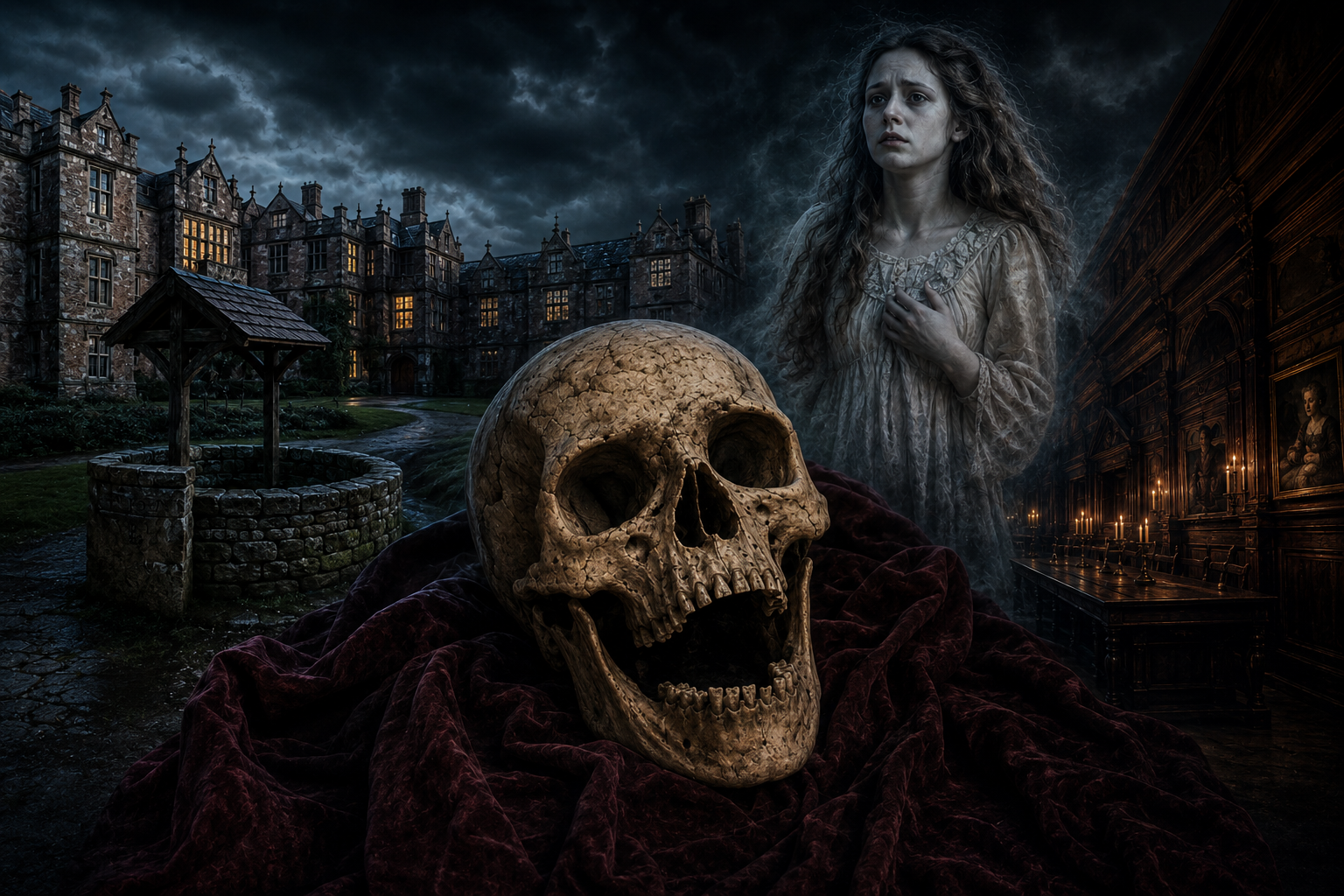
For centuries, visitors to Burton Agnes Hall, an elegant Elizabethan manor house in the English countryside, have whispered about a strange object kept inside the building. According to local legend, this skull belongs to a young woman whose dying wish was ignored. Ever since, people claim that anyone who tries to remove the skull from the house is met with terrifying screams, mysterious noises, unexplained disturbances, and overwhelming misfortune.
The story has become known as The Screaming Skull of Burton Agnes Hall, one of Britain’s most famous haunted legends.
Unlike many ghost stories that have changed dramatically over time, the central tale has remained surprisingly consistent. A young woman suffers a violent attack. As she lies dying, she asks that her head be buried within the home she loves. Her family refuses. Instead, she is buried in a churchyard. Soon afterward, strange screams echo through the house every night until her skull is brought back.
It is a haunting tale of love, grief, unfinished wishes, and the powerful role that folklore plays in preserving local history.
But how much of the story is actually true?
Did the mysterious screams really happen?
Does the skull truly belong to the young woman in the legend?
Has science investigated these claims?
And why has this eerie tale survived for more than four hundred years?
The real story is every bit as fascinating as the legend itself. It combines documented history, local tradition, archaeology, psychology, and centuries of storytelling into one of England’s most remarkable ghost stories.
Where Is Burton Agnes Hall?
Burton Agnes Hall is located in the East Riding of Yorkshire in northern England.
It is considered one of the finest surviving Elizabethan manor houses in Britain.
Construction began around 1598 under Sir Henry Griffith and was largely completed during the early seventeenth century.
Today the hall remains privately owned and is open to visitors during much of the year.
Its beautifully preserved architecture, gardens, artwork, and historical collections attract thousands of tourists annually.
Yet for many visitors, it is not only the elegant building that captures their imagination.
It is the mysterious skull hidden inside.
The legend has become inseparable from the history of Burton Agnes Hall itself.
The Beginning of the Legend
According to local tradition, the story begins with three sisters.
Their names are usually given as Anne, Mary, and Katherine Griffith.
The exact historical details differ slightly depending on the version of the legend, but the basic narrative has remained remarkably stable.
One day, while traveling near the family estate, the youngest sister, Anne, encountered several highwaymen.
Highway robbery was a genuine danger in England during earlier centuries.
Travelers carrying money or valuable possessions often became targets.
According to the legend, Anne resisted the robbers.
In response, one of the attackers struck her violently on the head.
Although she survived the assault initially, her injuries proved fatal.
She was carried back to her family home, where she slowly died.
Anne’s Final Wish
As Anne realized she would not recover, she made one unusual request.
She asked her sisters to ensure that her head would remain inside the home she loved forever.
Some versions say she specifically requested that her skull be placed within the walls of the new house.
Others simply state that she wanted her head to remain at Burton Agnes.
Exactly why she made this request remains unknown.
Perhaps she feared being separated from her family.
Perhaps she believed her spirit would never find peace otherwise.
Or perhaps the unusual wish was added later as the legend evolved.
Whatever the reason, her dying request became the foundation of the entire story.
The Wish That Was Ignored
After Anne died, her family buried her in the local churchyard, following normal Christian customs.
They ignored her strange final request.
At first, everything seemed normal.
Then, according to the legend, terrifying events began.
Every night, the house echoed with horrifying screams.
Doors slammed without explanation.
Furniture shook.
Unseen footsteps moved through empty rooms.
Family members found themselves unable to sleep.
The disturbances became so frightening that everyone living in the house believed something supernatural had taken hold.
Nothing seemed capable of stopping the nightly disturbances.
The Return of the Skull
Eventually, according to the story, the family reached a remarkable conclusion.
Anne’s final wish had to be fulfilled.
Her grave was opened.
Her skull was removed.
It was brought back to Burton Agnes Hall and hidden inside the house.
Almost immediately, the mysterious screams stopped.
Peace returned.
From that day onward, the legend claims, the skull has remained inside the hall.
Whenever someone attempts to remove it, strange disturbances supposedly begin again.
The message of the story is clear.
Anne’s final wish must never be ignored.
Is Anne Griffith a Historical Figure?
Unlike many ghost stories involving entirely fictional characters, Anne Griffith may have been inspired by a real historical person.
Members of the Griffith family certainly lived in Burton Agnes during the late sixteenth century.
Historical records confirm that the Griffith family owned the estate before Burton Agnes Hall was completed.
However, evidence directly confirming every part of Anne’s story is lacking.
No surviving contemporary records describe the alleged attack by highwaymen.
No official documents record her unusual burial request.
Like many legends passed through oral tradition, historical facts and later storytelling likely became intertwined.
Historians therefore distinguish between the documented history of the Griffith family and the folklore surrounding Anne.
The Skull Itself
One of the most intriguing aspects of the legend is that an actual human skull exists inside Burton Agnes Hall.
Visitors have been shown the skull for many years.
Its presence gives the legend unusual credibility compared with ghost stories involving invisible spirits alone.
However, an important mystery remains.
No one knows with certainty whose skull it actually is.
Although tradition identifies it as Anne Griffith’s, definitive scientific proof has never established its identity.
The skull’s true origin remains uncertain.
This uncertainty only deepens the mystery.
Scientific Examination
Modern researchers have examined the skull.
Scientific analysis suggests that it belonged to a real human being.
However, determining exactly who that person was is extremely difficult.
Centuries have passed.
Reliable burial records are limited.
Without confirmed DNA from known descendants or securely identified remains, assigning the skull to Anne Griffith is impossible.
Researchers therefore remain cautious.
The skull is genuine.
Its identity remains unknown.
Could the Skull Have Come From Somewhere Else?
Some historians suggest the skull may not be connected with Anne at all.
Human remains were occasionally disturbed during construction projects, church renovations, or cemetery relocations.
It is possible that the skull originated from another burial entirely.
Over generations, local storytelling may have attached it to the tragic tale of Anne Griffith.
This process is common in folklore.
Objects often acquire legendary identities as stories evolve through repeated retelling.
The Tradition of Screaming Skulls
Burton Agnes Hall is not unique.
England contains several legends involving so-called “screaming skulls.”
In these stories, removing a skull from its proper resting place supposedly causes supernatural disturbances.
Sometimes houses shake.
Sometimes terrifying screams are heard.
Sometimes misfortune follows those responsible.
The Burton Agnes legend is simply the most famous example.
Folklore experts believe these stories may reflect ancient beliefs about respecting the dead.
Rather than literal historical events, they often function as cautionary tales about disturbing human remains.
Why Do So Many Cultures Respect Human Remains?
Across the world, human remains have long been treated with extraordinary respect.
Ancient Egyptians carefully preserved bodies through mummification.
Many Indigenous cultures maintain sacred burial traditions.
Religions around the world emphasize respectful treatment of the dead.
These customs reflect universal human emotions.
Families want loved ones remembered.
Communities honor ancestors.
Disturbing graves often evokes discomfort even today.
The legend of the Screaming Skull fits naturally within these broader cultural traditions.
Could the Screams Have Been Real?
This question has fascinated visitors for centuries.
If screams truly occurred, several natural explanations are possible.
Old houses produce countless unusual sounds.
Wood expands and contracts as temperatures change.
Wind passing through narrow openings creates eerie whistles.
Animals living inside walls or attics generate unexpected noises.
Loose beams creak under shifting weight.
At night, when everything else is quiet, ordinary sounds often seem mysterious.
Stress, fear, and expectation can also heighten awareness of ambiguous noises.
None of this proves the legend false.
It simply demonstrates that unusual sounds need not require supernatural causes.
The Psychology of Haunted Places
Human psychology plays an important role in ghost stories.
When people expect a location to be haunted, they naturally pay closer attention to unfamiliar experiences.
Small creaks become footsteps.
Shadows appear threatening.
Ordinary noises seem significant.
Psychologists call this expectation bias.
It does not mean people are lying.
Rather, expectations genuinely influence perception.
Historic buildings naturally contain many unfamiliar sights and sounds.
Combined with a powerful legend, these environments easily stimulate the imagination.
Why Ghost Stories Survive
Ghost stories rarely survive for centuries unless they speak to something deeply human.
The Screaming Skull legend is ultimately about more than supernatural events.
It tells a story of a dying wish ignored.
It explores grief.
It emphasizes loyalty to family.
It warns against disrespecting the dead.
It suggests promises should be honored.
These emotional themes explain why the legend continues captivating audiences long after its historical origins became uncertain.
Burton Agnes Hall Today
Today Burton Agnes Hall embraces its fascinating history while presenting the legend responsibly.
Visitors come not only to admire its beautiful architecture but also to learn about the famous skull.
The hall presents the story as part of its historical folklore rather than established historical fact.
This balanced approach allows visitors to appreciate both the documented history and the enduring legend.
The house itself remains one of England’s finest preserved Elizabethan manor homes.
Its collections include paintings, furniture, decorative arts, and gardens in addition to the mysterious skull.
Folklore Versus History
Understanding the Screaming Skull requires distinguishing folklore from historical evidence.
History relies upon documents, archaeology, scientific analysis, and contemporary records.
Folklore depends upon stories passed between generations.
Neither is without value.
Historical evidence helps reconstruct actual events.
Folklore reveals how communities understand themselves.
Legends express cultural values, fears, hopes, and moral lessons.
Even if every supernatural element proved fictional, the legend would still possess enormous cultural significance.
The Influence on Popular Culture
Stories about screaming skulls have inspired countless books, documentaries, ghost tours, podcasts, television programs, and paranormal investigations.
The Burton Agnes legend frequently appears in collections of Britain’s greatest ghost stories.
Writers continue reimagining the tale for modern audiences.
Its combination of tragedy, mystery, and supernatural possibility makes it especially memorable.
Unlike many horror stories relying on violence alone, this legend possesses emotional depth.
At its heart lies a simple request that may—or may not—have been ignored.
What Archaeologists Say
Professional archaeologists generally approach the legend with caution.
They acknowledge the historical importance of the hall and the authenticity of the skull itself.
However, they distinguish carefully between physical evidence and oral tradition.
At present, archaeology cannot confirm that the skull belonged to Anne Griffith.
Nor can archaeology test claims regarding supernatural screams.
Instead, researchers focus on understanding the cultural context surrounding the legend.
This evidence-based approach allows folklore and archaeology to complement rather than contradict one another.
Why People Continue Visiting
Thousands of visitors travel to Burton Agnes Hall every year.
Some come because they enjoy historic architecture.
Others appreciate beautiful gardens.
Many simply want to see the famous skull.
Whether visitors believe in ghosts varies greatly.
Some arrive hoping for paranormal experiences.
Others come purely out of historical curiosity.
Nearly everyone leaves appreciating the remarkable way history and folklore have become intertwined within a single place.
The Enduring Mystery
Perhaps the greatest strength of the Screaming Skull legend is that it cannot be fully solved.
The skull exists.
The Griffith family existed.
Burton Agnes Hall exists.
Yet the connections between them remain partly hidden.
No document records Anne’s final request.
No scientific test identifies the skull beyond doubt.
No recording captures the mysterious screams.
The unanswered questions allow every generation to revisit the story with fresh curiosity.
That uncertainty keeps the legend alive.
Why the Legend Matters
The Screaming Skull is more than a ghost story.
It reminds us that history is shaped not only by kings and battles but also by ordinary human emotions.
Love for home.
Promises made to family.
Respect for the dead.
Fear of the unknown.
These feelings remain universal.
Whether Anne Griffith truly existed exactly as the legend describes almost becomes secondary.
Her story represents countless people whose memories survive through storytelling rather than official records.
Folklore preserves emotional truths even when historical details remain uncertain.
Conclusion
The legend of the Screaming Skull of Burton Agnes Hall remains one of England’s most captivating supernatural stories because it exists at the fascinating intersection of history, archaeology, folklore, and human imagination. At its center is a real Elizabethan manor house, a genuine human skull, and a centuries-old tradition claiming that the spirit of a young woman demanded her final wish be honored. While historical evidence confirms the existence of the Griffith family and the skull itself, no definitive proof establishes that the remains belonged to Anne Griffith or that terrifying screams ever echoed through the halls.
Modern historians and archaeologists approach the legend with careful skepticism, distinguishing documented facts from oral tradition. Scientific examination has helped answer some questions while leaving others unresolved. The skull is authentic, but its identity remains uncertain. The famous haunting belongs to folklore rather than verifiable historical record.
Yet this uncertainty is precisely what gives the story its lasting power. The legend speaks to universal themes of love, loss, remembrance, promises, and respect for the dead. It reminds us that people throughout history have searched for ways to explain grief, preserve memory, and make sense of unexplained experiences. Whether viewed as a genuine haunting, a symbolic tale, or a fascinating piece of English folklore, the Screaming Skull continues to inspire curiosity more than four centuries after the story first began to spread.
Today, Burton Agnes Hall stands not only as one of England’s finest Elizabethan houses but also as the guardian of one of Britain’s most enduring mysteries. Visitors may come seeking ghosts, but they often leave with something even more meaningful—a deeper appreciation of how history and legend can become so closely intertwined that separating one from the other is almost impossible. And perhaps that is the true mystery of the Screaming Skull: not whether it ever screamed, but why its story continues to echo so powerfully through the centuries.