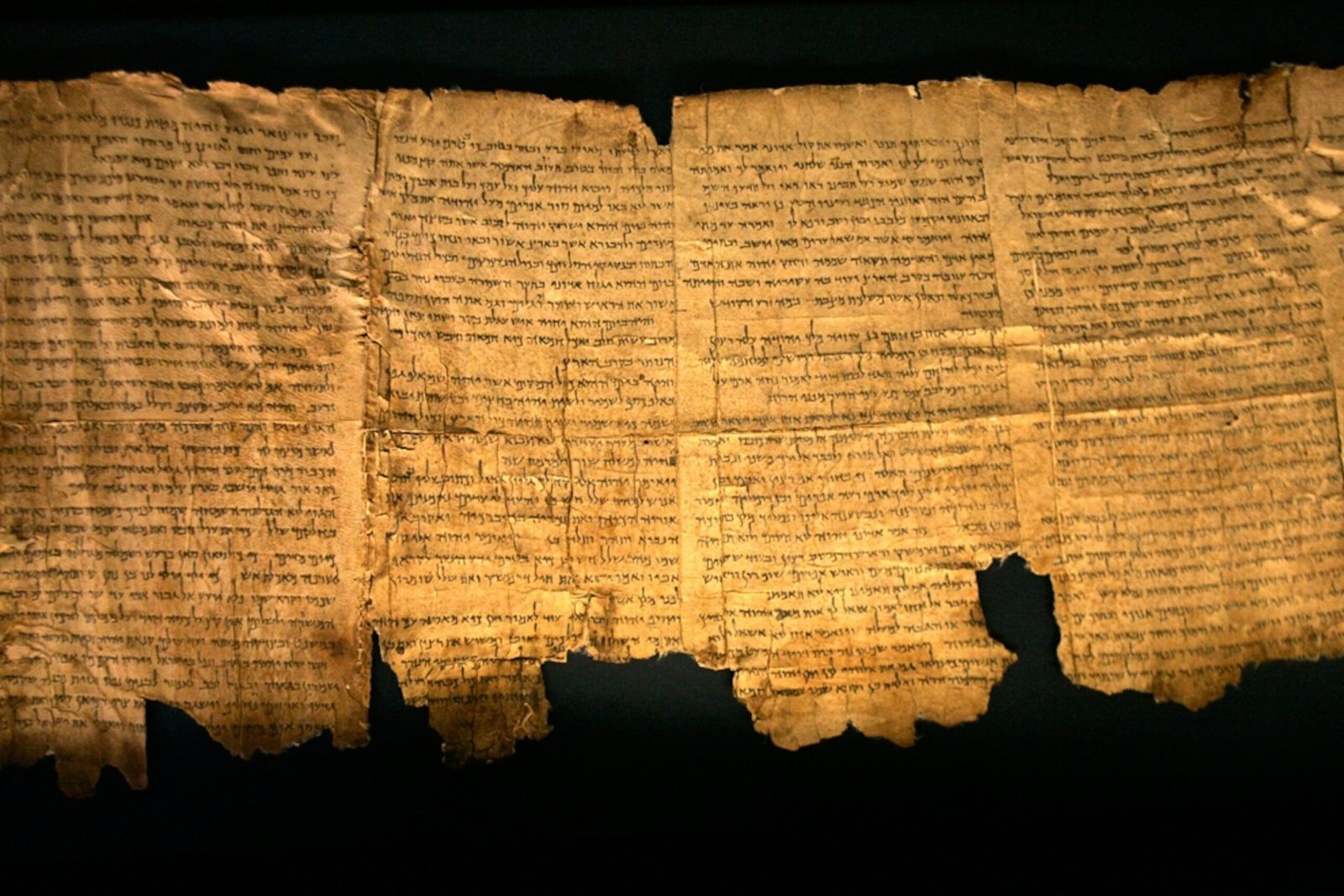
Few archaeological discoveries have captured the public imagination as powerfully as the Dead Sea Scrolls. Hidden for nearly two thousand years in caves overlooking the Dead Sea, these ancient manuscripts have inspired countless books, documentaries, and debates. Alongside genuine historical research, they have also become the center of one of the world’s most enduring conspiracy theories: that the Vatican possesses secret knowledge about the scrolls and has deliberately hidden their true meaning from the public.
It is a fascinating story. Secret archives, mysterious manuscripts, ancient religious texts, and claims of suppressed truths seem like the perfect ingredients for a historical thriller.
But how much of this story is supported by evidence, and how much belongs to the world of speculation?
The real history of the Dead Sea Scrolls is every bit as remarkable as the conspiracy theories surrounding them. Yet it is a story built on archaeology, history, and decades of careful scientific research rather than hidden plots.
An Extraordinary Discovery in the Desert
The story begins in 1947, in the rugged cliffs near the northwestern shore of the Dead Sea, in what is now the West Bank.
According to the traditional account, a young Bedouin shepherd searching for a lost goat threw a stone into a cave and heard the sound of breaking pottery. Curious, he climbed inside and found several tall clay jars. Some contained ancient leather scrolls wrapped in linen cloth.
At first, no one realized the enormous importance of the discovery.
Over the following years, archaeologists and Bedouin explorers searched nearby caves and uncovered one of the greatest collections of ancient manuscripts ever found.
Eventually, nearly one thousand manuscripts and thousands of fragments were recovered from eleven caves near the ancient settlement of Qumran.
The manuscripts had survived because of the region’s exceptionally dry climate, which helped preserve leather and parchment for nearly two millennia.
What Exactly Are the Dead Sea Scrolls?
The Dead Sea Scrolls are a collection of Jewish manuscripts dating roughly from the third century BCE to the first century CE.
They include biblical books, religious commentaries, legal writings, hymns, prayers, community regulations, calendars, and other texts.
Some scrolls contain copies of books that later became part of the Hebrew Bible. Others are works that were never included in biblical canons but were widely read by Jewish communities of the time.
The scrolls are written primarily in Hebrew, with some texts in Aramaic and a smaller number in Greek.
Together, they provide an extraordinary window into Jewish religious life during the centuries immediately before and during the lifetime traditionally associated with Jesus of Nazareth.
Why the Discovery Was So Important
Before the discovery of the Dead Sea Scrolls, the oldest complete Hebrew biblical manuscripts dated to around the tenth century CE.
The Dead Sea Scrolls pushed the surviving manuscript evidence back by roughly a thousand years.
This allowed scholars to compare much earlier versions of biblical texts with later copies.
The results were remarkable.
Many passages were found to have been copied with extraordinary accuracy across centuries.
Other passages showed expected variations, reflecting the fact that ancient texts were copied by hand long before the invention of printing.
Rather than undermining biblical scholarship, the scrolls greatly expanded historians’ understanding of how sacred texts were transmitted, copied, and interpreted.
Who Wrote the Scrolls?
One of the biggest historical questions concerns the people responsible for the scrolls.
The traditional view has been that many were associated with a Jewish religious community living at Qumran, often identified with a group known as the Essenes.
Ancient writers, including the Jewish historian Josephus, described the Essenes as a disciplined community devoted to prayer, study, ritual purity, and communal living.
Many features of the scrolls appear consistent with such descriptions.
However, modern scholarship has become more cautious.
Some researchers argue that the scrolls represent the library of several Jewish groups rather than a single community.
Others suggest that manuscripts from Jerusalem may have been hidden in the caves to protect them during the Roman invasion of the first century CE.
The exact origin of every manuscript remains an active area of research.
What Do the Scrolls Actually Say?
Contrary to sensational claims, the Dead Sea Scrolls do not contain shocking revelations that overturn history.
Instead, they offer an extraordinarily rich picture of Jewish religious thought during a period of great diversity.
Some manuscripts contain familiar biblical books.
Others describe strict community rules.
Some predict an apocalyptic struggle between forces of good and evil.
Several discuss priesthood, worship, purity laws, and expectations of future messianic figures.
These writings reveal that Jewish religious life during this period was far more varied than once believed.
Rather than presenting a single unified tradition, they show multiple interpretations existing side by side.
The Long Delay in Publication
This is where much of the controversy began.
After the scrolls were discovered, a relatively small international team of scholars was assigned the enormous task of reconstructing, translating, and publishing thousands of fragile fragments.
The work proved incredibly difficult.
Many manuscripts existed only as tiny pieces that had to be matched like enormous jigsaw puzzles.
Some fragments contained only a few letters.
Conservation techniques were still developing, and researchers worked under challenging conditions.
As years passed, frustration grew within the scholarly community because access to many unpublished fragments remained restricted.
Critics argued that too few scholars controlled too much material.
This lack of access created an atmosphere in which rumors flourished.
How Conspiracy Theories Took Shape
By the 1970s and 1980s, conspiracy theories began spreading widely.
Some writers claimed that the Vatican had secretly influenced scholars to suppress dangerous information.
According to these theories, the scrolls supposedly contained evidence that would undermine Christianity, expose hidden teachings, or reveal embarrassing truths about the origins of the Church.
These claims gained popularity because they combined several compelling themes: ancient mysteries, religious institutions, secrecy, and forbidden knowledge.
However, popularity is not the same as evidence.
No credible historical documentation has demonstrated that the Vatican controlled the scrolls or directed their publication.
Did the Vatican Ever Own the Scrolls?
One of the most common misconceptions is that the Vatican possesses the Dead Sea Scrolls.
The historical record tells a different story.
Most scrolls came under the control of Jordan after their discovery because the area was then administered by Jordan.
Following the 1967 Six-Day War, Israel took control of East Jerusalem, including the Rockefeller Archaeological Museum, where many scrolls were housed.
Today, most of the scrolls are held by the Israel Antiquities Authority, while a smaller number are preserved in museums and institutions around the world.
The Vatican does maintain one of the world’s greatest manuscript collections in the Vatican Apostolic Library, but the Dead Sea Scrolls themselves are not hidden there.
The conspiracy theory largely arises from assumptions rather than documented evidence.
Why People Believed the Rumors
Although there is no convincing evidence of Vatican suppression, there were real reasons why suspicion developed.
For decades, access to many scroll fragments was tightly restricted.
Only a limited group of specialists could study original materials.
Publication moved slowly.
Some researchers criticized what they viewed as an exclusive scholarly monopoly.
When information is difficult to obtain, people often assume someone is deliberately hiding it.
This environment allowed speculative theories to spread far beyond the available evidence.
The Opening of the Scrolls
Everything changed during the early 1990s.
Scholarly pressure increased.
Photographs of previously unpublished manuscripts became widely available.
Research institutions expanded access.
Eventually, nearly the entire collection was published.
Today, scholars from around the world study the scrolls using high-resolution digital images and advanced analytical technologies.
Many manuscripts can now be viewed online by anyone with an internet connection.
If revolutionary secrets had truly existed, thousands of independent historians, linguists, archaeologists, theologians, and researchers from many countries would have examined them.
Instead, decades of study have strengthened historical understanding rather than supporting conspiracy theories.
What Modern Science Has Revealed
Scientific research continues to uncover new information about the Dead Sea Scrolls.
Radiocarbon dating has confirmed that most manuscripts date between approximately the third century BCE and the first century CE.
Paleography—the study of ancient handwriting—helps estimate when different texts were copied by comparing writing styles.
Multispectral imaging allows faded ink that is invisible to the naked eye to become readable.
DNA analysis of the animal skins used to make parchment has helped researchers determine which fragments originally belonged together.
Artificial intelligence is increasingly assisting scholars in identifying handwriting patterns and reconstructing damaged manuscripts.
These scientific methods continue to improve our understanding without revealing hidden conspiracies.
Do the Scrolls Challenge Christianity?
Some people claim the Dead Sea Scrolls disprove Christianity.
This statement is misleading.
The scrolls are primarily Jewish documents.
Most were written before or during the earliest years of Christianity.
They illuminate the religious environment from which Christianity later emerged.
Historians have found similarities between some ideas in the scrolls and beliefs found in later Christian writings, including themes of repentance, expectation of a coming Messiah, ritual washing, and apocalyptic hope.
However, similarities do not mean direct dependence.
The scrolls do not mention Jesus by name, nor do they provide secret biographies or hidden accounts of his life.
Instead, they help historians better understand the world in which early Christianity developed.
Common Misunderstandings
Over the decades, many sensational claims have circulated online and in popular books.
Some allege that the scrolls reveal Jesus survived the crucifixion.
Others insist they identify the true Messiah as someone else.
Still others claim they expose secret teachings deliberately erased from history.
These stories make compelling fiction, but they are not supported by the manuscripts themselves.
Professional historians base conclusions on the actual texts rather than speculation.
The scrolls are remarkable because they expand knowledge of ancient Judaism, not because they overturn established history.
Why the Vatican Is Often Mentioned
The Vatican frequently appears in conspiracy theories involving ancient religious documents because it possesses one of the world’s largest historical archives and libraries.
Its collections include countless medieval manuscripts, official correspondence, and historical records accumulated over centuries.
For many people, this vast archive naturally inspires curiosity.
However, curiosity alone does not establish evidence of suppression.
Serious historical research depends on documents, archaeology, and verifiable sources—not assumptions based on secrecy or institutional size.
The Dead Sea Scrolls and the Public Today
Today, the Dead Sea Scrolls are more accessible than ever before.
Museums regularly display selected manuscripts.
Digital archives allow scholars and the public to examine high-resolution images.
Translations exist in numerous languages.
International teams continue studying every aspect of the collection.
Far from being hidden away forever, the scrolls have become one of the most extensively researched archaeological discoveries in history.
Their importance continues to grow as new analytical techniques reveal additional details about their origins, scribes, and preservation.
Why the Conspiracy Endures
If the evidence does not support Vatican suppression, why does the conspiracy remain so popular?
Part of the answer lies in human psychology.
People are naturally drawn to mystery.
Stories involving secret knowledge, hidden archives, and powerful institutions are emotionally compelling.
They suggest that history contains dramatic revelations waiting to be uncovered.
The Dead Sea Scrolls fit perfectly into this narrative because they are genuinely ancient, genuinely mysterious, and genuinely important.
The gap between reality and imagination can easily become blurred.
The Real Wonder of the Scrolls
The true significance of the Dead Sea Scrolls does not depend on hidden conspiracies.
Their real value lies in the extraordinary glimpse they provide into the beliefs, language, literature, and daily lives of Jewish communities more than two thousand years ago.
They preserve some of the oldest surviving copies of biblical texts ever discovered.
They reveal remarkable diversity within ancient Judaism.
They demonstrate the dedication of scribes who carefully copied sacred writings by hand across generations.
They help historians reconstruct one of the most influential periods in religious history.
None of these achievements requires secret plots to be fascinating.
Separating History from Mystery
The Dead Sea Scrolls remain one of archaeology’s greatest treasures, not because they expose hidden dark secrets, but because they preserve authentic voices from the ancient world. Scientific dating, archaeological evidence, linguistic analysis, and decades of international scholarship consistently support their authenticity and historical importance.
The claim that the Vatican deliberately hid shocking truths contained in the scrolls has become one of history’s most famous conspiracy theories. Yet after decades of careful research, no credible evidence has emerged to support that allegation. The delays in publication that once fueled suspicion were real, but they reflected scholarly practices, conservation challenges, and limited access—not a documented campaign of suppression.
Ironically, the greatest mystery of the Dead Sea Scrolls is not what they supposedly reveal about secret conspiracies. It is how fragile manuscripts, hidden in desert caves for nearly two thousand years, survived long enough to speak again. Their voices have transformed our understanding of the ancient world, reminding us that history’s most remarkable discoveries often prove even more fascinating than the myths that grow around them.