In 1974, a group of farmers digging a well in the countryside near Xi’an, China, made one of the most astonishing archaeological discoveries in human history. What began as an ordinary day of labor quickly turned into a moment that would reshape our understanding of ancient China. Buried beneath the earth for more than two thousand years stood thousands of life-sized clay soldiers, lined up in battle formation as if waiting for orders from a long-dead emperor.
The discovery became known as the Terracotta Army.
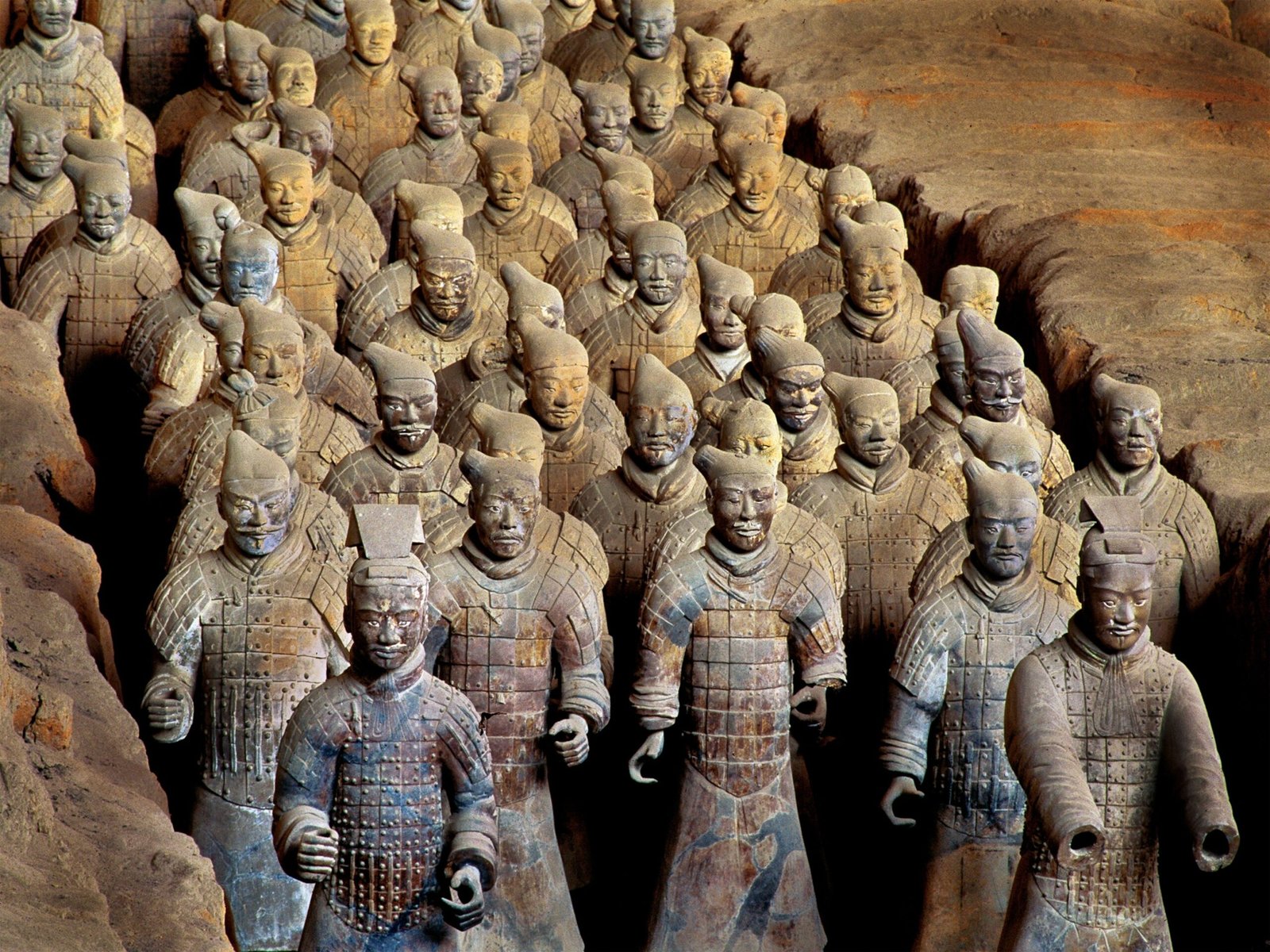
At first glance, the army itself is breathtaking. Thousands of warriors, horses, chariots, officers, generals, and support personnel fill enormous underground pits. But as archaeologists began studying the figures more closely, they noticed something even more remarkable.
No two faces seemed exactly alike.
Each soldier appeared to possess his own personality. Some looked stern and determined. Others appeared calm, thoughtful, or even weary. Their noses differed. Their eyes varied in shape. Their hairstyles changed from one figure to another. Their facial hair, expressions, and features created the impression of a real army composed of individual human beings.
The question naturally emerged: Why?
Were these sculptures based on actual soldiers? Did ancient artists create thousands of unique portraits? Or is something else happening beneath the surface?
The answer turns out to be more fascinating than many people imagine. The mystery of the Terracotta Army’s faces reveals not only extraordinary artistic skill but also the ambitions of one of history’s most powerful rulers and the remarkable civilization that created this underground world.
The Emperor Behind the Army
To understand the Terracotta Army, we must first understand the man who ordered its creation.
The army was built for Qin Shi Huang, the first emperor to unify China.
Before his reign, China consisted of competing kingdoms that frequently fought one another. Through military conquest, political strategy, and relentless determination, Qin Shi Huang brought these states under a single rule in 221 BCE.
For the first time in history, much of China became one empire.
The emperor standardized writing systems, currency, weights, and measurements. He launched enormous construction projects and laid foundations that would influence Chinese civilization for centuries.
Yet Qin Shi Huang was also deeply concerned with death.
Like many rulers throughout history, he wanted his power to continue beyond the grave.
As a result, he ordered the construction of one of the largest tomb complexes ever created.
The Terracotta Army became part of that grand vision.
An Underground Empire
Ancient Chinese beliefs often emphasized the importance of the afterlife. Many people believed that life continued after death in another form.
For a ruler as powerful as Qin Shi Huang, the next world required preparation.
His tomb complex was designed to function almost like a second empire.
Historical records suggest that the burial site included palaces, officials, entertainers, treasures, weapons, and countless other elements needed for an eternal reign.
The Terracotta Army served as the emperor’s military force in the afterlife.
Instead of sacrificing thousands of real soldiers, craftsmen created clay substitutes.
The result was an army unlike anything the world had ever seen.
Today, archaeologists estimate that the complex originally contained around 8,000 warriors along with hundreds of horses and chariots.
The scale alone is astonishing.
Yet it is the individuality of the soldiers that captures people’s imagination.
The Discovery That Shocked the World
When archaeologists first uncovered the Terracotta Army, they expected impressive craftsmanship.
What they did not expect was such extraordinary variation among the figures.
Many ancient armies depicted in art appear uniform. Soldiers often look nearly identical, serving as symbols rather than individuals.
The Terracotta Army was different.
Each warrior seemed to possess unique characteristics.
One soldier might have a broad face and thick eyebrows.
Another might have a narrow jaw and delicate features.
Some wear mustaches.
Others have beards.
Their expressions vary subtly.
The differences are so striking that many visitors leave convinced they are looking at portraits of real people.
For decades, this belief became one of the most popular explanations for the army’s appearance.
Were They Real Soldiers?
The most obvious theory is also the most appealing.
Perhaps each statue represents an actual soldier who served Qin Shi Huang.
After all, if the emperor wanted a realistic army for the afterlife, why not model the figures after real troops?
The idea is emotionally powerful.
Imagine thousands of craftsmen carefully sculpting portraits of living soldiers, preserving their appearances for eternity.
Many visitors find this explanation compelling.
However, most scholars believe the reality is more complicated.
Creating thousands of exact portraits would have required an enormous amount of time and effort.
Although the tomb project employed vast numbers of workers, producing detailed individual likenesses for every soldier would have been extraordinarily difficult.
Furthermore, researchers have found evidence suggesting that the statues were created using a more efficient system.
The soldiers may look unique, but they were not necessarily sculpted from scratch.
The Ancient Assembly Line
One of the greatest revelations from modern archaeological research is that the Terracotta Army appears to have been produced using methods surprisingly similar to an assembly line.
Different workshops created different parts.
Heads, arms, legs, torsos, and other components were often manufactured separately.
These parts could then be combined to create finished figures.
This system allowed craftsmen to produce thousands of statues while maintaining a high degree of variation.
Think of it like building with interchangeable pieces.
A limited number of basic components could be mixed and matched in countless ways.
The result created the illusion of endless individuality.
This approach was both practical and ingenious.
It balanced efficiency with artistic realism.
The emperor obtained a massive army, while artisans preserved the appearance of uniqueness.
The Secret of the Faces
Closer examination reveals that many facial features were created from a relatively small set of molds and design templates.
Researchers have identified recurring patterns among the faces.
Certain nose shapes appear repeatedly.
Specific eye styles recur throughout the army.
Ear designs often follow recognizable forms.
Yet these repeating elements were combined in different ways.
Artists also added hand-finished details after molding.
Small adjustments to eyebrows, facial hair, cheek contours, and expressions transformed similar faces into seemingly unique individuals.
This combination of standardization and customization produced extraordinary results.
From a distance, every warrior appears different.
Even at close range, the illusion remains remarkably convincing.
The artists achieved something modern manufacturers still strive for today: mass production without obvious repetition.
The Role of Hairstyles
One reason the soldiers appear so distinct is the incredible variety of hairstyles.
Hair carried important social and military significance in ancient China.
Different ranks often wore different hairstyles or headgear.
The Terracotta Army reflects this diversity.
Some warriors wear topknots positioned high on the head.
Others display different arrangements based on their military roles.
Officers often have more elaborate appearances than ordinary soldiers.
Generals possess distinctive styles that emphasize their status.
These variations contribute greatly to the sense of individuality.
Even when facial structures are similar, differences in hair create entirely different impressions.
Human beings naturally pay close attention to hair when recognizing faces.
The ancient craftsmen understood this instinctive tendency.
Facial Hair and Personality
Mustaches and beards also play a major role in differentiating the soldiers.
Some warriors have long mustaches.
Others wear short beards.
A few appear clean-shaven.
The variety creates subtle personality differences.
A thick beard may suggest age, experience, and authority.
A clean face may imply youth.
A carefully groomed mustache might indicate status or professionalism.
These details make the figures feel human.
Visitors often find themselves imagining stories behind individual warriors.
Who was this soldier?
What battles had he fought?
What was his life like?
The statues encourage such questions because they seem alive.
Expressions Frozen in Time
Another fascinating aspect of the Terracotta Army is the subtlety of facial expressions.
Unlike modern sculptures that may exaggerate emotions, the Terracotta warriors generally display restrained expressions.
Most appear serious.
Many seem focused.
A few look contemplative.
Others project confidence.
The differences are small but significant.
Human beings are highly sensitive to facial expressions.
Tiny changes in mouth position, eye shape, or brow angle can dramatically alter how we perceive a face.
The artists exploited this psychological reality.
Even slight variations create powerful impressions of individuality.
Not Just Soldiers
The Terracotta Army includes far more than ordinary infantry.
Archaeologists have identified numerous military roles represented within the pits.
There are archers, cavalrymen, chariot drivers, officers, and generals.
Each category possesses distinctive features.
Generals often appear taller and more imposing.
Their armor is more elaborate.
Their facial expressions frequently convey authority.
Lower-ranking soldiers tend to wear simpler uniforms.
These differences reinforce the hierarchy of the emperor’s military.
The army was designed not merely as a collection of figures but as a realistic representation of an organized fighting force.
The Incredible Skill of Qin Craftsmen
The individuality of the Terracotta Army reveals the extraordinary talent of the artisans who created it.
These craftsmen worked more than two thousand years ago without modern tools or technologies.
Yet they achieved a level of realism that continues to amaze experts today.
Creating thousands of life-sized figures required mastery of sculpture, engineering, organization, and logistics.
Each warrior stands upright and balanced.
Each figure displays intricate details.
Each one had to survive firing in kilns before being transported and assembled.
The project demanded both artistic vision and technical expertise.
The faces represent only one aspect of a much larger achievement.
Originally Painted in Brilliant Colors
Many people imagine the Terracotta Army as rows of gray clay soldiers.
In reality, the warriors were originally painted in vivid colors.
When newly completed, they would have appeared dramatically more lifelike.
Their clothing featured bright pigments.
Their armor carried decorative details.
Their faces displayed painted features.
Hair, eyes, and skin tones received careful attention.
Unfortunately, exposure to air after excavation caused much of the paint to deteriorate rapidly.
Within hours or days, many pigments flaked away.
This loss was heartbreaking for archaeologists.
Yet traces remain, revealing how vibrant the army once appeared.
The original colors likely enhanced the individuality of the faces even further.
Did the Artists Sign Their Work?
An intriguing detail discovered during excavations involves inscriptions found on some statues.
Certain figures contain marks identifying workshops or individual craftsmen.
These inscriptions suggest that artisans may have been held accountable for the quality of their work.
In some cases, names appear.
This practice may have encouraged high standards.
Workers knew their craftsmanship could be traced back to them.
The result was an extraordinary level of care and precision.
The army became not only a monument to the emperor but also a testament to the skill of countless unnamed artisans.
The Human Desire to See Individuals
Part of the mystery surrounding the Terracotta Army’s faces may actually originate within our own minds.
Humans are naturally skilled at recognizing faces.
Our brains constantly search for individuality and personality.
Even small differences can lead us to perceive unique identities.
When we walk through the Terracotta Army exhibition halls, we instinctively look for distinct people rather than repeating patterns.
This psychological tendency amplifies the effectiveness of the craftsmen’s work.
Minor variations become meaningful.
Slight changes appear profound.
The warriors seem alive because our brains interpret them as individuals.
The artists understood human perception far better than we often realize.
Theories About Ethnic Diversity
Some researchers have noted apparent differences among facial types within the army.
This observation has led to speculation that the statues may reflect the ethnic diversity present within the Qin Empire.
Ancient China contained numerous regional populations.
The emperor ruled over vast territories inhabited by different peoples.
Some scholars wonder whether artists intentionally incorporated a range of facial characteristics inspired by real populations.
However, evidence remains limited.
While diversity certainly existed within the empire, determining whether specific statues represent particular ethnic groups is extremely difficult.
Most experts remain cautious about drawing firm conclusions.
Nevertheless, the possibility highlights the complexity of the project.
The Tomb That Remains Unopened
Remarkably, the Terracotta Army represents only part of the larger tomb complex.
The central burial chamber of Qin Shi Huang remains unopened.
Archaeologists have chosen not to excavate it yet.
Ancient historical accounts describe astonishing treasures within.
One famous description suggests rivers of mercury flowed through a miniature representation of the empire.
Modern surveys have detected unusually high mercury levels around the tomb mound, lending some support to these ancient accounts.
Because excavation technology continues improving, researchers hope future generations may be better equipped to preserve whatever lies inside.
For now, the emperor’s final resting place remains one of archaeology’s greatest mysteries.
Why the Faces Matter So Much
The question of why the faces look different goes beyond simple curiosity.
The answer reveals something profound about the civilization that created them.
Many ancient rulers commissioned monuments celebrating power.
The Terracotta Army certainly fulfills that purpose.
Yet the individuality of the soldiers adds another dimension.
Instead of creating anonymous figures, the artists crafted an army that feels human.
Thousands of warriors stand together, yet each appears to possess his own identity.
This combination of unity and individuality creates emotional impact.
Visitors do not merely see clay statues.
They feel as though they are encountering people from another age.
The Legacy of the Terracotta Army
Since its discovery, the Terracotta Army has become one of the most famous archaeological sites on Earth.
Millions of visitors travel to Xi’an to see the warriors.
Scholars continue studying the statues using advanced technologies.
New discoveries regularly emerge.
Each finding deepens our understanding of ancient China.
The faces remain among the most compelling aspects of the army.
They connect modern viewers with people who lived more than two millennia ago.
Across the centuries, the warriors still seem to watch silently.
Their expressions continue provoking questions.
Their individuality continues inspiring wonder.
What Modern Science Reveals
Recent research using digital scanning and statistical analysis has helped scientists study the warriors in greater detail than ever before.
These investigations suggest that while many features were created from shared templates, the final combinations generated enormous diversity.
The process resembles sophisticated mass customization.
Instead of producing identical copies, craftsmen blended standard components with artistic modifications.
The result was a balance between efficiency and realism.
Modern manufacturing industries often pursue similar goals.
In this sense, the Terracotta Army was centuries ahead of its time.
The project demonstrates remarkable organizational sophistication.
The Emotional Power of Ancient Faces
Standing before the Terracotta Army can be a surprisingly emotional experience.
Visitors often expect to admire an archaeological treasure.
Instead, many find themselves feeling connected to the past.
A particular face catches their attention.
A warrior appears thoughtful.
Another seems determined.
A third looks almost familiar.
The illusion of individuality creates empathy.
These figures cease being merely artifacts.
They become representations of human beings.
That emotional connection may explain why the army continues captivating audiences around the world.
Conclusion
The Terracotta Army’s faces appear different because ancient craftsmen achieved an extraordinary combination of standardization, artistic skill, and psychological insight. Rather than sculpting thousands of completely unique portraits, they employed a sophisticated system of molds, interchangeable parts, hand-finished details, varied hairstyles, facial hair, and subtle expressions. The result created the powerful impression of individuality on an unprecedented scale.
Whether the warriors represent actual soldiers or idealized versions of them remains uncertain. What is clear is that the artisans who built the army understood how to make clay figures feel alive. More than two thousand years later, their achievement continues to astonish archaeologists, historians, and visitors alike.
The Terracotta Army is far more than a collection of statues. It is a frozen moment from one of history’s greatest empires. It reflects the ambitions of an emperor determined to rule forever and the talents of craftsmen capable of transforming clay into something that still feels human.
That is why the faces matter.
Each one reminds us that behind every great civilization were real people—people with dreams, fears, talents, and identities. The Terracotta warriors may have been created for an emperor’s afterlife, but their faces continue speaking to the living, inviting us to look closer and wonder about the countless stories hidden beneath the surface of history.