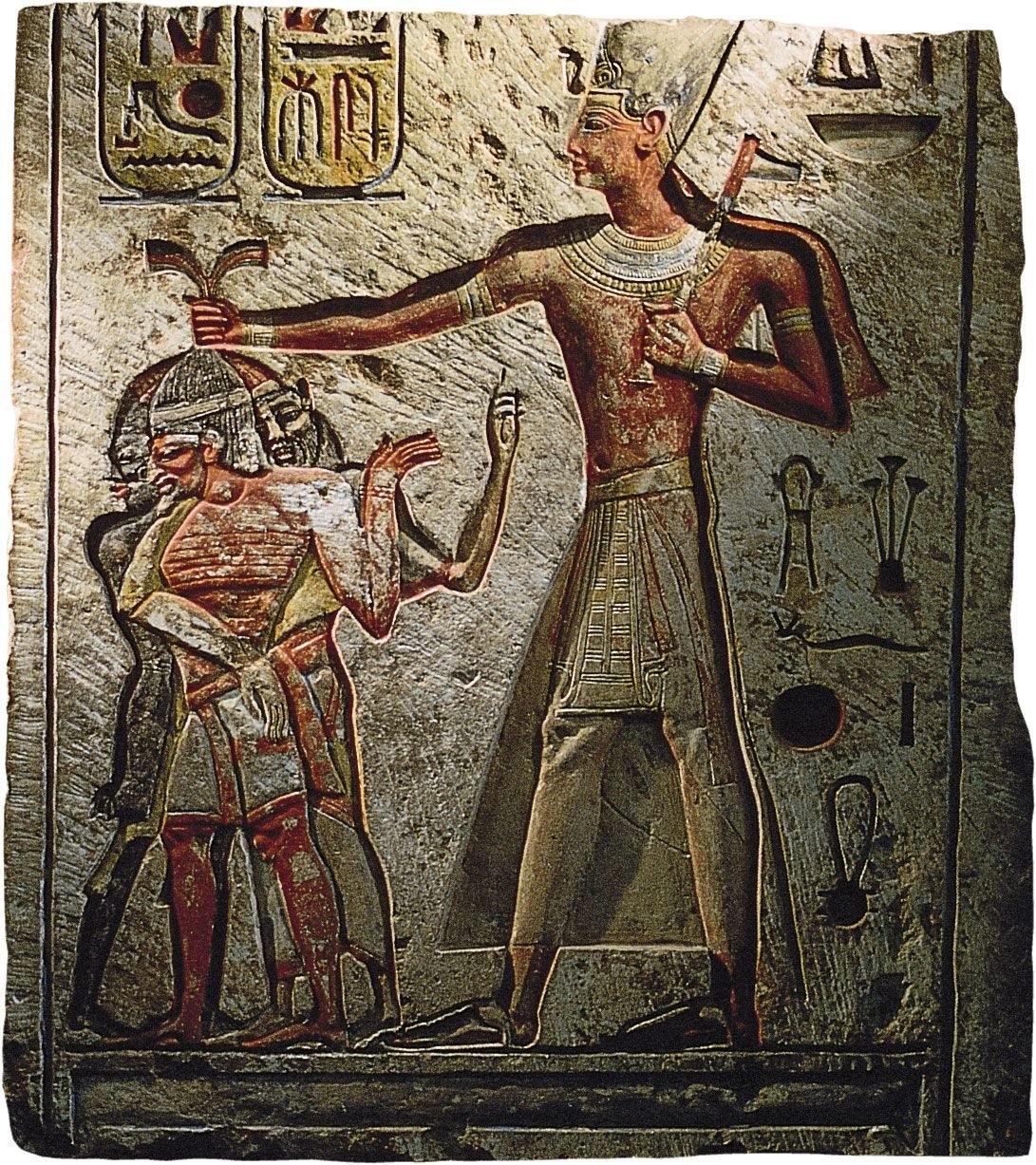
Ramses II (also spelled Ramesses II), commonly known as Ramses the Great, was an ancient Egyptian pharaoh who ruled from approximately 1279 to 1213 BCE during the 19th Dynasty of Egypt’s New Kingdom. He was born around 1303 BCE, probably in Egypt, and died in 1213 BCE at approximately 90 years of age. The son of Pharaoh Seti I and Queen Tuya, Ramses II became one of the longest-reigning rulers in ancient Egyptian history. He was known for his military campaigns, major building projects, diplomatic agreements, and efforts to strengthen Egypt’s power. His reign was marked by the construction of impressive temples and monuments, including the famous temples at Abu Simbel.
Early Life and Family Background
Ramses II was born around 1303 BCE during the New Kingdom, a period when ancient Egypt was a powerful kingdom with territories and influence extending beyond the Nile Valley. His father, Seti I, was a successful military leader and pharaoh who worked to restore Egyptian authority in neighboring regions. His mother, Queen Tuya, came from an important Egyptian family and held a respected position at court.
Ramses grew up in the royal household, where he received an education suited to a future ruler. He likely learned about government, religion, military organization, and the responsibilities of kingship. As a prince, he was also introduced to the traditions and ceremonies that shaped Egyptian royal life.
His father began preparing him for leadership while he was still young. Ramses received military responsibilities at an early age and accompanied Seti I on campaigns. These experiences gave him practical knowledge of the army and the challenges of defending Egypt’s borders.
Seti I eventually appointed Ramses as crown prince and associated him with royal duties. This arrangement allowed the young prince to gain experience in administration and government before taking the throne.
Becoming Pharaoh
Ramses II became pharaoh around 1279 BCE after the death of his father, Seti I. He inherited a kingdom with a strong military tradition, an established administration, and considerable influence in neighboring territories.
At the beginning of his reign, Ramses worked to secure his position and demonstrate his authority. Egyptian kings were expected to protect the country, maintain religious traditions, oversee public works, and preserve order. They also had to show that they could defend Egypt against foreign threats.
Ramses took these responsibilities seriously. He maintained a strong army, appointed trusted officials, and continued the building programs begun by his father. He also established a royal presence throughout Egypt and Nubia through temples, monuments, and official inscriptions.
His reign lasted about 66 years, giving him more time to develop his government and carry out major projects than most Egyptian rulers enjoyed. During this long period, he became closely associated with the image of a powerful and successful pharaoh.
Military Campaigns and the Battle of Kadesh
One of the major challenges during Ramses II’s early reign was the growing rivalry between Egypt and the Hittite Empire. The Hittites controlled much of Anatolia, in present-day Turkey, and held important territories in Syria. Both powers wanted influence over the eastern Mediterranean region, particularly areas containing valuable trade routes and strategic cities.
Ramses launched several military campaigns to protect Egyptian interests and regain influence in territories that had become contested. His most famous campaign took place around 1274 BCE, when he led an Egyptian army into Syria to confront the Hittites.
The campaign resulted in the Battle of Kadesh, fought near the city of Kadesh on the Orontes River, in present-day Syria. The Hittite army, led by King Muwatalli II, prepared an ambush for the Egyptian forces.
Ramses initially believed that the Hittite army was farther away than it actually was. As his forces approached Kadesh, Hittite chariots attacked parts of the Egyptian army before the remaining troops had fully assembled.
The Egyptian forces faced serious difficulties, and Ramses found himself in a dangerous position. Egyptian inscriptions later described the pharaoh fighting bravely and rallying his troops during the battle. Although these accounts emphasize his personal courage, they were also official royal propaganda intended to present him as a victorious ruler.
The battle did not produce a clear military victory for either side. The Egyptians did not capture Kadesh, and the Hittites maintained their control of the city. Both empires continued to compete for influence in the region.
Ramses later used the battle as an important part of his public image. He ordered detailed accounts of the campaign to be carved on temple walls, presenting himself as a heroic leader who had overcome overwhelming danger.
The Peace Treaty with the Hittites
After years of conflict, Egypt and the Hittite Empire eventually moved toward peace. Around 1259 BCE, during the reign of Ramses II and the rule of Hittite King Hattusili III, the two powers reached a formal agreement.
The treaty is often described as one of the earliest surviving written peace agreements between major states. It established peaceful relations between the two kingdoms, addressed mutual defense, and included arrangements for returning political refugees and people accused of crimes.
The agreement helped reduce the threat of further conflict between Egypt and the Hittites. It also allowed both kingdoms to focus on their internal affairs and other regional concerns.
The treaty was reinforced through diplomatic relationships. Ramses later married a Hittite princess, who became one of his principal royal wives. Another Hittite princess also entered his household in a diplomatic marriage.
These marriages strengthened the relationship between the royal families and demonstrated how diplomacy could support peace between powerful ancient kingdoms.
Marriage and Family Life
Ramses II had a large royal household and fathered many children. His numerous marriages reflected both personal relationships and the political responsibilities of Egyptian kingship.
His principal wife during much of the early reign was Nefertari, one of the most prominent queens of ancient Egypt. She held an important position at court and appeared alongside Ramses in royal monuments. Her name and image were preserved in temples and inscriptions, showing the respect she received during his reign.
Ramses also married Isetnofret, another important royal wife. She was the mother of several of his children, including Merenptah, who eventually succeeded him as pharaoh.
His other wives included members of the royal family and foreign princesses. Some marriages helped strengthen political relationships with neighboring kingdoms, particularly the Hittites.
Ramses had more than 100 children, although the exact number is not firmly established. His sons and daughters held important positions in royal and religious life. Several of his sons served as military leaders or administrators.
His eldest sons died before him, which meant that the succession passed to Merenptah, one of his younger sons. Merenptah became pharaoh after Ramses II’s death.
The large number of royal children also reflected the importance of family in Egyptian kingship. The pharaoh’s household was not simply a private family but an important part of the political structure of the kingdom.
Nefertari and the Temples at Abu Simbel
Nefertari was particularly important in Ramses II’s royal life. He honored her through monuments and inscriptions, making her one of the most visible queens of ancient Egypt.
One of the clearest examples of this relationship can be seen at Abu Simbel, in southern Egypt near the border with modern Sudan. Ramses ordered two temples to be carved into the sandstone cliffs there during his reign.
The larger temple was dedicated primarily to Ramses II and several important Egyptian gods. Its entrance is decorated with four enormous seated statues of the pharaoh, each representing his royal power and divine status.
The smaller temple was dedicated to the goddess Hathor and Queen Nefertari. Its entrance features statues of Ramses and Nefertari standing at nearly equal heights, an unusual honor for a queen in Egyptian royal art.
The temple complex was intended to demonstrate the authority of the pharaoh and the importance of the royal family. It also showed how Egyptian rulers used religious architecture to strengthen their public image.
Nefertari died before Ramses, although the exact date of her death is uncertain. Her beautifully decorated tomb in the Valley of the Queens reflects her high status and remains one of the most impressive royal burial sites in Egypt.
Building Projects and Monuments
Ramses II became famous for the number and scale of the monuments constructed during his reign. He expanded existing temples, built new religious complexes, and established statues and inscriptions throughout Egypt and Nubia.
His building program served several purposes. Temples honored the gods, supported religious ceremonies, employed workers, and demonstrated the wealth and organization of the Egyptian state. Royal monuments also presented the pharaoh as a powerful ruler responsible for protecting the kingdom.
One of his most important projects was the Ramesseum, his mortuary temple on the western bank of the Nile at Thebes, near modern Luxor. The complex included large courtyards, religious halls, statues, and storage areas. It was designed to preserve the pharaoh’s memory and support religious rituals connected with his rule.
Ramses also expanded the Temple of Amun at Karnak, one of the most important religious centers in Egypt. He added buildings and monuments, including a large hypostyle hall that had been begun during the reign of his father. A hypostyle hall is a large room supported by many columns. The hall at Karnak is famous for its enormous pillars and detailed carvings.
He also developed the ancient city of Pi-Ramesses in the eastern Nile Delta. This became an important royal residence and military center, giving the Egyptian government a stronger presence near the country’s northeastern frontier.
His monuments were not limited to Egypt itself. In Nubia, he built and expanded temples that displayed Egyptian religious traditions and royal authority. Abu Simbel was the most impressive of these projects.
Ramses sometimes placed his name and image on monuments originally built by earlier rulers. This practice, known as usurpation in Egyptology, was part of his effort to associate himself with important religious sites and earlier royal traditions.
Government and Daily Life During His Reign
Ramses II ruled a large kingdom supported by an organized system of officials, administrators, priests, soldiers, and workers. The pharaoh stood at the top of this system, but government depended on many people who managed different parts of the country.
Officials collected taxes, supervised agriculture, organized construction projects, and maintained records. Local administrators helped manage towns and agricultural areas, while priests oversaw temples and religious ceremonies.
Agriculture remained central to the Egyptian economy. Farmers depended on the annual flooding of the Nile River to provide water and fertile soil for growing crops. Grain production supported the population, the army, religious institutions, and the royal administration.
Large building projects required skilled workers, laborers, architects, sculptors, and supervisors. These projects provided employment and helped maintain the economic and political strength of the kingdom.
Egyptian society during Ramses II’s reign included farmers, craftsmen, merchants, soldiers, priests, scribes, and members of the royal administration. Most people lived in communities along the Nile, where water and fertile land supported farming and trade.
Although the pharaoh’s monuments celebrated royal power, the daily operation of Egypt depended on the work of ordinary people and the officials responsible for organizing the kingdom.
Later Years and Continued Rule
As Ramses II grew older, he continued to rule Egypt and maintain his public responsibilities. His long reign gave him an unusual degree of political stability and allowed him to complete many projects that had begun decades earlier.
During his later years, he remained an important figure in religious ceremonies and royal administration. His statues and inscriptions continued to appear throughout the country, reinforcing his authority.
The deaths of several older sons created challenges for the royal succession. Ramses had many children, but a number of the princes who originally stood in line to inherit the throne died before him.
Eventually, Merenptah became the leading successor. He was a son of Ramses II and Queen Isetnofret and was already an older man by the time he became pharaoh.
Ramses’ advanced age was remarkable for his era. He lived through several generations of Egyptian officials, soldiers, priests, and members of the royal family.
Death and Burial
Ramses II died around 1213 BCE after ruling Egypt for approximately 66 years. He was about 90 years old, an unusually long life for someone living in the ancient world.
Following his death, his son Merenptah succeeded him as pharaoh. The transition marked the beginning of a new reign after one of the longest periods of rule in Egyptian history.
Ramses was buried in the Valley of the Kings, a royal burial ground on the western bank of the Nile near Thebes. His tomb, known as KV7, was designed to hold his body and funerary treasures, although it was damaged by flooding and later disturbed by tomb robbers.
To protect royal mummies from theft, Egyptian priests eventually moved several royal remains into hidden burial places. Ramses II’s mummy was among those transferred to a royal cache at Deir el-Bahari.
In modern times, his mummy was discovered in the cache and later examined by researchers. It provides physical evidence of his advanced age and has helped historians and scientists study his appearance and health.
His mummy was eventually placed in the National Museum of Egyptian Civilization in Cairo, where it is preserved as part of Egypt’s collection of royal remains.