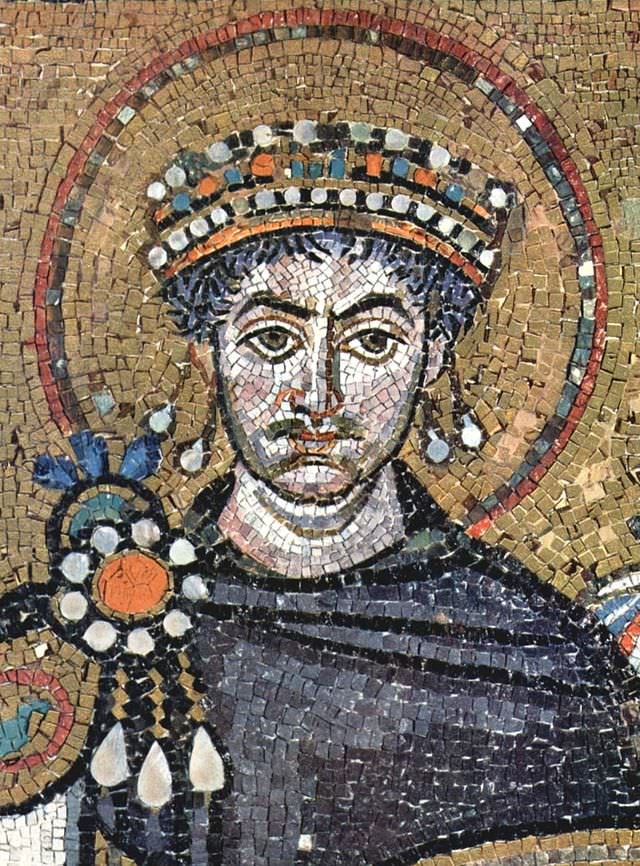
Justinian I (born around 482 CE in Tauresium, in the region of Dardania, near present-day Skopje, North Macedonia—died November 14, 565 CE, in Constantinople, now Istanbul, Turkey) was Byzantine emperor from 527 to 565. Also known as Justinian the Great, he ruled the Eastern Roman Empire during a period of major military campaigns, legal reforms, religious disputes, and ambitious building projects. He is best known for ordering the collection and organization of Roman law, expanding imperial territory through military campaigns, and rebuilding Constantinople, including the construction of the Hagia Sophia.
Early Life and Family Background
Justinian was born into a family of modest rural origins in the Balkans, a region that was part of the Eastern Roman Empire. His birth name is generally given as Petrus Sabbatius. His family belonged to a Latin-speaking population, although Greek was widely used in the eastern part of the empire.
His uncle Justin played an important role in shaping his future. Justin had risen through the ranks of the imperial army and eventually became a senior military commander in Constantinople. He brought his nephew to the capital, where Justinian received an education and gained access to the imperial court.
Justinian studied subjects that prepared him for public life, including Roman law, theology, administration, and military affairs. His education helped him develop an understanding of the empire’s legal traditions and political institutions.
When his uncle became emperor in 518, Justinian gained a position of influence within the government. He gradually became involved in important state affairs and developed relationships with influential officials, military leaders, and religious figures.
Justinian’s rise was unusual because he did not come from an established imperial family. His opportunities came largely through his uncle’s military career and his own growing influence at court.
Marriage to Theodora
One of the most important relationships in Justinian’s life was his marriage to Theodora. She came from a very different social background and had worked as an actress and performer before becoming involved with Justinian.
Their relationship faced social and political obstacles. Acting was associated with a low social position in the late Roman world, and marriage laws restricted unions between high-ranking officials and women from certain backgrounds. Justin’s government eventually changed the relevant rules, allowing Justinian to marry Theodora.
They married before Justinian became emperor, although the exact date is uncertain.
Theodora became empress when Justinian took the throne in 527. She was not simply a ceremonial figure. She participated in court affairs, maintained political relationships, and influenced important decisions.
Justinian and Theodora also differed in their religious views at times. Theodora supported Miaphysite Christians, whose beliefs differed from the official religious position favored by the imperial government. Justinian generally supported the religious unity of the empire under the position accepted by the imperial church, although he sometimes pursued compromises.
Their marriage lasted until Theodora’s death in 548. Her death was a major personal loss for Justinian, and she had been one of his closest political partners.
Rise to Power
During the later years of Justin’s reign, Justinian became increasingly involved in governing the Eastern Roman Empire. His uncle relied on him for advice and gradually gave him greater authority.
In April 527, Justinian was made co-emperor with Justin. When Justin died on August 1 of that year, Justinian became the sole ruler.
At the time, the Eastern Roman Empire was wealthy and relatively stable compared with the western territories, which had fallen under the control of various Germanic kingdoms during the previous century. Constantinople remained the political, economic, and cultural center of the empire.
Justinian inherited a government with a strong administrative structure, an experienced bureaucracy, and a powerful army. However, the empire faced several challenges, including tensions with Persia, religious divisions among its Christian population, financial pressures, and disputes over the administration of cities and provinces.
He wanted to strengthen imperial authority and restore Roman power in territories that had once belonged to the western empire. His ambitions required changes in government, law, military organization, and public administration.
The Nika Riots
One of the greatest challenges of Justinian’s early reign came in January 532, when Constantinople experienced a major uprising known as the Nika riots.
The name came from the Greek word for victory, which was shouted by the crowds. The unrest began among supporters of two major chariot-racing groups, the Blues and the Greens. These organizations had large followings and played important roles in the social and political life of the capital.
Although the rivalry between the groups began with sporting competitions, their supporters also represented wider political and social interests. Anger over government policies, taxation, and the treatment of accused criminals helped turn the unrest into a rebellion.
The two groups temporarily joined forces against Justinian. Rioters attacked public buildings, burned parts of the city, and demanded the removal of leading officials. Some rebels also supported a rival candidate for the throne.
Justinian considered leaving Constantinople, but Theodora reportedly opposed abandoning the throne. Her response encouraged the emperor and his supporters to remain in the palace and confront the rebellion.
The imperial forces, led by generals Belisarius and Mundus, eventually surrounded large groups of rebels in the Hippodrome, the city’s main chariot-racing stadium. Thousands of people were killed during the suppression of the uprising.
The rebellion ended Justinian’s immediate political crisis, but much of central Constantinople had been damaged or destroyed by fire. The emperor used the opportunity to reorganize parts of the city and begin major rebuilding projects.
Reform of Roman Law
One of Justinian’s most important projects was the reform and organization of Roman law.
By the sixth century, Roman legal rules had accumulated over many centuries. They included imperial decisions, legal opinions, older statutes, and official interpretations. Some rules conflicted with one another, while others had become outdated or difficult to apply.
Justinian wanted to create a more organized legal system that would strengthen imperial authority and make the law easier for officials and judges to use.
In 528, he appointed a commission to review existing imperial laws. The commission was led by the legal official Tribonian, who became one of the central figures in the project.
The work eventually produced a collection known as the Corpus Juris Civilis, meaning the Body of Civil Law. It consisted of four main parts:
- Codex Justinianus: A collection of imperial laws and official legal decisions.
- Digest: A compilation of writings and opinions from respected Roman legal experts.
- Institutes: A shorter textbook designed to introduce students to Roman law.
- Novellae: New laws issued by Justinian after the earlier collections were completed.
The first version of the Codex appeared in 529, and a revised edition followed in 534. The Digest and Institutes were also completed in 533.
The collection brought together a large body of Roman legal knowledge and established a more consistent foundation for legal administration.
Justinian’s legal reforms also addressed family relationships, inheritance, property, contracts, criminal matters, and the administration of justice. Some laws reflected his Christian beliefs, while others continued long-established Roman legal traditions.
The legal collection later became especially influential in medieval and modern Europe. It helped preserve Roman legal ideas and provided a foundation for the development of civil law systems in many countries.
Military Campaigns and the Recovery of Western Territories
Justinian wanted to recover parts of the former Western Roman Empire that had fallen under the control of Germanic rulers. He believed these territories belonged within the Roman imperial world and launched a series of military campaigns to bring them back under Constantinople’s authority.
His most successful campaigns took place in North Africa and Italy. The general Belisarius played a leading role in both.
The Conquest of North Africa
In 533, Justinian sent Belisarius to North Africa to fight the Vandal Kingdom, which controlled much of the region and had established its capital at Carthage.
The Vandals had taken control of North Africa in the fifth century. Their kingdom included valuable agricultural lands and important Mediterranean ports.
Belisarius led a relatively small but well-organized expeditionary force. He defeated the Vandal army in a series of battles, including the Battle of Ad Decimum in September 533.
Carthage fell soon afterward, and the Vandal king Gelimer was eventually captured. By 534, the Vandal Kingdom had been defeated, and North Africa had returned to imperial control.
The victory restored an important region to the empire and provided access to valuable agricultural resources and Mediterranean trade routes.
The Gothic War in Italy
After the success in North Africa, Justinian turned his attention to Italy, which was ruled by the Ostrogoths.
The Ostrogothic Kingdom had controlled Italy since the late fifth century. Justinian saw the region as an important part of the former Western Roman Empire and wanted to bring it back under imperial authority.
In 535, Belisarius began the invasion of Italy. He captured Sicily and then advanced onto the mainland. In 536, he entered Rome, which became a major center of the conflict.
The Ostrogoths responded by laying siege to the city. Belisarius and his forces defended Rome for more than a year before the Gothic army withdrew.
The war continued for many years. Although Belisarius achieved several important victories, the Ostrogoths resisted strongly and repeatedly regained territory.
The conflict became especially destructive during the reign of the Gothic king Totila, who recovered much of Italy and captured Rome in 546. Imperial forces eventually retook the city.
In 552, the Byzantine general Narses led a successful campaign against the Ostrogoths. Totila was killed at the Battle of Taginae, and organized Gothic resistance collapsed after further defeats.
By 554, much of Italy had returned to imperial control, although fighting and instability continued in some areas.
The campaign achieved Justinian’s territorial goals but came at an enormous cost. Many Italian cities had been damaged, farmland had suffered, and the population faced years of warfare, hunger, and economic disruption.
Conflict with the Persian Empire
While Justinian was fighting in the west, the Eastern Roman Empire continued to face a powerful rival in the east: the Sasanian Persian Empire.
The two states had competed for control and influence in the Middle East and the Caucasus for generations. Their rivalry involved border territories, trade routes, and political influence over neighboring kingdoms.
A war that began in 527 continued until a peace agreement in 532. This agreement, often called the Eternal Peace, temporarily ended the conflict, although Justinian had to make financial payments to Persia.
The peace did not last. Fighting resumed in 540 when the Persian king Khosrow I invaded Roman territory. His forces captured important cities, including Antioch, one of the empire’s largest and most prosperous urban centers.
The conflict continued for years, with both sides experiencing victories and setbacks. Justinian had to divide his military resources between the eastern frontier and his campaigns in the west.
In 562, the two empires agreed to another peace settlement. The agreement established a long-term arrangement for their frontier relations, although tensions remained.
The continuing Persian wars consumed considerable financial and military resources. They also limited Justinian’s ability to maintain permanent control over the territories recovered in the west.
Construction of the Hagia Sophia
Justinian was deeply interested in architecture and public construction. After the Nika riots destroyed much of central Constantinople, he ordered the rebuilding of several important structures.
His most famous project was the Hagia Sophia, a monumental Christian church built on the site of earlier churches that had been destroyed during the uprising.
Construction began in 532 under the direction of two architects, Anthemius of Tralles and Isidore of Miletus. The building was completed remarkably quickly and was dedicated in 537.
The Hagia Sophia featured an enormous central dome supported by an innovative system of arches and supporting structures. Its interior was decorated with marble, columns, and mosaics.
For centuries, it served as the main cathedral of Constantinople and was the center of important religious ceremonies in the Byzantine Empire.
Justinian also supported the construction and restoration of churches, monasteries, bridges, roads, fortifications, and public buildings throughout the empire.
His building program was not limited to religious architecture. It included defensive structures designed to protect the empire’s borders and important transportation routes.
One of his other major construction projects was the rebuilding of the Church of the Holy Apostles in Constantinople, which served as an important imperial burial church.
Religious Beliefs and Disputes
Christianity played a central role in Justinian’s government. He believed the emperor had a responsibility to defend the Christian faith, support the church, and promote religious unity throughout the empire.
However, Christianity in the sixth century was divided by serious disagreements over the nature of Jesus Christ.
The Council of Chalcedon, held in 451, had established a definition of Christ’s nature that was accepted by the imperial church. However, many Christians in Egypt, Syria, and other eastern provinces rejected that definition and followed Miaphysite traditions.
Justinian generally supported the Chalcedonian position, but he also tried at times to reconcile opposing groups. These efforts were complicated by the influence of Theodora, who supported Miaphysite Christians.
His religious policies included efforts to strengthen church authority, regulate religious institutions, and limit practices he considered incompatible with Christianity.
He also ordered restrictions against certain non-Christian religious groups. Pagan religious practices faced increasing legal pressure, and traditional institutions of classical learning lost imperial support. In 529, the philosophical school in Athens, often associated with the continuation of ancient Greek philosophy, was closed under Justinian’s rule.
Religious policy sometimes produced serious unrest, particularly in provinces where large communities rejected the emperor’s preferred theological position.
Despite his efforts, religious divisions continued throughout his reign and remained a major challenge for later Byzantine emperors.
The Plague of Justinian
A devastating epidemic struck the Eastern Roman Empire in 541. It became known as the Plague of Justinian because it occurred during his reign.
The disease is generally identified as bubonic plague, caused by the bacterium Yersinia pestis. It spread through parts of the Mediterranean world and affected cities, towns, and rural communities.
Constantinople was among the hardest-hit locations. Contemporary accounts describe widespread illness, deaths, and disruption to everyday life.
The epidemic continued in recurring waves for many years. Its effects included labor shortages, reduced agricultural production, weakened trade, and difficulties collecting taxes.
Justinian himself became seriously ill during the outbreak but recovered.
The plague placed additional pressure on an empire already dealing with military campaigns, construction expenses, and religious disputes. Its full demographic and economic effects remain difficult to measure because reliable population records from the period are limited.
Government, Administration, and Taxation
Justinian believed that a strong central government was essential to maintaining the empire. He worked to improve the administration of provinces, strengthen imperial authority, and reduce corruption among officials.
His government introduced measures intended to make provincial administration more effective and ensure that taxes reached the imperial treasury.
However, his ambitious military and construction programs required substantial financial resources. Taxation became a major concern during his reign.
The official John the Cappadocian played an important role in financial administration and became known for his strict methods of collecting revenue. His policies helped provide money for the government but also created widespread dissatisfaction.
Justinian’s laws attempted to regulate the conduct of officials and protect certain rights of ordinary people. Nevertheless, the demands of imperial government could be burdensome, particularly during periods of war and epidemic disease.
The emperor also worked to maintain the empire’s transportation and communication systems. Roads, bridges, ports, and fortifications supported trade, military movement, and government administration.
Later Years and Declining Health
During the final years of his reign, Justinian continued to direct imperial affairs, although the empire faced growing financial and military difficulties.
The territories recovered in the west required considerable resources to defend and administer. Italy remained unstable after decades of warfare, while the eastern frontier continued to demand military attention.
The empire also faced pressure from other groups along its borders, including Slavic peoples and Avars in the Balkans. Their movements and raids threatened communities and transportation routes.
Justinian continued to issue laws, support religious policies, and oversee government affairs. He remained committed to strengthening imperial authority and preserving the territories under his control.
Theodora had died in 548, leaving Justinian without his closest personal and political partner. Her absence meant that he had to manage the final years of his reign without the influence she had previously exercised at court.
As he grew older, Justinian became increasingly focused on religious questions. His later theological policies included an attempt to promote a particular interpretation concerning the writings of certain Christian theologians. These disputes caused disagreement among church leaders and created further tension within the empire.
Death and Final Years of His Reign
Justinian I died on November 14, 565, in Constantinople, at approximately 83 years of age. He had ruled the Eastern Roman Empire for nearly 38 years.
He was succeeded by his nephew Justin II, who had served in the imperial administration and was married to Sophia, Theodora’s niece.
Justinian left behind an empire with territories extending across parts of the Mediterranean, including North Africa, Italy, and regions of southeastern Spain. However, maintaining these possessions required substantial military and financial resources.
His reign had also transformed Constantinople through extensive construction, reorganized Roman legal traditions, and introduced major changes in the administration of the empire. His death marked the end of a long period of personal rule, while the government and institutions he had shaped continued under his successors.