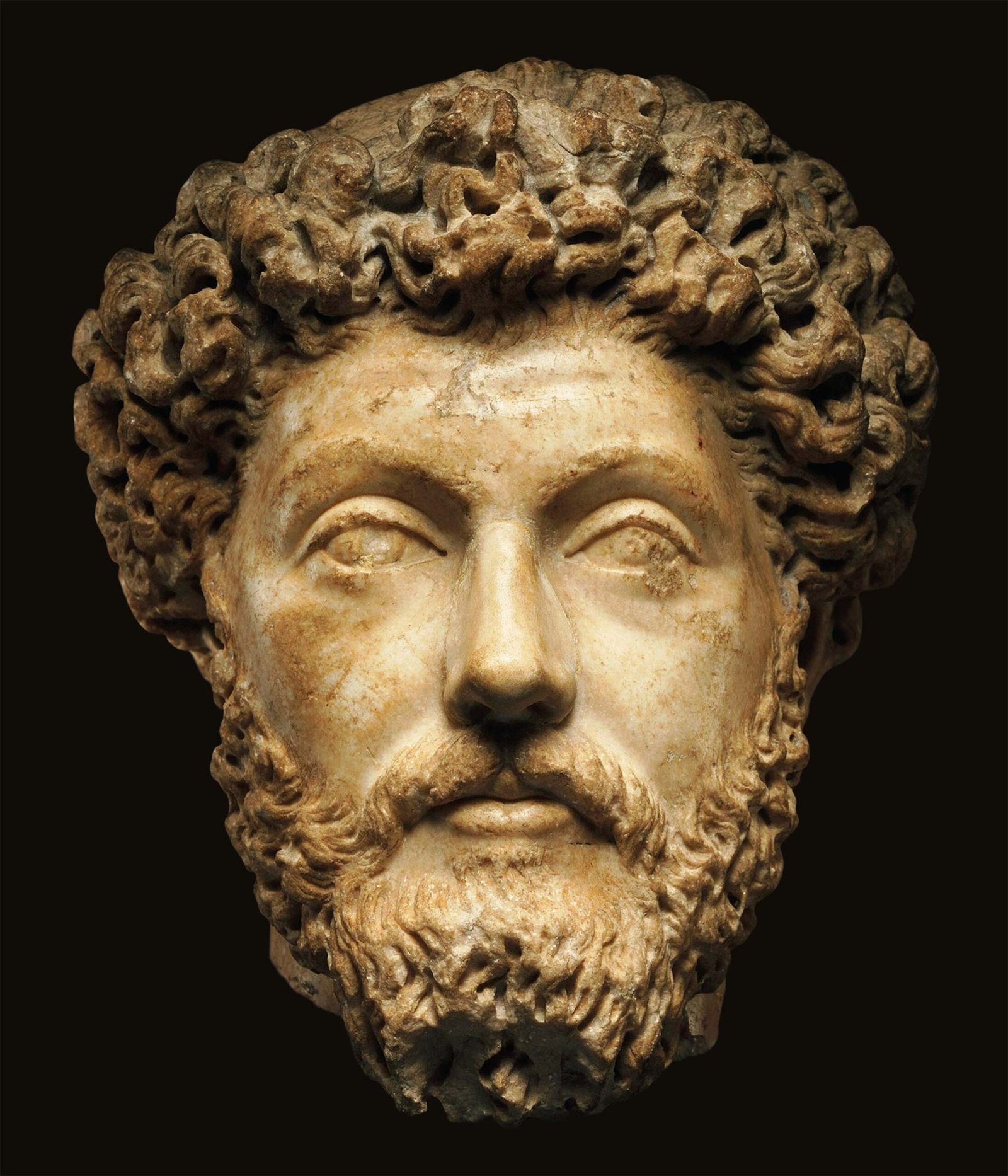
Marcus Aurelius (born April 26, 121 CE, in Rome, Italy—died March 17, 180 CE, in Vindobona, in the Roman province of Upper Pannonia, near modern-day Vienna, Austria) was a Roman emperor, military commander, and Stoic philosopher who ruled from 161 to 180 CE. His full name was Marcus Aurelius Antoninus. He is remembered for his philosophical writings, particularly Meditations, and for leading the Roman Empire through years of military conflict, political challenges, and a devastating plague. He was one of the last emperors traditionally associated with the period known as the Five Good Emperors.
Early Life and Family Background
Marcus Aurelius was born into a wealthy and influential Roman family. His father, Marcus Annius Verus, came from a prominent senatorial family and held important public positions. His mother, Domitia Lucilla, belonged to a wealthy family with extensive property and business interests.
Marcus’s father died when he was still a young child. Afterward, he was raised under the care of his mother, grandfather, and other relatives. His grandfather, Marcus Annius Verus, was an important Roman senator who helped provide him with a stable upbringing and access to influential political circles.
From an early age, Marcus showed an interest in learning and serious study. He received an education appropriate for a boy from a wealthy Roman family, studying literature, public speaking, philosophy, and Greek.
He became particularly interested in Stoicism, a school of philosophy that taught people to live according to reason, develop self-control, accept what they could not change, and fulfill their responsibilities toward others.
His early interest in philosophy shaped his personality and influenced many of the decisions he later made as emperor.
Education and Early Interest in Philosophy
Marcus received instruction from several respected teachers who helped develop his knowledge of literature, rhetoric, and philosophy.
Among his important teachers was Junius Rusticus, a Roman statesman and Stoic philosopher who introduced him to the writings of Epictetus. Marcus later credited Rusticus with teaching him the importance of examining his own behavior and avoiding unnecessary pride.
He also studied under Apollonius of Chalcedon, a Stoic philosopher who encouraged discipline and independence of thought. Other teachers introduced him to different branches of philosophy and helped him develop his understanding of ethics and public responsibility.
Marcus gradually adopted a simple and disciplined lifestyle. He became less interested in luxury and more concerned with controlling his emotions and improving his character.
His family initially had concerns about the intensity of his philosophical habits. Nevertheless, his interest continued, and philosophy became an important part of his daily life.
He also developed a close relationship with the emperor Hadrian, who recognized his intelligence and potential. Hadrian gave him the honorary name Verissimus, meaning very truthful, when he was still a child.
Adoption by Antoninus Pius
Hadrian had no biological children and needed to arrange a stable succession. In 138 CE, shortly before his death, he adopted Antoninus Pius and required him to adopt two younger men: Marcus Aurelius and Lucius Verus.
Marcus was approximately 17 years old at the time. His adoption placed him directly in the imperial succession and changed the course of his life.
Antoninus Pius became emperor after Hadrian’s death in 138 CE. He treated Marcus as a member of his immediate family and prepared him for future responsibilities.
Marcus received the name Marcus Aelius Aurelius Verus Caesar following his adoption. He also became engaged to Faustina the Younger, the daughter of Antoninus Pius.
During Antoninus’s reign, Marcus held several important political positions. He served as consul and gradually gained experience in government affairs.
He also became increasingly involved in the administration of the empire. Antoninus allowed him to participate in important decisions and gave him opportunities to understand the responsibilities of imperial leadership.
Marcus later described Antoninus as an important personal example. He admired his adoptive father’s patience, fairness, moderation, and ability to manage public affairs without unnecessary displays of authority.
Marriage and Family Life
Marcus Aurelius married Faustina the Younger in 145 CE. Their marriage connected him closely to the imperial family and strengthened his position as Antoninus Pius’s intended successor.
The couple had a large family, although several of their children died during infancy or childhood. Among their surviving children was Commodus, born in 161 CE, who later succeeded Marcus as emperor.
Their family life was affected by the demands of imperial responsibilities. Marcus frequently traveled with the army or worked away from Rome, particularly during periods of military conflict.
Faustina accompanied him on some journeys and remained an important figure in the imperial household. She received the title of Augusta and was recognized publicly as empress.
Marcus’s surviving writings contain little detailed information about his marriage or private family life. Most of what is known comes from historical accounts, inscriptions, and records of the imperial family.
Becoming Emperor of Rome
Antoninus Pius died on March 7, 161 CE, after ruling for more than two decades. Marcus Aurelius succeeded him as emperor.
However, Marcus made an unusual decision. He insisted that Lucius Verus, his adoptive brother, also receive imperial authority.
The Senate recognized both men as emperors, creating a joint arrangement in which Marcus and Lucius shared the highest position in the Roman government. This was the first time that Rome had two formally equal emperors ruling together.
Marcus was the senior partner in the arrangement and held considerable influence over government policy. Lucius Verus, meanwhile, played an important role in military affairs.
Marcus initially faced several challenges. The empire needed to manage conflicts along its eastern frontier, maintain its military strength, and respond to economic and administrative pressures.
He also had to establish his authority while maintaining the political stability that had existed during Antoninus Pius’s reign.
Despite his philosophical interests, Marcus understood that ruling Rome required practical decisions involving war, diplomacy, finances, and public administration.
The Parthian War
One of Marcus Aurelius’s first major challenges involved the Parthian Empire, Rome’s powerful rival in the East.
In 161 CE, Parthian forces invaded Armenia, a region that had long been disputed between Rome and Parthia. The Romans had traditionally sought to maintain influence over Armenia because of its strategic position between the two empires.
The invasion created a serious military crisis. Roman forces suffered setbacks, and the eastern provinces faced the threat of further attacks.
Lucius Verus traveled east to oversee the military response. Although he was the emperor formally associated with the campaign, much of the military planning and field leadership was handled by experienced Roman generals.
Roman forces gradually regained control of Armenia and advanced into Parthian territory. They captured important cities, including the Parthian capitals of Seleucia and Ctesiphon, in 165 and 166 CE.
The campaign ended with a Roman victory, and Roman influence in the East was temporarily strengthened.
However, returning soldiers brought a devastating epidemic into the empire. The disease, commonly known as the Antonine Plague, spread through Roman territories and caused widespread deaths.
The epidemic affected military units, urban communities, and the general population. Its exact cause remains uncertain, although smallpox is often considered a possible explanation.
The outbreak created serious economic and military problems that continued to affect Marcus’s reign.
The Antonine Plague
The Antonine Plague began spreading through the Roman Empire during the later stages of the Parthian campaign. It became one of the most serious public health crises of Marcus Aurelius’s reign.
The disease spread through major cities, military camps, and trade routes. It caused substantial population losses and disrupted everyday economic activity.
Roman officials struggled to maintain normal government operations as communities lost workers, soldiers, and local leaders.
The military was particularly affected. Recruiting enough soldiers became more difficult, and the empire faced additional pressure to defend its frontiers.
Marcus responded by supporting relief efforts and attempting to maintain public order. The government also took steps to address shortages of personnel in the army.
The epidemic continued for years and returned in later outbreaks. Its effects placed a heavy burden on the Roman state and contributed to the difficulties Marcus faced during his later military campaigns.
The Marcomannic Wars
While the Roman army was occupied in the East, pressure increased along the northern frontier.
Several groups, including the Marcomanni, Quadi, and other Germanic peoples, began threatening Roman territory along the Danube River.
In 166 and 167 CE, groups from beyond the frontier crossed into Roman lands. Some advanced into the provinces of Pannonia and Noricum, while others reached areas closer to northern Italy.
The situation became especially serious when enemy forces threatened important Roman settlements and trade routes.
Marcus and Lucius Verus organized a military response. However, Lucius died in 169 CE while returning from the eastern provinces, leaving Marcus as the sole emperor.
Marcus then devoted much of his remaining reign to the northern wars, which became known as the Marcomannic Wars.
He personally traveled to the frontier and spent long periods with the army. Military operations were difficult because of the challenging terrain, the size of the opposing forces, and the continuing effects of the plague.
Roman forces eventually regained control over several threatened territories. Marcus also negotiated agreements with some neighboring groups, although these settlements did not end the conflict permanently.
The wars continued intermittently until the end of his reign.
Life as a Military Emperor
Marcus Aurelius spent much of his later life away from Rome, overseeing military operations along the northern frontier.
He was not primarily known as a soldier before becoming emperor. His earlier interests had centered on philosophy, education, and government. Nevertheless, he adapted to the demands of military leadership.
He inspected troops, reviewed military supplies, supervised commanders, and made decisions about campaigns and negotiations.
The conditions of frontier life were difficult. Marcus often lived in military camps and faced the same environmental challenges as the soldiers under his command.
His philosophical writings from this period show that he continued practicing Stoicism despite the pressures of war. He frequently reminded himself to remain patient, control anger, perform his duties, and avoid being distracted by personal comfort.
He also faced financial difficulties because of the costs of maintaining large armies. To raise money, he sold valuable imperial possessions at auction rather than relying entirely on increased taxation.
These measures helped support military operations during a period when the empire’s resources were under considerable pressure.
Marcus Aurelius and Stoic Philosophy
Marcus Aurelius is widely known for his connection to Stoic philosophy. His understanding of Stoicism influenced how he approached personal behavior, government, and military responsibilities.
Stoicism teaches that people should distinguish between what they can control and what they cannot. Individuals cannot always control events, other people’s actions, illness, or death, but they can work to control their own judgments, decisions, and behavior.
Marcus believed that people should act with honesty, fairness, courage, and self-discipline. He also emphasized the importance of fulfilling responsibilities rather than seeking personal pleasure or recognition.
Another central idea in his thinking was that human beings belong to a larger community. People should cooperate, treat others fairly, and recognize their shared responsibilities.
His philosophical approach also encouraged him to avoid anger and resentment. He believed that people often act wrongly because of ignorance or mistaken judgment, and that understanding this could help a person respond with patience rather than hostility.
Marcus did not claim that following philosophy would eliminate hardship. Instead, he viewed it as a way to maintain a clear mind and act responsibly even when circumstances were difficult.
Meditations and His Personal Writings
Marcus Aurelius wrote a collection of personal reflections that later became known as Meditations. The work was written primarily in Greek and was probably composed during the later years of his life, much of it while he was on military campaigns.
The book was not originally intended for publication. It appears to have been a private record of his thoughts, reminders, and philosophical exercises.
In Meditations, Marcus repeatedly examines his own behavior and reminds himself to act according to reason and virtue.
He writes about the temporary nature of human life, the importance of controlling emotional reactions, and the need to treat other people with fairness.
He also reflects on the difficulties of leadership. Rather than allowing his position to make him arrogant, he reminds himself that power and public recognition are temporary.
A recurring theme is the importance of focusing on the present task. Marcus encourages himself to do what is necessary without becoming distracted by the past or worrying excessively about the future.
The work is divided into 12 books, each containing a series of short reflections. The writing is direct and personal, often resembling a private conversation with himself.
Although Meditations was not written as a formal philosophical textbook, it provides a detailed view of how Marcus tried to apply Stoic principles to his daily life.
Government and Legal Administration
Despite spending much of his reign dealing with military problems, Marcus Aurelius continued to oversee the administration of the Roman Empire.
He worked with the Senate and relied on experienced officials to manage government affairs. He also supported improvements to the legal system and took an interest in the treatment of vulnerable members of society.
Roman law developed further during his reign, particularly in areas involving family relationships, inheritance, guardianship, and the rights of individuals with limited legal protection.
Marcus supported measures that offered certain protections to enslaved people, although slavery remained a major part of Roman society throughout his rule.
He also maintained institutions that provided assistance to disadvantaged children in Italy. These programs continued earlier imperial efforts to support families and local communities.
His administration faced financial pressure from military spending and the plague. Nevertheless, he worked to maintain the established structures of government and preserve stability across the provinces.
Religious Beliefs and Treatment of Christians
Marcus Aurelius lived during a period when Christianity was spreading through the Roman Empire.
Christians refused to participate in traditional Roman religious ceremonies and worship of the emperor, which sometimes created tension with local authorities.
During Marcus’s reign, Christians faced persecution in several places, including Lyon in Gaul and other parts of the empire.
Historical accounts associate some of these persecutions with the broader religious and political tensions of the period. However, there is no clear evidence that Marcus personally organized a single empire-wide campaign against Christians.
His writings show that he valued traditional Roman religious practices and believed that people should fulfill their duties to the community.
Some ancient Christian writers criticized Marcus’s reign because of the suffering experienced by Christian communities during this period. At the same time, the surviving evidence does not establish the exact extent of his personal involvement in every local persecution.
Later Military Campaigns and the Final Years
By the 170s CE, Marcus Aurelius had spent many years dealing with conflicts along the Danube frontier.
Roman forces achieved several successes, but the northern situation remained unstable. Marcus continued military operations against the Marcomanni, Quadi, and other groups.
He considered reorganizing some northern territories under Roman control. However, these plans were never fully completed.
In 175 CE, Marcus faced another major challenge when Avidius Cassius, the governor of Syria and a powerful military commander, declared himself emperor after hearing a false report that Marcus had died.
Cassius received support in some eastern provinces, but the rebellion ended quickly. He was killed by members of his own forces before Marcus could reach the region.
Marcus responded with restraint toward many of those associated with the uprising. He sought to avoid unnecessary punishments and prevent the conflict from developing into a larger civil war.
During this period, Marcus also traveled through the eastern provinces with his wife, Faustina, and their son Commodus. Faustina died during the journey in 175 CE.
Marcus continued his work along the frontier after returning to military operations in the north.
Commodus and the Question of Succession
Marcus Aurelius had several children with Faustina the Younger, but many died before reaching adulthood. His surviving son Commodus became increasingly important as the emperor’s health declined.
In 177 CE, Marcus appointed Commodus as co-emperor, giving him experience and authority before his eventual succession.
This decision differed from the succession arrangements used by several earlier emperors, who had selected capable adult men through adoption rather than passing the throne directly to a biological son.
Marcus’s choice reflected his desire to maintain continuity within the imperial family. However, it also meant that the future of the empire would depend on a young heir whose abilities had not yet been fully tested.
Commodus accompanied his father during military operations and gradually assumed greater responsibilities.
Marcus continued leading the army while preparing his son to take over the government.
Death
Marcus Aurelius died on March 17, 180 CE, while serving with the Roman army along the Danube frontier. He was 58 years old.
The traditional account places his death at Vindobona, the Roman military settlement that later developed into modern Vienna, Austria. Some historical accounts associate his final illness with the nearby military headquarters at Sirmium, so the precise location is not entirely certain.
His death brought an end to a reign that had lasted nearly 19 years.
Commodus succeeded him as sole emperor and continued the northern military campaigns for a short time before negotiating peace with several groups beyond the Roman frontier.
Marcus Aurelius was honored by the Roman Senate and received the traditional recognition granted to a deceased emperor. His ashes were placed in the Mausoleum of Hadrian in Rome.
His personal writings, preserved under the title Meditations, remained available to later generations and became the most familiar record of his thoughts, personal struggles, and efforts to live according to Stoic philosophy.