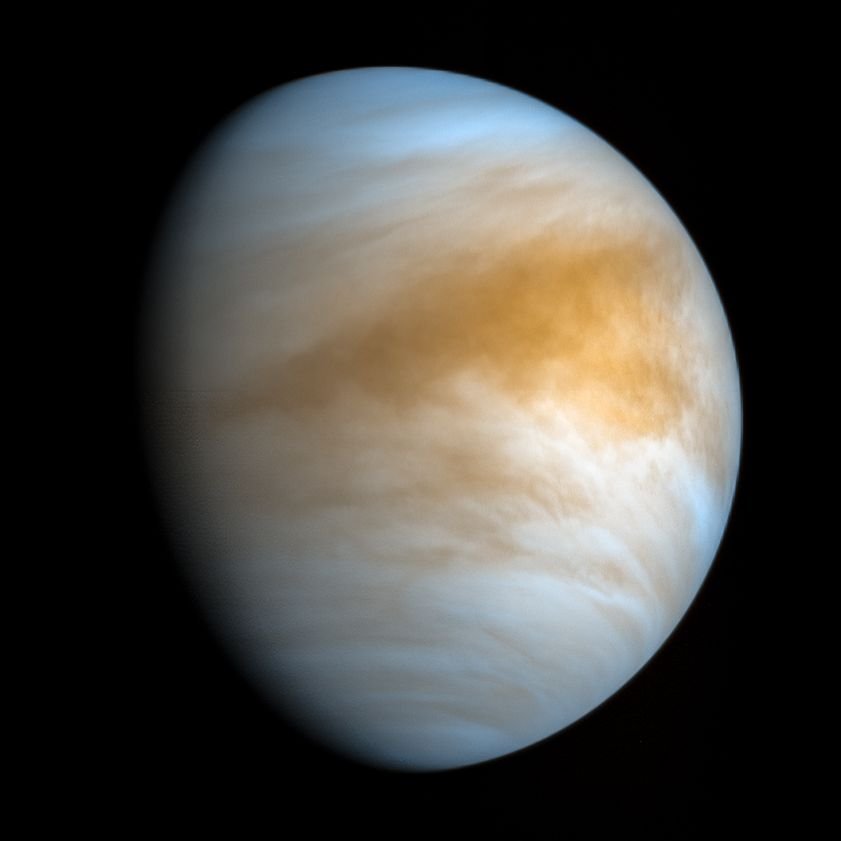
When we look up at the night sky and see Venus glowing with breathtaking brilliance, it’s easy to mistake it for a symbol of peace and beauty. The ancients called it the Morning Star and the Evening Star—a celestial beacon that heralded dawn and dusk. Yet beneath that shimmering light lies a planet of torment. Venus is a world smothered by clouds of sulfuric acid, crushed by a suffocating atmosphere, and scorched by heat so intense it could melt lead.
For centuries, humanity imagined Venus as a twin to Earth—similar in size, composition, and even age. But the deeper we’ve looked, the more it seems that Venus is not our sister, but our cautionary reflection.
This begs the haunting question: Could Earth one day become like Venus? Could our blue, life-filled world transform into a blistering wasteland, wrapped in fire and acid, where no ocean glimmers and no breath of life stirs?
To answer this, we must journey across billions of years—into the deep past, through the dynamic present, and forward into the far future of our planet.
The Twin That Burned
Venus and Earth began their existence side by side in the early solar system, about 4.5 billion years ago. They are nearly the same size, their compositions are strikingly similar, and both likely started with abundant water and a thick atmosphere. For a time, Venus may have been a habitable world, with oceans, rain, and perhaps even a mild climate.
But something went catastrophically wrong. As the young Sun grew brighter over eons, Venus began to warm. Its oceans evaporated, and water vapor—one of the most powerful greenhouse gases—trapped more and more heat. The hotter the planet became, the faster its remaining water boiled away, and as it did, the hydrogen escaped into space.
With no oceans left to absorb carbon dioxide from volcanic eruptions, CO₂ built up in the atmosphere unchecked. The greenhouse effect spiraled out of control, leading to what scientists call a runaway greenhouse effect.
The result was apocalyptic. Venus’s surface temperature soared to about 465°C—hotter than Mercury, even though Venus orbits farther from the Sun. Its atmosphere thickened to 90 times the pressure of Earth’s, and sulfuric acid clouds formed in its toxic skies. What was once a world of water became a furnace of fire.
If we can understand how Venus fell from grace, we can better grasp how fragile Earth’s own balance truly is.
The Delicate Balance of Earth’s Climate
Earth, by contrast, has maintained a climate that allows life to flourish. The key lies in balance—between the Sun’s heat, atmospheric gases, and geological processes that regulate carbon and water.
Our atmosphere is only a thin veil, composed mostly of nitrogen, oxygen, and a small but vital amount of carbon dioxide and water vapor. Without greenhouse gases, the Earth’s surface would be a frozen wasteland. But too much of them, and we risk transforming our world into something far deadlier.
What makes Earth unique is the carbon-silicate cycle—a natural thermostat that stabilizes global temperatures over geological timescales. When the planet warms, more water evaporates, increasing rainfall that weathers rocks and locks carbon dioxide into minerals. When it cools, volcanic activity releases CO₂ back into the air, trapping heat and restoring equilibrium.
It’s an elegant, self-correcting system—one that has kept Earth habitable for over 3 billion years. But this balance is fragile, and it depends on the presence of liquid water, active geology, and an atmosphere that doesn’t spiral out of control.
If any one of these components were to break, the consequences could be catastrophic.
The Venusian Lesson: When Oceans Boil
The most crucial difference between Earth and Venus is water. Water is the ultimate stabilizer—it absorbs heat, regulates temperature, and provides a sink for carbon dioxide. Without it, a planet is at the mercy of its atmosphere.
On Venus, as the oceans evaporated, they released vast amounts of water vapor into the atmosphere. This thickened the greenhouse blanket, trapping even more heat. With no rain to remove carbon dioxide and no seas to store it, CO₂ accumulated endlessly. Eventually, the planet reached a tipping point—its entire climate system collapsed into a permanent greenhouse state.
This process may have unfolded over hundreds of millions of years, but once the threshold was crossed, there was no turning back. Venus’s atmosphere became an engine of heat, recycling and amplifying its own energy until it stabilized at a hellish equilibrium.
Scientists refer to this as a runaway greenhouse effect—a self-reinforcing loop in which rising temperatures cause more greenhouse gases to accumulate, which in turn causes more heating.
The terrifying truth is that this same process could, in theory, happen to Earth. The question is not whether it’s possible—it’s whether we might one day push our planet past that same point of no return.
The Seeds of a Runaway Greenhouse on Earth
Right now, Earth’s greenhouse effect is moderate and essential. But human activity has begun to tip the scales. Since the Industrial Revolution, we’ve burned billions of tons of fossil fuels, releasing massive amounts of carbon dioxide, methane, and other heat-trapping gases into the air.
Global temperatures have already risen by more than 1°C since pre-industrial times, and the pace is accelerating. Ice sheets are melting, sea levels are rising, and extreme weather is becoming more frequent. These are the early signs of a shifting equilibrium.
But could this human-induced warming trigger a Venus-like runaway effect? Most climate models suggest that it’s unlikely in the near future—but not impossible over the long term.
Earth’s oceans and biosphere still absorb much of the excess carbon, and our atmosphere is thinner than Venus’s. However, if we continue on our current trajectory for thousands or millions of years, the accumulation of greenhouse gases—and the gradual brightening of the Sun—could push our planet toward a similar fate.
The seeds of a runaway greenhouse already exist within Earth’s climate system. Whether they germinate depends on what we do next.
The Sun’s Slow Brightening
One factor that no human can control is the evolution of the Sun. Stars like ours grow hotter as they age. Over the next billion years, the Sun’s luminosity is expected to increase by about 10%.
That may not sound like much, but even a small increase in solar energy can have enormous effects on planetary climate. As sunlight intensifies, Earth’s average temperature will rise. The oceans will slowly evaporate, and the water vapor released will amplify the greenhouse effect.
At first, the process will be gradual. But eventually, evaporation will accelerate exponentially, forming a thick layer of water vapor that traps more heat than our atmosphere can release. Once this threshold is crossed—estimated to occur in roughly one to two billion years—the oceans will boil away completely.
Without water, Earth will follow the same path as Venus: a runaway greenhouse effect that transforms it into a dry, scorched planet. The continents will burn, the atmosphere will thicken with carbon dioxide, and surface temperatures will climb to hundreds of degrees.
This distant future is not a product of human neglect—it is a natural outcome of stellar evolution. Yet, it’s a reminder of how delicate the conditions for life truly are.
The Fragile Shield of Life
What separates Earth from Venus today is life itself. The biosphere—every plant, bacterium, and organism that breathes, grows, and dies—plays a crucial role in regulating the atmosphere.
Photosynthesis removes carbon dioxide and releases oxygen. Marine organisms lock carbon in shells that settle into the ocean floor. Forests, wetlands, and soils act as carbon reservoirs, maintaining the fine balance between heat and habitability.
Life stabilizes the planet that sustains it. It is both the child and the guardian of Earth’s climate.
If we destroy too much of that biosphere—through deforestation, pollution, and ocean acidification—we weaken that shield. Once ecosystems collapse, the planet’s ability to absorb carbon diminishes, and the atmosphere thickens. The cycle feeds on itself, mirroring in miniature what happened to Venus long ago.
We may not cause an immediate Venusian catastrophe, but unchecked destruction of the biosphere could set in motion processes that slowly erode Earth’s resilience.
The Alchemy of the Atmosphere
Venus’s atmosphere is a deadly mix of carbon dioxide and sulfuric acid, while Earth’s is a delicate blend of nitrogen, oxygen, and trace gases. The composition of an atmosphere determines everything: the planet’s temperature, pressure, chemistry, and even color.
On Earth, volcanic activity releases gases like carbon dioxide and sulfur dioxide, but these are largely balanced by the carbon and sulfur cycles. On Venus, those same processes went unchecked. Without liquid water to bind and neutralize these gases, they accumulated in the air, thickening into a permanent haze of acid and carbon.
Could Earth’s atmosphere ever become that toxic? In a natural sense, yes—but only under extreme conditions. If the oceans vanished and volcanic outgassing continued without restraint, carbon dioxide could dominate the atmosphere. Sulfur dioxide from volcanoes would react with the remaining water vapor, creating sulfuric acid clouds like those on Venus.
In other words, without water and biological feedbacks, Earth’s sky could transform into a cauldron of chemistry—dense, corrosive, and deadly.
The Death of the Oceans
If Earth ever enters a runaway greenhouse phase, the oceans will be the first casualties. As temperatures rise, evaporation will accelerate. The upper atmosphere will fill with water vapor, which will then be broken apart by ultraviolet radiation from the Sun.
Hydrogen, the lightest element, will escape into space, while oxygen will react with the crust or be trapped in oxidized minerals. Over time, Earth will lose its water irreversibly.
This process may take hundreds of millions of years, but once begun, it cannot be stopped. The oceans will shrink into salty basins, then vanish entirely, leaving a planet of cracked plains and volcanic dust.
In a cruel irony, the last remnants of water would persist in the form of acid rain—a ghostly echo of the storms that once nourished life.
The End of the Biosphere
Without water, life would collapse. Plants would wither, animals would perish, and even microbes would struggle to survive. Photosynthesis would halt, oxygen levels would drop, and the air would fill with carbon dioxide.
Earth’s surface would become unrecognizable—a scorched wasteland of deserts and lava fields, where the heat never wanes and the sky glows with perpetual twilight.
The final life forms might cling to existence in isolated refuges—perhaps deep underground, or high in the atmosphere where temperatures remain tolerable. But eventually, even these last survivors would vanish, leaving behind a planet as silent as Venus.
This would mark the true death of Earth—not by impact or explosion, but by suffocation and heat. The planet that once bloomed with life would fade into stillness, its memory preserved only in the fossils of a lost biosphere.
The Human Role in the Tipping Point
Though the natural transformation of Earth into a Venus-like world will take eons, human activity could accelerate certain steps of that process.
The burning of fossil fuels, deforestation, and industrial emissions have already altered the balance of atmospheric gases. If global temperatures continue to rise unchecked, it could trigger feedback loops—melting permafrost releasing methane, dying forests releasing carbon dioxide, and the loss of polar ice reducing the planet’s ability to reflect sunlight.
While these processes alone would not make Earth exactly like Venus, they could lead to a “moist greenhouse effect”—a milder but still devastating version, where much of the water evaporates and the planet becomes unbearably hot and dry.
This scenario could unfold over thousands of years rather than billions. It wouldn’t be the total annihilation Venus endured, but it would be catastrophic for civilization and most life on Earth.
In this sense, Venus is not just a scientific curiosity—it is a warning, a prophecy written in carbon and fire.
The Long View: Earth’s Distant Future
Even if humanity survives its own self-made crises, time itself will eventually claim our planet. In roughly a billion years, the Sun’s gradual brightening will trigger a moist greenhouse effect naturally.
The polar ice caps will vanish, deserts will expand, and the oceans will begin to recede. As more water vapor fills the atmosphere, the planet’s infrared radiation will be trapped, accelerating the warming.
Over time, the oceans will boil away, and the carbon cycle will collapse. Earth will lose its last reservoirs of liquid water and become a barren, oxidized wasteland. The once-blue planet will turn white with clouds, then yellow-brown as sulfur and carbon dominate the sky.
In the final stages, our world will be nearly indistinguishable from Venus. Its surface will be scorched, its atmosphere dense and toxic, and its history erased beneath a global shroud of heat.
The Universe’s Irony
It is one of the universe’s greatest ironies that the same forces that create life eventually destroy it. The Sun, giver of warmth and light, will one day become the engine of Earth’s destruction. The same greenhouse effect that keeps us alive can also cook the planet to death.
Venus is the embodiment of this irony—a world that may once have been a paradise, now frozen in eternal fire.
When we peer at Venus through telescopes, we are not just seeing another planet. We are glimpsing a possible version of ourselves—a warning written across the cosmos in cloud and flame.
Lessons from the Morning Star
The story of Venus is not just a tale of doom; it is a lesson in balance and foresight. It teaches us that planetary habitability is neither guaranteed nor permanent. It must be preserved through understanding and care.
By studying Venus, scientists have learned to read the delicate signals of climate feedback, atmospheric chemistry, and planetary evolution. These insights help us predict and mitigate the dangers of climate change here on Earth.
Every satellite that maps Venus, every probe that tastes its air or scans its surface, is not just exploring a distant world—it’s helping us understand our own.
The Hope in the Science
Though the long-term fate of Earth is sealed by the laws of stellar evolution, our near-term future remains in our hands. The choices humanity makes in this century will determine whether Earth remains a thriving oasis or begins its slow descent toward desolation.
We cannot prevent the Sun’s brightening, but we can prevent a human-made runaway greenhouse. We can choose to restore forests, develop clean energy, and balance our relationship with the atmosphere that sustains us.
Venus may be a warning, but it is also a reminder of how special Earth is—a world balanced on the edge of chaos, where life and light coexist in rare harmony.
A Planetary Reflection
Imagine standing on Venus, beneath its sulfuric skies, looking upward. Through the haze, you might see a faint blue dot in the sky—Earth, shining across the void. That dot would represent everything Venus lost: oceans, clouds, forests, and the whisper of wind through trees.
Now imagine standing on Earth, looking at Venus as we do tonight. That brilliant light in the twilight sky is not just another world—it is a reflection of what could be.
The two planets are bound by shared origins and opposing destinies: one a paradise that endured, the other a paradise that perished.
The fate of Earth is not written yet. Venus shows us what is possible when equilibrium is lost—but it also inspires us to protect the fragile miracle we still have.
The Fire and the Blue
Venus burns with the memory of what it once was. Earth shines with the promise of what it can still be.
Both worlds remind us that beauty and destruction are two sides of the same cosmic coin. To keep our planet alive, we must understand the forces that nearly destroyed its twin.
For in the end, the story of Venus is not just about another world—it is about ours. It is a story of balance and loss, of fire and water, of the delicate threads that bind life to the stars.
If we are wise, we will listen to that story. We will look to the fiery goddess in the sky and remember that even the brightest light can hide a warning beneath its glow.
Venus is our mirror, and in her reflection we see both our past and our possible future. Whether Earth becomes a second Venus or remains the blue jewel of the cosmos depends not on fate, but on choice—our choice.
For now, we still live on the side of life. But the morning star burns above us, eternal and bright, reminding us with silent brilliance: the line between paradise and hell is thinner than we dare to imagine.