For generations, Mars has captured humanity’s imagination like no other world. It gleams faintly red in the night sky—a mysterious desert planet that has been the backdrop of myth, science fiction, and scientific ambition. From the ancient astronomers who named it after the god of war to modern engineers designing spacecraft to land there, Mars has long represented both fear and fascination.
Today, Mars stands as humanity’s next great frontier. It is a world within our reach yet filled with challenges that test the limits of our ingenuity and endurance. The question—Could humans truly survive on Mars?—is no longer a matter of fantasy. It is a scientific and moral inquiry into our species’ future, into whether we can turn an alien world into a second home or whether our destiny is bound to Earth forever.
The dream of Mars is a dream of survival, exploration, and transformation. It speaks to something deeply human—the urge to go beyond, to plant our feet where none have walked, to prove that life can thrive even under an alien sun. But before humanity can become an interplanetary species, we must confront the harsh truths of the Red Planet: its thin air, lethal cold, deadly radiation, and unyielding desolation.
A World Both Familiar and Alien
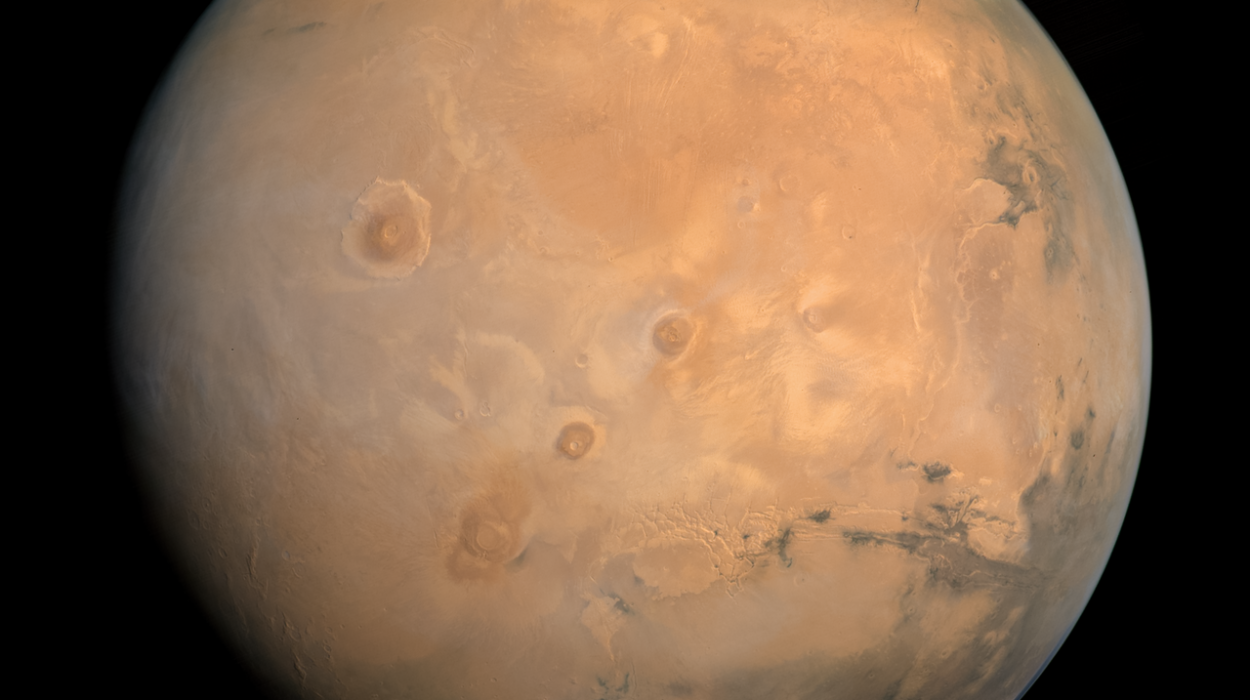
Mars, the fourth planet from the Sun, orbits just beyond Earth in the solar system’s habitable zone. It is about half the size of our planet, with gravity roughly one-third as strong. Its rusty hue, visible even to the naked eye, comes from iron oxide—the same compound that gives Earth’s soil its reddish tint. In many ways, Mars appears almost familiar: it has mountains, valleys, ice caps, and weather. It even has seasons and days nearly as long as Earth’s.
Yet beneath this apparent similarity lies a world profoundly hostile to life as we know it. Mars is a frozen desert, with average surface temperatures around -63°C. Its atmosphere is a whisper, less than 1% the density of Earth’s, composed mostly of carbon dioxide. Without a magnetic field to shield it, Mars is bombarded by cosmic rays and solar radiation. Its winds can rise to hundreds of kilometers per hour, creating dust storms that envelop the planet for weeks.
This is the paradox of Mars: it looks like Earth’s twin, yet behaves like its opposite. Scientists often call it the “most Earth-like planet,” but that title is deceptive. The real question is not whether Mars resembles Earth, but whether it can ever become like Earth—or at least hospitable enough for humans to survive.
The Promise of Exploration
Humanity’s relationship with Mars has evolved from mythology to observation, from curiosity to exploration. The first telescopic studies in the 1600s revealed its changing polar caps. By the late 19th century, astronomers such as Giovanni Schiaparelli and Percival Lowell imagined networks of canals on its surface—evidence, they believed, of intelligent life. Though those illusions faded, the fascination endured.
The modern era of Mars exploration began in the 1960s with NASA’s Mariner missions, which flew by and photographed a cratered, barren world. The Viking landers of the 1970s conducted the first direct experiments searching for life. Their results were ambiguous—chemical reactions mimicked biological signatures, but no definitive life was found.
Then came Pathfinder, Spirit, Opportunity, Curiosity, and Perseverance—rovers that traversed the dusty plains, climbed ancient hills, and drilled into Martian rocks. They revealed evidence that Mars once had flowing rivers, lakes, and possibly oceans. The discovery of clay minerals, sedimentary layers, and hydrated salts suggested a warmer, wetter past.
This revelation transformed Mars from a barren wasteland into a time capsule—a record of what may once have been a habitable world. If Mars once supported life, perhaps it could again. And if life ever existed there, then the universe is likely teeming with it.
The Challenge of Getting There
Reaching Mars is an extraordinary feat of physics and endurance. It lies, on average, 225 million kilometers from Earth. Depending on the planets’ alignment, a one-way journey can take between six and nine months using current propulsion technology. This distance creates immense logistical challenges—not only for transportation, but for communication, resupply, and safety.
Every mission to Mars must launch during a narrow window when Earth and Mars are optimally aligned, a period that occurs roughly every 26 months. Once launched, astronauts would be isolated, with no quick return. The delay in radio communication—ranging from 4 to 24 minutes one way—means that real-time conversation with Earth would be impossible.
Space agencies are developing spacecraft capable of carrying humans safely through deep space, protecting them from microgravity effects, cosmic radiation, and psychological strain. The journey itself would test the limits of endurance, both physical and emotional. Crew members would live in confined quarters for months, cut off from Earthly comforts, reliant on precise engineering and teamwork for survival.
NASA’s proposed Artemis and Mars Transit Habitat missions, along with private ventures like SpaceX’s Starship program, aim to make this journey feasible within the next few decades. The first steps are already being taken around the Moon—our celestial rehearsal for the far more distant Red Planet.
Landing on a World That Fights Back
Arriving at Mars is only half the battle. Landing safely on its surface presents one of the most complex engineering challenges ever faced. Mars’ atmosphere is too thin to provide adequate aerodynamic braking, yet thick enough to generate immense heat during entry.
Spacecraft entering the Martian atmosphere experience forces up to 20 times that of Earth’s gravity and temperatures exceeding 1,500°C. Parachutes can only slow descent so much, and traditional rocket-powered landings are difficult in the thin air. NASA’s Curiosity and Perseverance rovers used a “sky crane” system—a hovering descent stage that lowered the rovers on cables—a triumph of modern engineering.
For human missions, landers will need to deliver payloads of tens of tons, not hundreds of kilograms. Engineers are exploring inflatable heat shields, supersonic retropropulsion, and advanced parachutes to manage these challenges. Every successful landing will be a symphony of precision timing, physics, and courage.
Once on the surface, astronauts will face the next great question: How can we stay alive here?
Breathing in a Poisoned Sky
Mars’ atmosphere poses one of the most immediate threats to survival. It is composed of 95% carbon dioxide, 2.6% nitrogen, 1.9% argon, and trace amounts of oxygen and water vapor. Breathing this air would be fatal within minutes. Moreover, the surface pressure is so low—about 0.6% of Earth’s—that unprotected human blood would boil.
To live on Mars, humans must bring their own air or make it on-site. This is where one of the most promising technologies comes in: in-situ resource utilization (ISRU). NASA’s Perseverance rover carried an experiment called MOXIE (Mars Oxygen In-Situ Resource Utilization Experiment), which successfully extracted oxygen from Martian carbon dioxide using electrolysis. The process works by splitting CO₂ molecules into oxygen and carbon monoxide.
Though MOXIE produced only small amounts—enough for an astronaut to breathe for about ten minutes—it demonstrated that Mars’ atmosphere could become a source of life-supporting oxygen. Scaling up this technology could allow future missions to generate breathable air and oxidizer for rocket fuel directly from the Martian environment, drastically reducing dependence on Earth.
The Thirst for Water
Water is the foundation of life, and its presence on Mars is both scarce and precious. Though dry on the surface, the planet holds vast reserves of frozen water locked in its polar ice caps and buried beneath the soil. Orbiters have detected subsurface ice deposits extending from the poles toward the equator, and radar data suggest the existence of ancient, possibly briny liquid reservoirs deep underground.
Accessing this water will be crucial. It can sustain astronauts, grow crops, and provide hydrogen and oxygen for fuel. Ice mining technologies are being developed to extract, purify, and store water in the harsh Martian conditions. Solar-powered heaters, robotic drills, and even microwaves may one day melt ice directly into usable liquid.
In the near term, human missions will likely target regions where ice is accessible, such as mid-latitude plains or cratered terrains with exposed frost. Water will be both a survival resource and a symbol of adaptation—a literal wellspring of life on an alien world.
The Battle Against Cold and Radiation
If the lack of air and water weren’t enough, Mars presents another lethal combination: extreme cold and relentless radiation. With no magnetic field and only a thin atmosphere, Mars is constantly bombarded by cosmic rays and solar particles that can damage DNA and increase cancer risk.
On Earth, our magnetic field and atmosphere provide natural shields, but on Mars, exposure could reach 700 millisieverts per year—nearly 20 times the maximum safe level for humans. Future colonists will need protection through habitat design, underground living quarters, or radiation-absorbing materials such as polyethylene and regolith.
Temperature is equally challenging. At the equator, daytime temperatures may rise to a tolerable 20°C, but at night they plunge below -100°C. Colonies must be insulated, heated, and sealed to withstand the freezing air. Pressurized habitats, inflatable domes, or lava-tube shelters are being studied as potential refuges. The most promising sites may lie underground, where stable temperatures and radiation shielding naturally exist.
Survival on Mars will not depend on brute endurance alone—it will require ecosystems of engineering that mimic Earth itself.
Building Homes on a Hostile Planet
Any human presence on Mars must begin with shelter. Habitats must protect against vacuum, radiation, temperature swings, and dust storms—all while maintaining breathable air, livable pressure, and psychological comfort.
Early missions will likely bring prefabricated modules from Earth, similar to those on the International Space Station. These pressurized habitats would be buried under regolith for added protection. Over time, colonists could construct larger settlements using local materials. 3D printing with Martian soil—a technique already demonstrated on Earth—could build domes, bricks, and structural supports without transporting heavy cargo from home.
Engineers envision modular settlements with airlocks, hydroponic gardens, laboratories, and living quarters connected by pressurized tunnels. Inside, closed-loop systems would recycle air, water, and waste, creating a miniature biosphere. Artificial lighting would regulate circadian rhythms, while green spaces and communal areas would help maintain mental health in isolation.
Living on Mars will test more than technology—it will test adaptability, cooperation, and resilience. A habitat will not just be a shelter; it will be a living organism sustained by human ingenuity.
Growing Life on Martian Soil
For long-term survival, humans cannot depend on endless supplies from Earth. They must learn to cultivate life on Mars. But Martian soil, or regolith, is no ordinary soil—it lacks organic material, contains toxic perchlorates, and is exposed to sterilizing radiation.
Scientists are experimenting with ways to transform regolith into arable land. Washing or heating can remove perchlorates, while adding nutrients and microbes may help create fertile conditions. Experiments aboard the International Space Station and Earth-based simulators have shown that plants can grow in simulated Martian soil when supplemented with Earth-like nutrients.
Hydroponics and aeroponics—systems that grow plants in nutrient-rich water or air—may provide a faster path. Greenhouses with controlled light and temperature could yield crops of potatoes, lettuce, or beans. The challenge lies in closing the loop: recycling human waste into fertilizer, purifying water from condensation, and maintaining oxygen-carbon dioxide balance through plant respiration.
Growing food on Mars will not only sustain the body but nourish the spirit. The sight of living green in a world of red dust will remind colonists that life can take root anywhere determination allows it.
The Psychology of Isolation
Survival on Mars is not only a technical problem—it is a human one. Astronauts will face isolation, confinement, and distance on a scale never before experienced. The monotony of barren landscapes, the silence of the void, and the knowledge of being millions of kilometers from home can weigh heavily on the mind.
Studies of Antarctic stations, submarines, and simulated Mars habitats like NASA’s HI-SEAS project show that psychological health is as critical as physical survival. Team cohesion, conflict resolution, and mental stimulation become essential. Future Mars habitats may include virtual reality recreation, communication with loved ones, and structured routines to maintain morale.
In many ways, the journey to Mars will be an exploration of the human spirit. It will test not only technology but empathy, creativity, and endurance—the very traits that define our species.
Terraforming: Dream or Destiny?
Beyond survival lies a bolder question: could we one day transform Mars itself? The idea of terraforming—altering a planet’s environment to make it habitable—has long fascinated scientists and visionaries.
In theory, Mars could be warmed by releasing greenhouse gases, thickening its atmosphere, and melting its polar ice caps. This would raise pressure, release trapped CO₂, and create a self-reinforcing greenhouse effect. Eventually, liquid water could return, and engineered microbes might begin producing oxygen.
However, the challenges are astronomical. To raise Mars’ temperature significantly, we would need to release trillions of tons of gas—far beyond current capability. Moreover, much of Mars’ carbon dioxide is locked in mineral form, inaccessible without massive energy inputs. Terraforming Mars would likely take centuries or millennia, if it is possible at all.
Yet the dream persists, not because it is easy, but because it embodies humanity’s ultimate ambition: to become creators of worlds, caretakers of life beyond Earth. Even partial terraforming—such as creating habitable “pocket” ecosystems—could change our relationship with the cosmos forever.
Ethics Among the Stars
As humanity reaches for Mars, ethical questions follow. Does transforming another planet violate its natural state? What if microbial life exists there—should we protect it, or will colonization inevitably destroy it?
Planetary protection is a core principle of space exploration, ensuring that we do not contaminate other worlds or bring alien organisms back to Earth. Yet as human presence grows, complete sterility may be impossible. We must weigh our survival against the preservation of potential Martian ecosystems.
Moreover, Mars raises moral questions about inequality, governance, and ownership. Who controls a new world? Will Mars belong to all humanity, or will it become a new realm of competition and exploitation? The answers will shape not just our future on Mars, but our identity as a species.
A Mirror of Ourselves
In many ways, Mars is a mirror—a reflection of both our fragility and our audacity. It reminds us of what can be lost and what can be achieved. Mars was once a world of rivers and rain, perhaps even life. Something went wrong, and it froze. To study Mars is to study the fate that Earth might one day share if we fail to care for it.
Yet Mars also embodies hope. It challenges us to transcend our limits, to transform imagination into engineering, and to find meaning in the act of striving. The first humans to walk on its soil will not just be explorers; they will be representatives of all life on Earth, carrying our shared story to a new world.
The Future of Humanity on Mars
Could humans truly survive on Mars? The answer, scientifically and philosophically, is yes—but not easily, and not without cost. It will demand innovation, cooperation, and resilience on a scale unprecedented in history. Every breath, every meal, every sunrise beneath a salmon sky will be a triumph of adaptation.
Within this century, humans may establish permanent bases—perhaps near the poles or in lava tubes—and gradually build self-sustaining settlements. Mars could become humanity’s second cradle, a laboratory for science, and a gateway to the wider solar system.
Yet the greatest promise of Mars is not escape, but perspective. By reaching another world, we learn to see our own more clearly—to cherish the fragile blue oasis that birthed us. In every grain of Martian dust lies a reminder that life, wherever it arises, is precious beyond measure.
The Red Dawn
The first human footprints on Mars will mark a new epoch in cosmic history—the moment life from one world touched another. Those footsteps will echo across eons, proclaiming that a fragile species from a small planet dared to reach for the stars and found a way to endure.
Mars will not be an easy home. It will test our courage, ingenuity, and unity. But perhaps that is precisely why it calls to us. Survival on Mars is not only about living—it is about becoming more than we were.
When future generations stand beneath the pink twilight of the Martian sky and gaze toward the distant blue star of Earth, they will know that their ancestors refused to be bound by one world. They will know that the dream of survival was, at its heart, a declaration of hope.
For in the end, to ask Could humans truly survive on Mars? is to ask something even greater: Can humanity learn to survive—anywhere—together? And the answer, shining faintly from that red world in the night sky, is waiting for us to find out.