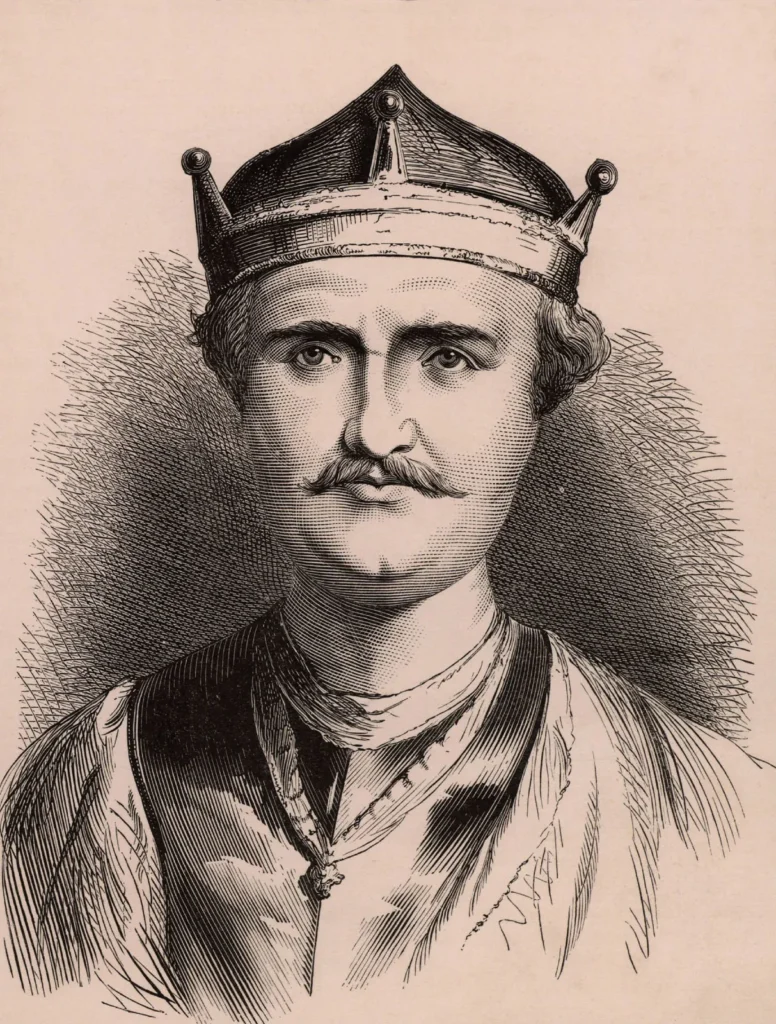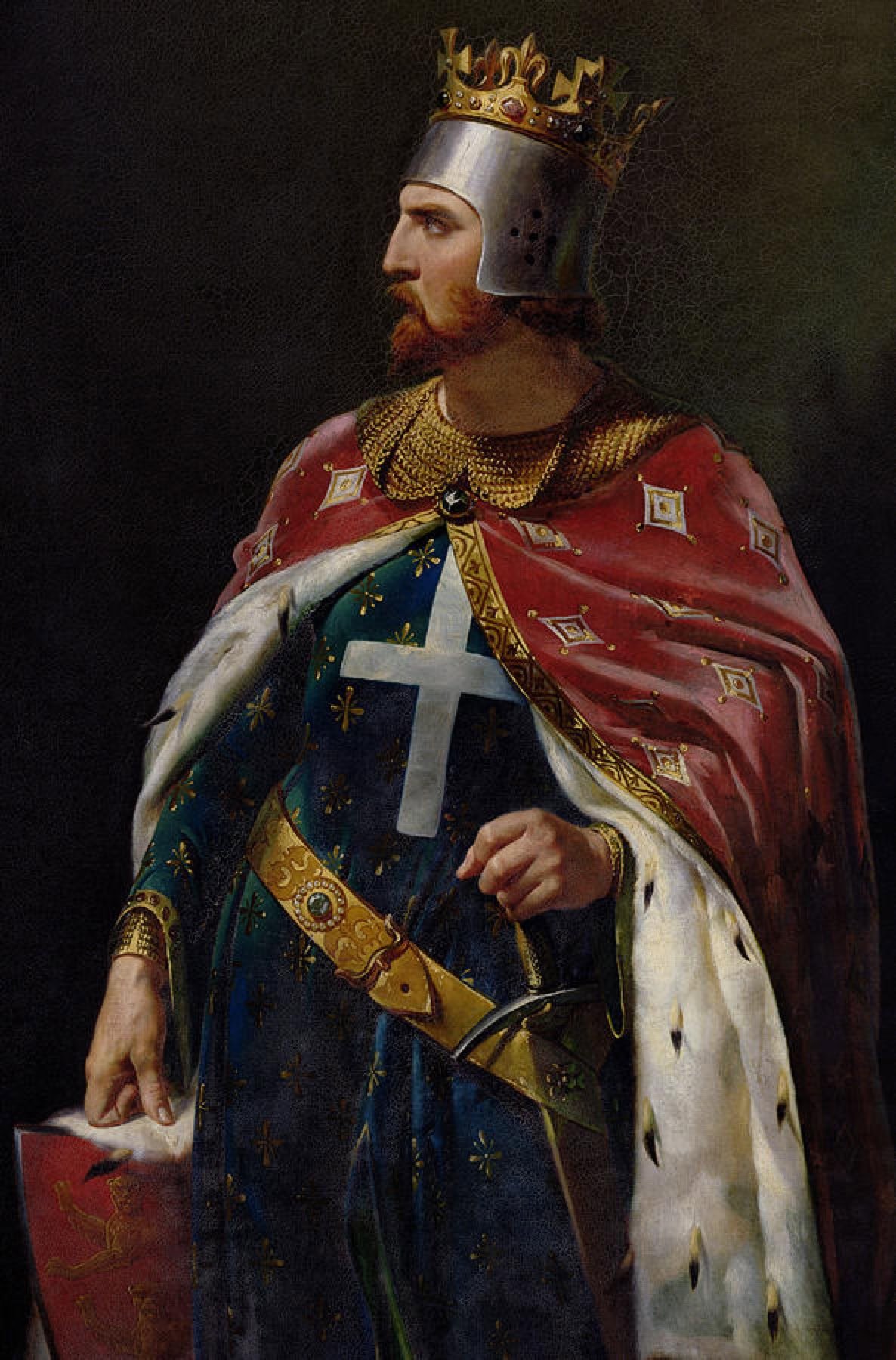
Richard I (born September 8, 1157, at Beaumont Palace in Oxford, England—died April 6, 1199, at Châlus Castle in the Duchy of Aquitaine, France) was King of England from 1189 until his death and a leading commander of the Third Crusade. Known as Richard the Lionheart, he belonged to the royal House of Plantagenet and was the son of King Henry II of England and Eleanor of Aquitaine. He became famous for his military leadership, courage in battle, and long-running conflicts with the French monarchy. Although he was one of England’s most celebrated medieval kings, he spent much of his reign outside the country, focusing on military campaigns and defending his family’s lands in France.
Early Life and Family Background
Richard was born into one of the most powerful royal families in Western Europe. His father, Henry II, ruled England and controlled extensive territories in France, including Normandy, Anjou, and Aquitaine through his marriage to Eleanor of Aquitaine. His mother was one of the wealthiest and most influential women of the medieval period. Before marrying Henry, Eleanor had been queen of France through her first marriage to King Louis VII.
Richard was the third surviving son of Henry II and Eleanor. His older brothers were Henry the Young King and Geoffrey, Duke of Brittany. His younger brother John was born several years later. Richard also had two sisters, Matilda and Eleanor, who married into other European royal families.
Although Richard was born in England, he grew up largely in the family’s French territories. His mother had inherited the Duchy of Aquitaine, a large region in southwestern France, and Richard became closely connected to its culture, language, and political traditions.
Richard received an education suitable for a medieval prince. He learned about government, diplomacy, warfare, and the responsibilities of royal leadership. He also developed an interest in poetry and music. He spoke French and was familiar with the language and culture of southern France.
As a young man, Richard became associated with the tradition of troubadour poetry, which celebrated love, honor, and courtly life. He composed poetry himself, including songs that reflected his experiences and emotions. His interests in literature and military affairs became important parts of his personality.
Richard Becomes Duke of Aquitaine
Richard’s future as a ruler began taking shape during his teenage years. In 1168, Henry II granted him the Duchy of Aquitaine, although Richard was still too young to exercise full independent authority. He later received additional responsibilities in his family’s territories.
Aquitaine was a wealthy and politically complicated region. Its powerful nobles often resisted central authority, and maintaining control required military strength and careful diplomacy. Richard spent much of his youth learning how to manage these challenges.
In 1172, he formally became Duke of Aquitaine. His mother, Eleanor, continued to influence the region’s affairs, while Richard gradually took on more responsibility for its government.
His relationship with the local nobility was often difficult. Some nobles challenged his authority, while others competed for influence over the duchy’s lands and resources. Richard responded with military campaigns to establish control.
His early experiences as duke helped him develop the skills he would later use as king. He became known for his determination in warfare and his willingness to use force against those who challenged his rule.
Conflict With His Father and Brothers
Richard’s relationship with his father became increasingly troubled during the 1170s. Although Henry II controlled a large collection of territories, his sons wanted greater independence and authority.
In 1173, Richard joined his older brothers, Henry the Young King and Geoffrey, in a rebellion against their father. Their mother, Eleanor, supported the uprising. The rebellion was partly driven by disputes over inheritance and the distribution of political power within the family.
Henry II managed to defeat the rebellion. Eleanor was captured and placed under restricted residence for many years. Richard eventually returned to his father’s side and continued governing Aquitaine.
However, the family disagreements did not end. Richard continued to resist his father’s attempts to control his duchy and was involved in further conflicts with local nobles.
In 1183, Henry the Young King died, leaving Richard as the oldest surviving son after his father’s death became a matter of growing concern. Henry II wanted Richard to transfer Aquitaine to his younger brother John, but Richard refused to surrender the territory he had been governing.
These disagreements created further tension within the royal family. Richard feared losing his inheritance, while Henry II wanted to maintain control over the future division of his lands.
In 1188, Richard joined forces with King Philip II of France against Henry II. Philip supported Richard’s claim to greater authority and used the family dispute to weaken the English king’s position.
The conflict ended in 1189 after Henry II suffered military defeats and agreed to Richard’s demands. Henry died on July 6, 1189, at Chinon in France. Richard succeeded him as King of England.
Becoming King of England
Richard became king in 1189, inheriting a powerful but complicated collection of territories. His authority extended beyond England to important French lands, including Normandy, Anjou, and Aquitaine.
He was crowned at Westminster Abbey in London on September 3, 1189. His coronation marked the beginning of a reign shaped largely by warfare, diplomacy, and the defense of his family’s continental possessions.
One of Richard’s first priorities was preparing for the Third Crusade. The crusade had been organized after Jerusalem fell to Muslim forces under Saladin in 1187. The loss of the city deeply affected Christian rulers in Europe, and Richard had already taken a public interest in the campaign before becoming king.
Preparing for the expedition required enormous financial resources. Richard raised money through taxes, the sale of royal privileges, and other measures. He also reorganized parts of the royal administration to support the campaign.
Richard’s departure preparations included appointing officials to govern England in his absence. His younger brother John received important responsibilities, although Richard did not trust him completely.
Before leaving England, Richard also arranged a marriage to Berengaria of Navarre, the daughter of King Sancho VI of Navarre. The marriage strengthened political relationships in southwestern Europe and provided Richard with a royal connection in a strategically important region.
The Third Crusade
Richard left England in 1190 to join the Third Crusade. He traveled through France and then sailed toward the eastern Mediterranean. His forces eventually joined those of other European rulers, including King Philip II of France.
The journey was difficult. Richard’s fleet stopped in Sicily, where political disagreements created tensions between the crusaders and the local authorities.
Richard also became involved in a dispute over the inheritance of the Kingdom of Sicily. His sister Joan had been married to the previous king, William II, but after William’s death, she was imprisoned and denied her property. Richard demanded her release and the restoration of her rights.
The dispute contributed to conflict with Tancred, the ruler of Sicily. Richard’s forces occupied Messina, and the two sides eventually reached an agreement. Joan was released, and Richard secured compensation and political concessions.
During his stay in Sicily, Richard met Berengaria of Navarre, who had traveled east with his mother, Eleanor of Aquitaine. Richard married Berengaria on May 12, 1191, in Limassol, Cyprus.
Before the marriage, Richard had become involved in another major conflict. His fleet had been scattered by a storm, and some ships were forced toward Cyprus. The island was ruled by Isaac Komnenos, who treated several shipwrecked crusaders poorly.
Richard responded by invading Cyprus. His forces defeated Isaac’s troops and took control of the island. Isaac was captured, and Richard established authority over Cyprus before continuing toward the Holy Land.
The conquest provided the crusaders with a valuable supply base and a secure position in the eastern Mediterranean. Richard later sold the island to the Knights Templar, although it eventually came under the control of Guy of Lusignan.
The Siege of Acre
Richard arrived in the Holy Land in June 1191 and joined the ongoing siege of Acre, an important coastal city held by Muslim forces.
The siege had begun in 1189, before Richard’s arrival, and had become one of the major military operations of the Third Crusade. The crusaders wanted to capture Acre because it was a strategically important port that could support further campaigns along the Mediterranean coast.
Richard played a major role in the fighting. His military experience, financial resources, and leadership strengthened the Christian forces. After months of resistance, Acre surrendered to the crusaders on July 12, 1191.
The victory was an important achievement for the expedition. However, disagreements among the European leaders continued to create problems.
Philip II had competing political interests and became increasingly frustrated with Richard’s leadership. He eventually decided to return to France, leaving Richard as the most prominent commander of the crusader army.
After Acre fell, Richard became involved in negotiations with Saladin. The two sides disagreed over the release of prisoners and the payment of ransom. When the negotiations failed, Richard ordered the execution of thousands of Muslim prisoners in August 1191.
The decision remains one of the most controversial events of the crusade. It reflected the harsh realities of medieval warfare and the serious breakdown of negotiations between the opposing armies.
The Battle of Arsuf
After capturing Acre, Richard led his army south along the Mediterranean coast toward Jaffa. His objective was to secure the coastal route and establish a position from which Jerusalem might eventually be approached.
Saladin’s forces repeatedly attacked the crusaders during their march. Muslim cavalry and archers harassed the advancing army, attempting to weaken it through repeated attacks.
Richard maintained a disciplined formation and carefully controlled his troops. He understood that allowing the army to become disorganized could expose it to defeat.
On September 7, 1191, the crusaders fought Saladin’s forces at the Battle of Arsuf. Richard’s army successfully resisted the attacks and eventually launched a powerful counterattack.
The crusaders won the battle, forcing Saladin’s forces to withdraw. The victory demonstrated Richard’s ability to organize and lead an army under difficult conditions.
Richard continued toward Jaffa and captured the city later in 1191. His forces then worked to strengthen its defenses.
Although the victory improved the crusaders’ position, Jerusalem remained in Muslim hands. Capturing the city would require another major campaign, and Richard faced serious difficulties in maintaining his army and securing supplies.
Attempts to Capture Jerusalem
Richard understood that taking Jerusalem was the central objective of the Third Crusade. However, he also recognized that capturing the city would not necessarily mean the crusaders could hold it.
Jerusalem was located inland, far from the coastal supply routes that supported Richard’s army. Moving toward the city would expose the crusaders to attacks and create serious problems involving food, water, and reinforcements.
During the winter of 1191–1192, Richard’s forces advanced toward Jerusalem but eventually withdrew. The army was not confident that it could successfully capture and defend the city.
In 1192, Richard organized another advance. His forces again came close to Jerusalem, but he decided against launching a full attack.
At the same time, Richard faced growing political and military difficulties. His brother John was creating problems in England, while Philip II was working to weaken Richard’s territories in France.
Richard also received reports that his political position at home was becoming increasingly unstable. Continuing the crusade for an uncertain victory could place his entire kingdom at risk.
Meanwhile, Saladin had reasons to negotiate. His forces had suffered losses, and continued warfare was costly. Both leaders recognized the need for an agreement.
The Treaty With Saladin
Richard and Saladin eventually reached an agreement known as the Treaty of Jaffa, signed on September 2, 1192.
The treaty established a truce between the crusaders and Saladin’s forces for three years and eight months. It allowed Christian pilgrims to visit Jerusalem without being attacked.
The agreement also confirmed Christian control over a stretch of the Mediterranean coast, while Jerusalem remained under Muslim rule.
Richard had not achieved his main objective of retaking Jerusalem, but he had secured important coastal territory and arrangements for Christian access to the holy city.
The agreement brought the Third Crusade to an end. Richard prepared to return to Europe, where his political and territorial interests required his attention.
Before leaving, he reportedly considered the possibility of continuing the campaign in the future. However, circumstances at home made his immediate return necessary.
Capture and Imprisonment in Europe
Richard began his journey home in October 1192. His return was dangerous because he had made powerful enemies during the crusade, including the Duke of Austria, Leopold V.
Leopold had been offended by Richard’s behavior during the campaign. The two men had disagreed over military leadership and the display of their banners after the capture of Acre.
Richard’s relationship with Philip II of France had also deteriorated. Philip had returned to France earlier and was now working to weaken Richard’s position.
Bad weather and difficult travel conditions forced Richard to take an overland route through central Europe. He traveled in disguise, but his identity was discovered near Vienna.
In December 1192, Leopold’s forces captured Richard near Vienna. He was later handed over to the Holy Roman Emperor, Henry VI.
Richard was imprisoned while Henry VI demanded a large ransom for his release. The emperor also accused him of various political offenses, including supporting opposition to imperial interests.
Richard’s imprisonment created a serious political crisis in England. His officials had to organize the ransom while defending the kingdom against threats from his brother John and Philip II.
The ransom was enormous, requiring substantial financial contributions from England and Richard’s continental territories. Taxes were increased, valuable goods were collected, and royal resources were used to secure his release.
Richard’s mother, Eleanor of Aquitaine, played an important role in organizing the effort and negotiating on his behalf.
Richard was eventually released in February 1194 after the ransom arrangements were secured and political agreements had been reached.
Return to England and Conflict With Philip II
Richard returned to England in March 1194. He was welcomed by supporters and quickly moved to restore his authority.
He also took action against those who had supported his brother John during his imprisonment. Some officials lost their positions, while John eventually submitted to Richard’s authority.
Richard’s stay in England was brief. He soon returned to France to defend his territories against Philip II.
The rivalry between the two kings had developed over many years. Philip wanted to expand French royal authority, while Richard wanted to protect the extensive lands inherited from his father.
Richard spent much of the remaining years of his reign fighting Philip and strengthening his defensive positions. He organized military campaigns, built fortifications, and negotiated with local nobles to secure support.
One of his most important building projects was Château Gaillard, a powerful fortress constructed above the Seine River in Normandy. Its position helped protect the approaches to Rouen and defend Richard’s Norman territories.
Construction began in 1196 and progressed rapidly. The fortress reflected Richard’s understanding of military engineering and the importance of controlling strategic locations.
The conflict with Philip continued through shifting alliances, battles, and temporary agreements. Neither king achieved a decisive victory before Richard’s death.
Marriage and Personal Life
Richard’s marriage to Berengaria of Navarre was an important political arrangement. Although she accompanied him during the Third Crusade, they spent relatively little time together after their marriage.
Berengaria did not play a major role in the government of England, and she was rarely present in Richard’s political affairs. The couple had no known children.
Richard therefore left no legitimate heir. His younger brother John eventually succeeded him as King of England.
Richard’s personal life has attracted considerable attention from historians. His close relationships with male companions, including Philip II during their earlier years of political cooperation, have sometimes led to speculation about his sexuality.
However, the surviving historical evidence does not establish a clear account of his private romantic life. Medieval accounts often reflected political rivalries, religious beliefs, and the moral expectations of their authors, making such claims difficult to assess with certainty.
Richard was also known for his interest in music and poetry. He composed songs in the traditions of the French-speaking aristocracy and was familiar with the culture of troubadours.
His personal interests existed alongside the demands of warfare and government, which occupied much of his adult life.
Final Military Campaign and Death
In 1199, Richard was involved in a conflict with a local lord in the Limousin region of southwestern France. The dispute concerned a castle and a reported discovery of treasure in the area.
Richard was besieging Châlus Castle, which belonged to a local nobleman who had resisted his authority.
During the siege, Richard was struck in the shoulder by a crossbow bolt. The wound became infected, and medieval medical treatment could not save him.
Richard died on April 6, 1199, at Châlus Castle, aged 41. His mother, Eleanor of Aquitaine, was present during his final days.
Before his death, Richard arranged his succession. He named his younger brother John as his heir, ensuring that the English crown and the family’s principal continental territories would pass to him.
Richard was buried at Fontevraud Abbey in France, where his father, Henry II, and his mother, Eleanor of Aquitaine, were also buried. His heart was buried separately at Rouen Cathedral, reflecting a medieval burial custom sometimes used for important rulers.
His death ended a reign dominated by military campaigns, political rivalries, and efforts to defend the extensive territories inherited from his family.